Russian satellite stalked ICEYE spacecraft in potentially dangerous on-orbit maneuvers俄罗斯卫星在轨道上进行潜在危险的机动,跟踪ICEYE探测器
The Cosmos 2612 came within 500 meters (about a third of a mile) to US-flagged ICEYE-X36 believed to be supporting Ukraine, according to LeoLabs.
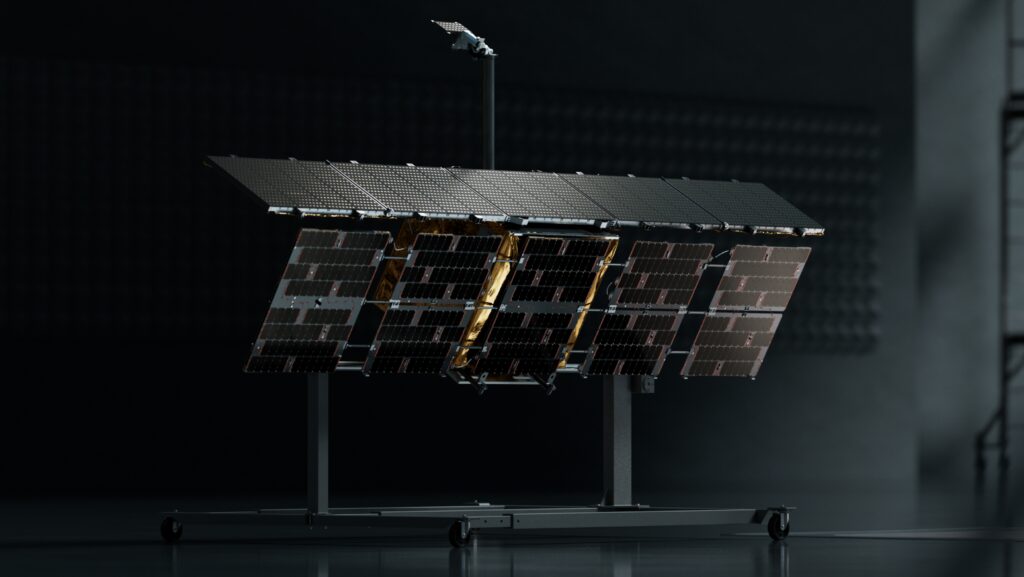
ICEYE launched its latest-model SAR-sat, called Generation 4 and boasting a 25 centimeter resolution, in March 2025. (Photo courtesy of ICEYE)
WASHINGTON — In an unprecedented move, A Russian government-owned satellite spen t weeks stalking an ICEYE satellite widely believed to be providing synthetic aperture radar (SAR) imagery to Ukraine — coming as close as 500 meters (about a third of a mile), according to space watching firm LeoLabs.
In a press release today, LeoLabs said Russia’s Cosmos 2612 “conducted a deliberate series of maneuvers toward ICEYE-X36” between Oct. 15-19 that involved “continued maneuvering around ICEYE-X36, shifting between positions ahead of and behind the commercial satellite.”
While Russia’s Cosmos birds have previously been observed closely following other Western satellites, Adam Marsh, LeoLabs vice president for technical solutions , told Breaking Defense that this was a first-of-its-kind rendezvous and proximity operation (RPO).
“This is the most advanced and potentially dangerous uncooperative RPO we’ve observed,” he said.
Victoria Samson, chief director of Space Security and Stability for Secure World Foundation, agreed.
“What is new is that I don’t think that there has ever been an uncoordinated RPO that was close,” she told Breaking Defense. “Also, in these earlier cases, the satellite that was being approached was a USG satellite; obviously in this case, it was a commercial satellite.”
LeoLabs’ analysis concluded that Cosmos 2612 “demonstrated a sequence of capabilities that could be used to inspect, characterize, shadow, or potentially interfere with another spacecraft. The observed tactics included:
Why Bigger Fences Aren’t Enough in the Age of Drones
Traditional thinking about how to protect facilities must adapt to new threats such as drones or downstream attacks.
Departing on a controlled trajectory
Deliberately matching the orbital plane of another satellite
Closing from long range in a controlled manner
Adjusting speed and altitude to manage relative motion
Repositioning ahead of and behind the target
Remaining close rather than conducting a simple flyby
Making repeated small maneuvers while in proximity.”
According to a blog post by longtime space watcher Marco Langbroek, the Cosmos 2612 ― which was launched in April ― began its “worrisome” stalking mission Sept. 30 and subsequently undertook a series of maneuvers “clearly designed” to catch up to the ICEYE satellite.
Clayton Swope, deputy director of the Aerospace Security Project at the Center for Strategic and International Studies, said in a web post on Friday that Cosmos 2612’s maneuvers should be viewed as a likely threat, given that the ICEYE satellite “supports Ukraine” in its effort to repel Russia’s 2022 invasion.
“Given Russia’s history of testing on-orbit weapons, policymakers should assume Cosmos 2612 could take an action that threatens the commercial satellite,” he wrote. “But the risk extends beyond just one satellite. A Russian counterspace activity in the vicinity of Western satellites should be assessed within the context of aggressive Russian gray zone activities targeting U.S. and European interests.”
ICE YE, headquartered in Finland, fi rst announced an agreement with Ukraine to provide SAR imagery via a dedicated satellite in 2022 , but has never publicly identified which specific satellite was provided.
Samson noted that although ICEYE-X36 may be collecting data used by Ukraine, although that has not been publicly confirmed. The spacecraft is operated by it’s US arm, ICEYE US , and was launched from the United States in 2024. That makes ICEYE-X36 a US satellite — or at least one for which the United States is the launching state, she explained.
“Russia and the US aren’t at war with each other, knock wood, but this does make me wonder why the USG [US government] has been silent on this matter,” she added.
Breaking Defense Video
Hegseth talks autonomy at AUSA, a key show focus
Army doubles down on autonomy, stakes out Indo-Pacific role: AUSA Day 2
Telle talks ‘manufacturing rodeo,’ supply chain ‘weak links’: AUSA Day 1
New leaders, new drone command: What we expect from AUSA 2026
Unpacking Boeing’s F/A-XX win, plus a report from wartime Ukraine
How Hegseth envisions a new Autonomous Warfare Command
What Europe’s military air fleets will look like in 30 years
Riyadh gets closer to F-35s, Damascus presses sovereignty and an expert take on Iran
Drone-hunting on the border, plus turmoil at an Air Force think tank
The future of European airpower might be unmanned
ICEYE于2025年3月发射了其最新一代SAR卫星,名为第四代,分辨率为25厘米。(图片由ICEYE提供)
华盛顿——据太空观测公司LeoLabs称,俄罗斯政府拥有的一颗卫星史无前例地跟踪了一颗被广泛认为正在向乌克兰提供合成孔径雷达(SAR)图像的ICEYE卫星数周之久,最近距离仅为500米(约三分之一英里)。
LeoLabs 在今天发布的新闻稿中表示,俄罗斯的 Cosmos 2612 卫星在 10 月 15 日至 19 日期间“对 ICEYE-X36 卫星进行了一系列蓄意的机动”,其中包括“持续围绕 ICEYE-X36 卫星进行机动,在商业卫星的前方和后方之间变换位置”。
虽然此前人们观察到俄罗斯的 Cosmos 卫星曾密切跟踪其他西方卫星,但 LeoLabs 技术解决方案副总裁 Adam Marsh 告诉 Breaking Defense,这是史无前例的交会和近距离操作 (RPO)。
“这是我们观察到的最先进、也可能最危险的非合作型远程点火装置,”他说。
世界安全基金会空间安全与稳定首席主任维多利亚·萨姆森对此表示赞同。
她告诉《防务新闻》:“新情况在于,我认为此前从未发生过如此近距离的非协调无线电定位事件。此外,在之前的案例中,被接近的卫星是美国政府卫星;而显然,这次是商业卫星。”
LeoLabs 的分析得出结论,Cosmos 2612“展示了一系列可用于检查、识别、跟踪或潜在干扰其他航天器的能力。观察到的策略包括:
为什么在无人机时代,更高的围栏还不够?
传统的设施保护思维必须适应无人机或下游攻击等新威胁。
按照受控轨迹起飞
故意使卫星的轨道平面与另一颗卫星的轨道平面相匹配
以可控的方式从远距离接近目标。
调整速度和高度以控制相对运动
在目标前方和后方重新定位
保持近距离飞行,而不是进行简单的低空掠过。
在近距离内反复进行小幅度机动。
根据长期关注太空的马可·朗布鲁克 (Marco Langbroek) 的一篇博客文章,于 4 月发射的 Cosmos 2612 卫星于 9 月 30 日开始了其“令人担忧的”跟踪任务,随后进行了一系列“明显旨在”追赶 ICEYE 卫星的机动。
战略与国际研究中心航空航天安全项目副主任克莱顿·斯沃普周五在一篇网络文章中表示,鉴于ICEYE卫星“支持乌克兰”抵御俄罗斯2022年的入侵,Cosmos 2612的机动应该被视为一种可能的威胁。
他写道:“鉴于俄罗斯过往在轨武器试验的历史,决策者应该假定‘宇宙2612’卫星可能会采取威胁商业卫星的行动。但风险远不止于一颗卫星。在西方卫星附近发生的俄罗斯反太空活动,应该放在俄罗斯针对美国和欧洲利益的咄咄逼人的灰色地带活动的背景下进行评估。”
总部位于芬兰的 ICE YE 公司于 2022 年首次宣布与乌克兰达成协议,通过专用卫星提供 SAR 图像,但从未公开透露具体是哪颗卫星。
萨姆森指出,尽管ICEYE-X36可能正在收集乌克兰使用的数据,但这一点尚未得到公开证实。该航天器由其美国分支机构ICEYE US运营,并于2024年从美国发射升空。她解释说,这使得ICEYE-X36成为一颗美国卫星——或者至少是美国是其发射国。
她补充说:“俄罗斯和美国并没有交战,但愿如此,但这确实让我感到疑惑,为什么美国政府对此事一直保持沉默。”
突破性防御视频
Hegseth 在 AUSA 大会上谈到了自主性,这是本次大会的一个重点议题。
陆军加倍强调自主性,明确印太地区角色:AUSA第二天
特勒谈“制造业乱象”、供应链“薄弱环节”:AUSA第一天
新领导人,新无人机指挥部:我们对 AUSA 2026 的期待
深入剖析波音F/A-XX的竞标结果,以及来自战时乌克兰的报道
赫格塞斯设想的新型自主作战指挥部
30年后欧洲军用空军机队会是什么样子
利雅得距离F-35战机更近一步,大马士革强调主权,以及专家对伊朗的看法
边境无人机猎杀行动,以及空军智库的动荡
欧洲空军的未来或许在于无人化。