KNDS proposes mixed French-German tank to replace France’s LeclercKNDS提议采用法德混合设计的坦克来取代法国的勒克莱尔坦克。
The French-Germany company plans for an in-house active protection system and the ability to change out the 120mm gun with a 140mm variant.
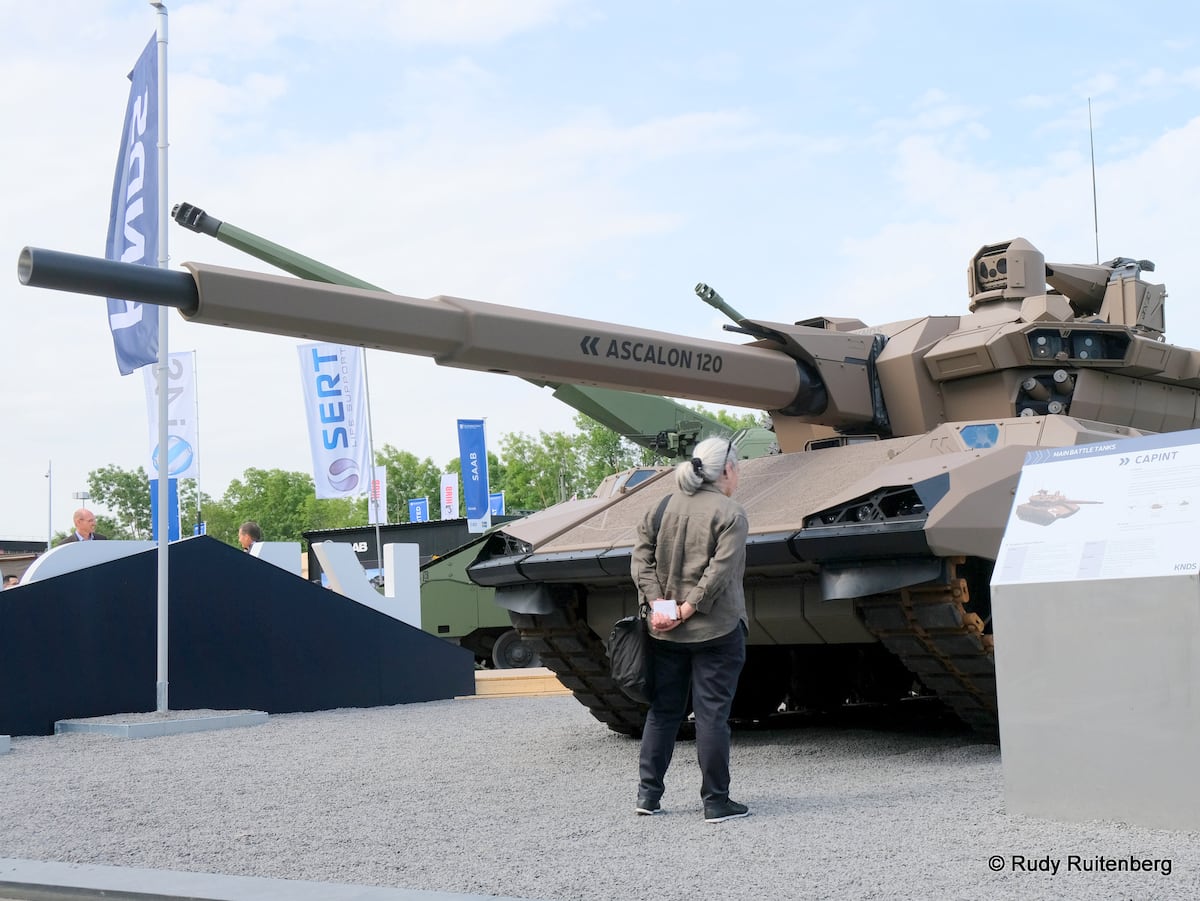
PARIS — KNDS is proposing a main battle tank with a turret and gun developed in France and mounted on the hull of Germany’s Leopard 2 as an intermediate solution to replace the French Army’s aging Leclerc tanks, which are expected to reach the end of their service life before the arrival of a next-generation tank.
The tank proposal unveiled at the Eurosatory defense show on Monday featured an unmanned turret with a 120mm auto-loader smoothbore gun developed by KNDS France, with the possibility of upgrading the cannon to 140mm. KNDS said it aims to deliver the first units of the tank, dubbed Capint, short for intermediate capability, in the 2030s.
With the French-German project to develop the Main Ground Combat System delayed and not expected to arrive until the mid-2040s, France will need a replacement for its Leclerc tank somewhere in the next decade. The country intends for the interim capability to be a building block of MGCS, Gen. Olivier Coquet, head of the French Army’s technical section, said on Sunday .
“We are already working to create what will be the combat of tomorrow,” KNDS CEO Jean-Paul Alary said in a press conference at the defense show outside Paris on Monday. “Maybe the combat of tomorrow, the ambition of MGCS, will come a little bit earlier than the project itself.”
The goal is to present France’s Directorate General for Armament with a demonstrator tank as early as 2030 and deliver the first production units in 2035, followed by deployment to the forces in 2037, said Julien Brunet, product line manager for main battle tanks and reconnaissance vehicles at KNDS France, in a separate briefing.
The proposed tank already represents the beginnings of a fourth-generation combat system, according to Brunet, who described such a platform as one with fully integrated AI, a combination of passive, reactive and active protection, counter-drone warfare and the ability to engage beyond line of sight.
The plan is for the intermediate tank to already include concepts initially planned for MGCS, including one or two robotic wingmen, KNDS France CEO Nicolas Groult said in the press conference.
French Army Chief of Staff Gen. Pierre Schill speaks to defense industry executives in front of a proposed KNDS main battle tank at the company's stand at the Eurosatory defense exhibition near Paris on June 15, 2026. (Rudy Ruitenberg/staff)
Groult said KNDS already tested firing on-the-move in Portugal in January. “So it’s not a concept, it’s not a drawing, it’s something that we are confident that can happen.”
Whether France and Germany will continue with the MGCS project is a political decision, but abandoning it would be “very bad news” for Europe, Alary said in response to questions about the future of the project. The two countries earlier this month abandoned a plan to jointly develop a sixth-generation fighter jet as part of the Future Combat Air System program.
The proposed French intermediate tank will carry a crew of three in an “extremely well protected citadel” at the front of the vehicle, with a combination of passive composite protection as well as reactive and active protection, Brunet said.
Active protection measures will be distributed, with some mounted on the turret and others on the chassis, according to Brunet. He said KNDS will use defensive effectors that are “potentially a bit different” from those of the Trophy active-protection system, with the company having in-house solutions to deal with hard-to-stop threats, though he said details are classified.
Robot wingmen will need to be big enough to keep up with the main platform, though small enough to keep costs under control, Brunet said. The number of robots accompanying the main battle tank will gradually be increased, and their level of passive protection will depend on the value of each robot, according to the executive.
KNDS’s French and German arms are in talks to determine which parts will be provided by each business, and protection of the chassis as well as the interfaces will probably be French, according to Brunet. If the Leopard 2 chassis is retained for the French intermediate tank, the aim is to build locally, also because manufacturing in Germany is already ramping up to meet existing demand, he said.
“If we need to produce the chassis quickly, the best option is still to produce them in France,” Brunet said. “We have the know-how, there’s no problem.”
KNDS said the Ascalon gun had already fired around 300 rounds, and the company said the firing by a main-battle tank demonstrator with a remote-control turret in January was a world-first. Brunet said the Ascalon 120mm cannon is “much more powerful” than standard NATO 120mm guns.
KNDS also showed off a possible successor to the Leopard 2 A8 with an unmanned turret and a 120mm cannon from Rheinmetall.
Rudy Ruitenberg is a Europe correspondent for Defense News. He started his career at Bloomberg News and has experience reporting on technology, commodity markets and politics.
巴黎——KNDS公司提议,将法国研制的炮塔和火炮安装在德国豹2坦克的车体上,作为取代法国陆军老旧的勒克莱尔坦克的过渡方案。勒克莱尔坦克预计将在下一代坦克到来之前达到使用寿命终点。
周一在欧洲防务展上亮相的这款坦克方案,配备了由法国KNDS公司研发的无人炮塔和一门120毫米自动装弹滑膛炮,并可升级至140毫米口径。KNDS公司表示,计划在2030年代交付首批名为“Capint”(意为“中等能力”)的坦克。
由于法德联合研制的“主战地面作战系统”(MGCS)项目延期,预计要到2040年代中期才能交付,法国将在未来十年内需要为其勒克莱尔坦克寻找替代装备。法国陆军技术部门负责人奥利维耶·科凯将军周日表示,法国计划将过渡性装备作为MGCS的基石。
“我们已经在着手打造未来的作战方式,”KNDS首席执行官让-保罗·阿拉里周一在巴黎郊外举行的防务展新闻发布会上表示。“或许未来的作战方式,也就是MGCS的目标,会比项目本身更早到来。”
KNDS法国公司主战坦克和侦察车产品线经理朱利安·布鲁内特在另一次简报会上表示,目标是在2030年向法国军备总局展示一辆演示坦克,并在2035年交付首批生产型坦克,随后在2037年部署到部队。
布鲁内特表示,拟议中的坦克已经代表了第四代作战系统的开端。他将这样的平台描述为具有完全集成的人工智能、被动、反应和主动防护的组合、反无人机作战能力以及超视距作战能力。
KNDS France 首席执行官 Nicolas Groult 在新闻发布会上表示,中型坦克计划将包含最初为 MGCS 计划的概念,包括一到两个机器人僚机。
2026年6月15日,在巴黎附近的欧洲防务展上,法国陆军总参谋长皮埃尔·席尔将军在KNDS公司展台上,向国防工业高管们展示了一款拟建的主战坦克。(Rudy Ruitenberg/staff摄)
格鲁尔特表示,KNDS公司今年1月已经在葡萄牙测试过行进间射击。“所以这不是概念,也不是图纸,而是我们有信心能够实现的事情。”
法德两国是否会继续推进MGCS项目是一个政治决定,但放弃该项目对欧洲来说将是“非常糟糕的消息”,阿拉里在回答有关该项目未来走向的问题时表示。本月初,两国放弃了作为未来作战空中系统(FCA)项目一部分的联合研发第六代战斗机的计划。
布鲁内特表示,法国拟建的中型坦克将在车辆前部“防护极其完善的堡垒”内搭载三名乘员,该堡垒结合了被动复合防护以及反应式和主动式防护。
布鲁内特表示,主动防护措施将分散部署,部分安装在炮塔上,部分安装在底盘上。他还说,KNDS公司将使用与“战利品”(Trophy)主动防护系统“可能略有不同”的防御效应器,该公司拥有应对难以阻止的威胁的自主解决方案,但他同时指出,具体细节属于机密。
布鲁内特表示,机器人僚机需要足够大,才能跟上主战平台的步伐,但又要足够小,才能控制成本。他还透露,伴随主战坦克的机器人数量将逐步增加,其被动防护水平将取决于每台机器人的价值。
据布鲁内特透露,KNDS的法国和德国分公司正在商讨各自负责哪些零部件,底盘防护和接口部分很可能由法国公司负责。他还表示,如果法国中型坦克沿用豹2底盘,目标是在本地生产,因为德国的产能已经提升到足以满足现有需求。
“如果我们需要尽快生产底盘,最好的选择仍然是在法国生产,”布鲁内特说。“我们拥有相关技术,这不成问题。”
KNDS公司表示,Ascalon火炮已经发射了约300发炮弹。该公司还称,今年1月,配备遥控炮塔的主战坦克演示车进行的试射是世界首例。布鲁内特表示,Ascalon 120毫米火炮比北约标准120毫米火炮“威力大得多”。
KNDS 还展示了豹 2 A8 的可能继任者,该坦克配备了无人炮塔和莱茵金属公司生产的 120 毫米火炮。
鲁迪·鲁伊滕贝格是《防务新闻》的欧洲记者。他的职业生涯始于彭博新闻社,拥有报道科技、大宗商品市场和政治方面的经验。