Rheinmetall pitches shipping container that can spit out swarms of attack drones莱茵金属公司推出一种可喷射出大量攻击型无人机的集装箱
One container can hold 18 of the company’s FV-014 munitions, meant to plop out of the container by way of rocket-assisted start.
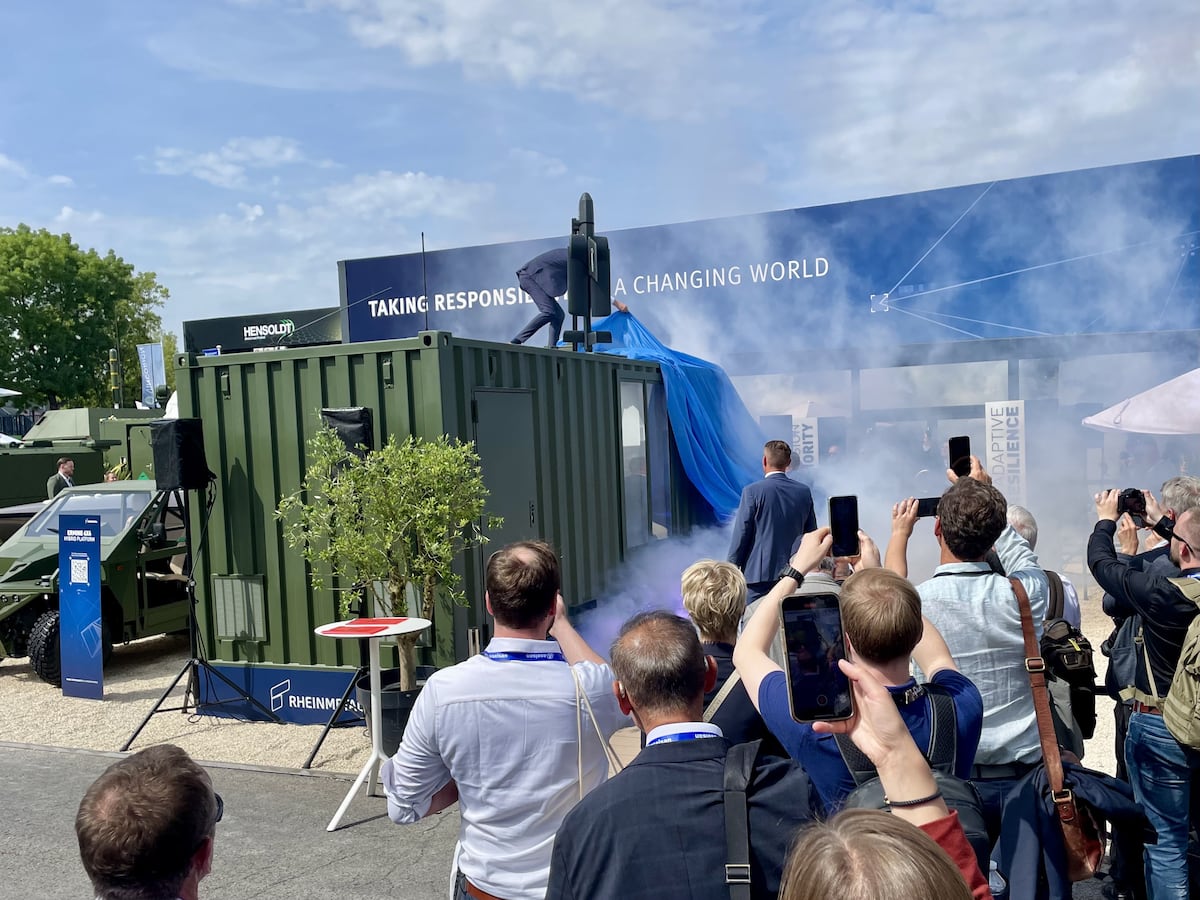
PARIS — German defense giant Rheinmetall unveiled a new concept for inundating battlefields with scores of loitering munitions : having them streak by the dozens out of 20-foot shipping containers.
Company officials presented the idea at the Eurosatory defense exhibition outside of Paris on June 15, pulling the cover off a mockup model in a mini ceremony that served as an ode to the combat punch of massed kamikaze drones, complete with glasses of cold beer and water on a warm Paris day.
One container can hold 18 of the company’s FV-014 munitions , meant to plop out of the container by way of rocket-assisted start. Following a post-launch tumbling phase, the munition is designed to spread its stabilizer fins and rush toward coordinates fed to its by the sensors of what Rheinmetall calls a “reconnaissance and strike” network.
Potential applications include driving the loaded containers to the front line on the back of trucks, where they would discharge their cargo to hit targets with their 4 kilogram warhead up to 100 kilometers away.
The loitering munitions have a maximum flight time of 70 minutes, meaning they can circle a general target area for a while until ground commanders call for a strike.
Another application could be arranging a number of the containers along a border, perhaps camouflaged, to spring into action when an enemy approaches, Timo Hass, CEO of Rheinmetall’s Digital Systems division, told reporters.
Haas said Rheinmetall will disclose the architecture of the drone launch interfaces inside the container — the physical slots and the electronic connectors — so that other companies could in theory design alternative, better munitions.
Whether it will come to that remains to be seen, as Rheinmetall only recently celebrated the award of a contract by the German armed forces, the Bundeswehr, for its brand new FV-014 loitering munition type.
German lawmakers in February authorized roughly $320 million each in funding for domestic loitering munitions makers Stark Defence, offering the Virtus, and Helsing, offering the HX-2.
They added Rheinmetall with the FV-014 as a later-comer a few weeks thereafter, leading to an April contract with the Düsseldorf-based defense company to the tune of roughly €300 million, or $348 million.
All three companies stand to make billions more in business if the Bundeswehr ends up finding their loitering munitions useful.
Sebastian Sprenger is associate editor for Europe at Defense News, reporting on the state of the defense market in the region, and on U.S.-Europe cooperation and multi-national investments in defense and global security. Previously he served as managing editor for Defense News. He is based in Cologne, Germany.
巴黎——德国国防巨头莱茵金属公司推出了一种向战场倾泻大量巡飞弹的新概念:让数十枚巡飞弹从 20 英尺的集装箱中疾驰而出。
6 月 15 日,公司官员在巴黎郊外的欧洲防务展上提出了这一想法,并在一个小型仪式上揭开了模型的面纱。这个仪式是对大规模神风特攻队无人机战斗力的颂歌,仪式上还准备了冰镇啤酒和水,以纪念巴黎温暖的一天。
一个容器可容纳18枚该公司生产的FV-014型弹药,该弹药采用火箭助推发射方式从容器中弹射而出。发射后,弹药会经历一段翻滚阶段,随后展开稳定翼,并根据莱茵金属公司所谓的“侦察打击”网络传感器提供的坐标快速飞行。
潜在应用包括将装载货物的集装箱用卡车运送到前线,在那里卸下货物,用其4公斤重的弹头打击100公里外的目标。
巡飞弹的最大飞行时间为 70 分钟,这意味着它们可以在目标区域附近盘旋一段时间,直到地面指挥官下令进行打击。
莱茵金属数字系统部门首席执行官蒂莫·哈斯告诉记者,另一种应用场景是沿着边境布置一些集装箱,或许可以进行伪装,以便在敌人接近时立即投入使用。
哈斯表示,莱茵金属公司将公开容器内无人机发射接口的架构——物理插槽和电子连接器——以便其他公司理论上可以设计出替代的、更好的弹药。
是否会发生这种情况还有待观察,因为莱茵金属公司不久前才庆祝其全新 FV-014 巡飞弹获得德国联邦国防军的合同。
德国议员在二月份批准向国内巡飞弹制造商 Stark Defence(提供 Virtus)和 Helsing(提供 HX-2)各提供约 3.2 亿美元的资金。
几周后,他们又将莱茵金属公司及其 FV-014 型飞机加入进来,最终在 4 月份与这家位于杜塞尔多夫的国防公司签订了一份价值约 3 亿欧元(约合 3.48 亿美元)的合同。
如果德国联邦国防军最终发现他们的巡飞弹有用,这三家公司都将获得数十亿美元的额外收入。
塞巴斯蒂安·斯普伦格是《防务新闻》欧洲版副主编,负责报道该地区的防务市场状况,以及美欧在防务和全球安全领域的合作和多国投资。此前,他曾担任《防务新闻》执行主编。他现居德国科隆。