USAF Orders ARRW Hypersonic Missile Into Production, The Same Weapon It Nearly Cancelled美国空军订购ARRW高超音速导弹投入生产,而这款武器此前几乎被取消。
The fortunes of the AGM-183A, which is now set to arm B-52 and B-1 bombers, have now been fully revered.
By Joseph Trevithick
Published Oct 26, 2026 8:04 PM EDT
The U.S. Air Force has handed Lockheed Martin a $694 million contract for the production of AGM-183A Air-launched Rapid Response Weapon (ARRW) hypersonic missiles . In 2023, the service had moved to cancel ARRW , which had been in line to be the U.S. military’s first operational hypersonic weapon. At the time, we had reservations about the service’s intent and speculated the missile could make a major comeback or continue development in a classified setting. The program has since made an incredible turnaround, and there are already plans for another variant that will be able to use an all-new seeker to hit moving targets, including enemy warships .
The ARRW contract was awarded on September 29, but only announced today . It is not immediately clear how many missiles are to be built under this deal or when the Air Force expects to start taking delivery of them. The Air Force has previously disclosed plans to integrate the missiles onto its B-52 and B-1 bombers . Other aircraft with sufficiently large payload capacities and physical space to carry outsized stores could potentially carry AGM-183As, or variants thereof, in the future.
A B-1 bomber seen carrying an ARRW missile, or a relevant test article, on an external pylon during a flight test. USAF capture
“The contract was executed under the Department of War’s Enterprise-Wide Agile Acquisition Contract to modernize America’s Arsenal of Freedom,” according to an Air Force press release . “This milestone marks the formal transition of the boost-glide hypersonic missile program from prototyping and flight testing into production, solidifying the Air Force’s commitment to fielding standoff, high-speed strike options.”
As noted here, the AGM-183A is a so-called boost-glide vehicle-type hypersonic weapon, which uses a rocket booster to bring it first to an optimal speed and altitude. The nose cone on ARRW then breaks away, and a wedge-shaped unpowered boost-glide vehicle concealed within is released.
A rendering depicting an ARRW hypersonic missile’s nose cone breaking away to reveal the unpowered boost-glide vehicle inside. Lockheed Martin
The vehicle then glides to its target along a relatively shallow flight path within the Earth’s atmosphere at hypersonic speed, defined as anything above Mach 5. It is capable of maneuvering along the way, sometimes erratically. The mix of speed, flight trajectory, and maneuverability creates significant challenges for opponents in terms of spotting and tracking the glide vehicle, let alone attempting to intercept it. As a result, hypersonic weapons of this type offer particular benefits for piercing enemy air defenses to very rapidly strike time-sensitive and otherwise high-value targets.
The ARRW production contract “is a turning point in our advanced weapons roadmap,” Secretary of the Air Force Troy Meink said in a statement accompanying today’s release. “By moving ARRW from test to production, we’re providing our combatant commanders with a credible, high-speed strike weapon capable of penetrating the most advanced anti-access and area-denial systems.” “Fielding ARRW enhances our ability to hold targets at risk anywhere around the world,” Air Force Chief of Staff Gen. Ken Wilsbach said in his own statement. “This hypersonic weapon provides the Joint Force a flexible and rapid response option for highly contested environments.”
A graphic offering a very general comparison of the typical flight trajectories of hypersonic boost-glide vehicle weapons and air-breathing hypersonic cruise missiles, as well as aeroballistic (or quasi-ballistic) missiles and traditional ballistic missiles. GAO
As mentioned, the Air Force had moved to cancel ARRW in 2023, following a number of failed flight tests . The explicit intent at the time was to shift resources to the Hypersonic Attack Cruise Missile (HACM) effort. HACM is an air-breathing hypersonic cruise missile that functions in a completely different way from ARRW. HACM is still in development, and the program has now moved into flight testing, as TWZ was first to report earlier this month.
There had already been steady signs in recent years that ARRW’s fortunes were changing and that it had not actually been axed , despite the Air Force’s stated plans to do so. The Air Force’s 2026 Fiscal Year budget request last year confirmed that the service had fully rebooted the program and was seeking new funding to procure actual missiles.
The service’s 2027 Fiscal Year budget request, released earlier this year, revealed further plans “to begin [ARRW] INC 2 [Increment 2] technology efforts such as but not limited to integrating pre-planned product improvements, design, trade studies, hardware upgrades, facilitization, affordability initiatives, and testing.”
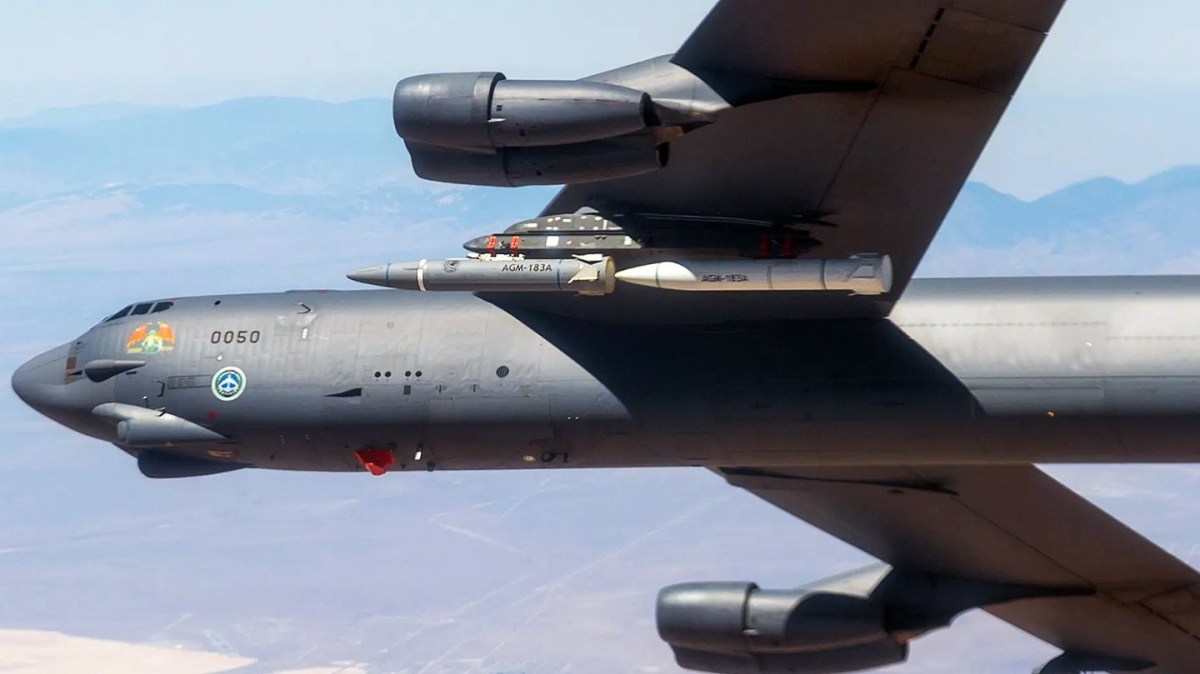
A live AGM-183A ARRW missile seen under the wing of a B-52 bomber at Andersen Air Force Base on Guam ahead of a test in 2024. USAF
A request for $296 million would support “the design, test, and evaluation of Air-Launched Rapid Response Weapon (ARRW) Increment 2 with terminal seeker and data link capability and other cost reduction production initiatives into ARRW,” those same documents added.
In general, the U.S. Air Force has historically framed hypersonic weapons, including ARRW and HACM, as being especially critical for success in future conflicts, especially high-end fights, such as one in the Pacific against China. This was underscored by the launch of an AGM-183A with a live warhead from a B-52 flying from Andersen Air Force Base on Guam in 2024. The future anti-ship variant could be even more relevant in a Pacific context.
As TWZ has written previously :
“…the Guam test sent clear signals to China. The Air Force has made no secret of how important it views the development and fielding of hypersonic weapons as part of larger preparations for a potential future high-end fight against the Chinese People’s Liberation Army (PLA) in the Pacific. This is further underscored by the fact that the mention of the ‘terminal seeker and data link capability’ for Increment 2 of ARRW is actually contained in the Pacific Deterrence Initiative (PDI) section of the Pentagon’s Fiscal Year 2027 budget request.”
A rare look at an ARRW shortly after launch, from a test in 2021. USAF A low-quality image of an ARRW after launch during a previous live-fire flight test. USAF
“ In the context of a major conflict in the Pacific, there would also be a very high demand for prompt, long-range anti-ship capability. The ability to conduct those strikes even in the face of dense anti-air defenses would be even more attractive for engaging very high-value vessels, such as China’s growing fleets of aircraft carriers or big deck amphibious assault ships . The PLA Navy’s (PLAN) combat fleets, overall, continue to grow in scale and scope at a prodigious rate, as well. This, in turn, has put additional emphasis on the development and fielding of new and improved anti-ship capabilities that can be air-launched , as well as employed from the maritime and ground domains , across the U.S. military in recent years. Increment 2 ARRWs could also offer another means to strike mobile, high-value targets on land, such as ballistic missile transporter-erector-launchers . ”
China’s aircraft carriers Shandong , at left, and Liaoning , at right, sail together, along with various escorts, as elements of their air wings fly overhead, in 2024. Chinese state media
“ For its part, the PLA has been actively developing and fielding various types of hypersonic weapons , including boost-glide vehicle designs . Its ever-growing arsenal of traditional ballistic missiles now includes several air-launched types, including ones with nuclear and conventional warheads . The latter are widely believed to be capable of being employed against enemy ships, as well as targets on land. ”
If nothing else, after moving to cancel the ARRW three years ago, the Air Force has now fully reversed course and has placed its first order for production examples of this hypersonic missile.
Contact the author: joe@twz.com
Comments couldn’t be loaded. Please refresh the page.
作者:约瑟夫·特雷维西克
发布于美国东部时间2026年10月26日晚上8:04
美国空军已与洛克希德·马丁公司签订了一份价值6.94亿美元的合同,用于生产AGM-183A空射快速反应武器(ARRW)高超音速导弹。2023年,美国空军曾计划取消ARRW项目,该项目原本有望成为美军首款投入作战的高超音速武器。当时,我们对空军的意图有所保留,并猜测该导弹可能会卷土重来,或者在保密环境下继续研发。然而,该项目此后发生了惊人的转变,目前已有计划开发另一种改进型,该改进型将采用全新的导引头,能够打击包括敌方军舰在内的移动目标。
ARRW的合同于9月29日授予,但直到今天才正式公布。目前尚不清楚根据该合同将建造多少枚导弹,也不清楚空军预计何时开始接收。空军此前已披露计划将这些导弹集成到其B-52和B-1轰炸机上。未来,其他有效载荷能力和空间足以携带超大型弹药的飞机也可能携带AGM-183A或其改进型导弹。
一架B-1轰炸机在飞行测试中,外挂架上挂载着一枚ARRW导弹或相关测试样品。(美国空军拍摄)
根据空军新闻稿,“该合同是根据美国战争部企业级敏捷采购合同执行的,旨在实现美国自由武器库的现代化。” “这一里程碑标志着助推滑翔高超音速导弹项目正式从原型设计和飞行测试阶段过渡到生产阶段,巩固了空军部署远程高速打击能力的承诺。”
如前所述,AGM-183A是一种所谓的助推滑翔飞行器型高超音速武器,它首先利用火箭助推器将其提升到最佳速度和高度。随后,ARRW的弹头锥体脱离,释放出隐藏其中的楔形无动力助推滑翔飞行器。
一张渲染图,描绘了ARRW高超音速导弹的弹头锥体脱落,露出内部无动力助推滑翔飞行器的过程。洛克希德·马丁公司
该飞行器随后以超音速(定义为超过5马赫)沿地球大气层内相对较浅的飞行轨迹滑翔至目标。它能够在滑翔过程中进行机动,有时甚至会出现不规则的机动。速度、飞行轨迹和机动性的结合,给对手在发现和追踪滑翔飞行器方面带来了巨大的挑战,更不用说拦截它了。因此,这类高超音速武器在突破敌方防空系统、快速打击时间敏感型或高价值目标方面具有显著优势。
美国空军部长特洛伊·梅因克在今天发布的新闻稿中表示,ARRW的生产合同“是我们先进武器发展路线图的一个转折点”。他指出,“通过将ARRW从测试阶段推进到生产阶段,我们为作战指挥官提供了一种可靠的高速打击武器,能够穿透最先进的反介入/区域拒止系统。”空军参谋长肯·威尔斯巴赫上将在自己的声明中表示,“部署ARRW增强了我们打击全球任何目标的能力。这种高超音速武器为联合部队在高度对抗的环境中提供了一种灵活快速的反应选项。”
该图大致比较了高超音速助推滑翔飞行器武器和吸气式高超音速巡航导弹的典型飞行轨迹,以及气弹道(或准弹道)导弹和传统弹道导弹的飞行轨迹。(美国政府问责局)
如前所述,由于多次飞行测试失败,空军已决定在2023年取消ARRW项目。当时的明确意图是将资源转移到高超音速攻击巡航导弹(HACM)项目上。HACM是一种吸气式高超音速巡航导弹,其工作原理与ARRW完全不同。HACM仍在研发中,并且正如TWZ本月初率先报道的那样,该项目目前已进入飞行测试阶段。
近年来已有迹象表明,ARRW项目的命运正在发生转变,尽管空军曾公开表示计划终止该项目,但实际上并未如此。去年空军提交的2026财年预算申请证实,空军已全面重启该项目,并正在寻求新的资金来采购实际的导弹。
该机构今年早些时候发布的 2027 财年预算申请揭示了进一步的计划,“开始 [ARRW] INC 2 [增量 2] 技术工作,例如但不限于整合预先计划的产品改进、设计、权衡研究、硬件升级、便利化、可负担性举措和测试。”
一枚实弹AGM-183A ARRW导弹悬挂在关岛安德森空军基地一架B-52轰炸机的机翼下,准备于2024年进行测试。美国空军
这些文件还补充说,2.96 亿美元的拨款申请将用于“设计、测试和评估具有末端导引头和数据链能力的空射快速反应武器 (ARRW) 2 型,以及其他降低 ARRW 生产成本的举措”。
总体而言,美国空军历来将高超音速武器,包括ARRW和HACM,视为未来冲突,尤其是高端战争(例如太平洋地区与中国的冲突)中取得胜利的关键。2024年,一架从关岛安德森空军基地起飞的B-52轰炸机成功发射了一枚携带实弹头的AGM-183A导弹,进一步印证了这一点。未来的反舰型AGM-183A在太平洋战场上可能发挥更为重要的作用。
正如TWZ之前所写:
“……关岛试验向中国发出了明确的信号。美国空军毫不掩饰其对高超音速武器研发和部署的重视,将其视为未来在太平洋地区与中国人民解放军(PLA)进行高端对抗的重要准备工作之一。五角大楼2027财年预算申请中的‘太平洋威慑倡议’(PDI)部分也提到了‘ARRW第二阶段’的‘末端导引头和数据链能力’,这进一步印证了这一点。”
这是一张罕见的ARRW火箭发射后不久的实弹照片,拍摄于2021年的一次测试中。(美国空军)这是一张ARRW火箭在之前一次实弹飞行测试中发射后的低质量照片。(美国空军)
在太平洋地区发生重大冲突的背景下,对快速、远程反舰能力的需求将非常高。即使面对密集的防空火力,能够进行此类打击的能力对于打击高价值舰艇(例如中国日益壮大的航空母舰或大型两栖攻击舰)而言更具吸引力。此外,解放军海军的作战舰队规模和范围也在以惊人的速度持续增长。这反过来又促使美军近年来更加重视研发和部署新型、改进型的反舰能力,这些能力既可空射,也可从海上和陆地部署。第二阶段的ARRW(空中反舰导弹)还可以提供另一种打击陆地上高价值移动目标(例如弹道导弹运输起竖发射车)的手段。
2024年,中国山东舰(左)和辽宁舰(右)及其护航舰艇一同航行,舰载机编队在空中盘旋。(中国官方媒体)
“解放军方面一直在积极研发和部署各种类型的高超音速武器,包括助推滑翔飞行器。其不断扩充的传统弹道导弹库现在也包括几种空射导弹,其中包括携带核弹头和常规弹头的导弹。后者被普遍认为能够用于打击敌方舰艇以及陆地目标。”
至少在三年前取消 ARRW 项目之后,空军现在已经彻底改变了立场,并下了第一份该高超音速导弹的生产型订单。
联系作者:joe@twz.com
评论加载失败,请刷新页面。