Britain will not join Canada-led defense bank initiative英国不会加入加拿大主导的国防银行倡议
Britain will not join the Canada-led Defence, Security and Resilience Bank, in a setback to efforts to create the world's first global defense bank, according to a person familiar with the matter.
Share on Facebook (Opens in new window) Facebook
Share on X (Opens in new window) X
Share on Bluesky (Opens in new window) Bluesky
Share on Reddit (Opens in new window) Reddit
Share on LinkedIn (Opens in new window) LinkedIn
Share using Native tools Share Copied to clipboard
Share on Mail (Opens in new window) Mail
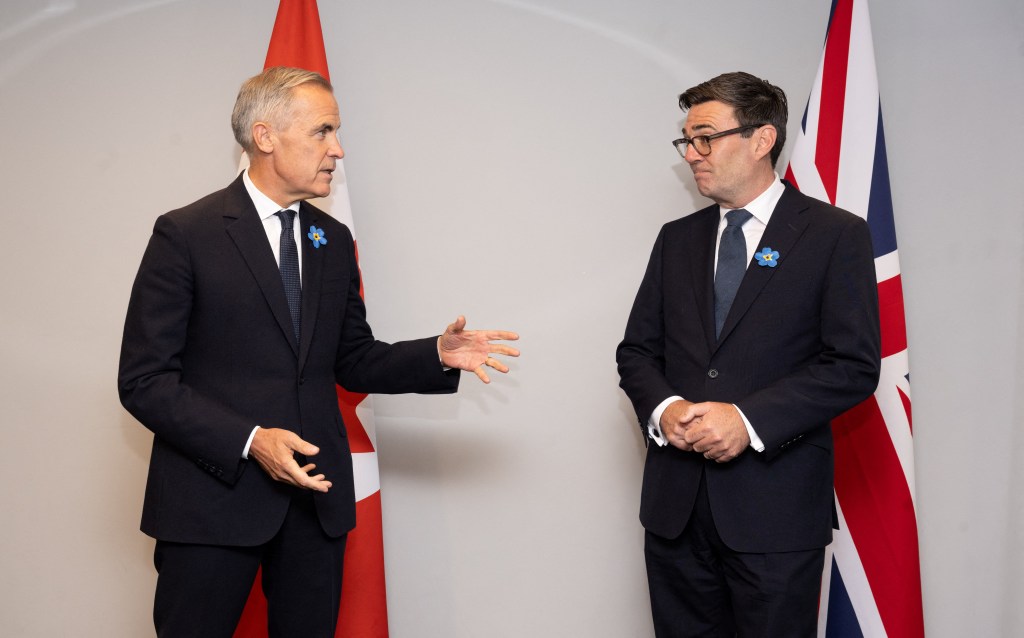
Canadian Prime Minister Mark Carney and British Prime Minister Andy Burnham speak as they attend a bilateral meeting, in Everton, Merseyside, Britain, Sept. 16. 2026. (Paul Cooper/Pool via Reuters)
Britain will not join the Canada-led Defence, Security and Resilience Bank, in a setback to efforts to create the world’s first global defense bank, according to a person familiar with the matter.
The two countries instead said on Sunday that they would develop a framework for cooperation between their respective defense-funding initiatives, establishing two distinct but complementary institutions to support each other on investment opportunities and strategic challenges.
“We have been working closely to consider how the Multilateral Defence Mechanism (MDM) and Defence, Security and Resilience Bank (DSRB) can best advance our shared objectives,” the statement said.
The two governments were unable to agree on key issues including the location of the headquarters of a joint institution, the level of joint procurement, lending to members, and the rules around new members, a second person said.
The MDM will focus on accelerating defense investment, joint procurement through financing, and bringing together demand across NATO allies to reduce procurement costs, while the DSRB will complement it by supporting investment in defense industries and supply chains, focusing more on single sovereign lending, the person added.
The DSRB, which will be based in Canada, has faced challenges securing support from larger European nations. Reuters was first to report in September last year that Britain had declined to join the project.
There were hopes Britain would reconsider its position under new Prime Minister Andy Burnham and his team. Germany had previously declined to join. A spokesperson for the German finance ministry said Germany was an observer in the negotiations on DSRB’s charter and is reviewing open questions.
Britain and Canada said the MDM and DSRB will be designed to work in close partnership, so they can support each other on emerging industrial priorities, investment opportunities and strategic financing challenges.
The DSRB has been aiming to raise around €100 billion ($112 billion) and use the money to lend at low cost to governments and contractors for defense projects. It will also offer guarantees for lenders financing smaller firms seen as riskier borrowers.
So far Albania, Belgium, Greece, Latvia, Luxembourg, Romania, Turkey and Ukraine have pledged their support, along with Canada.
Canadian Finance Minister Francois-Philippe Champagne said the group would meet in Luxembourg on Nov. 30 to sign articles of agreement establishing the bank.
“Membership (is) open to other allies and close partners who share the Bank’s objective,” he said in a statement.
Reuters previously reported that potential members had not joined because of concerns including whether the DSRB can offer cheaper financing than highly rated national governments as well as the amount of capital countries would need to commit, the bank’s governance, and overlaps with existing initiatives.
Britain’s Defence Secretary Wes Streeting had recently described the DSRB as a “really interesting and innovative mechanism” and said that he did not see the proposed defense bank and MDM as being in competition.
Britain previously declined to join, citing concerns over value for money. Reuters previously reported that Burnham discussed the DSRB alongside the MDM initiative with Canadian Prime Minister Mark Carney in July and with Luxembourg Prime Minister Luc Frieden during an August visit to Kyiv.
分享至 Facebook(在新窗口中打开) Facebook
分享至 X(在新窗口中打开)X
在 Bluesky 上分享(在新窗口中打开)Bluesky
分享到 Reddit(在新窗口中打开)
在领英上分享(在新窗口中打开)领英
使用原生工具分享 已复制到剪贴板
分享至邮件(在新窗口中打开)邮件
2026年9月16日,加拿大总理马克·卡尼和英国首相安迪·伯纳姆在英国默西塞德郡埃弗顿出席双边会晤并发表讲话。(保罗·库珀/路透社供图)
据一位知情人士透露,英国将不会加入由加拿大牵头的国防、安全和韧性银行,这对创建世界上第一家全球国防银行的努力来说是一次挫折。
两国周日表示,他们将制定各自国防融资计划之间的合作框架,建立两个独立但互补的机构,以便在投资机会和战略挑战方面互相支持。
声明称:“我们一直在密切合作,探讨多边防务机制(MDM)和国防、安全与韧性银行(DSRB)如何才能最好地推进我们的共同目标。”
第二位知情人士表示,两国政府未能就关键问题达成一致,包括联合机构总部所在地、联合采购水平、向成员贷款以及新成员规则等。
该人士补充说,MDM 将重点加快国防投资、通过融资进行联合采购,并将北约盟国的需求集中起来以降低采购成本,而 DSRB 将通过支持对国防工业和供应链的投资来补充 MDM,更侧重于单一主权贷款。
设在加拿大的DSRB在争取欧洲大国支持方面面临挑战。路透社去年9月率先报道,英国已拒绝加入该项目。
人们曾希望英国在新任首相安迪·伯纳姆及其团队的领导下会重新考虑其立场。德国此前拒绝加入。德国财政部发言人表示,德国是DSRB章程谈判的观察员,目前正在审查一些悬而未决的问题。
英国和加拿大表示,MDM 和 DSRB 将被设计成紧密合作,以便在新兴产业优先事项、投资机会和战略融资挑战方面互相支持。
国防储蓄银行(DSRB)的目标是筹集约1000亿欧元(1120亿美元),并将这笔资金以低成本向各国政府和承包商提供国防项目贷款。它还将为向被视为风险较高的小型借款人提供融资的贷款机构提供担保。
目前,阿尔巴尼亚、比利时、希腊、拉脱维亚、卢森堡、罗马尼亚、土耳其和乌克兰以及加拿大都已承诺提供支持。
加拿大财政部长弗朗索瓦-菲利普·尚帕涅表示,该集团将于11月30日在卢森堡举行会议,签署成立该银行的协议条款。
他在一份声明中表示:“其他与银行目标一致的盟友和紧密伙伴均可申请加入。”
路透社此前报道称,潜在成员尚未加入,原因是他们担心债务重组委员会能否提供比信用评级较高的国家政府更便宜的融资,以及各国需要承诺的资本数额、该银行的治理情况以及与现有倡议的重叠等问题。
英国国防大臣韦斯·斯特里廷最近将国防储备银行描述为“一个非常有趣和创新的机制”,并表示他不认为拟议的国防银行和军事数据管理机制之间存在竞争关系。
英国此前拒绝加入,理由是担心性价比问题。路透社此前报道称,伯纳姆曾在7月与加拿大总理马克·卡尼讨论过DSRB以及MDM倡议,并在8月访问基辅期间与卢森堡首相吕克·弗里登也讨论了该议题。