India capitalizes on Europe’s growing demand for ammunition印度利用欧洲日益增长的弹药需求获利
Indian Defence Secretary Rajesh Kumar Singh said that demand linked to the European Union’s “ReArm Europe” initiative is boosting exports.
Share on Facebook (Opens in new window) Facebook
Share on X (Opens in new window) X
Share on Bluesky (Opens in new window) Bluesky
Share on Reddit (Opens in new window) Reddit
Share on LinkedIn (Opens in new window) LinkedIn
Share using Native tools Share Copied to clipboard
Share on Mail (Opens in new window) Mail
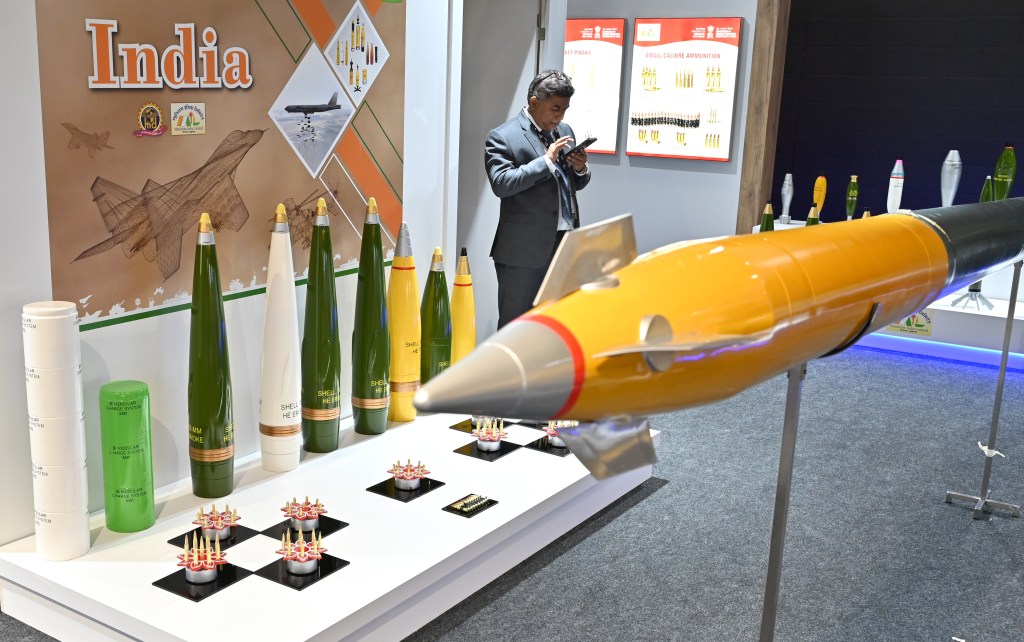
A Pinaka ER rocket and various artillery ammunition shells are displayed at the Munitions India Limited company exhibition stand during the DSEI trade show in London on Sept. 9, 2025. (John Keeble/Getty Images)
NEW DELHI — India’s defense exports to Europe have surged, driven largely by demand for ammunition and artillery shells as European countries ramp up military spending amid Russia’s war in Ukraine.
The rising exports could pave the way for deeper industrial cooperation between the two sides.
Indian Defence Secretary Rajesh Kumar Singh said that demand linked to the European Union’s “ReArm Europe” initiative, combined with India’s expanding defense manufacturing base, is boosting exports. He spoke Oct 23. at an event in New Delhi.
Singh cited a Bloomberg report that found a sharp increase in India’s exports of ammunition and related products to Europe.
India exported at least $872 million worth of ammunition in the four years since Russia’s invasion of Ukraine, a more than 1,600% increase compared with the preceding four-year period, according to the report , which cited data from Trade Data Monitor.
Central and East European countries including Romania, Slovenia, the Czech Republic, Slovakia, Bulgaria, Croatia, and Poland were among the biggest customers.
Ammunition exports have risen sharply since 2024 as European countries replenish stocks and strengthen defense capabilities following Russia’s invasion of Ukraine, analysts say. The exports include artillery shells, small-caliber ammunition, mortars, propellants and explosives.
European destinations accounted for 40% of Indian global exports of arms and ammunition in the last financial year, according to Samuel Rajiv, Research Fellow at the Manohar Parrikar Institute for Defence Studies and Analyses in New Delhi.
He said this surge could translate into a long-term trend. “There will be greater opportunities for India due to Europe’s greater focus on defense, which will result in a lot of money going into the transformation of its defense industrial base,” said Rajiv. “At the same time, Indian exports will gain momentum not just because of Europe’s requirements but the steps India is taking to expand its own defense manufacturing base.”
Indian exports could also get a fillip as tariffs on arms and ammunition from India become lower when a free trade agreement concluded between India and the European Union takes effect in the coming year.
New Delhi is also seeking a broader role in Europe’s defense market through industrial partnerships. Defense Secretary Singh said India wants to establish joint ventures with European companies in India, while Indian companies would seek partnerships in Europe to gain access to government defense procurement programs.
Russia is not an option for Europe, that is over. Dinakar Peri, Carnegie India
Russia is not an option for Europe, that is over.
Analysts say although it remains to be seen whether India and the EU can build more sustained defense industrial ties, partnering with each other is emerging as a viable option for both sides as Europe seeks to diversify its supply chains.
“India offers that scale, size and ecosystem as well as trust as Europe tries to build resilience from the United States. Russia is not an option for Europe, that is over. China has its own red flags in many ways in strategic areas and critical domains. So that leaves very few options available,” says Dinakar Peri, Fellow in the Security Studies Program at Carnegie India.
At the same time, India has also been working to diversify its defense relationships given its longstanding dependence on foreign suppliers, including the United States. “So a closer partnership with Europe also works for India,” he said.
Pointing out that several American, French, and Israeli contractors have already integrated Indian vendors into their supply chains, analysts say the EU can make India its sourcing hub for a range of items.
However New Delhi’s longstanding military ties with Russia could raise concerns in some European capitals as India eyes deeper defense partnerships with the EU.
“It remains to be seen whether this will become an obstacle to deeper defense industrial ties with the EU,” according to Peri. “Bilaterally, India already has strong defense relationships with countries such as France, but it is unclear how the EU as a bloc will view India’s military ties with Moscow.”
分享至 Facebook(在新窗口中打开) Facebook
分享至 X(在新窗口中打开)X
在 Bluesky 上分享(在新窗口中打开)Bluesky
分享到 Reddit(在新窗口中打开)
在领英上分享(在新窗口中打开)领英
使用原生工具分享 已复制到剪贴板
分享至邮件(在新窗口中打开)邮件
2025年9月9日,在伦敦举行的DSEI防务展上,印度军需有限公司的展位上展示了一枚皮纳卡ER火箭和各种炮弹。(John Keeble/Getty Images)
新德里——由于俄罗斯在乌克兰发动战争,欧洲各国加大了军费开支,印度对欧洲的国防出口大幅增长,这主要是由于对弹药和炮弹的需求增加所致。
出口增长可能为双方深化产业合作铺平道路。
印度国防部长拉杰什·库马尔·辛格表示,欧盟“重整欧洲”倡议带来的需求,加上印度不断扩大的国防制造业基础,正在推动出口增长。他于10月23日在新德里的一次活动上发表了上述讲话。
辛格引用彭博社的一份报告称,印度对欧洲的弹药及相关产品出口大幅增长。
据报告援引贸易数据监测机构的数据称,自俄罗斯入侵乌克兰以来的四年里,印度至少出口了价值 8.72 亿美元的弹药,与前四年相比增长了 1600% 以上。
包括罗马尼亚、斯洛文尼亚、捷克、斯洛伐克、保加利亚、克罗地亚和波兰在内的中欧和东欧国家是最大的客户群体。
分析人士称,自2024年以来,随着欧洲各国在俄罗斯入侵乌克兰后补充库存并加强防御能力,弹药出口大幅增长。出口产品包括炮弹、小口径弹药、迫击炮弹、推进剂和炸药。
据新德里马诺哈尔·帕里卡尔国防研究与分析研究所的研究员塞缪尔·拉吉夫称,上个财政年度,欧洲目的地占印度全球武器弹药出口的 40%。
他表示,这种增长势头可能会转化为长期趋势。“由于欧洲更加重视国防,大量资金将投入到国防工业基础的转型中,这将为印度带来更多机遇,”拉吉夫说。“与此同时,印度的出口不仅会因为欧洲的需求而加速增长,还会因为印度正在采取措施扩大自身的国防制造业基础而受益。”
随着印度与欧盟达成的自由贸易协定在明年生效,印度武器弹药的关税将会降低,印度的出口也可能因此得到提振。
新德里还寻求通过产业合作在欧洲国防市场扮演更广泛的角色。国防部长辛格表示,印度希望与欧洲公司在印度建立合资企业,同时印度公司也将在欧洲寻求合作伙伴关系,以获得参与政府国防采购项目的机会。
俄罗斯对欧洲来说已不再是选项,这一点已经结束了。——迪纳卡·佩里,卡内基印度
俄罗斯对欧洲来说已经不是一个选项了,这一点已经过时了。
分析人士表示,尽管印度和欧盟能否建立更持久的国防工业联系还有待观察,但随着欧洲寻求供应链多元化,双方合作正成为一种可行的选择。
“印度具备欧洲所需要的规模、体量、生态系统以及信任,而欧洲正试图增强自身抵御美国威胁的能力。俄罗斯对欧洲来说已不再是选择,这条路已经走不通了。中国在战略领域和关键领域也存在诸多隐患。因此,欧洲可选择的方案非常有限,”卡内基印度安全研究项目研究员迪纳卡尔·佩里说道。
与此同时,鉴于印度长期以来对包括美国在内的外国供应商的依赖,印度也在努力实现国防关系多元化。“因此,与欧洲建立更紧密的伙伴关系对印度也有好处,”他说道。
分析人士指出,一些美国、法国和以色列的承包商已经将印度供应商纳入其供应链,欧盟可以将印度作为一系列商品的采购中心。
然而,随着印度寻求与欧盟建立更深入的防务伙伴关系,新德里与俄罗斯之间长期存在的军事联系可能会引起一些欧洲国家的担忧。
佩里表示:“这是否会成为印度与欧盟深化国防工业联系的障碍,还有待观察。印度已经与法国等国建立了牢固的双边防务关系,但欧盟作为一个整体将如何看待印度与莫斯科的军事关系,目前尚不明朗。”