Where Are The Aircraft Carriers?: October 27, 2026航空母舰在哪里?:2026年10月27日
The Makin Island amphibious ready group pulls into Yokosuka a week behind the Theodore Roosevelt carrier strike group, as the carrier's jets conduct a simulated strike during exercise Keen Sword 27.
新闻视频
Published Oct 27, 2026 7:43 PM EDT
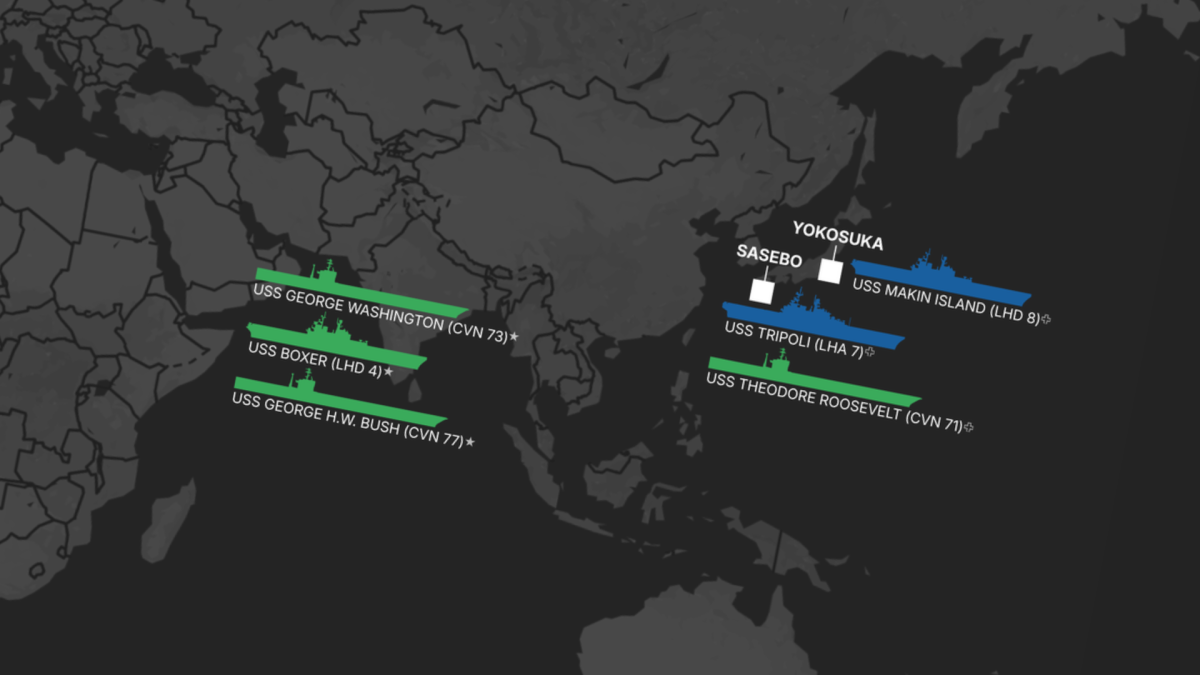
The Makin Island Amphibious Ready Group (ARG) tied up in Yokosuka, Japan , on Monday, a week after the Theodore Roosevelt Carrier Strike Group departed from the same base to participate in exercise Keen Sword 27. Both are reportedly destined for the Middle East, two U.S. officials confirmed to Fox News , which would place three CSGs and two ARGs in the U.S. Central Command (CENTCOM) area of responsibility (AOR) sometime in November, unless a group departs before their arrival. More than ten guided-missile destroyers are also operating independently in the region, as the U.S. beefs up force posture ahead of the possibility of renewed hostilities against the Iranian regime.
Meanwhile, on the other side of the world, the USS Ronald Reagan remotely controlled an MQ-25A Stingray tanker drone thousands of miles away for the first time, and the Navy announced that USS Abraham Lincoln , which just returned from a historic deployment, will conduct a homeport shift to Bremerton, Washington.
Here’s TWZ’s weekly carrier tracker monitoring America’s flattop fleet, including deployed CSGs and ARGs, using publicly available open-source information. Check out our last report here .
Where Is The USS Theodore Roosevelt ?
Surrounded by allied warships , the USS Theodore Roosevelt steamed through the Philippine Sea last week as large-scale combined exercise Keen Sword 27 got underway. Roosevelt and guided-missile cruiser USS Chosin departed Commander, Fleet Activities Yokosuka, on October 19 following a three-day port call. Roosevelt deployed on September 27 and was the first non-resident American carrier to pull into the vital naval port in over four years.
U.S. Navy, Japanese, Australian, Canadian, and French warships steam together during Exercise Keen Sword 27. U.S. Navy photo
Three American warships are participating in the exercise, a Navy official confirmed to TWZ . The third participant, Pearl Harbor-based guided-missile destroyer USS Decatur , another element of the five-ship strike group, also called port in Yokosuka and transited out of Tokyo Bay on October 26.
Australian, Canadian, and French warships joined the exercise alongside the U.S. and Japan in a large show of force. Keen Sword 27 runs through October 29, but it’s unclear if Roosevelt and her escorts will remain until the conclusion before heading toward the Middle East via the Strait of Malacca. More than 45,000 Japan Self-Defense Forces personnel and 11,000 U.S. service members are participating .
An F/A-18E Super Hornet launches off the flight deck of USS Theodore Roosevelt. U.S. Navy photo
F/A-18 Super Hornets and F-35Cs launched from Roosevelt and other airbases in Japan to complete a simulated strike against a target in the East Sea/Sea of Japan, which also included land-based launchers, an exercise spokesperson told Stars and Stripes . Japanese destroyers JS Kongo and JS Maya assumed the red team role. The precise location and munitions employed were not disclosed.
The Theodore Roosevelt CSG, which a different Navy official confirmed also includes USS Paul Hamilton and USS Carl M. Levin , will arrive in the Middle East, Fox News reported last week. Both destroyers are disaggregated from the rest of the group. Hamilton , the last ship to deploy, left San Diego on October 10 and most recently pulled out of Pearl Harbor last week. Levin , the first ship to deploy, is already operating in the CENTCOM AOR , based on public images posted on the military’s content platform, DVIDS.
If the CSG and ARG, which also includes amphibious transport docks USS Anchorage and USS John P. Murtha , arrive in the Middle East before the other two carriers on station, USS George H.W. Bush and USS George Washington , and big-deck amphibious assault ship, USS Boxer , depart, that would add roughly 10,000 Sailors and Marines to CENTCOM’s arsenal, the most significant force posture in the region since the war began. However, the overlap can only be maintained for a limited time given normal rotation schedules.
Amphibious assault ship USS Makin Island pulls in to Commander, Fleet Activities, Yokosuka. U.S. Navy photo
Acting Secretary of the Navy (SECNAV), Hung Cao, said during a panel at the Association of the United States Army (AUSA) convention that “the Teddy Roosevelt carrier strike group just deployed on October 8 with a medium sized unmanned surface vessel (MUSV). This is the first carrier strike group to ever deploy with a large size unmanned surface vessel.” However, despite multiple requests to comment, the Navy has not confirmed to TWZ that MUSV Seahawk (2) is assigned to the strike group. Seahawk was 10 nautical miles north of Guam, publicly available Automatic Identification System (AIS) data on MarineTraffic showed, as of publication.
The USS Ronald Reagan Controlled A Tanker Drone Thousands Of Miles Away
Providing a glimpse of the future, the USS Ronald Reagan used her brand-new Unmanned Air Warfare Center (UAWC) to operate a MQ-25A Stingray tanker drone at a Boeing facility in Illinois. “In a historic U.S. naval aviation event, an aircraft carrier connected to, and controlled, an unmanned aerial refueler MQ-25A Stingray more than 2,100 miles away,” the Navy said in a press release .
The first painted MQ‑25A Stingray sits on the ramp outside Boeing’s dedicated MQ‑25 production facility in Mascoutah, Illinois. Unmanned Carrier Aviation (PMA-2
The UAWC, installed during Reagan’s recently completed 15-month maintenance available, used its MD-5C ground control station to link beyond line-of-sight with the drone while the flattop was underway in the eastern Pacific Ocean. “The MQ-25A Stingray’s carrier-based refueling capabilities enable F/A-18 Super Hornets to fly farther and longer,” the Acting SECNAV said. “The integration of this unmanned aerial refueler demonstrates the transformational change our manned and unmanned asset integration provides the Fleet.”
The test took place during a preliminary sea trial, part of a “series of build-up exercises designed to validate procedures, networks and interfaces,” reads the release. Capt. Daniel Fucito, program manager of the Navy’s Unmanned Carrier Aviation Program Office’s (PMA-268), said, “We have redefined naval power projection. This first-ever underway connection between a carrier-based UAWC and an MQ-25A aircraft proves that the Carrier Air Wing of tomorrow is a reality today.”
USS Ronald Reagan (CVN 76) steams through the Pacific Ocean in October. U.S. Navy photo
Reagan is the second Nimitz class carrier equipped with the UAWC. The MQ-25A will eventually take the roll held by the F/A-18E/F Super Hornets that are tasked with fueling carrier-based aircraft, freeing up aircraft to take on higher-end combat roles.
Reagan moored at Kilo Pier at Naval Air Station North Island in San Diego on October 27 after finishing Fleet Replacement Squadron and Carrier Qualifications.
What’s Next For The USS Abraham Lincoln ?
The USS Abraham Lincoln recently returned from a record-setting deployment. The carrier arrived back home on x after being at sea for 321 days, less than a week short of the longest carrier deployment in the post-Vietnam era.
The Navy has confirmed what TWZ was the first to report: the Lincoln will complete a homeport shift to Bremerton, Washington, to undergo a Refueling and Complex Overhaul (RCOH) following a grueling deployment that left the carrier looking worse for wear. The release did not disclose the length of the availability, but Reagan was out of commission for more than a year, and was not previously involved in combat operations.
U.S. Navy Sailors aboard USS Abraham Lincoln conducts maintenance. U.S. Navy photo
“The carrier repeatedly demonstrated unmatched multi-theater combat lethality and safeguarded critical sea lanes across the Indo-Pacific and Middle Eastern theaters. Home port shifts are part of the Navy’s continued commitment to the strategic dispersal of ships,” a statement released from Commander, Naval Air Forces reads.
The move is a permanent change of station for the crew and their families.
Where Is The Rest Of The Fleet?
The two carriers enforcing the ongoing blockade of Iranian ports and coastal cities, USS George H.W. Bush and USS George Washington , have both been dark on AIS since arriving in the Middle East. The former is 210 days into her deployment and recently arrived back in CENTCOM after a five-day port call in Phuket, Thailand. The latter, forward-deployed out of Yokosuka, Japan, was spotted on DVIDS conducting flight operations on October 24.
USS Nimitz , homeported in Norfolk, welcomed the public with tours during Naval Station Norfolk’s Fleet Fest over the weekend, and got underway again for training on October 27. The 51-year old carrier is scheduled to be deactivated in Spring 2027. USS Dwight D. Eisenhower, also based at NS Norfolk, left port for work ups on October 24.
Also on the east coast, USS John C. Stennis has been undergoing maintenance since 2021. The RCOH was expected to be completed and the carrier redelivered in October 2026, according to budget documents, but it’s unclear if that timeline will hold. However, USS Harry S. Truman recently moved to begin an RCOH, suggesting Stennis is nearing completion.
On the other side of the country, USS Carl Vinson is in port in San Diego. Vinson returned on September 4 after a 25-day underway for a Final Evaluation Period and Tailored Ships’s Training Availability.
The future USS John F. Kennedy was operating in the Atlantic Ocean launching a T-45C Goshawk training aircraft and EA-18G Growler, both attached to the “Salty Dogs” of Air Test and Evaluation Squadron (VX) 23, on October 25.
T-45C Goshawk and EA-18G Growler on future JFK. U.S. Navy photo
Future USS John F. Kennedy conducts flight operations. U.S. Navy photo
The Big Deck Fleet At A Glance
Overall, three U.S. carriers are deployed, three are working up in various states of readiness, three are in maintenance availabilities, one is post-deployment, one is being used primarily for training before deactivation, and another will be delivered in 2027. Two amphibious ready groups are deployed, one is forward-deployed, three are working up or in port, and three are in maintenance.
Note: Positions are general approximations. Non-deployed LHA/LHD amphibious warships are not shown.
Contact the author: ian@twz.com or @ianellisjones
Comments couldn’t be loaded. Please refresh the page.
发布于美国东部时间2026年10月27日晚上7:43
周一,马金岛号两栖戒备群(ARG)停靠在日本横须贺港。一周前,西奥多·罗斯福号航母打击群从同一基地出发,参加“利剑27”联合军演。据两名美国官员向福克斯新闻证实,这两个打击群的目的地均为中东。这意味着,除非有其他打击群提前离开,否则到11月,美国中央司令部责任区内将部署三个航母打击群和两个两栖戒备群。此外,十余艘导弹驱逐舰也在该地区独立行动,美国正在加强军事部署,以应对可能再次爆发的针对伊朗政权的冲突。
与此同时,在世界的另一端,罗纳德·里根号航空母舰首次远程控制了数千英里外的 MQ-25A 魟鱼加油无人机;海军宣布,刚刚结束历史性部署的亚伯拉罕·林肯号航空母舰将把母港转移到华盛顿州布雷默顿。
以下是TWZ每周发布的航母追踪报告,监测美国航母舰队,包括已部署的舰载机群和两栖戒备群,数据来源于公开的开源信息。点击此处查看我们上一份报告。
“西奥多·罗斯福”号航空母舰在哪里?
上周,在盟军舰艇的簇拥下,美国海军“西奥多·罗斯福”号航空母舰驶过菲律宾海,大规模联合军演“利剑27”正式拉开帷幕。“罗斯福”号和导弹巡洋舰“长津”号于10月19日结束了为期三天的横须贺海军基地访问,随后离开该基地。“罗斯福”号于9月27日部署至此,是四年多来首艘停靠这一重要海军港口的非驻地美国航母。
在“利剑27”联合演习中,美国海军、日本、澳大利亚、加拿大和法国的军舰一同航行。(美国海军照片)
一位海军官员向TWZ证实,三艘美国军舰正在参加此次演习。第三艘参演舰艇是驻扎在珍珠港的导弹驱逐舰“迪凯特”号,它是五艘舰艇打击群的另一艘,也停靠在横须贺港,并于10月26日驶出东京湾。
澳大利亚、加拿大和法国的军舰与美国和日本的军舰一同参加了此次演习,展现了强大的军事实力。“利剑27”演习将持续到10月29日,但目前尚不清楚“罗斯福”号航母及其护航舰艇是否会在演习结束后继续留在演习现场,然后再经马六甲海峡前往中东。超过45000名日本自卫队人员和11000名美国军人参加了此次演习。
一架F/A-18E“超级大黄蜂”战斗机从“西奥多·罗斯福”号航空母舰的飞行甲板上起飞。(美国海军照片)
据《星条旗报》报道,演习发言人称,F/A-18“超级大黄蜂”和F-35C战斗机从罗斯福空军基地和日本其他空军基地起飞,对东海/日本海的目标进行了模拟打击,此次演习也包括陆基发射装置。日本驱逐舰“金刚”号和“摩耶”号担任红队角色。演习的具体地点和使用的弹药均未透露。
据福克斯新闻上周报道,西奥多·罗斯福号航母战斗群(另一名海军官员证实,该战斗群还包括“保罗·汉密尔顿”号驱逐舰和“卡尔·M·莱文”号驱逐舰)将抵达中东。这两艘驱逐舰目前已脱离该战斗群的其他舰艇。“汉密尔顿”号是最后部署的舰艇,于10月10日离开圣地亚哥,并于上周离开珍珠港。“莱文”号是第一艘部署的舰艇,根据军方内容平台DVIDS上发布的公开图片显示,该舰已在中央司令部责任区内执行任务。
如果包括两栖船坞运输舰“安克雷奇”号和“约翰·P·默塔”号在内的航母打击群和两栖戒备群,在驻扎在该地区的其他两艘航母“乔治·H·W·布什”号和“乔治·华盛顿”号以及大型两栖攻击舰“拳师”号离开之前抵达中东,那么中央司令部的兵力将增加约1万名水兵和海军陆战队员,这将是自战争爆发以来该地区规模最大的兵力部署。然而,鉴于正常的轮换计划,这种兵力重叠只能维持有限的时间。
两栖攻击舰“马金岛”号驶入横须贺舰队司令部。美国海军照片
美国海军代理部长洪曹在美军协会(AUSA)年会的一个小组讨论会上表示,“西奥多·罗斯福”号航母打击群于10月8日部署了一艘中型无人水面舰艇(MUSV)。这是航母打击群首次部署大型无人水面舰艇。” 然而,尽管多次请求置评,海军方面仍未向TWZ证实MUSV“海鹰”(2)号是否隶属于该打击群。截至发稿时,根据MarineTraffic网站上公开的自动识别系统(AIS)数据显示,“海鹰”号位于关岛以北10海里处。
“罗纳德·里根”号航空母舰控制了一架远在数千英里之外的加油无人机
为了让人们一窥未来,美国海军“罗纳德·里根”号航空母舰利用其全新的无人机作战中心(UAWC)在伊利诺伊州波音公司的一处设施内操控了一架MQ-25A“黄貂鱼”空中加油无人机。“在一次具有历史意义的美国海军航空演习中,一艘航空母舰与一架远在2100多英里之外的MQ-25A‘黄貂鱼’无人空中加油机建立了连接并对其进行了控制,”海军在一份新闻稿中表示。
第一架涂装完毕的MQ-25A“黄貂鱼”无人机停放在位于伊利诺伊州马斯科塔的波音公司MQ-25专用生产基地外的停机坪上。无人航母航空(PMA-2)
在里根号航母近期完成为期15个月的维护保养期间安装的UAWC系统,利用其MD-5C地面控制站,在航母于东太平洋航行期间,与无人机实现了超视距连接。“MQ-25A‘黄貂鱼’的舰载加油能力使F/A-18‘超级大黄蜂’战斗机能够飞得更远、更久,”代理海军部长表示。“这架无人空中加油机的加入,展现了我们有人和无人资产整合为舰队带来的变革性变化。”
新闻稿称,此次测试是在一次初步海上试验中进行的,是“一系列旨在验证程序、网络和接口的部署演练”的一部分。海军无人舰载航空项目办公室(PMA-268)项目经理丹尼尔·富西托上校表示:“我们重新定义了海军力量投送。这是舰载无人作战中心(UAWC)与MQ-25A无人机首次在海上成功对接,证明未来的舰载航空联队如今已成为现实。”
10月,美国海军“罗纳德·里根”号航空母舰(CVN 76)航行于太平洋上。(美国海军照片)
里根号是第二艘配备无人机空中加油系统的尼米兹级航母。MQ-25A最终将取代F/A-18E/F超级大黄蜂战斗机,承担为舰载机提供空中加油的任务,从而使舰载机能够执行更高端的作战任务。
10 月 27 日,里根号航母在完成舰队替换中队和航母资格认证后,停靠在圣地亚哥北岛海军航空站的基洛码头。
“亚伯拉罕·林肯”号航空母舰的下一步计划是什么?
“亚伯拉罕·林肯”号航空母舰最近结束了一次创纪录的部署任务。这艘航母在海上航行了321天后于x日返回母港,距离越战后时代航母最长部署时间仅差不到一周。
海军方面证实了TWZ此前率先报道的消息:林肯号航母将完成母港转移,前往华盛顿州布雷默顿进行大修和燃料补给,此前该航母刚刚结束了一次艰苦的部署,舰体状况明显恶化。官方声明并未透露此次维修的具体时长,但里根号航母此前已停航一年多,且从未参与过作战行动。
美国海军水兵在“亚伯拉罕·林肯”号航空母舰上进行维护作业。(美国海军照片)
“该航母反复展现了无与伦比的多战区作战能力,并保障了印太和中东战区的关键海上航道安全。母港变更体现了海军持续致力于舰艇战略分散部署的承诺,”海军航空兵司令部发布的一份声明中写道。
对于船员及其家人来说,这次调动意味着永久性的居住地变更。
舰队其他舰艇在哪里?
执行对伊朗港口和沿海城市持续封锁的两艘航母——“乔治·H·W·布什”号和“乔治·华盛顿”号——自抵达中东以来,其自动识别系统(AIS)信号一直处于未通联状态。“乔治·H·W·布什”号已部署210天,最近在泰国普吉岛进行了为期五天的港口访问后返回中央司令部。“乔治·华盛顿”号从日本横须贺前沿部署,10月24日曾出现在国防航空信息系统(DVIDS)上,当时正在进行飞行作业。
以诺福克为母港的“尼米兹”号航空母舰在周末诺福克海军基地舰队节期间向公众开放参观,并于10月27日再次出海进行训练。这艘服役51年的航母计划于2027年春季退役。同样以诺福克海军基地为母港的“德怀特·D·艾森豪威尔”号航空母舰于10月24日离港进行训练。
同样位于东海岸的“约翰·C·斯坦尼斯”号航空母舰自2021年以来一直在进行维护。根据预算文件,该舰的全面大修预计将于2026年10月完成并交付,但目前尚不清楚这一时间表能否实现。然而,“哈里·S·杜鲁门”号航空母舰最近也开始进行全面大修,这表明“斯坦尼斯”号的维护工作可能即将完成。
在国家的另一端,卡尔·文森号航空母舰停泊在圣地亚哥港。文森号于9月4日结束了为期25天的最终评估期和舰艇专项训练,返回母港。
10 月 25 日,未来的约翰·F·肯尼迪号航空母舰在大西洋上空执行任务,从空中起飞了一架 T-45C 苍鹰教练机和一架 EA-18G 咆哮者电子战飞机,这两架飞机都隶属于第 23 航空测试与评估中队(VX)的“咸狗”中队。
未来肯尼迪机场上的T-45C“苍鹰”和EA-18G“咆哮者”电子战飞机。美国海军照片
未来的“约翰·F·肯尼迪”号航空母舰正在进行飞行作业。(美国海军照片)
大型甲板舰队概览
总体而言,美国目前部署了三艘航母,三艘正在进行不同程度的战备准备,三艘正在进行维护保养,一艘已完成部署,一艘主要用于退役前的训练,另一艘将于 2027 年交付。此外,美国还部署了两个两栖戒备群,一个已前沿部署,三个正在进行准备或在港口,三个正在进行维护保养。
注:位置均为大致估计。未部署的LHA/LHD两栖攻击舰未显示。
联系作者:ian@twz.com 或 @ianellisjones
评论加载失败,请刷新页面。