The port-call situation is wearing out Navy warships频繁停靠港口让海军军舰疲惫不堪。
Diego Garcia is the only safe place for ships fighting Iran, but the remote atoll can’t provide the maintenance they need.
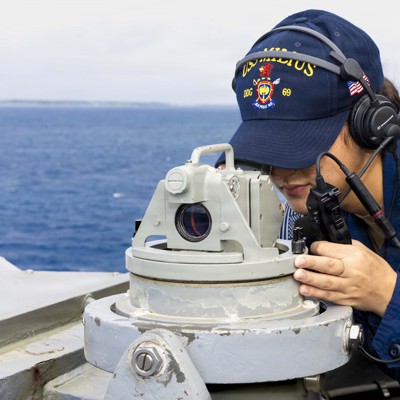
A sailor looks through an alidade as the guided-missile destroyer Milius leaves Diego Garcia on Sept. 20, 2026. U.S. Navy
Diego Garcia is the only safe place for ships fighting Iran, but the remote atoll can’t provide the maintenance they need.
A few years ago, a port call in the Middle East might mean bottomless-mojito brunches in Bahrain, hitting the indoor ski slopes in a Dubai megamall, or a desert safari in Qatar. But since Operation Epic Fury began eight months ago, U.S. warships in the theater have basically had just one option: Diego Garcia, some 2,500 miles away.
It’s not great for morale, but the consequences go beyond disgruntled sailors who tire of fishing off the British island in the Indian Ocean. The remote coral atoll lacks the pierside infrastructure that many Gulf, Mediterranean, and Pacific ports can offer. As the Navy stretches its fleet with longer deployments and fewer port calls , warships are losing the ability to do crucial mid-cruise maintenance.
“When a ship is deployed overseas for longer than the nominal seven-month deployment period, that increases the amount of time for equipment on the ship to break, get worn down, or worn out. As a result, when the ship finally does make it back to the United States, it might need more maintenance and repair work than it would have needed if the deployment had not exceeded seven months,” said Ron O’Rourke, who retired this year after more than 40 years as a naval analyst for the Congressional Research Service.
“That can increase the time and cost to do the maintenance and repair work, and an increased time needed to do the work could prevent other ships from entering maintenance and overhaul as scheduled. This can lead to a cascading effect in delaying maintenance on other ships.”
A Navy officer with expertise in maritime security agreed, noting that “even deployed ships need time alongside”—that is, moored directly to a pier or tender vessel for what’s called voyage repair availability—“to fix broken things, remediate rust, paint, etc. If these ships are kept out for 10 to 12 months, they’ll be missing other scheduled maintenance events and be much more broken than they should be when they get home.”
The Navy itself nodded to the problem in a recent press release about the aircraft carrier Abraham Lincoln, which is changing homeports to receive overdue depot-level maintenance after a nearly 11-month deployment.
“Regularly scheduled depot-level maintenance maximizes the lifespan of our Navy vessels and keeps our fleets lethal, modern, and ready to defend the nation.”
Are yearlong deployments the Navy’s new normal?
The Lincoln’s 321-day deployment —and the carrier Gerald R. Ford’s 326-day deployment before it—set records for consecutive days at sea and length of deployment, respectively. But a few Arleigh Burke-class guided missile destroyers are on track to far surpass those numbers. And Navy officials recently told families in Yokosuka, Japan, that for the foreseeable future they should expect all ships to deploy for 10 to 12 months.
A Navy spokesperson said they would “not discuss specific readiness rates, operational requirements, force-allocation deliberations, or future force movements. However, we remain committed to regular maintenance to maximize the lifespan of our Navy vessels and keep our fleets lethal and ready to defend our nation.”
Instead of the luxury hotels and hundreds of restaurants sailors can visit in ports like Dubai and Bahrain, Diego Garcia has a military supply base and a small town with a handful of restaurants. And since virtually every ship deployed in the region is using the island for port calls and resupply, store shelves don’t always stay stocked.
The guided-missile destroyer John Finn, which left Japan in January, pulled into Diego Garcia after months at sea.
“Everybody’s going to the ship store and it’s empty,” a sailor’s spouse told Defense One . “You can find ice cream, but you’re not going to find your necessities that you need to function.”
The ship had pulled in because it was “empty,” the spouse said, after having spent all of its weapons in the campaign against Iran. “So they had to spend that week resupplying.”
The spouse of a sailor on the Mustin, another guided-missile destroyer, said her husband was able to get socks but not shoe polish at the exchange on base during the only port call the ship has made since leaving Japan in April.
“He got off like, preparing to be able to get the stuff that he needed right now, and he goes, ‘They don’t have shit,’” she said. “They didn’t have anything.”
For the Mustin crew, the port call seemed like a welcome respite from their months at sea, until they were told just before getting off the ship that they would not return in August as originally planned, but stay deployed until April 2027, the spouse told Defense One .
“The sad part is, they were actually in good spirits,” she said. “And then I know things went really rowdy in Diego Garcia because they were given the bad news literally the day before they pulled in. … There was one of the nights in Diego Garcia that two sailors ended up in the ER with alcohol poisoning. And so then they lost their last night of liberty because of it.”
O’Rourke said the British island “can provide an opportunity to be on land for a while, and to engage in certain R&R activities. But the options for doing R&R things at Diego Garcia are a lot more limited than they are at other ports, such as Singapore or somewhere in the Mediterranean.”
Ralph Cossa, chairman of the Pacific Forum, was less diplomatic.
“Please shoot me if that’s the only R&R I’m going to get in 10 months,” he said.
Sailors have asked their families and friends to send them supplies, but mail is taking three to six months to reach the destroyers, the spouses said.
The Mustin spouse sent her husband six boxes at the end of June; he received one in September and the rest in October. The John Finn spouse said it took four months for a few packages to reach her sailor, and some that “took even longer than six months to get out there.”
“I think I’ve sent my husband the same thing three different times now, and I’m like, well, hopefully one of these gets to you in the next two or three months, and whenever the other ones show up, you’re just gonna have an abundance. Share it with somebody else.”
Both spouses expressed concern about the sailors’ ability to vote in the upcoming elections, given the mail delays. The John Finn spouse said her husband, who has done multiple deployments in the past, said, “There has been no conversation about voting because we don’t have time for it. We don’t have time to even have conversations because we are busy doing all of this other crap that nobody wants to be doing to begin with.”
By contrast, sailors aboard the George Washington aircraft carrier generally “can expect to receive mail shipped from the states within weeks,” Lt. Cmdr. Bobby Dixon, a ship spokesperson, told Defense One . “However, this can take longer when deployed overseas. We work with our U.S. military logistics teammates to minimize mail delays and we are committed to ensuring all service members can exercise their right to vote.”
Navy ships, like any other vehicles, require a certain amount of maintenance to continue working. There are three levels of repairs: basic, intermediate, and depot-level maintenance.
Deployed ships are under stress from the salt water and sea air, and more things are likely to wear down or break when they’re being used frequently for long periods of time. And the forward-deployed destroyers based in Yokosuka—including the John Finn and the Mustin—are usually in a cycle in which they spend just a few months at sea before heading back home for a few months of maintenance.
Now those two destroyers are slated to be at sea for a year or more, which will mean they will miss the beginning of their planned five-month shipyard maintenance periods. And the Mustin spouse said there were already some maintenance problems on that ship when it shifted homeports from San Diego, Calif., to Yokosuka, just before it left for deployment.
“Their maintenance log was 100 percent not empty,” and there were a lot of things “that they should have been turned around for,” she said. The ship was told to head to Japan anyway.
And though the sailors were told their lone port call was planned so they could perform maintenance, “they never got anything fixed when they went to Diego Garcia. … They didn’t actually go up pierside.”
O’Rourke said there are consequences for delays to the intermediate and depot levels of maintenance.
“If you have a period where the total fraction of the Navy being on deployment overseas is elevated above what the notional model calls for, there will be a period downstream where you have to pay the piper, where the fraction of the Navy that will be available for deployment will be less than what the notional model called for because you're making up for that earlier period,” he said.
It’s not a new problem.
“Years ago, the Navy got itself into a hole on conventional surface ship maintenance due in part to what turned out to be underestimates in planning, scheduling, and funding that work. Since then, the Navy has been working for years to dig itself out of that conventional surface ship maintenance hole. Perturbations in ship maintenance and repair schedules caused by ships being used for extended deployments can add to the Navy’s challenge of digging itself out of that hole,” O’Rourke said.
So the service needs to give its ships the maintenance they need. But that’s unlikely to happen while the Navy is keeping so many ships in theater, a second Navy expert said.
“The end result is that deferred maintenance becomes more and more problematic, causing knock-on effects like parts and equipment wearing out or breaking before they should. In the end, these ships will reach their end of service life well before their scheduled date.”
NEXT STORY: Funding, force-structure issues could hinder Hegseth’s new autonomous command
2026年9月20日,导弹驱逐舰“米利乌斯”号离开迪戈加西亚岛时,一名水兵正透过照准仪观察。美国海军
迪戈加西亚岛是与伊朗作战的舰船唯一安全的地点,但这个偏远的环礁无法提供它们所需的维护。
几年前,在中东停靠港口可能意味着在巴林享用无限畅饮的莫吉托早午餐,在迪拜的巨型购物中心体验室内滑雪,或者在卡塔尔进行沙漠探险。但自从八个月前“史诗狂怒行动”开始以来,该战区的美国军舰基本上只剩下一个选择:前往约2500英里之外的迪戈加西亚岛。
这无疑会打击士气,但其后果远不止是那些厌倦在印度洋英国岛屿附近捕鱼的不满水手。这座偏远的珊瑚环礁缺乏许多海湾、地中海和太平洋港口所具备的码头基础设施。随着海军延长部署时间、减少靠港次数,军舰正逐渐失去进行关键的航程中维护的能力。
“当一艘舰艇在海外部署的时间超过通常的七个月部署期时,舰上设备的故障、磨损或报废时间就会增加。因此,当这艘舰艇最终返回美国时,它可能需要比部署期不超过七个月时更多的维护和修理工作,”罗恩·奥罗克说道。他今年从国会研究服务处退休,此前担任海军分析师超过40年。
“这会增加维护和修理工作的时间和成本,而工作所需时间的增加可能会导致其他船舶无法按计划进行维护和大修。这可能会产生连锁反应,延误其他船舶的维护工作。”
一位在海上安全方面具有专业知识的海军军官对此表示赞同,并指出“即使是部署中的舰艇也需要靠岸”——即直接系泊在码头或补给船上进行所谓的航行维修——“来修理损坏的部件、清除锈迹、重新粉刷等等。如果这些舰艇在外停留 10 到 12 个月,它们就会错过其他计划内的维护活动,而且返回母港时损坏程度也会比正常情况严重得多。”
海军最近在一份关于“亚伯拉罕·林肯”号航空母舰的新闻稿中也承认了这个问题。该航母在进行了近 11 个月的部署后,正在更换母港,以便进行早就应该进行的基地级维护。
“定期进行基地级维护可以最大限度地延长海军舰艇的使用寿命,并使我们的舰队保持致命性、现代化,随时准备保卫国家。”
海军的年度部署是否已成为新常态?
林肯号航母321天的部署——以及此前杰拉尔德·R·福特号航母326天的部署——分别创下了连续海上航行天数和部署时长的纪录。但几艘阿利·伯克级导弹驱逐舰的部署时长有望远远超过这些数字。海军官员最近告知驻扎在日本横须贺的家属,在可预见的未来,所有舰艇都将部署10至12个月。
海军发言人表示,他们“不会讨论具体的战备率、作战需求、兵力分配方案或未来的部队调动。但是,我们仍然致力于定期维护,以最大限度地延长海军舰艇的使用寿命,并确保我们的舰队保持强大的战斗力,随时准备保卫国家。”
与迪拜和巴林等港口拥有的豪华酒店和数百家餐厅不同,迪戈加西亚岛只有一个军事补给基地和一个只有几家餐厅的小镇。而且由于部署在该地区的几乎所有舰船都会停靠该岛进行补给,商店货架上的商品也常常供不应求。
一月份离开日本的导弹驱逐舰“约翰·芬”号在海上航行数月后驶入迪戈加西亚岛。
一位水兵的配偶告诉《国防一号》:“大家都去船上的商店,结果发现空空如也。你能买到冰淇淋,但你找不到维持生活必需品。”
配偶说,这艘船靠岸是因为“空了”,因为在对伊朗的战役中已经耗尽了所有武器。“所以他们不得不花一周时间补充物资。”
另一艘导弹驱逐舰“穆斯汀”号上的一名水兵的配偶表示,她的丈夫在“穆斯汀”号自四月份离开日本以来唯一一次靠港期间,在基地商店买到了袜子,但没买到鞋油。
“他下车的时候,好像在准备马上去买他需要的东西,结果他说,‘他们什么都没有,’”她说。“他们什么都没有。”
据《Defense One》报道,对于“穆斯汀”号的船员来说,这次港口停靠似乎是他们几个月海上航行后难得的喘息机会,直到他们即将下船时才被告知,他们不会像原计划那样在 8 月份返回,而是会一直部署到 2027 年 4 月。
“令人难过的是,他们当时其实精神状态很好,”她说。“后来我知道在迪戈加西亚岛发生了很多骚乱,因为他们在抵达的前一天才得知噩耗……在迪戈加西亚岛的某个晚上,有两名水兵因酒精中毒被送进了急诊室。结果,他们因此失去了最后一晚的休假。”
奥罗克表示,这座英国岛屿“可以提供一段时间的陆地停留,并进行一些休闲放松活动。但与新加坡或地中海其他港口相比,迪戈加西亚岛的休闲放松选择要有限得多。”
太平洋论坛主席拉尔夫·科萨的措辞则不那么圆滑。
“如果这是我10个月内唯一能得到的休假,那就毙了我吧,”他说。
水兵们请求家人和朋友寄送补给,但配偶们表示,邮件需要三到六个月才能送达驱逐舰。
穆斯汀的妻子在六月底寄了六个包裹给她的丈夫;他九月份收到了一个,其余的十月份才收到。约翰·芬恩的妻子说,有些包裹花了四个月才送到她丈夫手中,有些包裹“甚至花了六个月以上才寄到”。
“我想我已经三次给我丈夫寄过同样的东西了,我就想,希望这些东西能在接下来的两三个月里送到你手上,等其他的到了,你就多得用不完了。记得分享给其他人。”
鉴于邮件延误,两位配偶都对水兵们能否在即将到来的选举中投票表示担忧。约翰·芬恩的配偶说,她的丈夫曾多次随军部署,他说:“我们根本没时间讨论投票的事。我们甚至连讨论投票的时间都没有,因为我们忙着做各种各样没人想做的破事。”
相比之下,乔治·华盛顿号航空母舰上的水兵通常“可以在几周内收到从美国本土寄来的邮件”,该舰发言人鲍比·迪克森中校告诉Defense One网站。“但是,部署到海外时,邮件送达时间可能会更长。我们与美国军方后勤部门的同事合作,尽可能减少邮件延误,并致力于确保所有军人都能行使他们的投票权。”
海军舰艇与其他任何车辆一样,需要一定的维护保养才能继续服役。维修保养分为三个级别:基础维修、中级维修和大修。
部署中的舰艇会受到海水和海风的侵蚀,频繁且长时间的使用会导致更多部件磨损或损坏。驻扎在横须贺的前沿部署驱逐舰——包括“约翰·芬”号和“穆斯汀”号——通常遵循一种循环模式:在海上航行几个月后,便返回母港进行几个月的维护保养。
现在这两艘驱逐舰预计将在海上航行一年或更久,这意味着它们将错过原定的五个月船厂维护期的开始阶段。穆斯汀的配偶表示,这艘驱逐舰在部署前不久,从加利福尼亚州圣地亚哥迁至横须贺时,就已经出现了一些维护问题。
她说:“他们的维修记录并非完全空白”,而且有很多“本应让他们返航”的项目。但无论如何,这艘船还是被告知要前往日本。
尽管水手们被告知,他们唯一的港口停靠是为了进行维护保养,但“他们去迪戈加西亚岛时什么都没修好……他们实际上根本没上码头。”
奥罗克表示,中级和维修站级别的维护延误会带来后果。
他说:“如果某个时期海军海外部署的总兵力比例高于预期模型所要求的水平,那么之后就会出现一个需要付出代价的时期,届时可用于部署的海军兵力比例将低于预期模型所要求的水平,因为你要弥补之前时期的不足。”
这不是什么新问题。
“多年前,海军在常规水面舰艇维护方面陷入困境,部分原因是规划、进度安排和资金投入方面存在低估。自那以后,海军多年来一直在努力摆脱常规水面舰艇维护的困境。舰艇长期部署造成的维护和修理计划的扰乱,会进一步加剧海军摆脱困境的难度,”奥罗克说道。
因此,海军需要对其舰艇进行必要的维护。但另一位海军专家表示,鉴于海军目前在战区部署了如此多的舰艇,这种情况不太可能发生。
“最终结果是,延期维护会变得越来越成问题,导致一系列连锁反应,例如零部件和设备过早磨损或损坏。最终,这些舰船的使用寿命将远远早于预定日期。”
下一篇报道:资金和兵力结构问题可能阻碍赫格塞斯的新自主指挥部