Industry needs more consistent demand signal to scale UGV production: Autonomy consortium exec自动驾驶联盟高管表示,行业需要更稳定的需求信号才能扩大无人地面车辆的生产规模。
“I think [industry has] the challenge of understanding what the demand signal is, and then again where to put their dollars," Warren Sponsler, the COO of NAMC, said in an interview.
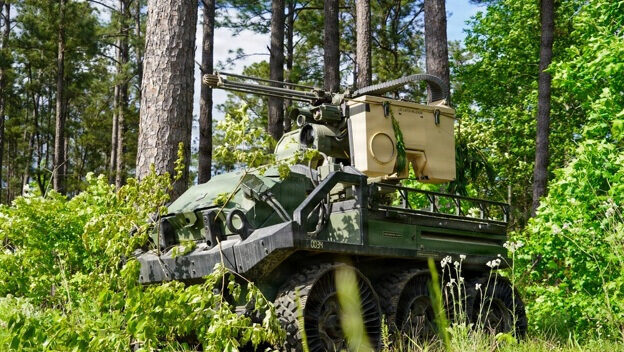
The U.S. Army Combat Capabilities Development Command (DEVCOM) Armaments Center helping explore what that future might look like through controlled experimentation with industry partners. (US Army photo by Eric Kowal)
WASHINGTON — The Army’s goal of scaling unmanned ground vehicles is being sabotaged by the service’s inability to provide clear, coherent demand signal to industry, according to the head of the National Advanced Mobility Consortium (NAMC) , a nonprofit organization bridging the Pentagon and industry for ground drone projects.
“I think [industry has] the challenge of understanding what the demand signal is, and then again where to put their dollars. We do talk a lot about these capabilities that the Army has asked for, but they [industry] want to know what’s next,” Warren Sponsler, NAMC’s CEO, s aid in a recent interview. “[Industry is] trying to align themselves to what’s next. I think that’s probably one of the biggest challenges — just being able to produce at scale.”
Oftentimes companies order parts and put stress on their supply chains before the Army has settled on a contract mechanism or specific capability, Sponsler said. The commitment from industry is there, but the commitment from the Army, or any service for that matter, is not distinct, Sponsler said, which can be rather discouraging for companies.
“Following through on those programs, I think it is critical to maintain that relationship between government and industry,” Sponsler said.
Exercises also sometimes send a murky demand signal, Sponsler said. While the Army has invited industry to demonstrate ground autonomy platforms at several events, the sheer amount of opportunities and unclear mission objectives leave companies unsure where to invest their time and money.
“I think it’s kind of the opposite challenge in many cases,” Sponsler said when asked if he thinks there are enough Army exercises for industry to demo their platforms. “There are so many opportunities right now, and then companies, especially those small companies, are having to make often hard decisions as to which experiments they participate in, and which ones they choose not to.”
Processor upgrades enable computing at the edge
Avoiding vendor lock and providing more room for sensors and upgrades are critical considerations.
He added that “focusing some of the demonstration experimentation activities would be a help” to provide a clear demand signal.
“There’s a lot of opportunities right now that the Army talks about for robotics and autonomy companies to get their stuff out in the field, get user feedback, and I think what [industry] is looking for is, ‘What is that path to scaling? Like, where is that path to revenue?’
“The more that they can describe what capabilities they’re actually looking to field and put together, the better,” he said.
Sponsler said the Army’s venture capital acquisition hub, FUZE , has provided a strong example through its xTech competitions for how the service should focus its demonstrations on certain capabilities. For example, xTech has held demonstrations, which are a part of larger competitions that will result in contract awards, for autonomous logistics and sustainment projects and for autonomous breaching . The path to revenue is clear in such cases as companies know they could be the winner of an eventual contract.
Sponsler said he urges companies, especially the nontraditionals, to enter such competitions, but he also urges them pay close attention to the Army’s programs of record for ground autonomy as they are the most indicative of how the Army plans to spend its money. The challenge there: the Army’s programs of record for ground autonomy have also fallen prey to the same lack of clarity as its outreach to industry.
For example, within roughly 18 months, the Army altered its UxS program of record and transformed the former Robotic Combat Vehicle program into the Unmanned Ground Commercial Robotic Vehicle program but then dispersed that program into Project Sustainment and the Engineer Autonomous Breaching Capability program .
The service also relocated its acquisition office for autonomy then stood up a separate Portfolio Acquisition Executive for autonomy and redesignated its Futures and Concepts Command as the new Army Futures and Autonomous Systems Command (FASCOM), which will work in coordination with the Pentagon’s newly established Autonomous Warfare Command (AUTOWARCOM). The good news, Sponsler said, is that he believes the new AUTOWARCOM, which has yet to be formally established since it requires Congressional approval, and FASCOM will allow the Army and the Pentagon’s autonomy efforts to be better streamlined.
He said the new organizations will help in “providing additional focus to robotics and autonomy integration at the formation level, looking beyond a product and more to a capability,” Sponsler said.
“[It] should also help to align resources and leadership to best prioritize based on the services’ needs. As the Army operates in multiple domains — ground, air, sea — having a [DoD]-level organization with a vision across services should help to mitigate duplicative efforts and better align resources,” he added.
Breaking Defense Video
Qatar’s domestic weapons, Turkey’s drone arsenal and the Mecca pact’s next test
3 congressional races that matter for defense
How General Atomics views Europe’s unmanned future
A more flexible way to defend maneuver forces from drones that doesn’t tie them down [Sponsored]
What’s haunting the Pentagon this Halloween?
The new must-have capabilities for drones [Sponsored]
Army’s tech chief talks autonomy, acquisition and the future of drones
Drones take over AUSA, plus the Army’s plan to bring in new vendors
Hegseth talks autonomy at AUSA, a key show focus
Army doubles down on autonomy, stakes out Indo-Pacific role: AUSA Day 2
美国陆军作战能力发展司令部(DEVCOM)军备中心正与工业伙伴合作,通过受控实验探索未来可能的发展方向。(美国陆军照片,摄影:埃里克·科瓦尔)
华盛顿——据国家先进机动联盟 (NAMC) 的负责人称,由于陆军无法向业界提供清晰、连贯的需求信号,陆军扩大无人地面车辆规模的目标正受到破坏。NAMC 是一个非营利组织,致力于连接五角大楼和业界,以推进地面无人机项目。
“我认为(业界)面临的挑战在于理解需求信号,以及如何将资金投入到这些领域。我们确实经常讨论陆军提出的这些能力需求,但他们(业界)想知道下一步的发展方向,”NAMC首席执行官沃伦·斯庞斯勒在最近的一次采访中表示。“(业界)正努力调整自身以适应未来的发展趋势。我认为这可能是最大的挑战之一——即如何实现规模化生产。”
斯庞斯勒表示,很多时候,企业在陆军尚未确定合同机制或具体能力之前就订购零部件,给供应链带来压力。他说,企业方面的承诺是有的,但陆军(或者任何其他军种)的承诺却并不明确,这可能会让企业感到相当沮丧。
“我认为,要落实这些计划,维持政府与产业界之间的关系至关重要,”斯庞斯勒说。
斯庞斯勒表示,演习有时也会发出模糊的需求信号。虽然陆军已邀请业界在多次活动中展示地面自主平台,但数量庞大的机会和不明确的任务目标让各公司不知该将时间和资金投入到哪里。
当被问及他是否认为陆军的演习足以让业界展示其平台时,斯庞斯勒表示:“我认为在很多情况下,挑战恰恰相反。现在机会很多,但企业,尤其是小企业,却不得不做出艰难的抉择,决定参与哪些实验,不参与哪些实验。”
处理器升级使边缘计算成为可能
避免厂商锁定,并为传感器和升级留出更多空间是至关重要的考虑因素。
他还补充说,“集中一些示范实验活动将有助于”提供明确的需求信号。
“目前陆军谈到了很多机会,让机器人和自主系统公司有机会将他们的产品投入实际应用,获得用户反馈。我认为(业界)正在寻找的是,‘如何实现规模化?如何实现盈利?’”
他说:“他们越能描述他们实际想要部署和整合哪些能力,就越好。”
斯庞斯勒表示,陆军的风险投资收购中心FUZE通过其xTech竞赛,为陆军如何将演示重点放在特定能力上树立了一个很好的榜样。例如,xTech已经举办了自主后勤保障项目和自主突入项目的演示,这些演示是更大规模竞赛的一部分,最终将授予合同。在这种情况下,盈利路径很清晰,因为公司知道自己有可能赢得最终合同。
斯庞斯勒表示,他鼓励各公司,尤其是非传统企业,积极参与此类竞标,但他同时也敦促他们密切关注陆军的地面自主系统项目,因为这些项目最能体现陆军的资金使用计划。然而,问题在于:陆军的地面自主系统项目也和其面向业界的推广活动一样,缺乏透明度。
例如,大约 18 个月内,陆军修改了其 UxS 记录计划,将以前的机器人作战车辆计划转变为无人地面商用机器人车辆计划,但随后又将该计划分散到保障项目和工程自主破障能力计划中。
该军种还将其自主采购办公室迁址,并成立了独立的自主采购项目执行机构,同时将其未来与概念司令部更名为新的陆军未来与自主系统司令部(FASCOM),该司令部将与五角大楼新成立的自主作战司令部(AUTOWARCOM)协调运作。斯庞斯勒表示,好消息是,他相信新的自主作战司令部(AUTOWARCOM,由于需要国会批准,尚未正式成立)和陆军未来与自主系统司令部将使陆军和五角大楼的自主化工作更加精简高效。
Sponsler表示,新成立的组织将有助于“在编队层面更加关注机器人和自主集成,着眼于能力而非产品”。
他还补充道:“这也有助于协调资源和领导,以便根据各军种的需求进行最佳的优先排序。由于陆军在陆地、空中和海上多个领域作战,因此拥有一个具有跨军种愿景的国防部级组织应该有助于减少重复工作,并更好地协调资源。”
突破性防御视频
卡塔尔的国产武器、土耳其的无人机武库以及麦加条约的下一次测试
3场对国防至关重要的国会选举
通用原子公司如何看待欧洲的无人化未来
一种更灵活的防御机动部队免受无人机攻击的方式,不会限制其行动[赞助]
今年万圣节,五角大楼究竟闹鬼?
无人机必备的新功能 [赞助内容]
陆军技术主管谈无人机的自主性、采购和未来
无人机主导了美国陆军协会(AUSA)的会议,此外,陆军还计划引入新的供应商。
Hegseth 在 AUSA 大会上谈到了自主性,这是本次大会的一个重点议题。
陆军加倍强调自主性,明确印太地区角色:AUSA第二天