Laser Weapon Now Guarding Trump’s Mar-a-Lago Estate激光武器现已用于保护特朗普的海湖庄园
Mar-a-Lago is the latest real-world deployment for the U.S. military's growing arsenal of LOCUST counter-drone lasers.
By Joseph Trevithick
Published Nov 2, 2026 4:39 PM EST
Andrew Harnik/Getty Images
At least one AeroVironment LOCUST laser counter-drone system is part of the array of anti-air defenses that have popped up around President Donald Trump’s Mar-a-Lago estate in Palm Beach, Florida, in recent weeks. Versions of LOCUST have been seeing steadily increasing use within the U.S. military in recent years , including deployments now along the border with Mexico . Though there has been much progress in the development of practical laser directed-energy weapons in recent years, the technology has continued to face hurdles to more widespread adoption.
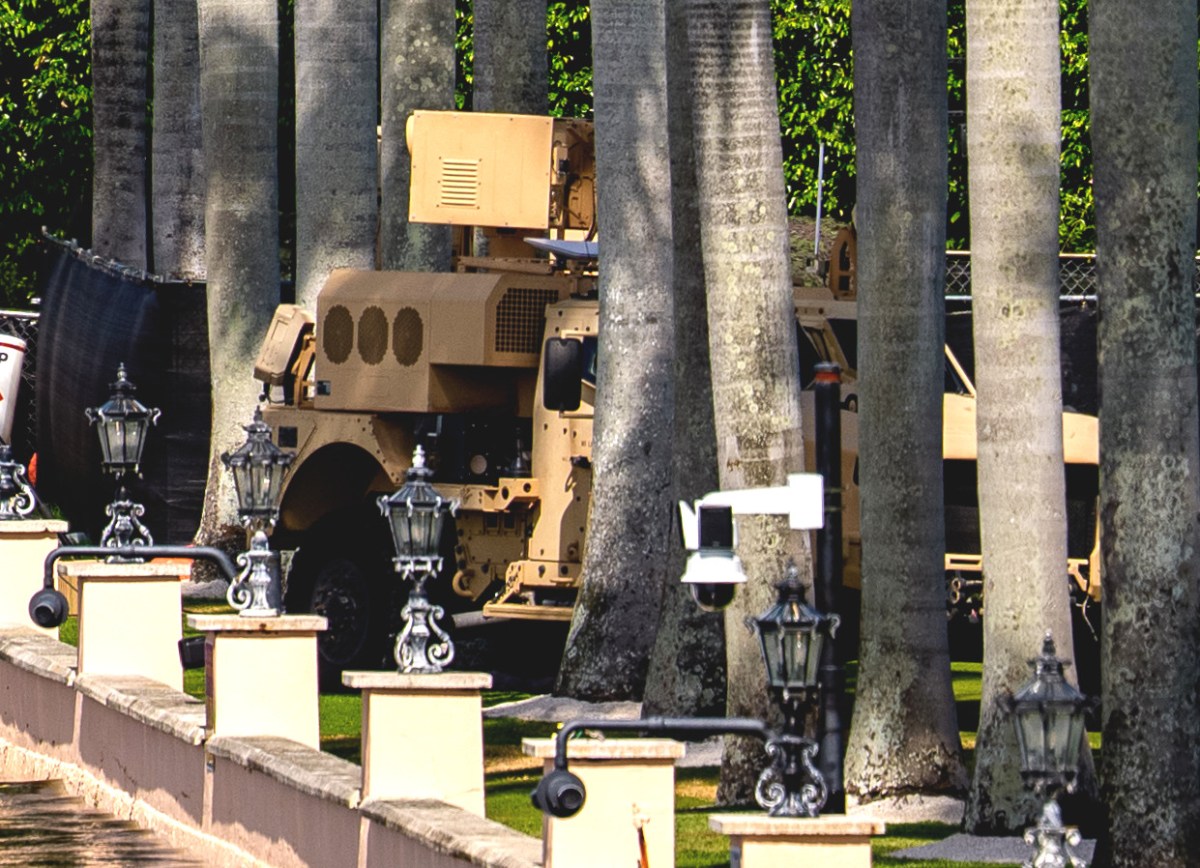
The LOCUST system at Mar-a-Lago, which is mounted on a 4×4 Joint Light Tactical Vehicle (JLTV), is seen in two pictures that Getty’s Andrew Harnik took on October 31. When exactly the laser-directed energy weapon was deployed is unclear.
Harnik’s main focus was a pair of Humvee-based AN/TWQ-1 Avenger short-range air defense systems on a floating platform in Lake Worth Lagoon near the edge of the estate, which were first deployed there just over two weeks ago. Additional Avengers have also been positioned around Donald J. Trump International Airport, which is situated some three miles to the west. The U.S. military has also set up elements of Counter-Unmanned Aircraft System Fly-Away Kits , including Ku-band radar, electronic support measures (ESM), jammers, and 360-degree infrared search and track systems nearby. TWZ covered the presence of the Avengers and the Fly-Away Kits in a report last Friday .
The JLTV-based LOCUST counter-drone laser system can be seen here, at right, between two palm trees. Two Humvee-based AN/TWQ-1 Avenger short-range air defense systems are also seen, at left, on a floating platform. Andrew Harnik/Getty Images
A stock picture of a JLTV-based LOCUST system. AeroVironment
This heightened security comes amid signs that a new round of major hostilities with Iran could be on the horizon , as well as the run-up to tomorrow’s mid-term elections. The regime in Tehran has threatened Trump’s life on several occasions over the years. The President has already been the subject of several domestic assassination attempts and threats.
“At the request of the U.S. Secret Service (USSS) and under NORAD [the U.S.-Canadian North American Aerospace Defense Command] and USNORTHCOM [U.S. Northern Command] authorities, NORAD and USNORTHCOM recently deployed ground-based air defense [GBAD] assets and Counter-Unmanned Aircraft System capabilities in and around Mar-a-Lago, Florida,” the commands told us in a statement last week. “These assets add a complementary layer of technology to enhance protection. Due to operational security, we are unable to provide additional details. For further detail, we refer you to the USSS.”
“The U.S. Secret Service is operating in a heightened threat environment, and we continuously adapt our protective operations to incorporate cutting-edge tools, technology, and methods to safeguard our protectees,” the Secret Service also told us in a prior statement. “At the request of the U.S. Secret Service, NORAD and U.S. Northern Command are providing Counter-Unmanned Aircraft System capabilities in support of our protective operations.”
The U.S. Army began recieving the JLTV-based versions of LOCUST, along with examples mounted on the smaller 4×4 Infantry Squad Vehicle (ISV) last year through a program called the Army Multi-Purpose High Energy Laser (AMP-HEL). This followed the delivery of palletized LOCUST systems under a rapid prototyping effort called the Palletized-High Energy Laser (P-HEL) in the early 2020s. The Army is now acquiring LOCUST X3 systems under its Enduring-High Energy Laser (E-HEL) program. LOCUST has become something of a star more broadly within the directed energy space across the U.S. military. The U.S. Marine Corps and the U.S. Navy have also been exploring the use of versions of LOCUST in ground-based and shipboard contexts .
A close-up look at the turret on an earlier palletized version of LOCUST acquired by the Army. US Army
To date, all versions of LOCUST consist of a turret with the laser beam projector, as well as built-in electro-optical and infrared video cameras for target acquisition and tracking. The complete system also includes power generation and cooling components. LOCUST variants can also be cued using offboard sensors, including small-form-factor high-frequency radars and passive radio frequency signal detection systems on host vehicles or located off-platform nearby, like what the Fly-Away Kit provides.
One of the Army’s ISV-mounted LOCUST systems. Note the small form factor radars on top of the cab, as well as at the rear of the vehicle. US Army
The stated power rating for LOCUST varies from version to version, with the latest X3 being a 30-kilowatt type. Though the system is categorized as a high-energy laser, this is at the lower end of the power spectrum for weapons of this type, and it is explicitly geared toward the countering small drones mission set. Layering LOCUST in with other hard- and soft-kill counter-drone and air defense systems in a potentially high-threat area, as we are seeing now at Mar-a-Lago, makes good sense.
A promitional image showing a JLTV-mounted LOCUST X3, as well as a stand-alone configuration of the system. AeroVironment
As mentioned, Mar-a-Lago is not the first time a LOCUST has been deployed in a real-world context. In 2022, the Army confirmed the operational deployment of two of P-HEL systems to unspecified foreign locales. Earlier this year, JLTV- and ISV-based AMP-HELs have appeared along the border with Mexico. One of the systems was part of the chain of events that led to the shutdown of airspace around El Paso, Texas, in February. That incident, in turn, prompted the Pentagon to craft a new agreement with the Federal Aviation Administration (FAA) regarding the use of laser directed energy weapons within the United States.
A JLTV-based LOCUST system seen deployed somewhere near the border with Mexico. US Army
As TWZ has written in the past :
“In general, laser directed energy weapons offer the promise of functionally unlimited magazine depth, as long as there is sufficient power and cooling capacity. They also present a drastically lower cost-per-intercept proposition compared to traditional anti-air interceptors. This is all advantageous for engaging drones, particularly smaller and cheaper designs that can still present very significant threats. The dangers posed by uncrewed aerial systems are only set to grow as networked swarming and automated targeting capabilities, enabled by advances in artificial intelligence and machine learning , become more accessible. Defenders already face real risks of just being overwhelmed by attacks involving volumes of drones.”
“At the same time, a laser like LOCUST can only engage a single target at once. Lower-powered lasers need to dwell on their targets for a longer period of time in order to cause significant damage by burning a hole in them, as well. This limits the number of targets a single system can engage in a given window of time.”
“In addition, the power of any laser beam drops as it propagates through the atmosphere further and further away from its source. Weather and other environmental factors like smoke and dust can also distort the beam and reduce its power. All of this only adds to the aforementioned dwell time. Adaptive optics , and just more power overall, can help produce useful effects at greater distances, but laser weapons continue to have short ranges, typically measured in handfuls of miles, as a general rule.”
“The Army, as well as other branches of the U.S. military, have repeatedly acknowledged challenges in fielding laser directed energy weapon systems. Sensitivity to vibration, humidity, dust, and sand, as well as fragile optics and cooling demands, have all created further complications for operating and sustaining these systems in real-world environments. “
A picture that the Army released in 2022 of quadcopter-type drones damaged during testing of P-HEL systems. US Army
Army officials just recently touted the benefits of laser directed energy weapons like LOCUST, while also acknowledging again that there is still work to be done at the Association of the U.S. Army’s (AUSA) main annual convention last month.
“Lasers are real. We can do it. We can go out. We can shoot things,” Kirk Williams, Chief Engineer at the Army’s Directed Energy Project Office, another one of the panelists, said. “But what we got to do now is make these systems reliable enough so that the soldiers have the faith in them when they need them, and that’s really the main point that we’re trying to go after right now.”
“We’re getting to the point where the systems are reliable enough, but we still have to make them maintainable and repairable because this is an Army system,” he continued. “It’s going to be on a battlefield. Things are going to break. We can break things in very creative ways, right? So if it’s not reliable, or if it’s not maintainable, if it’s not repairable, that’s a problem.”
At least one LOCUST system is at least now participating in a very high-profile mission to help protect President Trump.
Contact the author: joe@twz.com
Comments couldn’t be loaded. Please refresh the page.
作者:约瑟夫·特雷维西克
发布于美国东部时间2026年11月2日下午4:39
Andrew Harnik/Getty Images
最近几周,在美国总统唐纳德·特朗普位于佛罗里达州棕榈滩的海湖庄园周围,出现了一系列防空系统,其中至少有一套是AeroVironment公司生产的LOCUST激光反无人机系统。近年来,LOCUST的各种版本在美国军方的使用量稳步增长,目前已部署在美墨边境沿线。尽管近年来实用型激光定向能武器的研发取得了长足进步,但这项技术在更广泛的应用方面仍然面临诸多障碍。
盖蒂图片社的安德鲁·哈尼克于 10 月 31 日拍摄的两张照片显示,位于海湖庄园的 LOCUST 系统安装在一辆 4×4 联合轻型战术车辆 (JLTV) 上。目前尚不清楚这种激光定向能武器究竟何时部署。
哈尼克的主要关注点是位于沃思湖泻湖(Lake Worth Lagoon)靠近庄园边缘的一个浮动平台上的两套基于悍马车底盘的AN/TWQ-1“复仇者”(Avenger)短程防空系统,这两套系统于两周多前首次部署到位。此外,在西边约三英里处的唐纳德·J·特朗普国际机场附近也部署了额外的“复仇者”系统。美军还在附近部署了反无人机系统便携式套件,包括Ku波段雷达、电子支援措施(ESM)、干扰器和360度红外搜索跟踪系统。TWZ在上周五的报道中披露了“复仇者”系统和便携式套件的部署情况。
图中右侧两棵棕榈树之间可见基于JLTV底盘的“蝗虫”(LOCUST)反无人机激光系统。左侧浮动平台上还可见两套基于悍马底盘的AN/TWQ-1“复仇者”(Avenger)近程防空系统。(图片来源:Andrew Harnik/Getty Images)
一张基于JLTV的LOCUST系统的库存图片。AeroVironment
此次安保升级正值伊朗与美国之间可能爆发新一轮大规模冲突的迹象出现之际,同时也正值美国中期选举临近之时。多年来,德黑兰政权曾多次威胁特朗普的生命安全。总统本人也曾多次在国内遭遇暗杀未遂和威胁。
“应美国特勤局(USSS)的要求,并经北美防空司令部(NORAD)和美国北方司令部(USNORTHCOM)授权,北美防空司令部和美国北方司令部近期在佛罗里达州海湖庄园及其周边地区部署了地面防空(GBAD)装备和反无人机系统,”两司令部上周在一份声明中表示。“这些装备增添了一层补充性的技术,以增强防护能力。出于行动安全考虑,我们无法提供更多细节。如需了解更多详情,请联系美国特勤局。”
美国特勤局此前在一份声明中告诉我们:“美国特勤局正处于高度威胁的环境中,我们不断调整保护行动,采用尖端工具、技术和方法来保护受保护对象。”声明还指出:“应美国特勤局的要求,北美防空司令部和美国北方司令部正在提供反无人机系统能力,以支持我们的保护行动。”
去年,美国陆军通过一项名为“陆军多用途高能激光器”(AMP-HEL)的项目,开始接收基于联合轻型战术车辆(JLTV)的“蝗虫”(LOCUST)激光武器系统,以及安装在小型4×4步兵班组车辆(ISV)上的版本。此前,在2020年代初期,陆军还通过一项名为“托盘式高能激光器”(P-HEL)的快速原型开发项目,交付了托盘式“蝗虫”系统。目前,陆军正在其“持久高能激光器”(E-HEL)项目下采购“蝗虫”X3系统。“蝗虫”激光武器已成为美国军方定向能武器领域的一颗耀眼新星。美国海军陆战队和海军也一直在探索将“蝗虫”激光武器应用于地面和舰载作战环境。
近距离观察美国陆军早期采购的“蝗虫”导弹防御系统(LOCUST)的托盘式炮塔。美国陆军
迄今为止,所有版本的 LOCUST 系统都包含一个带有激光束投射器的炮塔,以及用于目标捕获和跟踪的内置光电和红外摄像机。整套系统还包括发电和冷却组件。LOCUST 的各种型号还可以使用外部传感器进行引导,例如安装在载具上的小型高频雷达和被动射频信号检测系统,或者像 Fly-Away Kit 套件中提供的那样,安装在平台附近的外部传感器。
这是美国陆军安装在步兵战车上的“蝗虫”(LOCUST)导弹防御系统之一。请注意驾驶室顶部和车辆后部的小型雷达。美国陆军
LOCUST 的额定功率因版本而异,最新的 X3 型号为 30 千瓦。虽然该系统被归类为高能激光武器,但就此类武器而言,其功率处于较低水平,并且明确针对小型无人机任务而设计。在潜在高威胁区域(例如我们目前在海湖庄园看到的)将 LOCUST 与其他硬杀伤和软杀伤反无人机及防空系统相结合,是明智之举。
宣传图片展示了安装在JLTV上的LOCUST X3系统,以及该系统的独立配置。AeroVironment
如前所述,海湖庄园并非“蝗虫”(LOCUST)系统首次在实际环境中部署。2022年,美国陆军确认已向未指明的海外地点部署了两套P-HEL系统。今年早些时候,基于JLTV和ISV的AMP-HEL系统出现在美墨边境。其中一套系统是导致今年2月德克萨斯州埃尔帕索附近空域关闭的一系列事件之一。该事件促使五角大楼与美国联邦航空管理局(FAA)就美国境内使用激光定向能武器达成新的协议。
一支基于联合轻型战术车辆(JLTV)的“蝗虫”(LOCUST)导弹系统被发现部署在美墨边境附近。美国陆军
正如TWZ过去所写的那样:
总的来说,只要功率和冷却能力充足,激光定向能武器就有望实现近乎无限的弹药储备。与传统防空拦截器相比,它们的单次拦截成本也大幅降低。所有这些优势都有利于打击无人机,尤其是那些体积更小、成本更低但仍然构成重大威胁的无人机。随着人工智能和机器学习技术的进步,网络集群和自动目标定位能力日益普及,无人飞行系统带来的危险只会与日俱增。防御者已经面临着被大量无人机攻击彻底压制的切实风险。
“同时,像LOCUST这样的激光器一次只能攻击一个目标。低功率激光器也需要对目标进行更长时间的照射,才能通过烧穿造成显著破坏。这限制了单个系统在给定时间内能够攻击的目标数量。”
此外,任何激光束的功率都会随着其在大气层中传播距离的增加而逐渐衰减。天气和其他环境因素,例如烟雾和灰尘,也会扭曲光束并降低其功率。所有这些都会延长上述的停留时间。自适应光学系统以及更高的整体功率可以帮助在更远的距离上产生有效效果,但一般来说,激光武器的射程仍然很短,通常只有几英里。
“美国陆军以及其他军种都曾多次承认,部署激光定向能武器系统面临诸多挑战。该系统对振动、湿度、灰尘和沙粒的敏感性,以及脆弱的光学元件和冷却需求,都进一步增加了在实际环境中操作和维护这些系统的复杂性。”
美国陆军于2022年公布的一张照片,照片显示四旋翼无人机在P-HEL系统测试中受损。
就在不久前,陆军官员还大力宣传了像 LOCUST 这样的激光定向能武器的好处,同时在上个月举行的美国陆军协会 (AUSA) 年度大会上再次承认,仍然有很多工作要做。
“激光是真实存在的。我们能做到。我们可以出去。我们可以发射激光,”陆军定向能项目办公室首席工程师柯克·威廉姆斯(Kirk Williams)说道,他也是小组成员之一。“但我们现在必须做的是让这些系统足够可靠,让士兵在需要时能够信任它们,这才是我们目前努力的方向。”
“我们现在正努力让系统变得足够可靠,但我们仍然需要确保它们的可维护性和可修复性,因为这是陆军系统,”他继续说道。“它将被部署在战场上。设备肯定会出故障。我们可能会以各种意想不到的方式弄坏设备,对吧?所以,如果它不可靠,或者无法维护,或者无法修复,那就是个问题。”
目前至少有一套 LOCUST 系统正在参与一项备受瞩目的任务,以帮助保护特朗普总统。
联系作者:joe@twz.com
评论加载失败,请刷新页面。