US Army tests autonomous boats during Philippine exercise美国陆军在菲律宾演习期间测试无人驾驶船只
Autonomous boats helped escort a U.S. Army vessel during a military exercise, in a demonstration of how uncrewed assets are changing maritime operations.
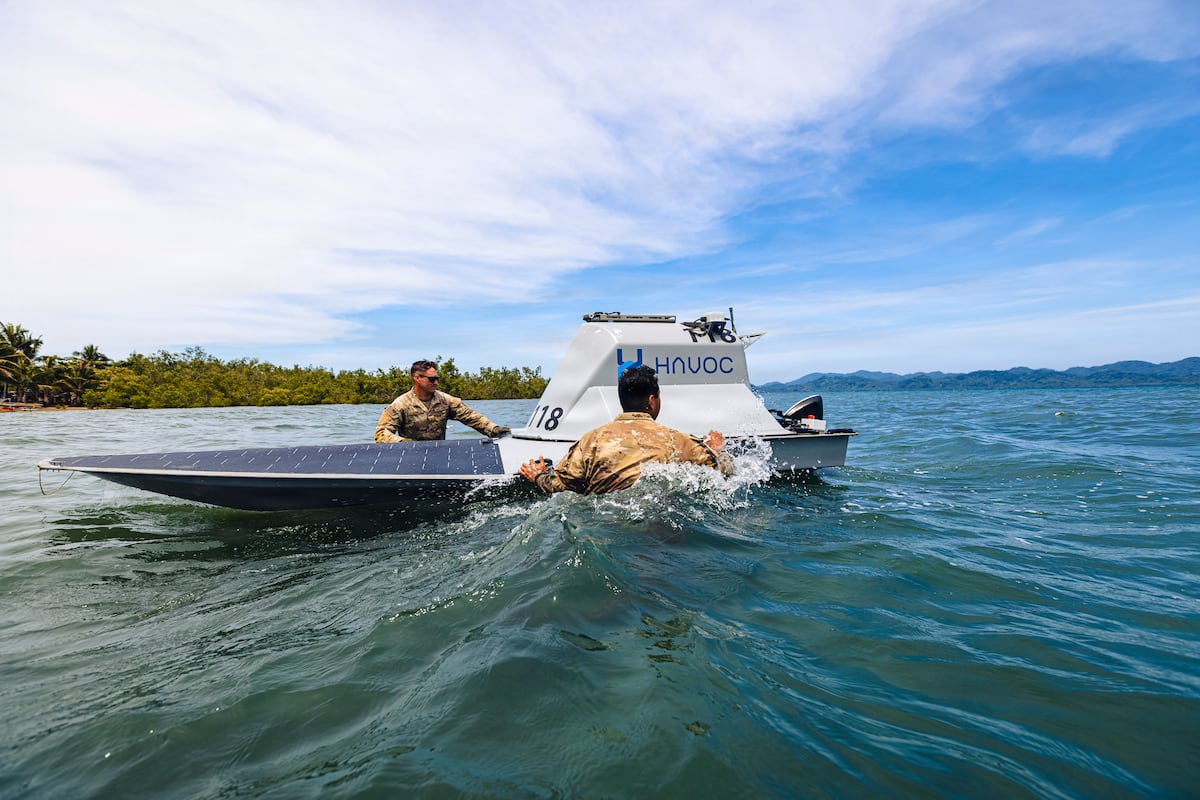
Autonomous boats helped escort a U.S. Army vessel during a recent military exercise, the Army said, in a demonstration of how uncrewed assets are changing maritime operations.
Soldiers from the 125th Intelligence and Electronic Warfare Battalion, 25th Infantry Division, deployed unmanned surface vessels, or USVs, in Casiguran Sound bay, during an exercise with the Philippine Army. The USVs deployed ahead of a U.S. Army Logistics Support Vessel, or LSV, as it neared Casiguran port, the Army said in a June release, observing the environment and transmitting information to personnel on land.
The operation was part of Salaknib 2026, and supported the transportation of Philippine Army personnel and vehicles — including armored personnel carriers — more than 260 miles to Port Casiguran.
The USVs navigated autonomously using onboard sensors to identify potential threats and provide commanders with a continuous picture of the operating environment.
“We deployed the autonomous intelligence, surveillance, reconnaissance boats to provide security for landing craft today,” said Pvt. Caleb Hannah, a soldier from the 125th Intelligence and Electronic Warfare Battalion, 25th Infantry Division. “They escorted the LSV to port from about six miles out, allowing Philippine vehicles to roll onto the dock.”
Photos released by the Army appear to show soldiers wading out into chest-deep water to recover a USV with HAVOC branding on its side. HAVOC is a defense technology company that develops autonomous systems.
The demonstration comes as the U.S. military is expanding its unmanned maritime fleet across the Indo-Pacific. Earlier this year, a Navy official said the service expects its fleet of medium unmanned surface vessels to grow from around four vessels in April to more than 30 by 2030, alongside thousands of smaller USVs and unmanned aircraft systems.
“These boats provide situational awareness to commanders with their ability to find, fix, target, kill, and confirm. With the information the USV provides, the commander’s decision-making process has been compressed from hours to seconds,” Ben Outlaw, an industry partner representative supporting the operation, said in the Army’s statement.
News of the exercise comes as the U.S. deployed a USV to help rescue two Army soldiers after their helicopter went down near the coast of Oman. In that incident, a U.S. Navy Corsair operated by 5th Fleet’s Task Force 59 was involved in the recovery. At the time, Capt. Tim Hawkins, a U.S. Central Command spokesperson, said the Task Force had started fielding those drones in the region in late March.
Eve Sampson is a reporter and former Army officer. She has covered conflict across the world, writing for The New York Times, The Washington Post and The Associated Press.
美国陆军表示,在最近的一次军事演习中,无人驾驶船只协助护送了一艘美国陆军舰艇,这表明无人驾驶资产正在改变海上作战方式。
美国陆军第25步兵师第125情报与电子战营的士兵在与菲律宾陆军的联合演习中,于卡西古兰湾部署了无人水面艇(USV)。陆军在6月份发布的一份声明中表示,这些无人水面艇部署在美军后勤支援舰(LSV)接近卡西古兰港之前,负责观察周围环境并将信息传输给岸上人员。
此次行动是 Salaknib 2026 的一部分,旨在支援菲律宾陆军人员和车辆(包括装甲运兵车)向 260 多英里外的卡西古兰港的运输。
无人水面艇利用船载传感器自主导航,识别潜在威胁,并为指挥官提供作战环境的持续图像。
“今天我们部署了自主情报、监视和侦察艇,为登陆艇提供安全保障,”第25步兵师第125情报与电子战营的士兵卡莱布·汉娜列兵说。“它们护送登陆艇从大约六英里外的海域驶入港口,使菲律宾的车辆得以顺利上岸。”
陆军公布的照片显示,士兵们涉水进入齐胸深的水中,打捞一艘侧面印有HAVOC标志的无人水面艇。HAVOC是一家研发自主系统的国防科技公司。
此次演示正值美军在印太地区扩充其无人海上舰队之际。今年早些时候,一位海军官员表示,海军预计其中型无人水面舰艇舰队将从4月份的约4艘增长到2030年的30多艘,此外还将部署数千艘小型无人水面舰艇和无人机系统。
“这些无人水面艇具备发现、定位、瞄准、摧毁和确认目标的能力,能够为指挥官提供态势感知。借助无人水面艇提供的信息,指挥官的决策过程已从数小时缩短至数秒,”支持此次行动的行业合作伙伴代表本·奥特洛在陆军的声明中表示。
此次演习的消息传出之际,美国刚刚部署了一架无人水面艇(USV)协助营救两名在阿曼海岸附近直升机坠毁的陆军士兵。在那次事件中,美国海军第五舰队第59特遣部队的一架“海盗”式战斗机参与了救援行动。当时,美国中央司令部发言人蒂姆·霍金斯上校表示,该特遣部队已于3月下旬开始在该地区部署这些无人机。
伊芙·桑普森是一名记者,也是一名前陆军军官。她曾报道过世界各地的冲突,为《纽约时报》、《华盛顿邮报》和美联社撰稿。