US couldn’t repair battle-damaged ships in war with China, study finds研究发现,美国在与中国的战争中无法修复受损舰艇。
Battle-damaged U.S. warships could not be quickly repaired and returned to combat during a war with China, according to a new study by RAND.
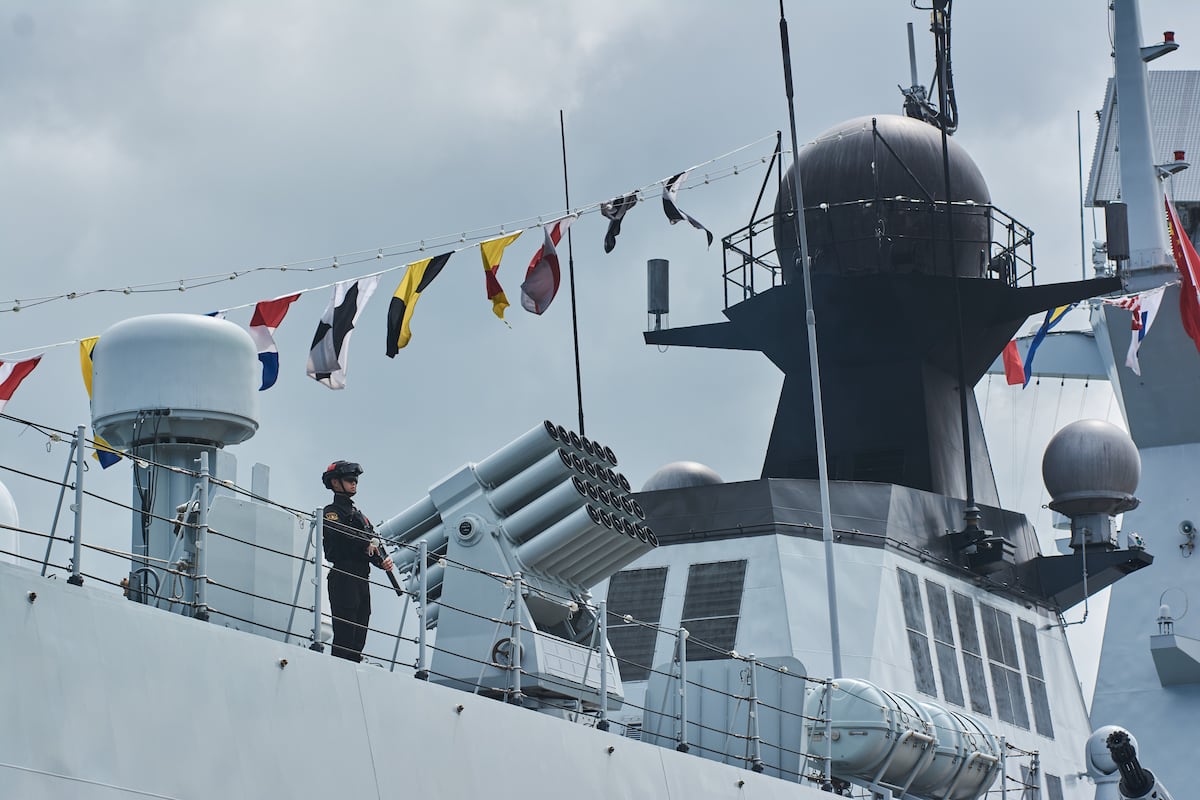
Battle-damaged U.S. warships could not be quickly repaired and returned to combat during a war with China, according to a new report.
U.S. maintenance facilities would be overwhelmed and would lack sufficient spare parts to repair ships in theater, concluded the study by RAND, a Washington-based think tank. Nor can the U.S. Navy assume that its Pacific allies have adequate shipyard capacity — or political willingness — to fix damaged vessels.
The U.S. Navy has struggled with overworked ships and crews , as well as overburdened shipyards and repair depots. But a war with China, which has the world’s largest navy , would almost certainly result in American ships being hit by everything from ballistic “carrier-killer” missiles, to hypersonic weapons and torpedoes, the study says.
“The Navy has not faced damage at the level likely to occur in a major war since World War II,” warned RAND.
The study recommended that command-and-control authority for repair work be streamlined, including prior agreements with allied nations regarding access to facilities. It also urged the U.S. Navy to expand its mobile repair capabilities, including “deployable repair teams, flyaway assessment units, and scalable Expeditionary Mobile Repair Facilities.”
RAND’s analysis was based on a tabletop wargame conducted in August 2025. The setting was a hypothetical war with China, as U.S. ships race to defend Taiwan from invasion or blockade. The American vessels in question were Arleigh Burke-class destroyers, the backbone of the U.S. surface fleet.
The U.S. Navy will need every ship it can get, including damaged vessels patched up and rejoining the fight. However, “existing Navy systems for battle-damage repair are burdened by a variety of inefficiencies that hinder the Navy’s capacity for responding to widespread battle damage,” the study warned.
Analysts also found that “attempting repairs in a hostile Indo-Pacific environment will be significantly more complex than existing plans allow. This complexity creates serious risks to U.S. and allied rapid force regeneration and maritime dominance.”
Meanwhile, Chinese ships would be operating close to their home bases and repair facilities.
“China is not only closer, it also has significantly better industrial repair capability,” Bradley Martin, a RAND analyst who co-authored the report, told Defense News.
Though the game focused on Arleigh Burke-class destroyers, repair issues would “apply to all ship classes, and in fact may be more pronounced where nuclear repairs are involved. Issues of access, vulnerability, and industrial capacity apply across all ship classes.”
Rather than combat, the game focused on how damaged ships could be repaired in the Pacific theater and returned to combat, rather than spending weeks limping back to U.S. ports. This would likely require U.S. access to ports and shipyards in allied nations.
During the game, teams represented the U.S. and its allies, including Japan, Korea and Australia.
The four scenarios spanned a variety of situations. They included a U.S. destroyer colliding with a Chinese frigate in the Straits of Malacca, two destroyers damaged by gunfire and rockets from Chinese ships and helicopters while escorting Philippines ships in disputed waters in the South China Sea, several destroyers severely damaged by Chinese anti-ship missiles while defending the Philippines, and multiple destroyers badly damaged while intercepting a Chinese amphibious invasion of Taiwan.
Poor coordination with allies
The common denominator was that all of the American ships needed quick repairs. But that was easier said than done.
For starters, there were difficulties determining what resources were needed for repairs, and whether a vessel could be fixed locally or would have to sail back to the United States.
Players also “assumed that regulations and standards for repair and maintenance would remain the same in a wartime environment as they are during peacetime,” the report said.
Nor were command arrangements clear. For example, “the group that represented the in-theater logistics and maintenance team at times took actions, specifically those related to in-theater repair options, that the theater operational commander had already rejected because of operational constraints,” said the report.
In addition, coordination was lacking between organizations in the Pacific and the U.S. The U.S. team didn’t fully understand what its Pacific allies could offer.
“U.S. participants demonstrated knowledge gaps about the locations of host nations’ ports, not to mention host nations’ capabilities or access requirements,” the study noted. Though Japan, Korea and Australia have significant resources, “some kinds of operations — such as ordnance handling or a lengthy repair — would bring complications.“
Allied nations were also mindful that repairing U.S. warships could bring Chinese retaliation.
“Japan, the ROK [Republic of Korea], and Australia are in principle committed to supporting U.S. repair, but this cannot be assumed once the threat level starts to escalate,” said Martin.
However, the study did note that “although there were significant knowledge gaps at the outset of the exercise, once ally members explained their capabilities, collaboration was mostly seamless.”
Sufficient spare parts were also an issue, especially for older ships.
“Even ships within the same class can be significantly different from one another,” the study noted. “Some critical parts or systems from one ship might not translate to another ship.”
Michael Peck is a correspondent for Defense News and a columnist for the Center for European Policy Analysis. He holds an M.A. in political science from Rutgers University. Find him at theuncommondefense.com. His email is mikedefense1@gmail.com.
最新报告显示,在与中国的战争中,受损的美国军舰无法迅速修复并重新投入战斗。
华盛顿智库兰德公司的一项研究得出结论,美国的维修设施将不堪重负,并且缺乏足够的备件来维修战区内的舰船。美国海军也不能想当然地认为其太平洋盟友拥有足够的造船能力或政治意愿来修复受损舰船。
美国海军一直面临着舰艇和船员过度劳累、造船厂和维修站不堪重负的问题。但研究表明,与拥有世界最大规模海军的中国开战,几乎肯定会导致美国舰艇遭受各种武器的攻击,从弹道“航母杀手”导弹到高超音速武器和鱼雷,无所不包。
兰德公司警告说:“自二战以来,海军还没有遭受过像重大战争中可能出现的那种程度的损失。”
该研究建议简化维修工作的指挥控制权限,包括事先与盟国就设施使用达成协议。研究还敦促美国海军扩大其移动维修能力,包括“可部署维修小组、飞行评估单元和可扩展的远征移动维修设施”。
兰德公司的分析基于2025年8月进行的一次桌面兵棋推演。推演背景设定为一场假想的中美战争,美国舰艇竞相保卫台湾免受入侵或封锁。推演中使用的美国舰艇是阿利·伯克级驱逐舰,这是美国水面舰队的主力。
美国海军需要尽可能多的舰艇,包括修复受损舰艇并重新投入战斗。然而,该研究警告说,“现有的海军战损修复系统存在诸多效率低下的问题,阻碍了海军应对大范围战损的能力。”
分析人士还发现,“在充满敌意的印太地区进行维修将比现有计划复杂得多。这种复杂性对美国及其盟国的快速兵力恢复和海上优势构成了严重风险。”
与此同时,中国舰船将在其母港和维修设施附近作业。
“中国不仅距离更近,而且工业维修能力也明显更强,”兰德公司分析师布拉德利·马丁(Bradley Martin)告诉《防务新闻》,他是该报告的合著者。
虽然游戏主要以阿利·伯克级驱逐舰为主题,但维修问题“适用于所有舰艇类型,事实上,涉及核动力维修的问题可能更为突出。维修通道、脆弱性和工业能力等问题适用于所有舰艇类型。”
游戏的重点并非战斗本身,而是如何在太平洋战场上修复受损舰船并使其重返战场,而不是耗费数周时间艰难地返回美国港口。这很可能需要美国能够使用盟国的港口和造船厂。
比赛期间,参赛队伍分别代表美国及其盟国,包括日本、韩国和澳大利亚。
这四个场景涵盖了各种情况。其中包括:一艘美国驱逐舰在马六甲海峡与一艘中国护卫舰相撞;两艘驱逐舰在南海争议水域护送菲律宾船只时,遭到中国舰船和直升机的炮火和火箭弹袭击而受损;数艘驱逐舰在保卫菲律宾时,遭到中国反舰导弹的严重袭击而受损;以及多艘驱逐舰在拦截中国对台湾的两栖入侵时严重受损。
与盟友协调不力
所有美国舰船的共同点是都需要尽快维修。但这说起来容易做起来难。
首先,很难确定维修需要哪些资源,以及船只是否可以在当地修理,还是必须驶回美国。
报告称,玩家们还“认为战时环境下的维修保养规章制度和标准与和平时期相同”。
指挥安排也不明确。例如,报告指出,“代表战区后勤和维护团队的小组有时会采取一些行动,特别是与战区维修方案相关的行动,而这些行动由于作战限制,已被战区作战指挥官否决。”
此外,太平洋地区各组织与美国之间缺乏协调。美国团队并不完全了解其太平洋盟友能够提供什么。
该研究指出,“美国参与者对东道国港口的位置缺乏了解,更不用说东道国的能力或准入要求了。”尽管日本、韩国和澳大利亚拥有丰富的资源,“但某些类型的作业——例如弹药装卸或长时间的维修——会带来诸多复杂情况。”
盟国也意识到,修理美国军舰可能会招致中国的报复。
马丁说:“日本、韩国和澳大利亚原则上致力于支持美国的维修工作,但一旦威胁级别开始升级,就不能想当然地认为它们会继续这样做。”
然而,该研究确实指出,“尽管在演习开始时存在很大的知识差距,但一旦盟军成员解释了他们的能力,合作就基本无缝衔接了。”
充足的备件也是一个问题,特别是对于老旧船舶而言。
研究指出,“即使是同一级别的舰艇,彼此之间也可能存在显著差异。一艘舰艇上的某些关键部件或系统可能无法移植到另一艘舰艇上。”
迈克尔·佩克是《防务新闻》的通讯员,也是欧洲政策分析中心的专栏作家。他拥有罗格斯大学政治学硕士学位。您可以在theuncommondefense.com找到他。他的邮箱是mikedefense1@gmail.com。