US Army integrates veterinarians into human combat care美国陆军将兽医纳入人类作战护理体系
The Army wants to better utilize veterinarians in combat medicine to prepare for the possibility of large-scale operations in the Indo-Pacific.
HONOLULU — In an effort to mitigate logistical issues that accompany large-scale combat operations, the U.S. Army is working to better integrate veterinarians into combat care.
To better prepare for the possibility of a large injury rate in a future Indo-Pacific fight, combat medical teams are working on ways to utilize human and animal health at the same time, given the similar anatomies between humans and canines, as demonstrated by the 18th Theater Medical Command at the 2026 Land Forces of the Pacific Symposium and Exposition in Hawaii.
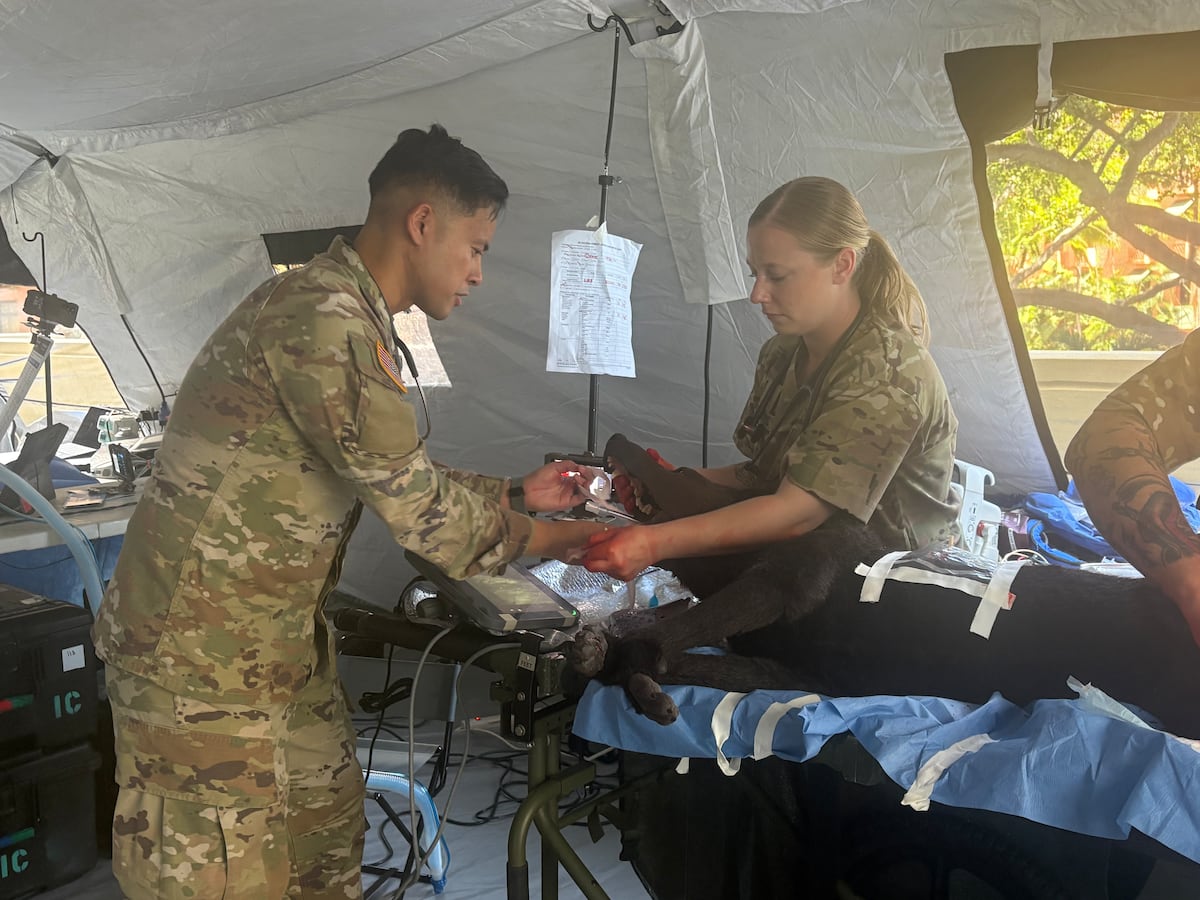
The unit, based at Fort Shafter, Hawaii, showcased a mock Forward Resuscitative Surgical Detachment tent to display their high-fidelity canine model, which is an anatomically accurate representation of a canine meant for veterinary training, and how the initial stages of triage are the same for canines and humans.
“The only difference is there’s some anatomical differences between us and a dog,” Capt. John Hutchison, a veterinarian with the Oahu Veterinary Network, said during the demonstration.
“But the principles are identical, and then all the equipment that you’re seeing is all the human equipment from our partners and all the medications that they’re using too are all the same medications, with dosaging just being a little bit different,” Hutchison continued.
A close up of the high-fidelity canine model used in the demonstration at LANPAC on May 13, 2026. (Military Times)
Hutchison said the initial stage of isolation is the same between a canine and a human, and they undergo the same trauma assessment, called a MARCH sequence. He said that the medics address hemorrhaging as they look to get an airway established and for any signs of respiratory compromise, shock, hypothermia or head trauma.
With large-scale combat operations, there are logistical challenges to account for, such as manpower issues and contested environments.
As veterinarians and human medics “deliberately” operate and train alongside one another, they are increasing their survivability and preserving combat manpower, which provides a more resilient forward medical capability, Hutchison said.
“Here we’ve got veterinary staff, but it could be human medics working on canine patients or it could be veterinarians even helping in the [operating room] on a human patient because the principles are all the same,” Hutchison said.
Veterinarians demonstrate medical care on a high-fidelity canine model at LANPAC on May 13, 2026.
The crew also displayed the Battlefield Assisted Trauma Distribution Observation Kit, or BATDOK system , that is used by the team to ensure a streamlined care process. The software models an electronic medical record system, instead of the previous paper model.
In the case that a veterinarian isn’t there, the system contains various guides that can be used by combat medics or handlers unfamiliar with medical dosing.
“It makes it a lot easier, so you can identify your point of injury, what time you gave your interventions, what kind of intervention you gave it to them, so it really organizes a lot better, makes it easy to kind of keep track of all those patients,” said Maj. Luigi Topacio, a Veterinary Corps officer at Joint Base Pearl Harbor-Hickam, Hawaii.
Since a cut suite OR would use the same technology used for military working dogs and human patients, whoever is providing the care can use a QR code to locate or create an electronic medical record for the patient to document their care as they move forward since it automatically transfers it to a record-keeping system, Maj. Tim Fogarty, a certified registered nurse anesthetist with the 18th TMC, said during the demonstration.
Lt. Col. Lauren Hamlin, commander of Veterinary Readiness Activity, Hawaii who assisted in the demonstration, told Military Times on Tuesday that in low-resource or prolonged care environments, veterinarians bring a wide-range of expertise that assists combat care, such as surgical, emergency, anesthesia, trauma and public health skills.
“Side-by-side training with human medical teams builds shared skills in triage, anesthesia, surgical support, resuscitation, logistics and evacuation while increasing overall medical capacity across the force,” Hamlin said.
Cristina Stassis is a reporter covering stories surrounding the defense industry, national security, military/veteran affairs and more. She previously worked as an editorial fellow for Defense News in 2024 where she assisted the newsroom in breaking news across Sightline Media Group.
檀香山——为了缓解大规模作战行动带来的后勤问题,美国陆军正在努力将兽医更好地融入战斗医疗中。
为了更好地应对未来印太地区战争中可能出现的大量伤亡,战斗医疗队正在研究如何同时利用人类和动物的健康,因为人类和犬类的解剖结构相似,正如第 18 战区医疗司令部在夏威夷举行的 2026 年太平洋陆军研讨会和展览会上所展示的那样。
该部队驻扎在夏威夷沙夫特堡,展示了一个模拟的前线复苏外科分遣队帐篷,展示了他们的高保真犬模型,该模型是犬类解剖学上精确的代表,用于兽医培训,并展示了犬类和人类的初步分诊阶段是如何相同的。
“我们和狗之间唯一的区别在于它们的解剖结构有所不同,”瓦胡岛兽医网络的兽医约翰·哈奇森上尉在演示中说道。
“但原理是相同的,你看到的所有设备都是我们合作伙伴提供的所有人体设备,他们使用的所有药物也都是相同的药物,只是剂量略有不同,”哈奇森继续说道。
这是2026年5月13日在LANPAC演习中使用的高仿真犬类模型的特写照片。(《军事时报》)
哈奇森表示,犬类和人类的初始隔离阶段相同,它们都会接受相同的创伤评估,即MARCH流程。他说,医护人员会处理出血情况,同时努力建立呼吸道,并检查是否存在呼吸功能受损、休克、体温过低或头部外伤等迹象。
大规模作战行动中,需要考虑后勤方面的挑战,例如人力问题和敌对环境。
哈奇森表示,兽医和人类医务人员“有意地”并肩工作和训练,提高了他们的生存能力,并保留了战斗人力,从而提供了更具韧性的前沿医疗能力。
“这里有兽医人员,但也可能是人类医务人员在治疗犬类患者,甚至可能是兽医在手术室里协助治疗人类患者,因为原理都是一样的,”哈奇森说。
2026年5月13日,兽医在LANPAC上用高仿真犬模型演示医疗护理。
工作人员还展示了战场辅助创伤分发观察工具包(BATDOK系统),该工具包用于确保医疗救治流程的简化。该软件模拟了电子病历系统,取代了之前的纸质病历。
如果兽医不在场,该系统包含各种指南,可供不熟悉医疗剂量的战斗医护人员或训导员使用。
“这样就容易多了,你可以确定受伤点、你进行干预的时间、你对他们进行了什么样的干预,这样组织起来就方便多了,也更容易跟踪所有这些病人,”夏威夷珍珠港-希卡姆联合基地兽医部队军官路易吉·托帕西奥少校说。
18 战地医疗中心注册麻醉护士蒂姆·福格蒂少校在演示中表示,由于手术室将使用与军犬和人类患者相同的技术,因此提供护理的人员可以使用二维码查找或创建患者的电子病历,以记录他们接下来的护理情况,因为它会自动将其传输到记录保存系统中。
参与此次演示的夏威夷兽医战备活动指挥官劳伦·哈姆林中校周二告诉《军事时报》,在资源匮乏或需要长期护理的环境中,兽医们带来了广泛的专业知识来协助战斗护理,例如外科手术、急诊、麻醉、创伤和公共卫生技能。
“与人类医疗团队并肩训练,可以培养在分诊、麻醉、外科手术支持、复苏、后勤和撤离方面的共同技能,同时提高整个部队的整体医疗能力,”哈姆林说。
克里斯蒂娜·斯塔西斯是一位记者,主要报道国防工业、国家安全、军事/退伍军人事务等领域的新闻。她曾于2024年在《防务新闻》担任编辑助理,协助Sightline媒体集团旗下新闻编辑室处理突发新闻。