For Germany, the plot thickens toward a US-optional nuclear deterrent对德国而言,美国可选择是否采取核威慑措施的局面变得更加复杂。
Opinion: All discussion formats must be expanded to include other European states as soon as possible, argues guest author Karl-Heinz Kamp.
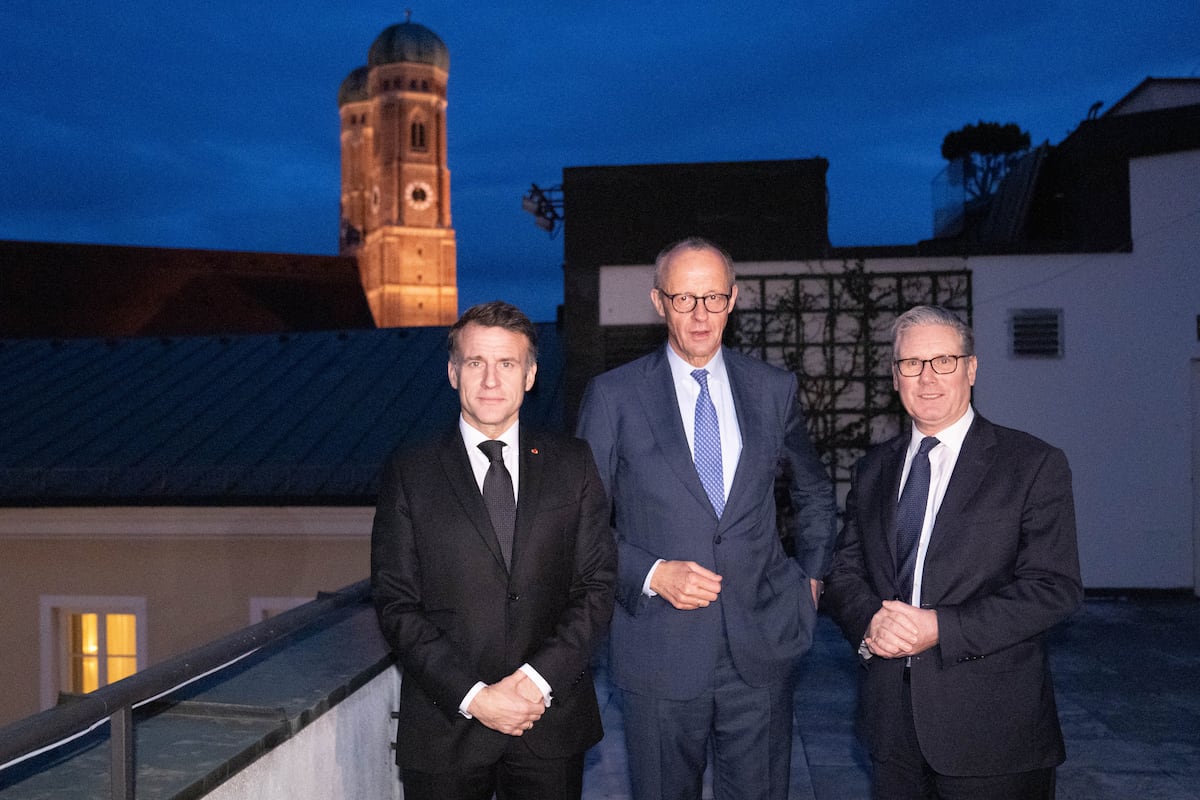
U.S. President Donald Trump’s erratic policies and his disdain for NATO have weakened transatlantic security bonds and eroded trust in the credibility of the U.S. nuclear umbrella over Europe.
That is why the German government, and particularly the newly created National Security Council, started early in assessing options for a credible European nuclear deterrence mechanism in addition to the U.S. nuclear umbrella, as long as it holds.
As Berlin weighs next steps, here is an overview of the various channels through which the conversation about nuclear weapons — namely those of France and the United Kingdom — is progressing.
Firstly, the U.K.-France nuclear talks, which have been ongoing since 2010, were taken to a new level with the “Northwood Declaration” of July 2025. The communiqué put a “coordination” of both nations’ nuclear forces on the table for the first time.
Secondly, in October 2024, the defense ministers of Germany and the U.K. agreed on a German-British defense cooperation framework, the “Trinity House Agreement,” which was also intended to cover nuclear issues. However, this dialogue is still at a rudimentary stage.
Thirdly, Chancellor Merz and President Macron have agreed on a Franco-German nuclear dialogue. A high-level Steering Group is to conduct regular exchanges on all nuclear-related issues and develop opportunities for cooperation.
The fourth dialogue to start soon is based on the proposal of Friedrich Merz and Emmanuel Macron to extend the bilateral dialogue to other European NATO member states. Poland, Denmark, Sweden, the Netherlands, Belgium and Greece have already expressed interest. Should the U.K., Europe’s second nuclear power, join this initiative, it would result in an all-encompassing European nuclear dialogue modeled on the NATO Nuclear Planning Group.
These processes are only just beginning, and the initial focus is on developing a common understanding and formulating shared objectives within the various formats. In this regard, the British-French dialogue differs from the other formats because here two nuclear powers can discuss their respective nuclear doctrines on an equal footing, exchange nuclear-related data, or coordinate their operational principles and targeting.
The German-British, German-French and multinational dialogues, meanwhile, put their initial focus on the exchange of information and the building of trust between nuclear and non-nuclear states. Such trust is essential when it comes to matters such as the sharing of sensitive data or documents.
The conversations aren’t merely a dialogue for dialogue’s sake, but rather the development of a credible European deterrent based on the capabilities of France and the U.K. and – for as long as the U.S. so wishes – remaining linked to the American nuclear umbrella.
German considerations in that direction envision the following steps:
To begin with, the German-British and German-French dialogues can only be a starting point. Both formats must be expanded to include other European states as soon as possible. Only in this way can potential political reservations be overcome regarding the predominance of a Paris-London-Berlin connection as well as France’s history of a strictly national nuclear policy. Furthermore, representatives from the U.S. and Canada should always be invited to this expanded dialogue to underpin the transatlantic link.
Moreover, the dialogue should initially focus on political issues – such as the willingness of nuclear states to make a nuclear security pledge to their non-nuclear allies. The U.K. has already done so within the framework of NATO’s “extended deterrence,” while France has consistently opposed this concept and intended its nuclear weapons solely for the protection of its own territory.
Most recently, however, President Emmanuel Macron has proposed an idea of “advanced deterrence” (dissuasion avancée), thereby cautiously moving toward extended deterrence, albeit without explicitly saying so.
Furthermore, political guidelines could be drawn up for consultations between nuclear powers and their non-nuclear allies in the event of an imminent nuclear strike, as has been the case within NATO since 1962 — the so called “Athens Guidelines.” This does not restrict the nuclear states’ sole right to decide, but gives the allies the assurance that, in the event of a strike, they will at least be heard.
Non-nuclear states can provide various forms of compensation in return for the nuclear protection afforded to them. These could, for example, take the form of direct financial contributions. In the case of Germany, the Research Service of the German Parliament had already recognized in May 2017 that such nuclear co-financing is legally possible.
Nevertheless, a European nuclear deterrent, however it is structured, also requires adequate conventional defense. Here, Germany, as Europe’s largest economic power, bears a special responsibility. France and the U.K. are equally called upon, as a division of labor between the nuclear-armed states, which are left to focus on strategic forces while the other allies ensure sufficient conventional forces, is not realistic.
This will require painful steps in London and Paris to establish new financial priorities.
Karl-Heinz Kamp was a special advisor in the German Ministry of Defense and is an associate fellow at the German Council on Foreign Relations .
美国总统唐纳德·特朗普反复无常的政策以及他对北约的蔑视削弱了跨大西洋安全纽带,并损害了人们对美国在欧洲的核保护伞的信任。
正因如此,德国政府,特别是新成立的国家安全委员会,很早就开始评估除了美国的核保护伞之外,建立可信的欧洲核威慑机制的各种方案(只要美国的核保护伞仍然存在)。
在柏林权衡下一步措施之际,以下概述了有关核武器的对话(特别是法国和英国的对话)正在通过的各种渠道进行的进展情况。
首先,自 2010 年以来一直在进行的英法核谈判,随着 2025 年 7 月的《诺斯伍德宣言》的发表,提升到了一个新的水平。该公报首次将两国核力量的“协调”提上了议程。
其次,2024年10月,德国和英国国防部长就德英防务合作框架——“三位一体协议”达成一致,该协议也旨在涵盖核问题。然而,这一对话仍处于起步阶段。
第三,默茨总理和马克龙总统已就法德核问题对话达成一致。一个高级别指导小组将定期就所有核相关问题进行交流,并探索合作机遇。
即将启动的第四次对话是基于弗里德里希·默茨和埃马纽埃尔·马克龙的提议,旨在将双边对话扩展到其他欧洲北约成员国。波兰、丹麦、瑞典、荷兰、比利时和希腊已表示有兴趣。如果欧洲第二大核大国英国也加入这一倡议,将形成一个以北约核计划小组为蓝本的、涵盖所有成员国的欧洲核对话机制。
这些进程才刚刚起步,初期重点在于在各种机制下达成共识并制定共同目标。在这方面,英法对话与其他机制有所不同,因为在英法对话中,两个核大国可以在平等的基础上讨论各自的核战略,交换核相关数据,或协调其作战原则和目标选择。
与此同时,德英对话、德法对话以及多边对话的初期重点是促进核国家与非核国家之间的信息交流和建立信任。这种信任在共享敏感数据或文件等问题上至关重要。
这些对话不仅仅是为了对话而对话,而是为了发展一种基于法国和英国能力的可信的欧洲威慑力量,并且——只要美国愿意——继续与美国的核保护伞保持联系。
德国在这方面的考虑设想了以下步骤:
首先,德英对话和德法对话只能是一个起点。这两种对话机制都必须尽快扩展到其他欧洲国家。只有这样,才能消除潜在的政治顾虑,例如巴黎-伦敦-柏林关系的主导地位以及法国长期以来奉行的严格的国家核政策。此外,应始终邀请美国和加拿大的代表参与这一扩大后的对话,以巩固跨大西洋联系。
此外,对话初期应聚焦政治议题,例如核国家是否愿意向其无核盟友做出核安全承诺。英国已在北约“延伸威慑”框架内做出此项承诺,而法国则一直反对这一概念,并坚持其核武器仅用于保护本国领土。
然而,最近埃马纽埃尔·马克龙总统提出了“先进威慑”(dissuasion avancée)的概念,从而谨慎地朝着延伸威慑的方向迈进,尽管他没有明确表示这一点。
此外,可以制定政治准则,供核大国与其无核盟友在即将遭受核打击时进行磋商,正如北约自1962年以来一直采用的“雅典准则”一样。这并非限制核国家拥有完全的决策权,而是让盟友确信,一旦发生打击,它们的意见至少会被听到。
无核国家可以提供各种形式的补偿,以换取其所获得的核保护。例如,这些补偿可以采取直接财政捐助的形式。以德国为例,德国联邦议院研究服务处早在2017年5月就已确认,这种核能共同出资在法律上是可行的。
然而,无论欧洲核威慑力量如何构建,都需要充足的常规防御。作为欧洲最大的经济体,德国肩负着特殊的责任。法国和英国也同样重要,因为在拥有核武器的国家之间进行分工,让它们专注于战略力量而其他盟国负责确保足够的常规力量,是不现实的。
这将需要伦敦和巴黎采取痛苦的措施来确立新的财政优先事项。
卡尔-海因茨·坎普曾任德国国防部特别顾问,现任德国外交关系委员会副研究员。