Here’s What A Sinister Looking Giant Black Pyramid Is Doing At An Abandoned Military Base一座外形诡异的巨型黑色金字塔出现在一座废弃的军事基地,它究竟在做什么?
It is a burial site of sorts, but you won't find mummies of dead pharaohs and their treasures there.
Updated Sep 19, 2018 10:09 PM EDT
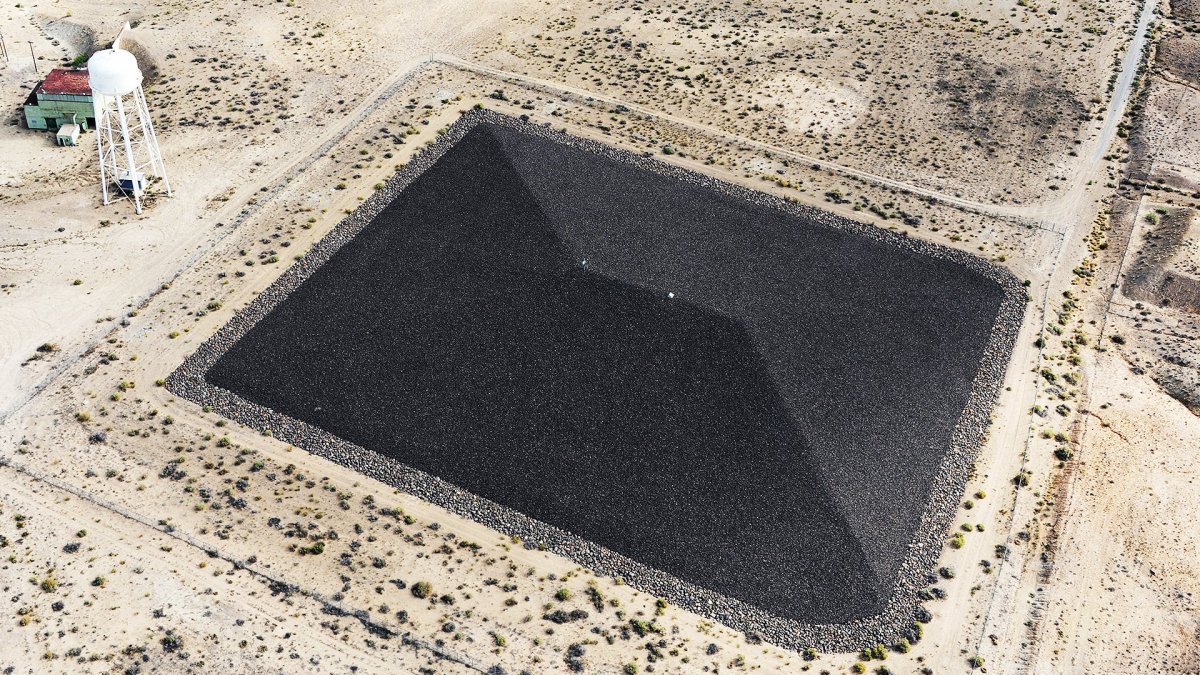
You see all types of crazy looking structures on and around military bases when perusing satellite imagery. But once in a while you find something that is just too bizarre to move on from without an explanation. Looking more like the evil lair of a comic book pharaoh brought back to life than something you would find on an ex-missile test range, the strange installation seen in the banner image above is a burial tomb, but of a different kind.
The peculiar site is situated on the western edge of the long defunct Green River Launch Complex in Utah and measures 530 feet by 450 feet—the Luxor Hotel is 600 feet by 600 feet for comparison—and covers five an d half acres. But the thing is that this imposing fixture isn’t even a structure— it’s a pile. What you are seeing in the image above is a giant, contoured mound of radioactive waste.
Originally a mill on the site was operated by Union Carbide from 1957 to 1961—at the height of the atomic age. During just three years of operation as a uranium upgrading facility it produced 183,000 tons of ore and generated an estimated 114,000 cubic yards of radioactive tailings, a predominantly sandy material, that covered about 9 acres to an average depth of 7 feet.
The mill remained for decades after its closure before the State of Utah took over the site in 1988. The DOE then stepped in to manage the disposable of the toxic tailings on the site in 1989. The mound also contains radioactive waste from 17 other sites from the region as well. Dubbed the Green River Uranium Disposal Cell, it is ringed by chain link fencing with signs everywhere warning of the toxic danger of its contents.
The ominous waste pile site just off a major highway that bisects the abandoned launch site in half. To the west is the Green River. , Google Earth
Geologicnow.com , an absolutely fascinating site, has an awesome little article about what exactly this thing is, and apparently it has plenty of radioactive cousins splattered around the U.S. that were also born out of the Cold War:
Though the underground nuclear catacombs for America’s spent nuclear fuel are yet to be created, radioactive tombs of America’s various nuclear programs already exist today, with more to come. Most are repositories for the remains of uranium mills, processing facilities, weapons plants, and contaminated tailings, bulldozed into engineered isolation mounds designed to limit contact with their surroundings for hundreds of years. There are dozens of these mounds, across the country from Pennsylvania to Arizona, built mostly by the Department of Energy, and maintained by their Legacy Management office. These disposal mounds are generally low, rectilinear piles with flat, sloping tops – terrestrial umbrellas, keeping moisture out of the pile as much as possible. In arid environments, the outer layer is a coating of coarse riprap rock, a dead space where nothing grows, where no soil forms, and no roots take hold that could pierce the radioactive core. This tough skin allows occasional rains to pass through it to the next layer, a low-permeability clayey mixture a few feet thick. Water drains off to the side of the pile through channels at the base held in place with more layers of crushed stone. These disposal cells are located primarily in the Southwest, where natural uranium deposits were found and exploited. Some of these former uranium mills were set up secretly for the Manhattan Project. Most started in the 1950s, and many operated until the 1990s. Presently, only one conventional uranium mill is operating in the USA, the White Mesa Mill in Blanding, Utah, in the heart of the uranium district and Indian country. However, that may change as the nation shifts towards more self-reliant energy sources. Each disposal cell covers many acres and as much as half a square mile. They resemble ancient pyramids or relics from a geometrical mound-building culture, like archeological forms made for the future. They represent the legacy of the most advanced technology of a global culture: the creation of the atomic bomb, the ability to destroy the world at the push of a button. They are part of the nationwide network of industrial sites created to extract, process, manufacture, and engineer nuclear fuel for reactors and weapons–a continent-wide landscape machine to concentrate a naturally occurring trace material into such compressed atomic density that it explodes with galactic energy. These mound sites, byproducts of this effort, are the end of the line, meant to be unconnected to the rest of the world, like deadly anachronistic time capsules. These are the most negative of spaces, non places, meant to stay inert and isolated for as much of forever as possible, kept from the present, but destined for the future.
Though the underground nuclear catacombs for America’s spent nuclear fuel are yet to be created, radioactive tombs of America’s various nuclear programs already exist today, with more to come. Most are repositories for the remains of uranium mills, processing facilities, weapons plants, and contaminated tailings, bulldozed into engineered isolation mounds designed to limit contact with their surroundings for hundreds of years. There are dozens of these mounds, across the country from Pennsylvania to Arizona, built mostly by the Department of Energy, and maintained by their Legacy Management office.
These disposal mounds are generally low, rectilinear piles with flat, sloping tops – terrestrial umbrellas, keeping moisture out of the pile as much as possible. In arid environments, the outer layer is a coating of coarse riprap rock, a dead space where nothing grows, where no soil forms, and no roots take hold that could pierce the radioactive core. This tough skin allows occasional rains to pass through it to the next layer, a low-permeability clayey mixture a few feet thick. Water drains off to the side of the pile through channels at the base held in place with more layers of crushed stone.
These disposal cells are located primarily in the Southwest, where natural uranium deposits were found and exploited. Some of these former uranium mills were set up secretly for the Manhattan Project. Most started in the 1950s, and many operated until the 1990s. Presently, only one conventional uranium mill is operating in the USA, the White Mesa Mill in Blanding, Utah, in the heart of the uranium district and Indian country. However, that may change as the nation shifts towards more self-reliant energy sources.
Each disposal cell covers many acres and as much as half a square mile. They resemble ancient pyramids or relics from a geometrical mound-building culture, like archeological forms made for the future. They represent the legacy of the most advanced technology of a global culture: the creation of the atomic bomb, the ability to destroy the world at the push of a button. They are part of the nationwide network of industrial sites created to extract, process, manufacture, and engineer nuclear fuel for reactors and weapons–a continent-wide landscape machine to concentrate a naturally occurring trace material into such compressed atomic density that it explodes with galactic energy.
These mound sites, byproducts of this effort, are the end of the line, meant to be unconnected to the rest of the world, like deadly anachronistic time capsules. These are the most negative of spaces, non places, meant to stay inert and isolated for as much of forever as possible, kept from the present, but destined for the future.
A fact sheet that is publicly available online about the site includes details about its particular construction:
The cell was excavated to bedrock and was lined with 6 feet of low-permeability soil. Most of the contaminated materials are below grade. A clay-rich soil layer placed over the contaminated materials extends to the edge of the cell below grade and serves as a lowpermeability radon barrier. Above grade, the radon barrier is covered by a layer of rock (riprap) placed on granular bedding material. The cell design promotes rapid runoff of precipitation to minimize leachate. The walls around the edge of the disposal cell are lined with riprap and bedding material. A large riprap apron extends outward from the edge of the disposal cell for about 20 feet. Precipitation flows down the 20-percent side slopes into the surrounding rock apron. The disposal cell was located and designed to prevent or minimize erosion from storm water. The cell is located 75 feet above the Brown’s Wash floodplain. Existing gullies were filled and regraded during cell construction, and all disturbed grass surrounding the disposal cell were reseeded with native vegetation.
The document continues, stating:
The disposal cell at Green River is designed and constructed to last for 200 to 1,000 years. However, the general license has no expiration date, and DOE understands that its responsibility for the safety and integrity of the Green River site will last indefinitely.
So like the pyramids of Egypt, these are also eternal resting places with the contents within not ever intended to be moved or molested. An indestructible reminder of a very dark time in mankind’s past. One also has to wonder what toxic impact this waste had on its surrounds before it was organized into a neat and isolated, albeit huge pile?
Tuba City Uranium Disposal Cell in Arizona, one of number of uranium tailings disposal sites in various configurations scattered around the country. Some sites have entire mills buried beneath them along with their tailings. , CFLUI
As for the Green River Launch Complex, the largely abandoned site may ring a bell as it was ridiculously claimed by Popular Mechanics in 1997 that operations at Area 51 had packed up and moved there, as well as to Dugway Proving ground that lies about 200 miles to the Northwest. This was totally unsubstantiated and incorrect, but the myth propagated for years and drew attention to the crumbling base.
Now, even as the base’s once important Cold War infrastructure continues to be demolished or just disintegrate with the passage of time, that huge charcoal colored pile of atomic waste will sit begrudgingly for ages.
Some things mankind simply can’t reverse and the Green River Uranium Disposal Cell is a stark and ominous reminder of that.
Contact the author: Tyler@thedrive.com
Comments couldn’t be loaded. Please refresh the page.
更新于美国东部时间2018年9月19日晚上10:09
浏览卫星图像时,你会看到军事基地内外各种奇形怪状的建筑。但偶尔也会遇到一些实在太过诡异,让人不禁想要探究一番。与其说像导弹试验场上的设施,不如说更像是漫画中复活的法老的邪恶巢穴。上图所示的这座奇特建筑是一座墓穴,但又与一般的墓穴截然不同。
这个奇特的地点位于犹他州早已废弃的绿河发射场西侧边缘,长530英尺,宽450英尺——相比之下,卢克索酒店的面积为600英尺乘600英尺——占地五英亩半。但奇怪的是,这个引人注目的“建筑”甚至算不上什么建筑物,而是一堆废料。你在上面的图片中看到的,是一个巨大的、轮廓分明的放射性废料堆。
最初,该厂址上的选矿厂由联合碳化物公司于 1957 年至 1961 年运营——正值原子时代鼎盛时期。在作为铀提纯设施运营的短短三年内,它生产了 183,000 吨矿石,并产生了约 114,000 立方码的放射性尾矿,这些尾矿主要为沙质材料,覆盖了约 9 英亩的土地,平均深度为 7 英尺。
这家铀矿厂关闭后,场地闲置了数十年,直到1988年犹他州政府接管。1989年,美国能源部介入,负责处理场地上的有毒尾矿。该堆体还包含来自该地区其他17个地点的放射性废物。该堆体被称为“绿河铀矿处置库”,周围环绕着铁丝网,到处都有警示牌,提醒人们注意其中存在的有毒危险。
一条主要公路旁,横穿废弃发射场的废弃物堆放场显得格外阴森。西边是格林河。(谷歌地球)
Geologicnow.com 是一个非常有趣的网站,上面有一篇很棒的小文章,介绍了这种物质到底是什么,而且显然它在美国各地还有很多类似的放射性物质,这些物质也是冷战时期产生的:
尽管美国尚未建造用于存放乏核燃料的地下核掩体,但美国各种核计划的放射性废料堆如今已然存在,而且未来还会有更多。这些废料堆大多是铀矿厂、加工厂、武器工厂和受污染尾矿的处置库,它们被推土机夷为平地,形成经过精心设计的隔离堆,旨在数百年内与外界环境隔绝。从宾夕法尼亚州到亚利桑那州,全国各地有数十个这样的废料堆,它们大多由能源部建造,并由其遗留管理办公室负责维护。这些处置堆通常是低矮的矩形堆,顶部平坦倾斜,如同陆地上的雨伞,尽可能地防止水分进入堆体内部。在干旱地区,堆体外层覆盖着一层粗糙的碎石,形成一个寸草不生的死寂空间,这里不会形成土壤,植物的根系也无法扎入,从而避免穿透放射性核心。这层坚韧的表层允许偶尔的雨水渗入下一层,下一层是几英尺厚的低渗透性粘土混合物。水通过底部由更多碎石层固定的沟渠排到堆体侧面。这些处置单元主要位于美国西南部,那里曾发现并开采过天然铀矿。其中一些曾经的铀矿加工厂是为曼哈顿计划秘密建造的。大多数建于20世纪50年代,许多一直运营到20世纪90年代。目前,美国只有一家传统的铀矿加工厂仍在运营,即位于犹他州布兰丁的白梅萨工厂,它位于铀矿区和印第安人保留地的中心地带。然而,随着美国转向更加自给自足的能源,这种情况可能会发生改变。每个处置单元占地数英亩,面积可达半平方英里。它们形似古代金字塔或几何形土墩建造文化的遗迹,如同为未来而建的考古遗迹。它们代表着全球最先进技术的遗产:原子弹的制造,只需轻轻一按按钮就能毁灭世界的能力。它们是遍布全国的工业设施网络的一部分,这些设施旨在提取、加工、制造和设计用于反应堆和武器的核燃料——这是一台横跨大陆的巨型机器,将天然存在的微量物质浓缩成极高的原子密度,使其爆炸时释放出惊人的能量。这些土堆遗址,作为这项工程的副产品,是终点,注定与世隔绝,如同致命的、不合时宜的时间胶囊。它们是最为消极的空间,非场所,旨在尽可能永远保持静止和孤立,与现在隔绝,却注定走向未来。
尽管美国尚未建造用于存放乏核燃料的地下核废料库,但美国各种核计划的放射性废料堆如今已然存在,而且未来还会有更多。这些废料堆大多是铀矿厂、加工厂、武器工厂和受污染尾矿的存放地,它们被推土机夷为平地,形成经过精心设计的隔离土堆,旨在数百年内与外界环境隔绝。从宾夕法尼亚州到亚利桑那州,全国各地有数十个这样的土堆,它们大多由能源部建造,并由其遗留问题管理办公室负责维护。
这些处置堆通常是低矮的矩形堆,顶部平坦倾斜,如同陆地上的雨伞,尽可能地防止水分渗入堆体。在干旱环境中,最外层是一层粗糙的碎石,形成一个死层,寸草不生,土壤无法形成,植物根系也无法扎根穿透放射性核心。这层坚韧的表层允许偶尔的雨水渗入下一层,即几英尺厚的低渗透性粘土混合物。水通过堆体底部由更多碎石层固定的沟槽排到侧面。
这些铀矿处置设施主要位于美国西南部,那里曾发现并开采过天然铀矿。其中一些铀矿加工厂是为曼哈顿计划秘密建造的。大多数铀矿加工厂始建于20世纪50年代,许多一直运营到90年代。目前,美国仅剩一家仍在运营的传统铀矿加工厂,即位于犹他州布兰丁的白梅萨铀矿加工厂,该厂地处铀矿区和印第安人保留地的中心地带。然而,随着美国向更加自给自足的能源转型,这种情况可能会发生改变。
每个处置单元占地数英亩,面积可达半平方英里。它们形似古代金字塔或几何形土墩建造文化的遗迹,如同为未来而建的考古遗址。它们代表着全球最先进技术的遗产:原子弹的制造,只需轻按按钮即可毁灭世界的能力。它们是遍布全国的工业设施网络的一部分,该网络旨在提取、加工、制造和设计用于反应堆和武器的核燃料——这是一台横跨大陆的巨型机器,将天然存在的微量物质浓缩成极高的原子密度,使其爆炸时释放出惊人的能量。
这些土墩遗址,作为这项工程的副产品,是终点,旨在与世隔绝,如同致命的、不合时宜的时间胶囊。它们是最为消极的空间,非场所,旨在尽可能永远保持静止和孤立,与当下隔绝,却注定走向未来。
网上公开的一份关于该遗址的情况说明书包含了有关其具体构造的详细信息:
该处置池开挖至基岩,并衬砌了6英尺厚的低渗透性土壤。大部分污染材料位于地面以下。覆盖在污染材料上的富含粘土的土壤层延伸至地面以下的处置池边缘,形成低渗透性的氡气屏障。地面以上,氡气屏障上覆盖着一层碎石(护坡石),碎石下方铺设有颗粒状垫层材料。处置池的设计旨在促进雨水快速流走,从而最大限度地减少渗滤液的产生。处置池边缘的墙壁衬有护坡石和垫层材料。一个大型护坡护堤从处置池边缘向外延伸约20英尺。雨水沿着20%的边坡流入周围的护堤石中。处置池的选址和设计旨在防止或最大限度地减少雨水侵蚀。该处置池位于布朗斯沃什河漫滩上方75英尺处。在填埋场建设过程中,现有的沟壑被填平并重新平整,填埋场周围所有被扰动的草地都重新播种了本地植物。
文件继续写道:
格林河处置库的设计和建造寿命为200至1000年。然而,通用许可证没有到期日,美国能源部也明白,其对格林河处置库的安全和完整性的责任将无限期地持续下去。
就像埃及金字塔一样,这些也是永恒的安息之地,其中的物品原本就不应该被移动或触碰。它们是人类历史上那段黑暗时期的永恒见证。人们不禁要问,在这些废弃物被整理成如此整齐而孤立的巨大堆放之前,它们对周围环境究竟造成了怎样的毒害?
位于亚利桑那州的图巴市铀矿处置场是遍布全国的众多不同结构的铀尾矿处置场之一。有些处置场甚至将整个选矿厂及其尾矿一起埋在地下。
至于绿河发射场,这个基本废弃的基地或许会让你想起1997年《大众机械》杂志荒谬地宣称51区的行动已经转移到那里,以及位于西北方向约200英里处的达格威试验场。这种说法完全没有根据,而且是错误的,但这个谣言却流传多年,并让这座破败的基地受到了关注。
如今,即使该基地曾经重要的冷战基础设施仍在被拆除或随着时间的推移而逐渐瓦解,那堆巨大的炭黑色原子废料也将默默地矗立多年。
有些事情人类是无法逆转的,格林河铀矿处置库就是一个鲜明而令人不安的例证。
联系作者:Tyler@thedrive.com
评论加载失败,请刷新页面。