Area 51 Has A Huge New Hangar Facility That Points To A Drone Swarm Future51区新建了一个巨大的机库设施,预示着无人机集群的未来。
The Air Force is accelerating its advanced combat drone development efforts and the facility's unique attributes seem perfect for supporting them.
Updated Nov 27, 2020 6:25 PM EST
The Air Force’s clandestine flight test center deep inside the Nevada Test and Training Range , known as Area 51 or Groom Lake , among more colorful nicknames, continues to grow as it approaches its seventh decade of operations . Constant construction has grown the remote facility dramatically since the turn of the millennium, including the addition of a massive and still mysterious hangar built at the base’s remote southern end. Now, an even larger extension to an existing hangar facility that is quite peculiar in nature points to the very real possibility that the age of large swarms of unmanned combat air vehicles (UCAVs) has finally arrived.
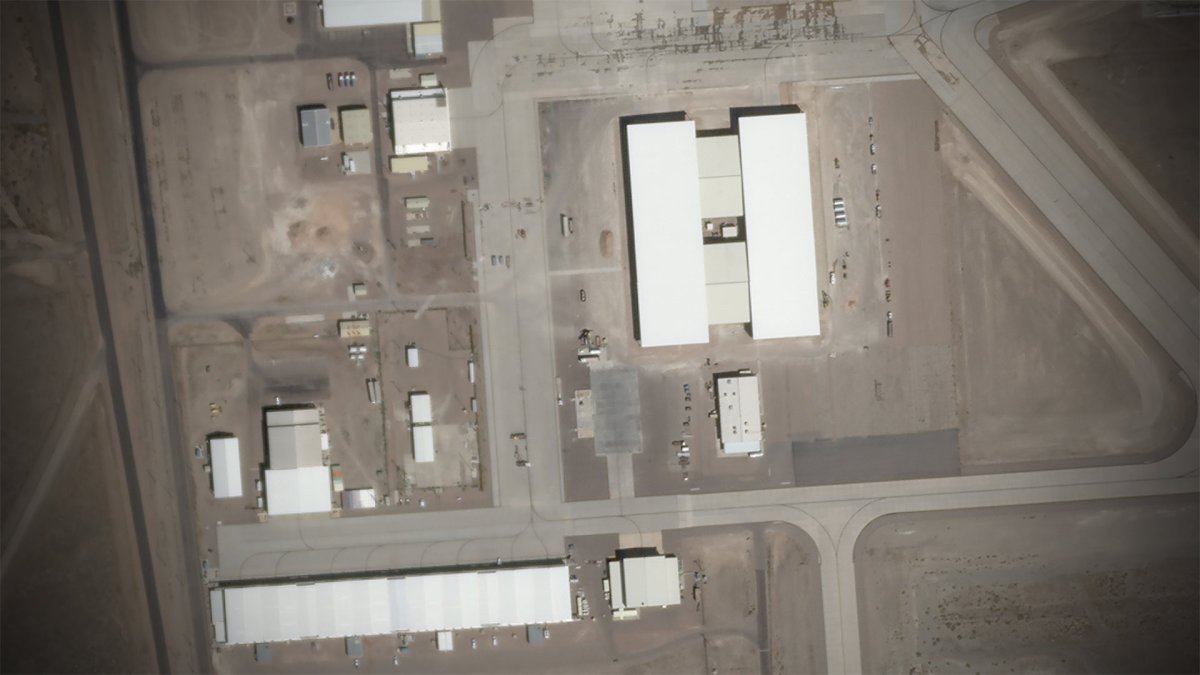
For around a year, construction has been underway in a prominent section of the southern ramp area at the base, near where the original A-12 Oxcart hangars still stand. A quartet of more modern hangars that are divided into two separate buildings, with each bay measuring roughly 90 feet wide, and are understood to be known as hangars 20-23, has been the recipient of a highly curious series of modifications.
The hangars have stood for decades and are thought to largely serve Air Combat Command tactical aircraft programs, including supporting F-117 testing for many years. At first, it looked like they were about to be torn down. This didn’t end up being the case. Instead, massive enclosures were built over the aprons that flank the east and west sides of the original drive-through hangars.
From left to right: February 2020, July 2020, September 2020. , PHOTO © 2020 PLANET LABS INC. ALL RIGHTS RESERVED. REPRINTED BY PERMISSION.
In addition, the soft structure located just to the southwest of hangars 20-23 that has been badly torn for years and was eventually patched, has now been totally demolished. Interestingly, it appears that the soft structure actually concealed a unique-looking building inside of it, before it was torn down.
The same area circa 2016. , Google Earth
The near-finished product seen in September 2020., PHOTO © 2020 PLANET LABS INC. ALL RIGHTS RESERVED. REPRINTED BY PERMISSION.
The unique additions to hangars 20-23 create a combined hangar facility that is the largest of any on base by a substantial margin, measuring roughly 400 by 500 feet, overall. The additions have more in common with the ‘scoot and hide’ shelter extensions built onto the arm-de-arm hangar located between the ramp and the runway in the mid-2000s than they do with a traditional hangar. They appear to be more of a covered area portico-like addition than anything else, with the existing central hangars still acting as they always did.
The ‘scoot and hit’ extensions built over the arm-de-arm shelter that sits between the apron and the runway at Groom Lake., Google Earth
More views of this new add-on facility and its shed-like nature came from Gabriel Zeifman’s photos that he took while circumnavigating the Nevada Test and Training Range (NTTR) with air traffic control’s approval on a number of occasions :
A shot by private pilot Gabriel Zeifman of Area 51 included early stages of construction of the extensions to Hangar 20-23, Gabrial Zeifman
Another shot months later shows the relatively massive covered area taking shape. , Gabrial Zeifman
So, what is this somewhat peculiar addition all about? For hangars that easily fit one F-117 each with plenty of room to spare, having a huge covered structure built onto them doesn’t make a lot of sense, at least not for their original purpose, and especially on both sides of what are already drive-through hangars. As such, it seems that this revamped facility is not meant for a small number of large tactical aircraft, but instead, it seems to have been remodeled to support a fleet of smaller tactical aircraft, ones that are designed to fly together in a collective swarm on missions.
What’s the justification behind this conjecture? Well, it solves a number of problems with scaling up testing of large swarms of unmanned combat air vehicles. First off, servicing and then staging the aircraft for a mission requires a lot of space and would benefit more by a production line-like arrangement than a traditional hangar and apron layout. The modifications are fairly ingenious as the arrangement would allow for a large group on drones to park outside of the view of satellites and out of the weather on one side, with the hangars in the center working as pass-through servicing bays for preparing them for another flight, and then moving them to the other side to await a launch en-masse on their next mission. Upon return, they would be parked on the other side once again and await servicing and staging for reuse. Just learning how to best stage, launch, and recover a large number of semi-autonomous jet-powered unmanned systems together will surely be a focus of any such program.
The notional concept behind this odd construction., PHOTO © 2020 PLANET LABS INC. ALL RIGHTS RESERVED. REPRINTED BY PERMISSION.
We believe, and sincerely hope, that advanced unmanned combat air vehicle (UCAV) testing has occurred for years under deep classification after the Air Force suddenly acted like the entire concept doesn’t even exist towards the end of the 2000s, a bizarre reality with huge implications you can read all about in this must-read feature of ours . In fact, it is even possible that a small pocket force of advanced UCAVs exists today in a semi-operational state. Regardless, the type of testing this revamped facility would support would likely be on a different scale.
It is highly likely that higher-end UCAVs that are the size of manned fighters or larger and possess extreme range and low-observability have been in testing for years or even a small pocket operational force exists, but this is less likely the case for large swarms of attritable unmanned systems. , Northrop Grumman
Testing of advanced networked UCAVs in groups of three or even six is one thing, what we are seeing here could potentially support much larger groups of lower-end, smaller UCAVs or drone surrogates, the likes of which have taken on a high profile recently. As such, the aircraft that would occupy this facility could be more about testing the concepts of networking, command and control, and experimental tactics and operating procedures related to large swarms than it would be about just the vehicles themselves. That being said, it is totally possible that those airframes could still represent a potential future production vehicle.
Boeing, Kratos, and certainly Lockheed are all working on so-called attritable UCAVs that cost millions each, not tens of millions, are highly modular, and are optionally expendable. Beyond Kratos’ XQ-58A Valkyrie , the company is known to have a number of classified programs underway that are of a similar in nature, but have to do with more advanced concepts and testing. You can read all about the future of attritable swarming drones here.
Kratos XQ-58A Valkyrie., USAF
Boeing’s loyal wingman drone that is currently being developed for the Royal Australian Air Force. A similar system is also being offered to the USAF, depending on their requirements. , Boeing
These jet-powered stealthy drones are smaller than their fighter-sized, high-end UCAV counterparts, and would be better suited for the airspace restrictions within ‘the box’ around Area 51 and within the greater NTTR. Many of the lessons learned from attritable UCAVs could be extrapolated over large swarms of those higher-end unmanned systems, as well. These types of drones are also the types that are being designed for the so-called loyal wingman role, in which a number of them are electronically ‘tethered’ via a semi-autonomous command-link interface to another manned aircraft. So, this concept of operations, which you can read all about here , could also be part of this advanced testing.
All this comes as the news that a demonstrator for the Air Force’s Next Generation Air Dominance (NGAD) program has flown. As we discussed in detail , NGAD is not a new fighter, but a family of systems that will leverage common networking and command and control architecture, as well as sensor concepts, to work as a team to dominate air battles of the future. Swarming UCAVs are absolutely going to be part of that, so a facility that can support that aspect of NGAD makes a lot of sense. In fact, the ‘demonstrator’ itself could be the Air Force’s first large UCAV swarm, not just one airplane, and the manufacturer of those drones would have leveraged the flying force’s new ‘e-Plane’ concept of rapid digital design and prototyping to migrate the concept from idea to iron on the ramp in record time.
Thanks to our colleagues Steve Trimble and Marcus Weisgerber , The War Zone’s long-standing assertion that the Air Force’s new B-21 Raider stealth bomber would work as a central C3 node for tactical aircraft , including networked swarms of UCAVs , was all but outright confirmed by the Air Force’s Chief of Staff. Once again, we are talking about an interconnected family of systems here.
Chief of Staff Brown also underlined that the NGAD demonstrator is more about how it was designed and built under the ‘e-Plane’ doctrine than it being an exquisite airframe (or airframes) itself. Regardless, with any UCAV type initiative, especially on the lower end, rapid evolutionary iterations of a design produced in small batches that use the same foundational networking and command and control architecture will be central to the effort. Once again, this fits perfectly with what we think this new facility at Area 51 will be used to support.
Considering how fast the rest of the world is moving forward on UCAVs and attritable unmanned air combat systems , not to mention the glaring limitations of traditional manned tactical aircraft when it comes to emerging peer-state threats in Asia, one would imagine that the USAF has finally put these programs into high gear. Once again, while advanced UCAVs have likely been tested for some time clandestinely, larger swarms of smaller and far more modular and affordable systems that are emerging today as a key future air superiority concept are less likely to have been.
Our assessment is that there is a strong possibility this major construction project indicates that this is about to change.
Contact the author: Tyler@thedrive.com
Comments couldn’t be loaded. Please refresh the page.
更新于美国东部时间2020年11月27日下午6:25。
美国空军位于内华达州试验训练靶场深处的秘密飞行测试中心,又称51区或格鲁姆湖(还有其他一些更形象的绰号),在其运行即将进入第七个十年之际,仍在不断扩张。自千禧年以来,持续不断的建设使这座偏远设施规模显著扩大,其中包括在基地偏远的南端建造了一座巨大且至今仍充满神秘色彩的机库。如今,一座规模更大的现有机库扩建工程正在进行,其结构也颇为奇特,这预示着大规模无人作战飞行器(UCAV)时代或许已经到来。
大约一年来,基地南坡道区域的一处显眼位置一直在进行施工,该位置靠近原A-12“牛车”攻击机库的所在地。四座较为现代化的机库(分为两栋独立的建筑,每个机库宽约90英尺,据了解编号为20至23号机库)正在进行一系列非常奇特的改造。
这些机库屹立数十年,据信主要用于空战司令部的战术飞机项目,包括多年来为F-117的测试提供支持。起初,它们似乎即将被拆除。但最终并未如此。取而代之的是,在原有贯通式机库东西两侧的停机坪上,建造了巨大的封闭式建筑。
从左至右:2020年2月、2020年7月、2020年9月。照片© 2020 PLANET LABS INC. 保留所有权利。经许可转载。
此外,位于20-23号机库西南侧的那座多年来破损严重、虽经修补但最终还是被彻底拆除的软体结构,如今也已不复存在。有趣的是,这座软体结构在被拆除之前,似乎内部隐藏着一座造型独特的建筑。
同一区域,约摄于2016年。(谷歌地球)
2020年9月拍摄的接近完成的产品。照片© 2020 PLANET LABS INC. 保留所有权利。经许可转载。
20-23号机库的独特扩建部分形成了一个综合机库设施,其规模远超基地内其他任何机库,总面积约为400英尺乘500英尺。这些扩建部分与其说是传统机库,不如说更像是2000年代中期在停机坪和跑道之间的武器库上建造的“快速撤离”式掩体。它们看起来更像是一个有顶的门廊式建筑,而原有的中央机库仍然像以前一样正常运作。
格鲁姆湖机场停机坪和跑道之间的扶手舱上方建造了“滑行即停”延伸段。(谷歌地球)
更多关于这座新建附属设施及其棚屋状外观的照片来自加布里埃尔·泽夫曼,他在多次获得空中交通管制部门批准后,绕内华达州试验和训练靶场 (NTTR) 飞行时拍摄的照片:
私人飞行员加布里埃尔·泽夫曼拍摄的51区照片显示,20-23号机库扩建工程的早期阶段已经完成。
几个月后拍摄的另一张照片显示,面积相对较大的覆盖区域已初具规模。——加布里埃尔·泽夫曼
那么,这个略显奇特的扩建究竟有何意义?对于每个机库都能轻松容纳一架F-117且空间绰绰有余的机库来说,在上面加盖一个巨大的室内建筑似乎不太合理,至少与它们最初的用途不符,尤其是在原本就是贯通式机库的两侧。因此,这个改造后的设施似乎并非为少量大型战术飞机而设计,而是为了支持一支小型战术飞机编队,这些飞机的设计用途是在执行任务时进行集群飞行。
这种推测的依据是什么?它解决了大规模无人作战飞行器集群测试中存在的诸多问题。首先,对飞行器进行维护和任务部署需要大量空间,相比传统的机库和停机坪布局,流水线式的布置更为高效。这种改进方案相当巧妙,它允许一大批无人机停放在一侧,避开卫星视线和恶劣天气;而位于中央的机库则作为便捷的维修区,用于为下一次飞行做准备,然后将无人机转移到另一侧,等待集体发射执行下一次任务。任务结束后,它们将再次停放在另一侧,等待维护和部署以备再次使用。任何此类项目都将重点关注如何高效地部署、发射和回收大量半自主喷气式无人系统。
这种奇特建筑背后的概念。照片 © 2020 PLANET LABS INC. 保留所有权利。经许可转载。
我们相信,并真诚地希望,在空军于2000年代末突然对“无人作战飞行器”(UCAV)这一概念视而不见之后,先进的UCAV测试已经在高度保密的情况下进行了多年。这一离奇的现实影响深远,您可以在我们这篇必读专题文章中了解详情。事实上,甚至有可能目前已经存在一支处于半作战状态的小型先进UCAV部队。无论如何,这座改造后的设施所支持的测试规模很可能与以往截然不同。
高端无人作战飞行器(UCAV)尺寸与有人驾驶战斗机相当甚至更大,拥有超远航程和低可探测性,很可能已经进行了多年的测试,甚至可能已经存在一支小型作战部队。但对于大规模的、可消耗的无人系统集群来说,这种情况发生的可能性较小。——诺斯罗普·格鲁曼公司
以三架甚至六架为一组测试先进的联网无人作战飞行器(UCAV)是一回事,而我们在这里看到的设施可能支持更大规模的低端小型UCAV或无人机替代机型,这类机型最近备受关注。因此,入驻该设施的飞行器可能更多地用于测试网络化、指挥控制以及与大型集群相关的实验性战术和操作程序,而不仅仅是飞行器本身。话虽如此,这些机身仍然完全有可能代表未来潜在的量产机型。
波音、克拉托斯以及洛克希德·马丁公司都在研发所谓的消耗型无人作战飞行器(UCAV),这些飞行器单价仅为数百万美元,而非数千万美元,具有高度模块化设计,并且可以根据需要进行替换。除了克拉托斯公司的XQ-58A“女武神”无人机之外,该公司还进行着一些性质类似的机密项目,但这些项目涉及更先进的概念和测试。您可以在这里阅读更多关于消耗型集群无人机未来发展的信息。
克拉托斯 XQ-58A 女武神,美国空军
波音公司目前正在为澳大利亚皇家空军开发一款名为“忠诚僚机”的无人机。根据美国空军的需求,波音公司也正在向其提供类似的系统。
这些喷气式隐形无人机比战斗机大小的高端无人作战飞机(UCAV)更小,更适合在51区周围“禁飞区”以及更大的NTTR区域内的空域限制下执行任务。从消耗型无人作战飞机中汲取的许多经验教训也可以推广到这些高端无人系统的大规模集群上。这类无人机也是为所谓的“忠诚僚机”角色而设计的,在这种角色中,多架无人机通过半自主指令链路接口与另一架有人驾驶飞机进行电子“系留”。因此,这种作战概念(您可以在这里阅读所有相关信息)也可能成为此次高级测试的一部分。
与此同时,美国空军下一代空中优势(NGAD)项目的一架验证机成功试飞。正如我们之前详细讨论过的,NGAD并非一款新型战斗机,而是一系列系统,它们将利用通用的网络和指挥控制架构以及传感器概念,协同作战,在未来的空战中占据主导地位。集群式无人作战飞机(UCAV)无疑将是其中的重要组成部分,因此,能够支持NGAD这一方面的设施意义重大。事实上,这架“验证机”本身可能就是美国空军首个大型UCAV集群,而不仅仅是一架飞机。这些无人机的制造商将利用空军最新的“电子飞机”(e-Plane)概念——即快速数字设计和原型制作——以创纪录的速度将概念从构想到最终的实物制造。
感谢我们的同事史蒂夫·特林布尔和马库斯·韦斯格伯,《战区》长期以来关于空军新型B-21“突袭者”隐形轰炸机将作为战术飞机(包括联网的无人作战飞机集群)的中央指挥、控制和通信(C3)节点的说法,几乎得到了空军参谋长的直接证实。我们再次强调,这里讨论的是一个相互关联的系统家族。
布朗参谋长还强调,NGAD演示机的重点在于其如何根据“电子飞机”理论进行设计和建造,而非其本身是否拥有精良的机身。无论如何,对于任何无人作战飞行器(UCAV)项目,尤其是在低端项目阶段,快速迭代开发基于相同基础网络和指挥控制架构的小批量产品将是关键所在。这一点与我们认为51区新设施将要支持的目标完美契合。
考虑到世界其他地区在无人作战飞机(UCAV)和消耗型无人空中作战系统方面进展神速,更不用说传统有人驾驶战术飞机在应对亚洲新兴的势均力敌对手威胁时所存在的明显局限性,人们或许会认为美国空军终于已将这些项目推向了高潮。然而,尽管先进的无人作战飞机可能已经秘密测试了一段时间,但如今作为未来空中优势关键概念而兴起的、规模更大、模块化程度更高、成本更低的系统集群,却不太可能进行过秘密测试。
我们评估认为,这项大型建设项目极有可能预示着这种情况即将改变。
联系作者:Tyler@thedrive.com
评论加载失败,请刷新页面。