War-weary Ukrainian troops doubt proposed pact will bring real peace饱受战争蹂躏的乌克兰军队怀疑拟议的协议能否带来真正的和平。
Amid peace talks, troops near the front believe that Russia remains determined to conquer Ukraine — either now, or with a fresh army in a few years' time.
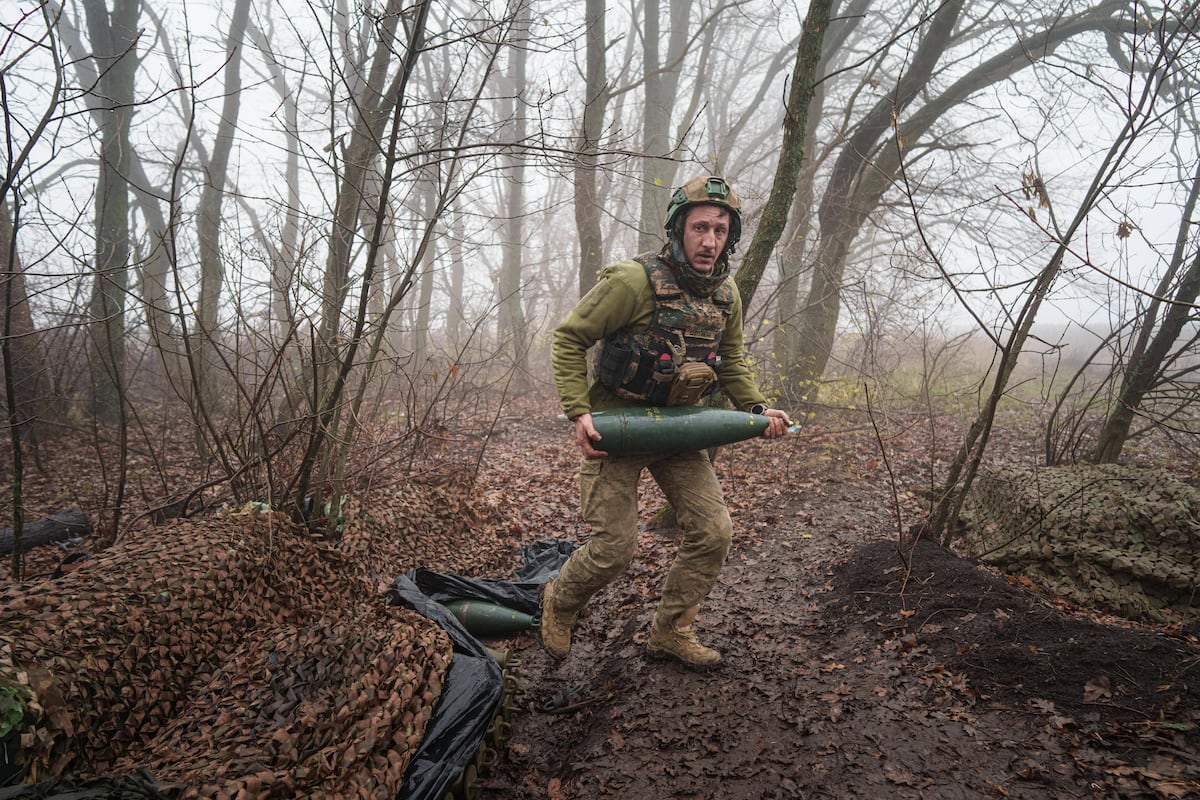
Moving between damp basements and muddy dugouts to fend off constant Russian attacks in the nearly 4-year-old war, exhausted Ukrainian soldiers say their motivation is fortified by knowing they’re fighting for higher cause: the defense of their homeland.
But as negotiators try to hammer out a peace deal, the troops also believe that Russia remains determined to conquer Ukraine — either now, or with a fresh army in a few years’ time — no matter what kind of agreement is reached.
And they also say Kyiv must maintain a sizable military to protect the now-800-mile (nearly 1,300-kilometer) front line.
“The Armed Forces of Ukraine are now the main barrier between peaceful civilian life of Ukrainians and our bad neighbor,” said a 40-year-old artillery gunner who spoke to The Associated Press near the border between the Dnipropetrovsk and Donetsk regions. He identified himself only by his call sign of ”Kelt," in keeping with military protocol, and on condition his exact location is not revealed.
The soldiers expressed strong doubts that Moscow can be trusted to abide by any peace deal. Without substantial security guarantees, such as NATO membership for Ukraine, they and military analysts believe a new Russian invasion with fresh troops and equipment is inevitable.
From a dark, mud-walled trench, where he was sheltering to avoid buzzing enemy drones, Kelt fears any peace will be short-lived.
“This truce will be short-term, to restore Russia’s forces — for some three or five years — and they will come back,” said the former furniture salesman from Kyiv as the sound of booming artillery reverberated around him.
Serhii Filimonov, commander of the Da Vinci Wolves Battalion, in an operations room near the front line in eastern Ukraine, Nov. 27, 2025. (Evgeniy Maloletka/AP)
Serhii Filimonov, the commander of the Da Vinci Wolves battalion, worried that a deal would give Russia everything it needed to attack again.
“I think it would be nice for the Russians -- to end the war, remove the sanctions, prepare for a new war and attack again,” he said. “I don’t believe there can be peace before Russia is destroyed, or at least the leadership is changed.”
Filimonov described how Russian troops had briefly entered the eastern town of Pokrovsk, a key logistics hub in the Donetsk region, but were pushed out. His brigade had managed to hold its stretch of the defensive line but were often let down by neighboring units filled with inexperienced recruits.
The Kremlin on Monday boasted that Russian troops captured the city after more than a year of fighting, but Ukrainian President Volodymyr Zelenskyy said in Paris that fighting was still ongoing.
A major breakthrough by Russian forces will depend on Ukraine’s ability to increase and sustain its troop numbers, said American military analyst and academic Rob Lee.
“Ukraine lacks manpower, lacks reserves,” he said. “All it takes is for one Ukrainian brigade to really struggle, and then Russia can advance.”
Taras Chmut, a Ukrainian military expert and fundraiser, told public broadcaster Suspilne on Friday that many battalions on the front are made up of only 20 fighters, instead of the usual 400-800.
Even though Ukraine may be mobilizing up to 30,000 recruits per month, many of them find a way out of serving or prove to be unfit to replace front-line troops.
Nevertheless, Ukrainian forces are managing to hold their ground in places like Pokrovsk, as well as in Kupiansk and Vovchansk in the Kharkiv region — two sites on the front that Russia has been trying to capture for over a year, said Yurii Fedorenko commander of the Achilles UAV Brigade that is fighting in the area.
A medic of Da Vinci Wolves Battalion treats a Ukrainian soldier injured during fighting with Russian forces, Nov. 28, 2025. (Evgeniy Maloletka/AP)
Russia has poured tens of thousands of soldiers at the towns, he said, noting that its failure to capture them “testifies to the high motivation and resilience of the Ukrainian army.”
Russian President Vladimir Putin said last week the fighting won’t stop unless Ukraine withdraws troops from the regions of Donetsk, Luhansk, Zaporizhzhia and Kherson — the four provinces Moscow illegally annexed in September 2022. Russian troops occupy only half of Zaporizhzhia and Kherson, and two-thirds of Donetsk.
The draft of a U.S.-Russia peace plan stipulated that Ukraine’s army be limited and that Kyiv’s forces must effectively withdraw from the rest of the Donetsk region. Zelenskyy has said since then that a subsequently revised version could be “workable,” but it’s unclear what will be in the final document.
Lee, who regularly visits the front, said Russia is advancing at a faster pace in 2025 than the previous year, but it is not a given that Moscow would capture the remaining third of the Donetsk region in 2026.
“Wherever Russia advances, Ukraine kind of prioritizes defenses (and) they can hold for a long time, but (then) Russia advanced in other directions,” Lee said, describing Moscow’s progress through Donetsk by simultaneously pushing in multiple directions.
From his muddy trench, Kelt ridiculed the proposal to reduce the size of Ukraine’s military, saying it was tantamount to making it easier for Russia “to kill you” later rather than now.
But sustaining an army of Ukraine’s current size of just over 1 million would be nearly impossible without continued Western support. Since the war began in 2022, Ukraine has spent almost all its tax revenue on feeding, clothing, housing and arming its military. The rest of its expenditures — for health care, social programs, education, pensions and energy — have been financed by Western grants and loans.
The European Union allocated $50 billion in aid from 2024 to 2027 as part of the Ukraine Facility Program, but Kyiv will need $83.4 billion for the military and $52 billion for the rest of the state expenditures for 2026 and 2027, said Glib Buriak, associate professor of economics at the Ukrainian-American Concordia University.
Ukraine’s future finances — including its ability to maintain an army — depends on what the peace plan includes regarding Russia’s frozen assets, said Buriak, noting the risk of a drop in aid if the war ends.
“How they will be managed will determine Ukraine’s financial situation over the coming years,” he said.
Yehor Konovalov contributed reporting.
在这场持续近 4 年的战争中,疲惫不堪的乌克兰士兵在潮湿的地下室和泥泞的掩体之间辗转,抵御着俄罗斯的不断进攻。他们表示,知道自己是在为更高的事业而战——保卫祖国——这更加坚定了他们的战斗意志。
但随着谈判人员努力敲定和平协议,士兵们也认为,无论达成何种协议,俄罗斯仍然决心征服乌克兰——无论是现在,还是几年后用一支新军队。
他们还表示,基辅必须维持一支规模可观的军队,以保护目前长达 800 英里(近 1300 公里)的前线。
“乌克兰武装部队现在是乌克兰人民和平生活与我们那个恶劣邻国之间的主要屏障,”一位40岁的炮兵在第聂伯罗彼得罗夫斯克州和顿涅茨克州交界处附近接受美联社采访时说道。按照军方规定,他只透露了自己的呼号“凯尔特”,并要求不透露其确切位置。
士兵们强烈怀疑莫斯科是否会遵守任何和平协议。他们和军事分析人士认为,如果没有实质性的安全保障,例如乌克兰加入北约,俄罗斯将携新部队和新装备再次入侵乌克兰将不可避免。
凯尔特躲在一条黑暗的泥墙战壕里,以躲避嗡嗡作响的敌方无人机,他担心任何和平都将是短暂的。
“这次停火是短期的,目的是恢复俄罗斯的军队——大概三到五年——然后他们就会回来,”这位来自基辅的前家具推销员说道,此时隆隆的炮声在他周围回荡。
2025年11月27日,达芬奇狼营指挥官谢尔盖·菲利莫诺夫在乌克兰东部前线附近的一间作战室里。(叶夫根尼·马洛列特卡/美联社)
“达芬奇之狼”营指挥官谢尔盖·菲利莫诺夫担心,这项协议会让俄罗斯获得再次发动进攻所需的一切。
他说:“我认为对俄罗斯人来说,结束战争、解除制裁、准备发动新战争并再次进攻,会是一件好事。我不认为在俄罗斯被摧毁,或者至少其领导层更迭之前,能够实现和平。”
菲利莫诺夫描述了俄军如何短暂进入顿涅茨克地区重要的后勤枢纽——东部城镇波克罗夫斯克,但随后被击退。他的旅设法守住了防线的一部分,但经常被邻近部队拖后腿,因为邻近部队大多是缺乏经验的新兵。
克里姆林宫周一吹嘘说,经过一年多的战斗,俄罗斯军队占领了这座城市,但乌克兰总统泽连斯基在巴黎表示,战斗仍在继续。
美国军事分析家兼学者罗布·李表示,俄罗斯军队能否取得重大突破,取决于乌克兰能否增加并维持其军队数量。
他说:“乌克兰缺乏人力,缺乏后备力量。只要乌克兰一个旅陷入苦战,俄罗斯就能趁机推进。”
乌克兰军事专家兼筹款人塔拉斯·奇穆特周五告诉公共广播公司Suspilne,前线许多营只有20名战士,而不是通常的400-800人。
尽管乌克兰每月可能动员多达 30,000 名新兵,但其中许多人会想方设法逃避服役,或者被证明不适合取代前线部队。
尽管如此,在波克罗夫斯克以及哈尔科夫州的库皮扬斯克和沃夫昌斯克等地,乌克兰军队仍在坚守阵地——这两个地点是俄罗斯一年多来一直试图占领的前线据点,在该地区作战的阿喀琉斯无人机旅指挥官尤里·费多连科说道。
2025年11月28日,达芬奇狼营的一名医护兵正在救治一名在与俄军交战中受伤的乌克兰士兵。(Evgeniy Maloletka/AP)
他说,俄罗斯已向这些城镇投入了数万名士兵,并指出俄罗斯未能占领这些城镇“证明了乌克兰军队的高度士气和韧性”。
俄罗斯总统弗拉基米尔·普京上周表示,除非乌克兰从顿涅茨克、卢甘斯克、扎波罗热和赫尔松地区撤军,否则战斗不会停止。这四个地区是莫斯科在2022年9月非法吞并的。俄罗斯军队只占领了扎波罗热和赫尔松的一半,以及顿涅茨克的三分之二。
美俄和平计划草案规定,乌克兰军队的规模应受到限制,基辅军队必须切实撤出顿涅茨克地区的其他地区。泽连斯基此后曾表示,后续修订版可能“可行”,但最终文件的内容尚不明确。
经常到前线视察的李表示,俄罗斯在 2025 年的推进速度比前一年更快,但莫斯科能否在 2026 年占领顿涅茨克地区剩余的三分之一还未可知。
李说:“无论俄罗斯向哪个方向推进,乌克兰都会优先进行防御,他们可以坚守很长时间,但(然后)俄罗斯又会向其他方向推进。”他描述了莫斯科在顿涅茨克的推进方式,即同时向多个方向推进。
凯尔特站在泥泞的战壕里,嘲笑削减乌克兰军队规模的提议,称这无异于让俄罗斯以后更容易“杀死你”,而不是现在就杀死你。
但若没有西方的持续支持,维持乌克兰目前超过百万的军队规模几乎是不可能的。自2022年战争爆发以来,乌克兰几乎将所有税收收入都用于军队的伙食、服装、住房和武器装备。其余支出——包括医疗保健、社会福利、教育、养老金和能源——则全部由西方的赠款和贷款资助。
乌克兰康考迪亚大学经济学副教授格利布·布里亚克表示,欧盟在2024年至2027年期间拨款500亿美元作为乌克兰援助计划的一部分,但基辅在2026年和2027年需要834亿美元用于军事,520亿美元用于其余国家支出。
布里亚克表示,乌克兰未来的财政状况——包括其维持军队的能力——取决于和平计划中关于俄罗斯冻结资产的内容,并指出如果战争结束,援助可能会减少。
“如何管理这些债务将决定乌克兰未来几年的财政状况,”他说。
叶霍尔·科诺瓦洛夫 (Yehor Konovalov) 贡献了报道。