How the New Zealand Navy plans to fix its sailor and ship shortfalls新西兰海军计划如何解决水兵和舰艇短缺问题
“We have lost significant flexibility,” said Rear Adm. David Proctor, “and we have lost the ability to undertake a number of concurrent activities.”
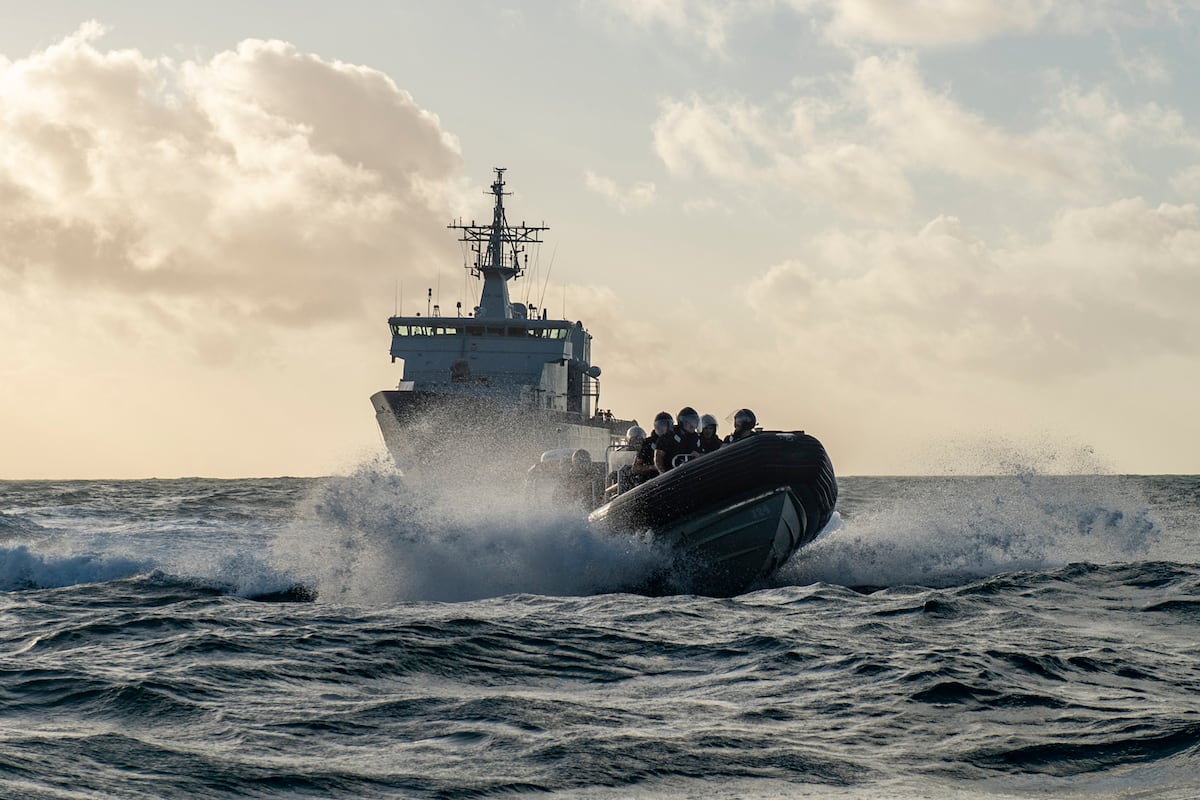
WELLINGTON, New Zealand — A third of Royal New Zealand Navy ships are docked due to a shortage of sailors, causing a loss of “significant flexibility,” the service’s top officer told Defense News.
Last month, the 279-foot offshore patrol vessel HMNZS Wellington became the third ship to enter a period of idleness, joining the Navy’s other offshore patrol vessel HMNZS Otago and one of the two remaining 180-foot inshore patrol vessels, HMNZS Hawea.
The other six ships are two Anzac-class frigates, HMNZS Te Kaha and HMNZS Te Mana; one inshore patrol vessel, HMNZS Taupo; one replenishment ship, HMNZS Aotearoa; one sealift ship, HMNZS Canterbury; and one hydrographic ship, HMNZS Manawanui.
“We have lost significant flexibility,” said Rear Adm. David Proctor, “and we have lost the ability to undertake a number of concurrent activities.”
But “I wouldn’t describe it as a catastrophe,” he added. “We are still able to deliver the expectation of government from an agreed-outputs point of view. Having a third of the fleet alongside is certainly less than ideal. I would love to be able to offer New Zealand and the government more options to respond.”
Chief of Defence Force Air Marshal Kevin Short said putting the Wellington dockside would free up engineering personnel amid workforce attrition. Placing a ship into care and custody will consolidate the workforce and allow better management of the effects of attrition, he argued.
The Navy currently has funding for 2,230 people, but Proctor said the service’s ideal end strength is about 2,340. As of Nov. 30, it had 2,117 in service, he said.
The service has “often struggled” to hit recruitment targets, Proctor noted, with the group coming in next year representing half of the service’s goal. Part of the problem is the highly competitive labor market.
“If the current attrition rate of 16.5% can be arrested, it is expected [that we] will have sufficient sailors to operate the rest of the fleet,” a Navy spokesperson told Defense News. “However, there remains a level of uncertainty until this attrition rate is reversed. This requires a number of initiatives to take effect, including addressing the widening gap between our sailor remuneration and what the highly competitive job market is offering.”
Still, the Navy’s two frigates are still operating — a ship type Proctor said can respond quicker than offshore patrol vessels and carry more personnel. But using frigates in place of OPVs means “I then don’t have a frigate to respond to whatever else may occur in the region,” he noted.
The Royal New Zealand Navy has funding for 2,230 people. (New Zealand Defence Force)
“From [the] ability to undertake surveillance and reconnaissance, we’re not perceiving any issues, but at this point there isn’t a ship able to undertake enforcement. With HMNZS Aotearoa, we can certainly be present … but until we have a dedicated ship that can operate in ice, or very near to ice, we are unable to undertake that enforcement activity within the Southern Ocean and the Ross Sea. So there’s a policy gap at the moment; I am unable to meet the government’s direction,” Proctor added.
Robert Patman, a professor of international relations at New Zealand’s Otago University, described the idle ships as a “worrying” development.
“We have one of the biggest exclusive economic zones in the world, quite a lot of marine resources to protect, and this is just not the time when we should be signaling or indicating that we are weakening our capabilities in maritime security,” he told Defense News.
Beyond New Zealand’s local waters, he added, the country has an obligation to neighboring Pacific islands, which absorb “about 60% of our overseas development aid and has been defined, particularly by this government, but by successive governments, as our major priority in foreign policy terms and security terms.”
Furthermore, the country should not assume its allies will fill the gap, and the government ought to consider raising its defense expenditure, Patman said.
“We’ve been spending about 1.5% of [gross domestic product]. ... If we were spending more ... then we could support the Navy to get it into a situation that it is operationally more capable than it is at the moment,” he added. “All governments have problems of conflicting financial demands. It’s just a question of whether we are going to bite the bullet — in a very troubled world — of committing ourselves more unambiguously to raising the level of defense expenditure to a point which matches our national and international interests more commensurately.”
Tackling the personnel gap
Salary is certainly part of the reason the Navy can’t reach its ideal end strength.
“Our sailors are being enticed out by remuneration levels significantly different to what we pay. These sailors are highly competent, highly disciplined, and they want to provide the best for their families,” Proctor said. “If they can see the competitive labor market outside is going to give them [up to] NZ$50,000 extra per annum, they’re going to take it, notwithstanding they wish to serve the nation.”
But pay is not necessarily the major reason for attrition rates, according to independent defense consultant Gordon Crane.
“Many of the personnel ordered to manage quarantine facilities during the COVID epidemic subsequently resigned,” Crane told Defense News.
Police and Royal New Zealand Navy staff are seen at the northern Auckland border at Te Hana on Nov. 17, 2021, amid the global COVID-19 pandemic. (Fiona Goodall/Getty Images)
Indeed, sailors were tapped to manage hotels hosting those under quarantine during the COVID-19 pandemic. “They weren’t in ships, and they joined the Navy to go away in ships,” Proctor said. “So it’s a mixed bag. In some areas there is high morale, in other areas it’s tough.”
The shortfall is further exasperated by “severe restrictions in some of the critical technical trades,” Proctor added. “It’s a bit of a perennial problem for many of our technical trades, I don’t think we’ve ever had enough in 20 years; certainly it’s been a long time since we had an excess of technical sailors.”
Proctor said some of the crew members of idle ships are helping to fill readiness gaps on other ships, while others are taking leave or participating in training courses. Some personnel will sail with other navies.
”I want our sailors to retain their skills as mariners and sailors, so where we don’t have an ability to send our own ships, I am inviting partners [to see] if they have an ability to help us,” Proctor said. “That’s not unusual; we have exchanges going all the time. It’s just this time we will potentially send larger numbers of Kiwi sailors to our partners’ ships to deliver security outcomes.”
The Navy has responded to its readiness gap with technical and financial measures, in particular the introduction of training simulators that make the process faster and more efficient, according to Proctor.
“We can get them to sea … in less time. We had an engineering training reform project [in which we asked]: Were we training the right things with the sailors that we require at sea?” he said. “Our seaman combat specialist [trade] has undertaken a similar review; simulation has provided similar benefits with them.”
“We are specific in recruiting targets for particular trades. We’ve introduced a training scheme for enlisted sailors whereby they can go and undertake tertiary training — one or two each year — that satisfies their professional desire for development,” he added. “One of the key ones that I am keen on and we are still putting resources into is the School to Seas program. It’s woman-focused on the [science, technology, engineering and math] trades. We’ve run that program once, and we’re running it again next year.”
“Across the Defence Force we have introduced an international operational enabling allowance that’s encouraging people to remain in the service in some of the areas where [living] costs are high,” he added.
Furthermore, sailors that deploy for more than 210 days in a year are now granted two days of extra leave for each month they’re over that balance. “Obviously that doesn’t help them when they are at sea, but they get to do a degree of reconnection with [their] family when they do come home,” Proctor noted.
“We have introduced retention payments for critical trades,” he added. “That’s short term and buys us time to address those core issues that sit behind our attrition.”
Even though New Zealand was aware of its chronic sailor shortage, it still decided to acquire more ships, according to Paul Buchanan, a former defense policy analyst with the U.S. government who now leads the geopolitical consultancy 36th Parallel Assessments in Auckland.
And that’s where it went wrong, Buchanan told Defense News.
The vessels Te Kaha and Te Mana entered service in the late 1990s, while the Canterbury joined in 2007, followed by the Hawea and the Taupo in 2009. The next year saw the Wellington and the Otago join the fleet. More recently, the Manawanui entered service in 2019, and the Aotearoa in 2020.
“I think the acquisition of these [ships] was more aspirational than practicable because they could see that they were having recruitment and retention problems,” Buchanan said. “But they felt the need to protect our [exclusive economic zone] and those of our neighbors, and went ahead anyway.”
Nick Lee-Frampton is the New Zealand correspondent for Defense News.
新西兰惠灵顿——新西兰皇家海军最高官员告诉《防务新闻》,由于水兵短缺,三分之一的皇家海军舰艇停泊在码头,导致“重大灵活性”丧失。
上个月,279 英尺长的近海巡逻舰 HMNZS Wellington 成为第三艘进入闲置期的舰艇,与海军的另一艘近海巡逻舰 HMNZS Otago 和剩余的两艘 180 英尺近岸巡逻舰之一 HMNZS Hawea 一起进入闲置期。
其他六艘舰艇包括两艘澳新军团级护卫舰,即新西兰皇家海军“特卡哈”号和“特马纳”号;一艘近岸巡逻舰,即新西兰皇家海军“陶波”号;一艘补给舰,即新西兰皇家海军“奥特亚罗瓦”号;一艘海运舰,即新西兰皇家海军“坎特伯雷”号;以及一艘水文测量舰,即新西兰皇家海军“马纳瓦努伊”号。
“我们失去了很大的灵活性,”海军少将戴维·普罗克特说,“我们也失去了同时开展多项活动的能力。”
但他补充道:“我不会将其描述为一场灾难。从既定产出的角度来看,我们仍然能够达到政府的预期。三分之一的舰队停泊在外当然远非理想状态。我非常希望能够为新西兰和政府提供更多应对方案。”
国防军司令凯文·肖特空军上将表示,将“惠灵顿”号停靠在码头可以缓解人员流失带来的工程人员压力。他认为,将一艘舰艇置于维护和保管之下,能够整合人员,更好地应对人员流失的影响。
海军目前有经费维持2230人的编制,但普罗克特表示,海军的理想编制约为2340人。他说,截至11月30日,海军共有2117名在役人员。
普罗克特指出,该机构“经常难以”完成招聘目标,明年入职的人员仅占其目标的一半。部分原因是劳动力市场竞争异常激烈。
海军发言人告诉《防务新闻》:“如果能遏制目前16.5%的人员流失率,预计我们将有足够的兵力来维持舰队的正常运转。然而,在扭转这一流失率之前,仍然存在一定程度的不确定性。这需要一系列措施生效,包括解决水兵薪酬与竞争激烈的就业市场提供的薪酬之间日益扩大的差距。”
尽管如此,海军的两艘护卫舰仍在服役——普罗克特表示,这种舰艇比近海巡逻舰反应更快,也能搭载更多人员。但他指出,用护卫舰代替近海巡逻舰意味着“我就没有护卫舰来应对该地区可能发生的其他情况了”。
新西兰皇家海军的经费足以维持2230人的编制。(新西兰国防军)
“就监视和侦察能力而言,我们目前没有发现任何问题,但现阶段我们还没有能够执行执法任务的舰船。有了‘奥特亚罗瓦’号(HMNZS Aotearoa),我们当然可以派驻到位……但在我们拥有能够在冰区或冰区附近作业的专用舰船之前,我们无法在南大洋和罗斯海开展执法活动。因此,目前存在政策缺口;我无法满足政府的要求,”普罗克特补充道。
新西兰奥塔哥大学国际关系学教授罗伯特·帕特曼将闲置船只描述为“令人担忧”的现象。
“我们拥有世界上最大的专属经济区之一,有很多海洋资源需要保护,现在绝不是我们应该发出或表明我们正在削弱海上安全能力的时候,”他告诉《防务新闻》。
他补充说,除了新西兰的本地水域之外,该国还对邻近的太平洋岛屿负有义务,这些岛屿吸收了“我们大约 60% 的海外发展援助,并且已被本届政府,以及历届政府,定义为我们在外交政策和安全方面的主要优先事项”。
帕特曼表示,此外,该国不应指望其盟友会填补这一缺口,政府应该考虑增加国防开支。
“我们目前的国防开支约占国内生产总值的1.5%……如果我们增加国防开支……就能支持海军提升作战能力,”他补充道。“所有政府都面临着财政需求冲突的问题。问题在于,在这个动荡不安的世界里,我们是否愿意下定决心,更加明确地提高国防开支水平,使其与我们的国家和国际利益更加匹配。”
解决人员缺口问题
薪资水平无疑是海军无法达到理想兵力规模的原因之一。
“我们的水兵正被远高于我们薪资水平的外部薪酬所吸引。这些水兵能力出众、纪律严明,他们想为家人提供最好的生活,”普罗克特说。“如果他们看到外部竞争激烈的劳动力市场能让他们每年多赚高达5万新西兰元,即使他们仍然想为国家效力,他们也会选择离开。”
但据独立国防顾问戈登·克莱恩称,薪酬未必是造成人员流失率的主要原因。
克莱恩告诉《防务新闻》:“许多奉命在新冠疫情期间管理隔离设施的人员随后辞职了。”
2021年11月17日,在全球新冠疫情大流行期间,警方和新西兰皇家海军人员在奥克兰北部边境的特哈纳(Te Hana)执勤。(Fiona Goodall/Getty Images)
事实上,在新冠疫情期间,一些水兵被征召去管理收治隔离人员的酒店。“他们不在船上,而他们加入海军就是为了上船出征,”普罗克特说。“所以情况比较复杂。有些地方士气高昂,有些地方则很艰难。”
普罗克特补充说,一些关键技术工种的“严格限制”进一步加剧了人员短缺。“对于我们许多技术工种来说,这算是一个长期存在的问题,我认为过去20年里我们从未真正人手充足过;当然,我们已经很久没有出现技术水手过剩的情况了。”
普罗克特表示,一些闲置舰艇的船员正在帮助其他舰艇填补战备空缺,而另一些船员则在休假或参加培训课程。部分人员将随其他国家的海军出海。
“我希望我们的水兵能够保持他们的航海技能,所以当我们无法派遣自己的舰船时,我会邀请合作伙伴看看他们是否能够提供帮助,”普罗克特说。“这并不罕见;我们一直都有人员交流。只是这一次,我们可能会派遣更多新西兰水兵到合作伙伴的舰船上,以确保安全。”
据普罗克特称,海军已通过技术和财政措施应对其战备差距,特别是引入训练模拟器,使训练过程更快、更高效。
“我们可以让他们更快地出海。我们开展了一项工程兵训练改革项目,旨在探究:我们对水兵的训练是否符合海上作战需求?”他说道。“我们的水兵作战专家也进行了类似的评估;模拟训练也为他们带来了类似的益处。”
“我们在招募特定工种人员时有明确的目标。我们为入伍水兵推出了一项培训计划,让他们每年可以参加一到两项高等教育培训,以满足他们的职业发展需求,”他补充道。“我非常重视的一个项目,也是我们仍在投入资源的项目,是‘从学校到海洋’计划。该计划专注于女性在科学、技术、工程和数学(STEM)领域的技能培训。我们已经举办过一次,明年还将再次举办。”
他补充说:“我们在整个国防部队中推出了一项国际作战津贴,鼓励人们在一些生活成本较高的地区继续服役。”
此外,水兵每年部署时间超过210天,每个月超出部分可额外获得两天假期。“显然,这并不能帮助他们在海上航行时获得休息,但当他们回家时,可以与家人进行一定程度的团聚,”普罗克特指出。
“我们已经为关键岗位引入了留任奖金,”他补充道。“这是短期措施,可以为我们提供时间,解决导致人员流失的根本问题。”
据保罗·布坎南(Paul Buchanan)称,尽管新西兰意识到其长期存在水手短缺问题,但新西兰仍然决定购置更多舰艇。布坎南曾是美国政府的国防政策分析师,现在领导着位于奥克兰的地缘政治咨询公司“第36平行线评估”(36th Parallel Assessments)。
布坎南告诉《防务新闻》:“事情就是从这里开始出错的。”
Te Kaha 号和 Te Mana 号于 20 世纪 90 年代末投入使用,Canterbury 号于 2007 年加入,Hawea 号和 Taupo 号则于 2009 年加入。次年,Wellington 号和 Otago 号也加入了船队。最近,Manawanui 号于 2019 年投入使用,Aotearoa 号于 2020 年投入使用。
布坎南说:“我认为购买这些舰艇更多的是一种愿景而非实际行动,因为他们意识到自己面临着人员招聘和留任方面的问题。但他们感到有必要保护我们和邻国的专属经济区,所以还是决定购买。”
Nick Lee-Frampton 是《国防新闻》驻新西兰记者。