Setting the scene: Army to test new hub for stockpiling in Australia背景介绍:陆军将在澳大利亚测试新的物资储备中心
The Army is establishing major sites to shelter equipment that could be used during war, humanitarian crises or natural disasters in the Pacific theater.
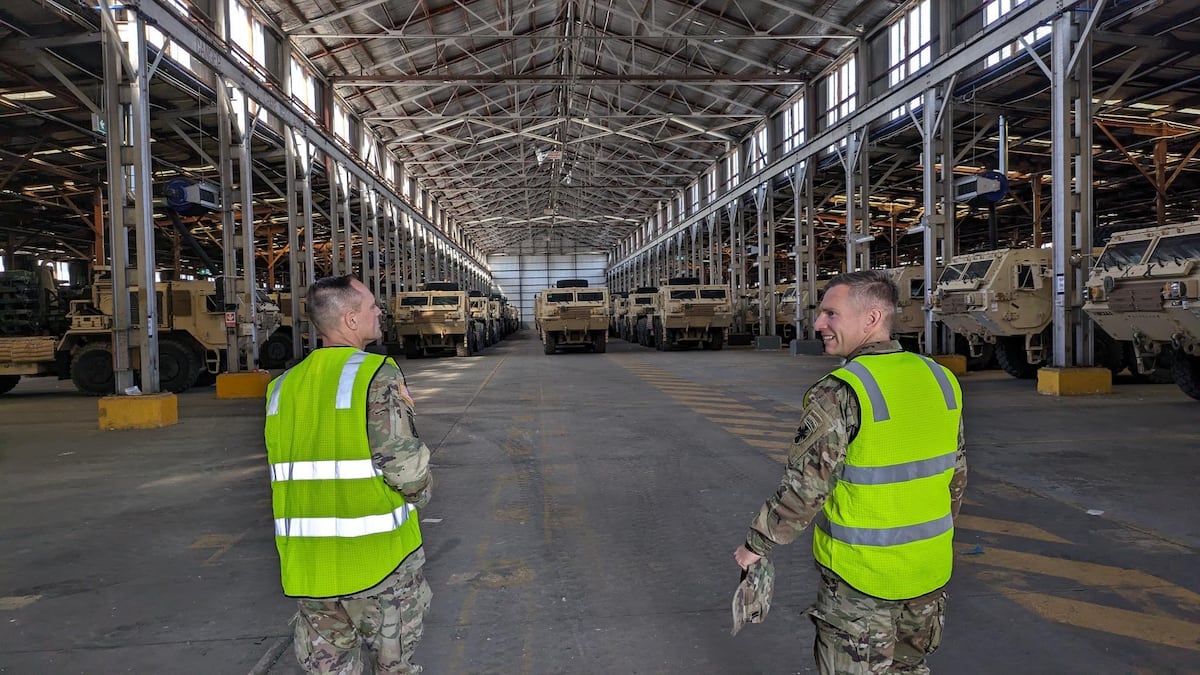
The U.S. Army will test a nascent capability to effectively preposition equipment and supplies forward in the Pacific theater in Australia during the large-scale exercise Talisman Sabre kicking off this month, according to U.S. Army Pacific Command commander Gen. Ronald Clark .
As the U.S. military tackles preparing for the difficult challenge of sustaining a possible protracted operation in the Pacific theater, the services are working together to develop what they are calling Joint Theater Sustainment Distribution Centers .
The Army is largely responsible for establishing several of these major sites that will shelter equipment and a variety of supplies that could be used during war, humanitarian crises or natural disasters.
“We are responsible for setting the theater for the joint force,” Clark told Defense News in a June 27 interview. “The way that we’ve undertaken that strategically is to build joint interior line through Joint Theater Distribution Centers that we’re establishing across the Pacific.”
The Army has so far established one center in the Philippines and one in Australia, for which the service is directly responsible. The other services are tasked with building out more centers across the first and second island chains in the Pacific, key archipelagos stretching from Japan through Taiwan and down to Borneo in the south Pacific.
One of the JTDCs is being established in Townsville, Australia, just north of the Gold Coast on the eastern side of the country.
During Talisman Sabre, the Army will be building its concept for the center along with other logistics and sustainment capabilities the service expects it will need in a highly contested environment.
The exercise happens every other year. This time, roughly 35,000 soldiers from 19 countries will participate.
“This gives us a great opportunity to test some of the capability associated with that because we have to move personnel and materiel into Australia. The tyranny of distance, of which you’re well aware of, requires that,” Clark said.
Having JTDCs “in and near the first island chain is exceptionally important for us and to be able to work through some of those challenges in the concept, in peacetime, as we’re working through contested logistics,” he said. “We’re building those concepts and building those capabilities with the Australians side-by-side to facilitate setting the theater.”
The locations throughout the theater will vary in size and scope, “but the things that will be universal,” Clark said, “is, one, you’re going to have to have a port capability to move surface vessels with large amounts of material.
“Two, they’re going to have to have storage capability for our efforts that store classes of supply. Three, they’re going to have to have some sort of airfield and air capability so we can move quickly materiel, supplies, from one place to another in rapid fashion.”
The centers “will allow us to essentially cheat the requirement for strategic air because, should there be crisis or conflict, the ability to use strategic lift to get into position will be highly contested by ourselves,” Clark said during a Center for Strategic and International Studies event June 27.
“Our efforts to get Army prepositioned stocks on the ground in multiple locations where we can draw and then move inter-theater to a place of need is essential.”
Talisman Sabre will also test out other capabilities designed for contested logistics, such as Army watercraft concepts, as the service works to shape that strategy.
The exercise will also mark the first time the Army’s Typhon, or Mid-Range Capability missile, is live-fired in the Pacific theater.
Jen Judson is an award-winning journalist covering land warfare for Defense News. She has also worked for Politico and Inside Defense. She holds a Master of Science degree in journalism from Boston University and a Bachelor of Arts degree from Kenyon College.
据美国陆军太平洋司令部司令罗纳德·克拉克将军称,美国陆军将在本月开始的大规模“护身军刀”演习中,测试一项新兴能力,即在太平洋战区有效地提前部署装备和物资。
在美国军方努力应对在太平洋战区可能持续作战的艰巨挑战之际,各军种正在共同努力,建立他们所谓的联合战区保障分发中心。
陆军主要负责建立其中几个主要基地,这些基地将存放可在战争、人道主义危机或自然灾害期间使用的设备和各种物资。
克拉克在6月27日接受《防务新闻》采访时表示:“我们负责为联合部队设定作战区域。我们从战略上实现这一目标的方式,是通过我们在太平洋地区建立的联合战区配送中心来构建联合内线。”
陆军目前已在菲律宾和澳大利亚各设立了一个中心,并由陆军直接负责。其他军种的任务是在太平洋第一和第二岛链(从日本经台湾延伸至南太平洋婆罗洲的重要群岛)建立更多中心。
其中一个 JTDC 正在澳大利亚汤斯维尔建立,该地位于黄金海岸以北,在该国东部。
在“护身军刀”演习期间,陆军将构建其中心概念,以及该军种预计在高度对抗的环境中需要的其他后勤和保障能力。
这项演习每两年举行一次。这次,将有来自19个国家的约35000名士兵参加。
克拉克说:“这给我们提供了一个绝佳的机会来测试相关的一些能力,因为我们必须将人员和物资运往澳大利亚。正如你所知,距离的限制迫使我们这样做。”
他说:“在第一岛链及其附近设立联合战术发展中心对我们至关重要,这有助于我们在和平时期解决一些挑战,尤其是在后勤保障方面。” “我们正在与澳大利亚并肩构建这些概念和能力,以促进战区的部署。”
整个战区的各个地点在规模和范围上都会有所不同,“但有些东西是共通的,”克拉克说,“第一,你必须要有港口能力来移动携带大量物资的水面舰艇。
“第二,他们必须具备储存各类物资的仓储能力。第三,他们必须具备某种机场和空中运输能力,以便我们能够快速地将物资从一个地方运送到另一个地方。”
克拉克在6月27日战略与国际研究中心举办的一次活动上表示,这些中心“将使我们基本上可以规避对战略空军的需求,因为一旦发生危机或冲突,我们自身将很难利用战略运输能力到达指定位置。”
“我们努力将陆军预置物资部署到多个地点,以便我们可以提取物资,然后跨战区调配到需要的地方,这至关重要。”
“护身军刀”演习还将测试其他为对抗性后勤而设计的能力,例如陆军水上交通工具概念,因为陆军正在努力制定该战略。
此次演习还将标志着陆军的“台风”(Typhon)或中程能力导弹首次在太平洋战区进行实弹射击。
珍·贾德森是一位屡获殊荣的记者,为《防务新闻》报道陆地战争。她也曾为《政治报》和《内幕防务》工作。她拥有波士顿大学新闻学硕士学位和凯尼恩学院文学学士学位。