This Is All The Stuff You Can Hang Out of a C-130’s Rear Paratrooper Doors这就是你可以从C-130运输机后部伞兵舱门挂出去的所有东西
Various kits use those openings to mount surveillance systems, communications antennas, firefighting gear, and more.
新闻视频
By Joseph Trevithick
Updated Jun 29, 2019 11:50 PM EDT
After more than five decades of steady service, it’s safe to say that Lockheed Martin’s C-130 Hercules family, as well as the civilian L-100 and now LM-100J models , has proven to be an especially versatile design . Its widespread use has prompted a whole associated industry of third party upgrades and add-ons, including one modular system called the Special Airborne Mission Installation and Response (SABIR) in particular, that can turn the aircraft’s rear paratrooper doors into surveillance arrays, communications nodes, even a radio and television broadcast antennas and more.
Airdyne , an engineering firm based on Calgary, Canada, has been actively developing SABIR, one of the better known systems, and expanding on what it can do since 2007. Its subsidiary, Airdyne Aerospace, handles the sales and marketing of the equipment, as well as repairs, from its headquarters in Florida. Rather than one single piece of equipment, SABIR is a modular kit that includes a new door, a retractable “arm” able to carry a store weighing up to 400 pounds, and an equipment rack and work station with a seat so a member of the crew can operate the systems now attached to the aircraft.
Relatively easy and quick to install, crews can substitute the rig for either the left or right rear paratrooper doors on any C-130, or both. Airdyne’s website says it initially developed the setup for the Hercules specifically, but that it is “platform independent” and able to fit on other aircraft, though the Hercules still appears to be the primary platform.
The company says that an aircraft with this rapidly reconfigurable kit could be useful in a variety of military, law enforcement , and civilian roles . Its website lists more than a dozen possible mission sets, including surveillance missions , border patrol, search and rescue, and scientific research .
Airdyne itself offers a number of modular pods that fit onto the extendable strut, the AS-4 and AS-18, both of which can accept a variety of different sensors, including electro-optical and infrared still and video cameras, imaging and surface search and surveillance radars, laser imaging equipment, and signals intelligence suites. Another option is a wide-area surveillance system that incorporates multiple video cameras to capture imagery across a large swath of land or sea. Analysts can then put imagery together in a large mosaic making it easier to spot routine patterns of enemy movement or changes to the landscape over an extended period of time. Multiple users can exploit different parts of the imagery at one time, and vehicles and even people can be tagged tracked, including “rewinding” past footage and tracing their steps over a period of time.
With the retracting arm, which only takes approximately one minute to extend or fold back up, the crew can position the pod well below the aircraft’s fuselage, as well. This reduces physical obstructions and other interference that might limit the range, field of view, intensity, or other capabilities of the sensors on board. Airdyne says that the full SABIR system works with nearly 170 different sensor packages.
We at The War Zone have written numerous times in the past about the immense value of modular sensor packages, especially for cash-strapped military forces and civilian agencies who might have limited numbers of actual aircraft available, but the need to perform a wide variety of missions. In July 2017, while exploring the U.S. Air Force’s new AgilePod system specifically, I wrote :
“This level of modularity makes perfect sense. If the AgilePod works as intended, during actual operations, crews on the ground could quickly swap out gear to better fir the situation at hand rather than having to prepare an entirely different aircraft or even just install a completely different pod. This would reduce the total number of aircraft a unit might need to be able to perform the different mission sets, as well as potentially speeding up the process of getting the appropriate equipment into the air. It would be especially useful for units at forward locations where existing infrastructure and resources may be otherwise limited. … “Of course, individual manned or unmanned aircraft would only be able to perform the missions that the pod is configured for at any one time. However, the multiple stations inside the AgilePod would allow it to carry more than one type of sensor during each mission, which would still provide additional flexibility over some existing configurations. ARFL already has a number of examples within the Air Force and elsewhere in the U.S. military it can look to for evidence of the benefits of similar modular architecture.”
“This level of modularity makes perfect sense. If the AgilePod works as intended, during actual operations, crews on the ground could quickly swap out gear to better fir the situation at hand rather than having to prepare an entirely different aircraft or even just install a completely different pod. This would reduce the total number of aircraft a unit might need to be able to perform the different mission sets, as well as potentially speeding up the process of getting the appropriate equipment into the air. It would be especially useful for units at forward locations where existing infrastructure and resources may be otherwise limited.
“Of course, individual manned or unmanned aircraft would only be able to perform the missions that the pod is configured for at any one time. However, the multiple stations inside the AgilePod would allow it to carry more than one type of sensor during each mission, which would still provide additional flexibility over some existing configurations. ARFL already has a number of examples within the Air Force and elsewhere in the U.S. military it can look to for evidence of the benefits of similar modular architecture.”
So it’s not surprising that SABIR is already in service across the U.S. military, including with the U.S. Air Force, Marine Corps, and Navy, as well as U.S. Special Operations Command and the Air National Guard. A number of other countries around the world also operate the system. The Air National Guard in particular has been steadily exploring the versatility of the concept to handle less typical missions.
In 2006, the New York Air National Guard turned to Sandia National Laboratories to develop an X-band radar for its LC-130H Hercules, already specially configured to support U.S. government activities in extreme cold weather locales such as Greenland and Antarctica . The 109th Airlift Wing had suffered a number of accidents when crews tried to land on what appeared to be stable ice, only to have the aircraft run into a hidden crevasse .
An LC-130H sits snagged in the ice in Antarctica after hitting a hidden crevasse during a landing in December 1998., USAF
With the X-band radar, crews could see beneath the top sheet of ice and make sure their impromptu runway was safe before touching down. The 109th used SABIR to attach the equipment to the aircraft.
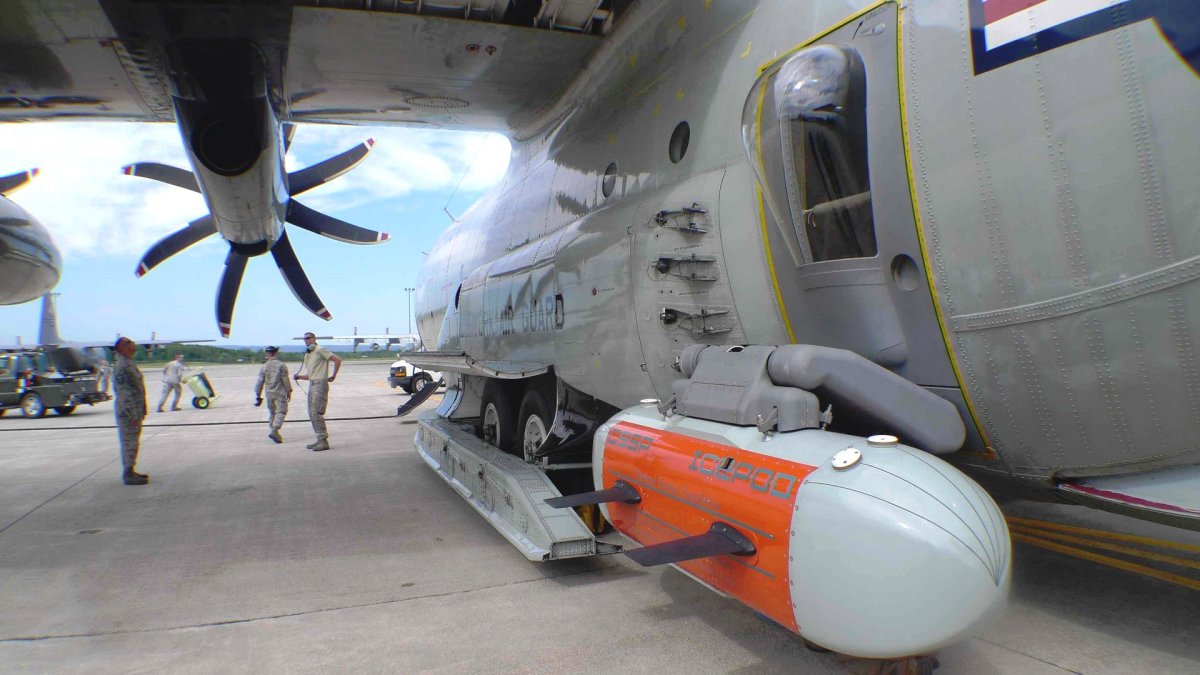
Afterwards, in cooperation with the National Science Foundation and Colombia University, the unit began helping test the “IcePod,” which could carry the radar, along with various other sensors for research purposes. The final design had multiple visual and infrared cameras, radars, and a GPS navigation system, and was able to gather data on ice depth and density and air and surface temperatures, among other information.
The IcePod on one of the 109th’s LC-130s., USAF
The Pennsylvania Air National Guard’s 193rd Special Operations Wing also had a unique requirement, but one that didn’t involve sensors at all. The unit flies the EC-130J Commando Solo variant, a psychological warfare platform that can beam out propaganda radio and television broadcasts over warzones, urging civilians to avoid certain areas or implore them to give up any support they might be giving to the enemy.
The only problem was that the Commando Solo conversions were complicated, costly, and would only ever apply to a small fleet. In 2008, the U.S. military decided to trim back the planned fleet from an already paltry six aircraft, down to just three. This left the 193rd with three “slick” C-130 airframes, plus an additional spare, that it suddenly had no idea what to do with.
The unit subsequently combined SABIR carrying a pod with a version of a U.S. Army psychological operations broadcasting system. The cost-effective combination meant that these EC-130J aircraft, though less complex than the Commando Solos, could still transmit FM radio, analog and digital television, and even SMS text messages.
One of the 193rd Special Operations Wing’s “slick” C-130s with SABIR system., via ThinkDefence
The psychological warfare mission highlights SABIR versatility beyond just modular sensor packages. Along with the broadcast equipment, the arm could just as easily accommodate a communications or data sharing hub to help pass information between friendly forces on the ground and in the sky. This could be an especially important capability for smaller militaries that cannot afford to field dedicated aircraft for this mission, such as the U.S. Air Force’s fixed wing E-11 or EQ-4B drone, both of which carry the powerful Battlefield Airborne Communication Node (BACN).
Off the battlefield, this capability could be especially useful for more civilian authorities, in particular during a natural disaster that disables a significant amounts the communications infrastructure, including emergency assistance hotlines , or knocks out large portions of the power grid in a particular area. A C-130 flying an orbit with a communications relay could provide a quick substitute system to get first responders and larger government disaster relief agencies back in regular contact with each other so that they can best direct their efforts and quickly share critical information about the overall situation.
The possible uses of SABIR as a datalink or communications node., Airdyne
With its 400 pound load capacity and a standardized bomb rack, the system could theoretically carry small munitions or other types of stores, as well. In a pinch, a C-130 with SABIR might be able to double as an attack platform or release swarms of small drones able to conduct their own myriad missions .
For maritime surveillance and anti-submarine work, Airdyne already offers a sonobouy launcher that fits into the new door. This doesn’t impede the ability of the system to carry other equipment, meaning that crews could have that capability plus a surface search radar for long range patrol operations over the open ocean just on one side of the aircraft. A second SABIR setup on the other size could carry additional sensors.
According to Airdyne, that same dispenser can accommodate other manually dropped payloads, too. These include the GBU-44/B Viper Strike lightweight glide bomb and small, expendable drones . It could also likely drop research probes, such as the dropsondes storm chasing aircraft drop into hurricanes and other extreme weather patterns to gather data on temperature, wind speed, and various other data.
It’s not the first time the U.S. military in particular has explored what it can do by simply swapping out the C-130’s rear paratroop doors. The U.S. Air Force Reserve flies two types of unique aerial spraying C-130s, both of which utilize that space.
In the 1970s, the Air Force first started using the Modular Airborne Firefighting System, or MAFFS , consisting of five pressurized tanks than can hold 2,700 gallons of fire retardant chemicals or water. The system fits inside the the main cargo area of a C-130 and dispenses the liquid over large forest and other wildfires through nozzles that poke out through the rear paratrooper doors.
In 2007, the Aero Union delivered the first improved MAFFS II, which replaced the five individual tanks with a single unit that also had a large 3,000 gallon capacity. In addition, the new system included two air compressors on board the aircraft, allowing the crew to pressurize the system themselves without the need for a separate piece of ground equipment.
In addition to MAFFS, the Air Force Reserve also has a small number of C-130s fitted with the Modular Air Spray System (MASS). This configuration includes spray nozzles fitted in modified paratrooper doors and under the wings. Unlike the fire-fighting MAFSS, MASS crews primarily spray chemicals to control harmful insects or invasive plants.
In the wake of Hurricane Harvey, the aircraft headed to Texas to help control a potentially dangerous explosion in the mosquito population. The planes have have also gone to work after other natural and man-made environmental disasters, including spraying oil dispersing chemicals in the Gulf of Mexico following the Deepwater Horizon oil rig explosion in 2010, which you can see in the video above.
In the 1980s, the Air National Guard began flyingh C-130s with a special signals intelligence system called Senior Scout , as well. While, the bulk of the equipment fit inside a container that slides into the main cargo bay, new paratrooper and landing gear bay doors held the antenna farm necessary to spot and monitor enemy emitters.
Replacement doors bristling with antennas on a C-130 fitted with the Senior Scout system., via ThinkDefence
Ground crews could relatively quickly install all of the equipment onto any C-130 or remove it to put it back to work as a regular airlifter. The modular nature of the system meant that the Air Force built up a few versions, called Senior Warrior, for the U.S. Marine Corps to use on its KC-130 tanker transports during the first Gulf War. The Air National Guard appeared to have retired its remaining Senior Scout systems by 2013.
More recently, the U.S. Marine Corps added a new paratrooper door to its KC-130 fitted with the Harvest Hawk weapons kit . Nicknamed the “Derringer Door” for its two weapons launch tubes, crews could fire various lightweight precision guided munitions, include the GBU-44/B and the AGM-176 Griffin missile , from inside the aircraft. Earlier Harvest Hawks had a larger launcher on the rear cargo ramp, but that meant the crew had to depressurize the main cargo compartment in order to use it.
The inside of the Derringer Door on a KC-130 Harvest Hawk., Lockheed Martin
A Harvest Hawk could conceivably expand its capabilities by using SABIR to combine the stores release capability with a sensor or other additional equipment. At present, the gunships use a modular sensor turret system that fits onto the rear of one of the aircraft’s under wing drop tanks.
SABIR could also offer a quick, bolt-on electronic warfare capability , especially when combined with something such as the U.S. Marine Corps’ Intrepid Tiger precision jamming pod. Many of these systems can double as electronic intelligence suites since they have to be able to locate and monitor enemy signal sources. Intrepid Tiger itself makes use of so-called “open architecture” software that will allow engineers to quickly install upgrades and add new capabilities as time goes on, including potentially radar jamming and even the ability to launch cyber attacks .
In June 2017, Lockheed Martin unveiled a special operations configuration for the C-130J, the C-130-SOF. The concept art the company showed included a 30mm cannon firing through the left-side paratrooper door. This is a simpler, more modular arrangement than the purpose-built gun mount in the forward fuselage on the U.S. Air Force’s AC-130W and AC-130J gunships.
You really can hang a lot of stuff out of those rear paratrooper doors. More than six decades after its first flight, the C-130 is still going strong and it seems unlikely we’ve seen everything you can do with that space.
Contact the author: joe@thedrive.com
Comments couldn’t be loaded. Please refresh the page.
作者:约瑟夫·特雷维西克
更新于美国东部时间2019年6月29日晚上11:50
经过五十多年的稳定服役,洛克希德·马丁公司的C-130“大力神”系列运输机,以及民用版L-100和现役的LM-100J机型,已被证明是一款用途极为广泛的设计。其广泛的应用催生了一个庞大的第三方升级和附加组件产业,其中就包括一个名为“特种机载任务安装与响应”(SABIR)的模块化系统。该系统可以将飞机后部的伞兵舱门改造成监视阵列、通信节点,甚至是无线电和电视广播天线等等。
总部位于加拿大卡尔加里的工程公司Airdyne自2007年以来一直积极研发SABIR系统,并不断扩展其功能。SABIR是业内较为知名的系统之一。其子公司Airdyne Aerospace总部位于佛罗里达州,负责该设备的销售、市场推广和维修。SABIR并非单一设备,而是一个模块化套件,包含一扇新舱门、一个可伸缩的“机械臂”(能够承载重达400磅的货物)、一个设备架和一个带座椅的工作站,以便机组人员操作安装在飞机上的系统。
该装置安装相对简便快捷,机组人员可将其替换任何C-130运输机的左侧或右侧后部伞兵舱门,或同时替换两个舱门。Airdyne公司网站称,该装置最初是专门为C-130“大力神”运输机开发的,但它“与平台无关”,也能安装在其他飞机上,尽管“大力神”运输机似乎仍然是其主要应用平台。
该公司表示,配备这种快速改装套件的飞机可用于多种军事、执法和民用用途。其网站列出了十几种可能的任务组合,包括监视任务、边境巡逻、搜救和科学研究。
Airdyne公司提供多种模块化吊舱,可安装在可伸缩支架上,包括AS-4和AS-18。这两种吊舱均可搭载多种传感器,例如光电和红外静态及视频摄像机、成像雷达、水面搜索和监视雷达、激光成像设备以及信号情报套件。另一种选择是广域监视系统,该系统集成多个摄像机,可拍摄大片陆地或海洋区域的图像。分析人员可以将这些图像拼接成大型马赛克图,从而更容易发现敌方行动的常规模式或长期地形变化。多个用户可以同时查看图像的不同部分,还可以对车辆甚至人员进行标记和跟踪,包括“回放”过去的录像,追踪其一段时间内的行踪。
借助伸缩臂(展开或折叠仅需约一分钟),机组人员可以将吊舱定位在飞机机身下方较远的位置。这减少了物理障碍物和其他干扰,从而避免限制机载传感器的探测范围、视野、强度或其他性能。Airdyne公司表示,完整的SABIR系统可与近170种不同的传感器组件兼容。
我们“战区”栏目过去曾多次撰文探讨模块化传感器组件的巨大价值,尤其对于资金紧张的军队和民用机构而言,他们可用的飞机数量有限,却需要执行各种各样的任务。2017年7月,在专门研究美国空军的新型敏捷吊舱(AgilePod)系统时,我曾写道:
“这种模块化程度的设计非常合理。如果敏捷吊舱(AgilePod)能够按预期运行,在实际作战中,地面人员可以快速更换装备,以更好地适应当前情况,而无需准备完全不同的飞机,甚至无需安装完全不同的吊舱。这将减少部队执行不同任务所需的飞机总数,并有可能加快将相应装备部署到空中的速度。对于基础设施和资源可能有限的前沿部署部队来说,这将尤其有用。……当然,单架有人或无人驾驶飞机在任何特定时间只能执行吊舱配置的任务。然而,敏捷吊舱内部的多个工作站使其能够在每次任务中携带多种类型的传感器,这仍然比一些现有配置提供了更大的灵活性。ARFL 在美国空军和其他军种中已经有很多类似模块化架构的案例可供参考。”
“这种模块化设计非常合理。如果敏捷吊舱(AgilePod)能够按预期运行,在实际作战中,地面人员可以快速更换装备,以更好地适应当前情况,而无需准备一架全新的飞机,甚至无需安装一个全新的吊舱。这将减少部队执行不同任务所需的飞机总数,并有可能加快将相应装备部署到空中的速度。对于驻扎在前线、基础设施和资源可能有限的部队来说,这将尤其有用。”
当然,单架有人或无人驾驶飞机在任何特定时间只能执行吊舱预设的任务。然而,敏捷吊舱内部的多个工作站使其能够在每次任务中携带多种类型的传感器,这比一些现有配置更具灵活性。ARFL公司在美国空军和其他军方部门已经有很多类似模块化架构的成功案例,可以作为其优势的佐证。
因此,SABIR系统已在美国军方广泛服役也就不足为奇了,其中包括美国空军、海军陆战队和海军,以及美国特种作战司令部和空中国民警卫队。世界上许多其他国家也在使用该系统。特别是空中国民警卫队,一直在稳步探索该概念的多功能性,以应对非常规任务。
2006年,纽约州空中国民警卫队委托桑迪亚国家实验室为其LC-130H“大力神”运输机研发X波段雷达。该机此前已进行特殊改装,用于支持美国政府在格陵兰岛和南极洲等极寒地区的活动。第109空运联队曾发生多起事故,机组人员试图在看似稳定的冰面上降落时,飞机却撞入了隐藏的冰缝。
1998年12月,一架LC-130H运输机在南极洲着陆时撞上一条隐蔽的冰缝,被困在冰层中。(美国空军)
借助X波段雷达,机组人员可以看穿冰层,确保临时跑道安全后再着陆。第109飞行大队使用SABIR公司将设备安装到飞机上。
随后,该团队与美国国家科学基金会和哥伦比亚大学合作,开始协助测试“冰舱”(IcePod)。冰舱可以搭载雷达以及其他各种用于科研的传感器。最终设计方案配备了多个可见光和红外摄像机、雷达以及GPS导航系统,能够收集冰层深度、密度、气温和地表温度等数据。
美国空军第109运输机联队LC-130运输机上的冰舱。
宾夕法尼亚州空中国民警卫队第193特种作战联队也有一项独特的需求,但这项需求与传感器完全无关。该部队装备的是EC-130J“突击队员单兵”型,这是一种心理战平台,可以向战区发射宣传广播和电视信号,敦促平民避开某些区域,或恳求他们放弃可能对敌人提供的任何支持。
唯一的问题是,突击队单兵运输机的改装工程复杂、成本高昂,而且只适用于小型机队。2008年,美军决定将原计划的机队规模从可怜的六架缩减到三架。这使得第193运输机联队拥有了三架性能优良的C-130机身,外加一架备用机,却突然不知道该如何处理。
该部队随后将搭载吊舱的SABIR系统与美国陆军心理作战广播系统的改进型相结合。这种经济高效的组合意味着,这些EC-130J飞机虽然比突击队单兵运输机结构简单,但仍然可以传输调频广播、模拟和数字电视信号,甚至短信。
这是第193特种作战联队的一架“炫酷”C-130运输机,配备了SABIR系统。(图片来自ThinkDefence)
心理战任务凸显了SABIR系统除了模块化传感器组件之外的多功能性。除了广播设备外,该系统还可以轻松集成通信或数据共享中心,以帮助地面和空中友军之间传递信息。对于那些无力为此类任务部署专用飞机的规模较小的军队而言,这可能是一项尤为重要的能力,例如美国空军的E-11固定翼飞机或EQ-4B无人机,它们都搭载了功能强大的战场机载通信节点(BACN)。
在战场之外,这种能力对民事机构尤其有用,尤其是在自然灾害导致通信基础设施(包括紧急救援热线)严重瘫痪,或特定区域大面积电网瘫痪的情况下。一架搭载通信中继设备的C-130运输机可以快速替代现有系统,使一线救援人员和大型政府救灾机构恢复正常联系,从而更好地协调救援工作,并迅速共享有关整体情况的关键信息。
SABIR作为数据链路或通信节点的潜在用途,Airdyne
该系统拥有400磅的有效载荷能力和一个标准化的炸弹挂架,理论上可以携带小型弹药或其他类型的物资。在紧急情况下,配备SABIR系统的C-130运输机或许能够兼作攻击平台,或者释放大量小型无人机,这些无人机能够执行各种各样的任务。
针对海上监视和反潜任务,Airdyne公司已经提供了一种可安装在新舱门上的声呐浮标发射器。这并不影响系统搭载其他设备的能力,这意味着机组人员可以在飞机的一侧同时拥有声呐浮标发射器和用于远洋巡逻的地面搜索雷达。另一侧的SABIR系统还可以搭载其他传感器。
据艾尔达因公司称,该投放器还可以投放其他手动投放的有效载荷,例如GBU-44/B“蝰蛇打击”轻型滑翔炸弹和小型一次性无人机。它也可能投放科研探测器,例如追风飞机投放到飓风和其他极端天气系统中的探空仪,用于收集温度、风速和其他各种数据。
这并非美军首次探索通过更换C-130运输机的后部伞兵舱门来实现其用途。美国空军预备役部队装备有两种独特的C-130空中喷洒型运输机,这两种运输机都利用了这一空间。
上世纪70年代,美国空军首次开始使用模块化机载灭火系统(MAFFS),该系统由五个加压罐组成,可容纳2700加仑阻燃化学品或水。该系统安装在C-130运输机的主货舱内,并通过从后部伞兵舱门伸出的喷嘴,将液体喷洒到大型森林火灾和其他野火上。
2007年,Aero Union交付了首套改进型MAFFS II系统,该系统用一个容量高达3000加仑的单体储气罐取代了原有的五个独立储气罐。此外,新系统还在飞机上配备了两台空气压缩机,使机组人员无需借助地面设备即可自行加压。
除了MAFFS之外,空军预备役还拥有少量配备模块化空气喷洒系统(MASS)的C-130运输机。这种配置包括在改装的伞兵舱门和机翼下方安装喷嘴。与用于灭火的MAFSS不同,MASS机组人员主要喷洒化学药剂来控制有害昆虫或入侵植物。
飓风哈维过后,这架飞机飞往德克萨斯州,帮助控制蚊子数量可能出现的危险激增。在其他自然灾害和人为环境灾难发生后,这些飞机也曾参与救援行动,例如在2010年墨西哥湾深水地平线钻井平台爆炸后,向海平面喷洒石油分散剂,您可以在上面的视频中看到相关画面。
上世纪80年代,美国空军国民警卫队也开始使用配备名为“高级侦察兵”(Senior Scout)的特殊信号情报系统的C-130运输机。该系统的大部分设备都装在一个滑入主货舱的集装箱内,而新安装的伞兵舱门和起落架舱门则用于存放发现和监视敌方信号发射源所需的天线阵列。
图片来自 ThinkDefence,展示了一架安装了高级侦察兵系统的 C-130 运输机上布满天线的替换舱门。
地勤人员可以相对快速地将所有设备安装到任何一架C-130运输机上,或者将其拆卸下来,使其恢复作为常规运输机的用途。该系统的模块化特性意味着空军为美国海军陆战队在第一次海湾战争期间的KC-130加油运输机上配备了几个名为“高级战士”(Senior Warrior)的改进型系统。到2013年,空中国民警卫队似乎已经退役了剩余的“高级侦察兵”(Senior Scout)系统。
最近,美国海军陆战队在其配备“丰收鹰”(Harvest Hawk)武器套件的KC-130运输机上加装了一个新型伞兵舱门。该舱门因其两个武器发射管而被戏称为“德林格门”,机组人员可以从机舱内发射各种轻型精确制导武器,包括GBU-44/B制导炸弹和AGM-176“格里芬”(Griffin)导弹。早期的“丰收鹰”运输机在后部货舱坡道上配备了一个更大的发射器,但这意味着机组人员必须先对主货舱进行减压才能使用该发射器。
KC-130“收割鹰”加油机德林格机门内部结构,洛克希德·马丁公司
“丰收鹰”武装直升机理论上可以通过使用SABIR系统来扩展其作战能力,将弹药投放能力与传感器或其他附加设备相结合。目前,该型武装直升机使用模块化传感器炮塔系统,该系统安装在机翼下方副油箱的后部。
SABIR还可以提供快速、即插即用的电子战能力,尤其是在与美国海军陆战队的“无畏虎”(Intrepid Tiger)精确干扰吊舱等设备结合使用时。许多此类系统还可以兼作电子情报套件,因为它们必须能够定位和监视敌方信号源。“无畏虎”本身采用所谓的“开放式架构”软件,这使得工程师能够随着时间的推移快速安装升级并添加新功能,包括潜在的雷达干扰甚至网络攻击能力。
2017年6月,洛克希德·马丁公司公布了C-130J的特种作战配置方案——C-130-SOF。该公司展示的概念图显示,该机左侧伞兵舱门上装有一门30毫米机炮。与美国空军AC-130W和AC-130J炮艇机前机身安装的专用机炮相比,这种方案更为简洁,模块化程度更高。
你真的可以从后部的伞兵舱门上挂很多东西。C-130运输机首飞六十多年后依然性能强劲,而且我们似乎还没有完全见识到它空间的所有用途。
联系作者:joe@thedrive.com
评论加载失败,请刷新页面。