The Army Tried To Turn Nerf Footballs Into Hand Grenades军方曾试图将软弹橄榄球改装成手榴弹
The goal of the "football device" was to give soldiers a way to take out tanks at close range in a package the Army hoped would be instinctual to use.
新闻视频
By Joseph Trevithick
Updated Nov 27, 2020 6:01 PM EST
Few things are as quintessentially American as football and most people in this country have probably played it in some form at least once in their life. This was what the U.S. Army was banking on when it developed an anti-tank grenade using an explosive charge jammed into a hollowed-out Nerf football in the early 1970s.
The Army’s Land Warfare Laboratory (LWL) at Aberdeen Proving Ground in Maryland concocted the “football device,” something I wrote about briefly years ago now, as part of a broader effort to develop a hand-thrown anti-tank weapon of some kind that began in July 1973. The Army had originally established LWL in 1962 to develop, test, and evaluate any and all weapons or other technology that might be applicable to counter-insurgency campaigns, a type of warfare that was emerging around the world at the time. This included in various countries in Southeast Asia, such as South Vietnam and Thailand, where the United States was already becoming increasingly embroiled at that time.
In 1970, LWL was renamed the Land Warfare Laboratory, a switch that kept its acronym intact, and it began exploring systems that be might useful to a broader set of conflict types. One of these efforts was the anti-tank grenade project, a requirement driven by concerns about the utility of existing infantry anti-armor capabilities, especially in an urban environment, such as the ones the U.S. military expected to be a primary setting for any major conflict against the Soviets in Europe.
“Current standard US Army antitank weapons have been designed to provide maximum practical stand-off range,” a 1974 final test report on the football grenade, as well as the other types LWL evaluated, explained. The primary infantry anti-tank weapons in Army service at the time were the BGM-71 TOW and FGM-77 Dragon anti-tank guided missiles and variants of the M72 Light Anti-Tank Weapon (LAW), a shoulder-fired rocket launcher.
The issue with these weapons, as LWL’s report noted, was that firing them would often reveal the location of the shooter. The Dragon was a particularly notorious offender in this regard, putting the person that fired it immediately at risk and making it difficult for them to quickly re-engage if the first shot missed. In addition, the missiles, as well as the M72s, could not be employed safely from within confined spaces, such as from the inside of a building.
On top of that, to protect those firing them from getting caught in the blast, these missiles and rockets had to travel certain minimum distances before arming themselves. In a cramped urban setting with fighting that could be in very close quarters, this would also have limited the ability of troops to employ these weapons.
At the time, the Army trained troops to engage heavily armored vehicles under these conditions using a variety of improvised means, including ponchos filled with oil and gasoline and explosive charges packed into empty ammunition cans. They were to, whenever possible, exploit the lack of situational awareness that armored vehicles crews have when they are “buttoned-up” inside with all their hatches closed.
A low-quality scan of a page from a comic book-style Army manual from 1972 describing improved explosive means for damaging tanks in close quarters., US Army via FOIA
This is very much how the service had done things since World War II. Steven Spielberg’s famous 1998 film about that war, Saving Private Ryan , notably includes the use of improvised “sticky bombs,” consisting of socks full of explosives dipped in thick oil, against Nazi tanks in its climactic final battle.
“A hand-thrown short-range device appeared to overcome the deficiencies of standard weapons in an urban environment,” LWL’s 1974 report said. “A hand deployed device which will give the infantryman in urban warfare the capability to disable a ‘buttoned-up’ tank is desired.”
LWL decided to focus on hand-thrown weapons containing a shaped charge, a warhead design commonly used in anti-tank missiles and rockets. A shaped charge, also known as a hollow charge, features a large open cavity inside between the main explosive charge and the front of the projectile. An inverted cone-shaped metal liner, typically made copper, is inserted into the explosive charge. When the charge goes off, it expands outward, turning the liner into a high-speed metal dart of sorts that then punches through the target.
The video below shows the basic function of such a shaped charge, using a high-explosive anti-tank shell as an example.
This is a technology that dates back to the late 19th century and is still in use today. It works, but its effect is greatly diminished if the full force of the resulting projectile isn’t directed at the target at an optimal distance or angle. Countries around the world have added a wide array of spaced armor, slats and nets , and even small bricks of explosives to the side of armored vehicles to prevent shaped charge weapons from detonating as intended.
LWL then determined that the optimal methods of attack for a hand-thrown anti-tank grenade using a shaped charge at close range were dropping it out of a window on top of the vehicle, lobbing it on top of the vehicle from cover, or otherwise trying to hit the top of the vehicle from the furthest distance away possible. Typically, the top of the turret or the rear hull of a tank or another heavily armored vehicle is where its armor is the weakest. Furthermore, killing crew members inside or severely damaging or destroying the engine compartment could be enough to achieve a mission kill.
It’s interesting to note that when LWL started its work on developing a weapon that would meet these requirements and be usable in one or more of those scenarios, many other countries, including America’s European allies and the Soviet Union , had already fielded anti-tank grenades decades earlier. By the 1970s, some nations, especially the Soviets and their allies, were still using them.
Personnel at the Army laboratory identified multiple foreign types that informed its work, primarily so-called “potato masher” grenade designs with stick-like handles for throwing. Anti-tank versions of these grenades almost universally had some kind of retarding device, such as cloth strips or even a small parachute , which would help stabilize the grenade. The idea is that these features would help the grenades fall near vertically on top of a vehicle to maximize the effect of their shaped charge warheads. Rather than timed fuzes found on typical hand grenades, these hand-thrown weapons often had impact fuzes that would only go off when they struck something.
A Cold War-era Polish-made Soviet-designed “potato masher” style RPG-43 anti-tank grenade. When thrown, the cone at the base of the handle would drop off, extending two cloth strips in the process to stabilize the grenade., International Military Antiques
Not surprisingly, LWL crafted two of its own potato masher grenade designs, including one with a magnet at the front to help it stick to the target before going off. It also built two experimental dart-shaped designs, one with fins and another with a cowling of some kind, both designed to stabilize them after they were thrown. Sadly, there do not appear to be any pictures readily available of either of these apparent anti-tank lawn darts. The basic idea sounds similar in some respects to the British World War II-era No. 68 anti-tank grenade . It also sounds broadly reminiscent of the U.S. Civil War-era Ketchum hand grenade , a Union weapon that featured an egg-shaped explosive body with a wooden tail fin and that has its own visual similarities to a modern vortex football .
A deactivated No. 68 anti-tank grenade., Arundel Militaria
A Ketchum hand grenade., Wilson’s Creek National Battlefield
And then there was the football device. “Since a regulation size football weighs 14 ounces, it was considered feasible to make a shaped charge grenade within this weight limitation,” according to LWL’s 1974 report. “In addition, most US troops are familiar with throwing footballs.”
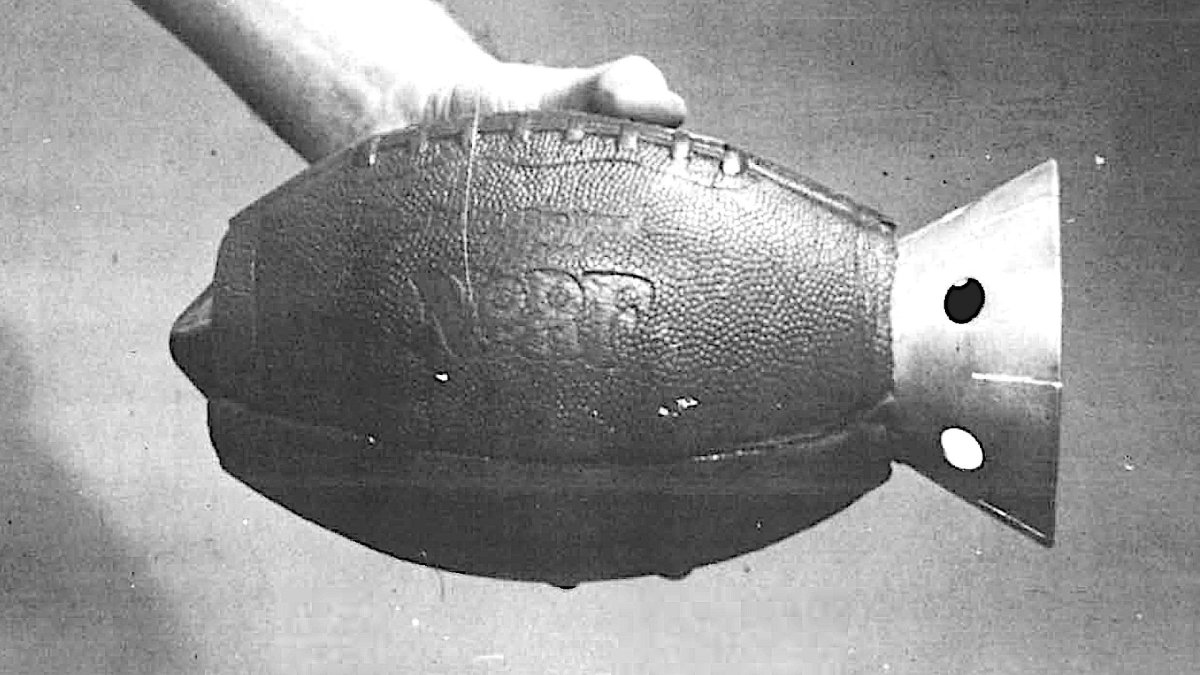
LWL made at least one experimental model using a hollowed-out Nerf football with a metallic container and a conical fin at one end that held the shaped charge inserted in the middle, but it’s not clear if this was a functional prototype. Parker Brothers had launched its brand of now-iconic foam balls in 1969, but there is no indication that they were in any way directly involved in the project. Nerf has since gone on to become a cultural institution better known for its foam dart-shooting guns .
The football device., US Army
In a way, this idea makes perfect sense. Footballs are intended to be thrown across relatively long distances in a manner that stabilizes them in flight making them more accurate. The Army says that it expects an average soldier to be able to throw a standard fragmentation grenade out to a distance of 35 meters, or just under 115 feet, while standing. NFL quarterbacks routinely demonstrate their ability to throw footballs much further than that. It was not necessarily out of the realm of reason to believe average soldiers, while not professional football players, would still be able to get more range and accuracy out of a football-shaped grenade.
It’s not the first time the Army had used this kind of logic, either. During World War II, the service, together with the Office of Strategic Services , the predecessor of the Central Intelligence Agency, had experimented with fragmentation grenades that were the exact same size and weight as regulation baseballs for similar reasons. Those grenades, designated the T-13 and nicknamed the “Beano,” never entered service owing to their use of a dangerously sensitive impact fuze that killed two people and injured 44 others in the course of testing.
A cutaway schematic of the baseball-shaped T-13 Beano grenade., US Army
They did, however, inform the design of the spherical hand grenades that the Army subsequently adopted to replace its French-derived World War I-era Mk 2 “pineapple” grenades . To this day, the service uses a similar design with a slightly more ovular shape as its standard fragmentation grenade.
It’s not clear how many football grenades LWL made in total and what the ultimate configuration might have been, but the design never came close to being field operationally. As perfect as the idea probably sounded in the heads of the engineers who came up with it, it’s probably just as obvious to anyone who has ever seen a football bounce after hitting something as to why it didn’t work. It proved to be virtually impossible to ensure the grenade’s shaped charge detonated at the correct moment to reliably penetrate any armor. The weight distribution of the Army’s “device,” unlike a regulation football, which is uniformly hollow inside, made it unstable in flight, too.
Here is how LWL’s 1974 report explained the results of the tests:
Test on the football shape indicated it also had a low tendency of nose-on impact. In addition, both the spring wire and soft aluminum placed on the nose to cause the “football” to rotate upon impact, so the nose would be perpendicular to the tank surface, did not work as envisioned. The “football” would bounce away before the nose rotated any significant amount. In addition, the “football” never attained a stable trajectory. This was apparently caused by the mass of the grenade type “football” being near the longitudinal axis while a real football has all its weight in the “skin.” The football shape was not considered practical for further development.
LWL testing also showed that none of the anti-tank grenades it developed, including the football type, could be practically employed at distances over 10 meters, or just under 33 feet. One has to imagine that it could not have been easy to ensure that the football grenade would come down on a target, at all, and, even if it had worked as intended, it seems unlikely that drilling it into the side of a tank or other heavy armored vehicle would have produced the desired result.
The 1974 final report’s one-sentence conclusion on the entire project, which cost the Army a paltry $12,167, is curt. “The lightweight (1 1/2-lb.) ‘potato masher’ grenade with parachute showed some promise that it could be developed into a useful antitank weapon if a 10 meter average range could be tolerated.”
The Army shuttered LWL entirely the same month the report came out, amid post-Vietnam War drawdowns, and ultimately decided not to pursue any of the designs, or an anti-tank grenade of any kind. It, along with the U.S. Marine Corps, also passed on the curious spherical-shaped Rifleman’s Assault Weapon (RAW), a rocket-propelled weapon intended to be fired from a standard M16 rifle. That weapon had come from the Brunswick Corporation, a major manufacturing company that had gotten its start making bowling balls and pool tables.
An M16A1 rifle equipped with a launcher for the Rifleman’s Assault Weapon. One of the rocket-propelled weapons is seen loaded underneath the muzzle., DOD
The service ultimately fielded high-explosive dual-purpose rounds , which have some anti-armor capability, for its 40mm grenade launchers . Versions of the M72, as well as its successor in Army service, the M136 , have since been developed with features allowing them to be safely fired from enclosed spaces .
In contrast, the Soviets continued to field anti-tank grenades, as well as export them. Insurgents were still using 1950s-era RKG-3s, a potato masher anti-tank grenade with a small parachute in the handle, against American forces in Iraq to significant effect in the 2000s, especially against lightly armored Humvees and even early Mine-Resistant Ambush Protected (MRAP) vehicles. In 2009, the U.S. Department of the Treasury sanctioned one Iraqi militant group, Jaysh Rijal al-Tariq al-Naqshabandi, specifically citing its use of the RKG-3, among other things.
It’s not clear what happened to any examples of the football device that LWL built, but anyone who’s ever played with a Nerf ball knows that they’re not exactly designed to stand the test of time. The author knows of only one picture to exist of a prototype, which is seen in this story, but there is always the hope that more are hiding, yet to be discovered, in an archive or attic somewhere.
The idea of a literal football grenade has appeared in popular culture at least once, 25 years after the LWL’s real-life project ended, in the 1999 film Three Kings , a sort of action heist movie with the aftermath of the first Gulf War as a backdrop. Spike Jonze’s character uses electrical tape to tie C4 explosive charges and detonators to brightly-colored Nerf-like footballs out of boredom and Ice Cube’s character eventually uses one to blow up a helicopter toward the end of the film.
All in all, the football grenade may not have worked out, but it certainly one of, if not the most distinctly American weapons to ever be developed on any level.
Contact the author: joe@thedrive.com
Comments couldn’t be loaded. Please refresh the page.
作者:约瑟夫·特雷维西克
更新于美国东部时间2020年11月27日下午6:01
很少有什么东西能像橄榄球一样具有鲜明的美国特色,这个国家的大多数人一生中可能至少玩过一次橄榄球。正是基于这种理念,美国陆军在20世纪70年代初开发了一种反坦克手榴弹,其原理是将爆炸物塞进一个掏空的Nerf橄榄球中。
位于马里兰州阿伯丁试验场的陆军陆战实验室(LWL)研制出了“橄榄球装置”,我几年前曾简要介绍过它。这是陆军一项更广泛的计划的一部分,该计划旨在开发某种手掷式反坦克武器,始于1973年7月。陆军最初于1962年成立了LWL,其目的是研发、测试和评估所有可能适用于反叛乱作战的武器或其他技术。当时,反叛乱作战这种战争形式正在世界各地兴起,其中包括东南亚的多个国家,例如南越和泰国。当时,美国已在这些国家日益卷入冲突。
1970年,陆战实验室(LWL)更名为陆地作战实验室(Land Warfare Laboratory),保留了其缩写。此后,该实验室开始探索可能适用于更广泛冲突类型的系统。其中一项工作是反坦克手榴弹项目。该项目的需求源于对现有步兵反装甲能力效用的担忧,尤其是在城市环境中,例如美军预期在欧洲与苏联的任何重大冲突中都将主要发生的城市环境。
“目前美国陆军的标准反坦克武器设计旨在提供最大的实际射程,”一份1974年关于“足球手榴弹”以及LWL公司评估的其他类型武器的最终测试报告解释道。当时陆军服役的主要步兵反坦克武器是BGM-71“陶”式和FGM-77“龙”式反坦克导弹,以及M72轻型反坦克武器(LAW,一种肩扛式火箭筒)的各种型号。
正如LWL的报告所指出的,这些武器的问题在于,发射它们往往会暴露射手的位置。“龙”式导弹在这方面尤其臭名昭著,它不仅会立即将射手置于危险之中,而且如果第一发子弹落空,射手也很难迅速重新投入战斗。此外,这些导弹以及M72导弹都无法在狭小空间内(例如建筑物内部)安全使用。
此外,为了保护发射人员免受爆炸冲击,这些导弹和火箭必须飞行一定的最短距离后才能启动。在狭窄的城市环境中,战斗往往发生在非常近的距离,这也会限制部队使用这些武器的能力。
当时,陆军训练士兵在类似条件下使用各种临时武器攻击重型装甲车辆,包括装满油和汽油的雨披以及装在空弹药箱里的炸药。他们的任务是尽可能利用装甲车辆乘员在车内“严密保护”、所有舱门都关闭时缺乏态势感知的弱点。
这是一张质量较低的扫描件,内容是1972年美国陆军一本漫画风格的手册中的一页,描述了近距离破坏坦克的改进型爆炸方法。(美国陆军,通过《信息自由法》提供)
自二战以来,美军一直沿用这种作战方式。史蒂文·斯皮尔伯格1998年拍摄的著名二战电影《拯救大兵瑞恩》中,就曾在高潮迭起的最终决战中使用过简易的“粘性炸弹”,这种炸弹是用装满炸药并浸透浓油的袜子制成的,用来对付纳粹坦克。
“手掷式短程装置似乎能够克服标准武器在城市环境中的不足,”LWL在1974年的报告中指出。“人们需要一种手掷式装置,使步兵在城市作战中能够瘫痪一辆‘全副武装’的坦克。”
LWL决定专注于手掷武器,该武器装有聚能装药,这种弹头设计常用于反坦克导弹和火箭。聚能装药,也称为空心装药,其特点是在主装药和弹体前端之间有一个较大的空腔。一个倒锥形的金属衬套(通常由铜制成)被插入到主装药中。当装药爆炸时,它会向外膨胀,将衬套变成一个高速金属飞镖,穿透目标。
下面的视频展示了这种聚能装药的基本功能,并以高爆反坦克炮弹为例进行说明。
这项技术可以追溯到19世纪末,至今仍在使用。它的确有效,但如果弹丸的全部威力没有以最佳距离或角度射向目标,其效果就会大大降低。世界各国都在装甲车辆侧面加装了各种各样的间隔装甲、栅栏和网状物,甚至小型炸药块,以防止聚能装药武器按预期引爆。
LWL随后确定,近距离使用聚能装药手掷反坦克手榴弹的最佳攻击方式包括:从车辆顶部窗口投掷、利用掩体投掷,或者尽可能从最远距离击中车辆顶部。通常情况下,坦克或其他重型装甲车辆的炮塔顶部或车体后部是其装甲最薄弱的部位。此外,击毙车内乘员或严重损坏甚至摧毁发动机舱足以完成任务。
值得注意的是,当LWL公司开始研发一种能够满足这些要求并可在上述一种或多种场景中使用的武器时,包括美国的欧洲盟友和苏联在内的许多其他国家早在几十年前就已经装备了反坦克手榴弹。到了20世纪70年代,一些国家,特别是苏联及其盟国,仍在继续使用反坦克手榴弹。
陆军实验室的人员识别出多种外国手榴弹类型,并以此为研究提供参考,其中最主要的是所谓的“土豆捣碎器”式手榴弹,这种手榴弹带有类似棍状的投掷手柄。这些手榴弹的反坦克版本几乎都配备了某种减速装置,例如布条,甚至是小型降落伞,以帮助稳定弹体。其设计理念是,这些装置能使手榴弹近乎垂直地落在车辆顶部,从而最大限度地发挥聚能装药战斗部的杀伤效果。与普通手榴弹上的定时引信不同,这些手掷武器通常使用撞击引信,只有撞击物体才会引爆。
一枚冷战时期波兰制造的、苏联设计的“土豆捣碎器”式RPG-43反坦克手榴弹。投掷时,手柄底部的锥形部分会脱落,同时伸出两条布条以稳定手榴弹。(国际军事古董)
不出所料,LWL公司设计了两款土豆捣碎器手榴弹,其中一款前端装有磁铁,以便在引爆前吸附在目标上。该公司还制造了两款实验性的飞镖形手榴弹,一款带有尾翼,另一款带有某种罩状物,这两款手榴弹的设计目的都是为了在投掷后保持稳定。遗憾的是,目前似乎没有这两款疑似反坦克草坪飞镖的图片可供参考。其基本原理在某些方面与二战时期英国的68号反坦克手榴弹相似。它也让人联想到美国内战时期的凯彻姆手榴弹,这是一种北方联邦军的武器,其爆炸体呈蛋形,带有木制尾翼,其外观与现代的旋涡橄榄球有几分相似。
一枚已失效的68号反坦克手榴弹,阿伦德尔军用品公司出品
一枚凯彻姆手榴弹,威尔逊溪国家战场
然后还有橄榄球装置。“由于一个标准尺寸的橄榄球重14盎司,因此在这个重量限制内制造聚能装药手榴弹被认为是可行的,”LWL在1974年的报告中写道。“此外,大多数美军士兵都熟悉投掷橄榄球。”
LWL公司至少制作过一个实验模型,该模型使用一个掏空的Nerf橄榄球,一端装有一个金属容器和一个锥形鳍片,锥形鳍片用于放置中间的聚能装药。但目前尚不清楚这是否是一个功能齐全的原型。帕克兄弟公司于1969年推出了如今已成为标志性产品的泡沫球,但没有迹象表明他们以任何方式直接参与了该项目。此后,Nerf发展成为一种文化现象,并以其泡沫飞镖枪而闻名。
足球装置,美国陆军
从某种意义上说,这个想法完全合情合理。橄榄球的设计初衷就是为了在相对较远的距离上投掷,并且投掷方式能够使其在飞行中保持稳定,从而提高精准度。陆军表示,他们期望普通士兵能够在站立状态下将一枚标准破片手榴弹投掷到35米(略低于115英尺)的距离。而NFL四分卫经常能将橄榄球投掷得更远。因此,即使普通士兵并非职业橄榄球运动员,他们也能利用橄榄球形状的手榴弹获得更远的投掷距离和更高的精准度,这种想法并非完全没有道理。
这并非陆军第一次使用这种逻辑。二战期间,陆军曾与中央情报局的前身战略情报局(OSS)合作,出于类似的原因,试验过一种尺寸和重量与标准棒球完全相同的破片手榴弹。这种手榴弹被命名为T-13,绰号“Beano”,但由于其使用的撞击引信极其敏感,在测试过程中造成两人死亡、44人受伤,最终未能投入使用。
美国陆军T-13“比诺”棒球形手榴弹的剖面示意图。
然而,它们确实为陆军后来采用的球形手榴弹的设计提供了参考,这种手榴弹取代了其源自法国一战时期的Mk 2“菠萝”手榴弹。时至今日,陆军仍然使用一种形状略呈椭圆形的类似设计作为其标准破片手榴弹。
目前尚不清楚LWL公司总共生产了多少枚足球手榴弹,也不清楚其最终的配置方案,但这种设计从未真正投入实战。尽管在设计者的脑海中,这个想法听起来或许完美无缺,但任何看过足球撞击物体后弹跳的人都能轻易看出它为何行不通。事实证明,要确保手榴弹的聚能装药在正确的时间引爆,从而可靠地穿透任何装甲,几乎是不可能的。此外,与内部均匀中空的正规足球不同,陆军的这种“装置”重量分布不均,导致其飞行不稳定。
以下是LWL在1974年的报告中对测试结果的解释:
对橄榄球形状的测试表明,其正面撞击的倾向较低。此外,为了使“橄榄球”在撞击时旋转,从而使其头部与坦克表面垂直,在头部设置了弹簧钢丝和软铝,但这些措施并未达到预期效果。“橄榄球”在头部旋转到任何显著角度之前就会弹开。而且,“橄榄球”始终无法获得稳定的飞行轨迹。这显然是由于手榴弹式“橄榄球”的质量集中在纵轴附近,而真正的橄榄球的全部重量都集中在“皮”上。因此,橄榄球形状被认为不具备进一步开发的实用性。
LWL的测试还表明,其研发的所有反坦克手榴弹,包括足球型手榴弹,都无法在10米(约33英尺)以上的距离上实际使用。可以想象,要确保足球型手榴弹能够击中目标绝非易事,即便它能够按预期发挥作用,将其钻入坦克或其他重型装甲车辆的侧面也很难达到预期效果。
1974 年的最终报告对整个项目仅用一句话作结,该项目耗资陆军区区 12,167 美元。报告简洁地写道:“这种轻型(1.5 磅)带降落伞的‘土豆捣碎器’手榴弹展现出一定的潜力,如果能够接受 10 米的平均射程,它有可能发展成为一种有用的反坦克武器。”
在越战后裁军潮的背景下,陆军在报告发布的当月就彻底关闭了LWL公司,并最终决定不再推进任何设计方案,包括任何类型的反坦克手榴弹。陆军和美国海军陆战队也放弃了外形奇特的球形步枪突击武器(RAW),这是一种火箭推进武器,计划由标准的M16步枪发射。该武器来自布伦瑞克公司,这家大型制造企业最初是生产保龄球和台球桌起家的。
一支配备有突击步枪发射器的M16A1步枪。可以看到枪口下方装填着一枚火箭推进武器。(美国国防部)
该部队最终为其40毫米榴弹发射器配备了具有一定反装甲能力的高爆双用途弹药。M72及其在陆军中的后继型号M136,此后都经过改进,具备了在封闭空间内安全发射的功能。
相比之下,苏联继续装备并出口反坦克手榴弹。在21世纪初,伊拉克境内的叛乱分子仍在使用20世纪50年代的RKG-3反坦克手榴弹——一种手柄内装有小型降落伞的“土豆捣碎器”式手榴弹——对美军造成了显著的打击,尤其对轻型装甲悍马车,甚至早期的防地雷反伏击车(MRAP)都有效。2009年,美国财政部对伊拉克武装组织“纳克沙班迪军”(Jaysh Rijal al-Tariq al-Naqshabandi)实施制裁,制裁理由之一便是该组织使用了RKG-3反坦克手榴弹。
目前尚不清楚LWL公司制造的那种橄榄球装置究竟去了哪里,但任何玩过Nerf球的人都知道,这种球的设计初衷并非为了经受时间的考验。作者目前只找到一张原型机的照片,也就是本文中提到的那张,但我们始终抱有希望,或许还有更多原型机隐藏在某个档案馆或阁楼里,等待着我们去发现。
在LWL的现实项目结束25年后,足球手榴弹的概念至少在流行文化中出现过一次,那就是1999年的电影《三个国王》(Three Kings)。这部电影以第一次海湾战争的余波为背景,是一部动作劫匪片。斯派克·琼斯饰演的角色因为无聊,用电工胶带把C4炸药和雷管绑在颜色鲜艳的类似Nerf玩具的橄榄球上。影片结尾,艾斯·库珀饰演的角色用其中一个炸毁了一架直升机。
总而言之,足球手榴弹可能并不成功,但它无疑是美国历史上最具特色的武器之一,甚至可以说是最具特色的武器。
联系作者:joe@thedrive.com
评论加载失败,请刷新页面。