USS Desert Ship Sits In A Sea Of Sand And Launched The Navy To The Forefront Of Missile Tech“沙漠”号军舰静静地伫立在沙海之中,将海军推向了导弹技术的前沿。
This unique and historic facility has played an essential role in developing the U.S. Navy's missile technology since the dawn of the Cold War.
新闻视频
Updated Nov 17, 2021 10:45 AM EST
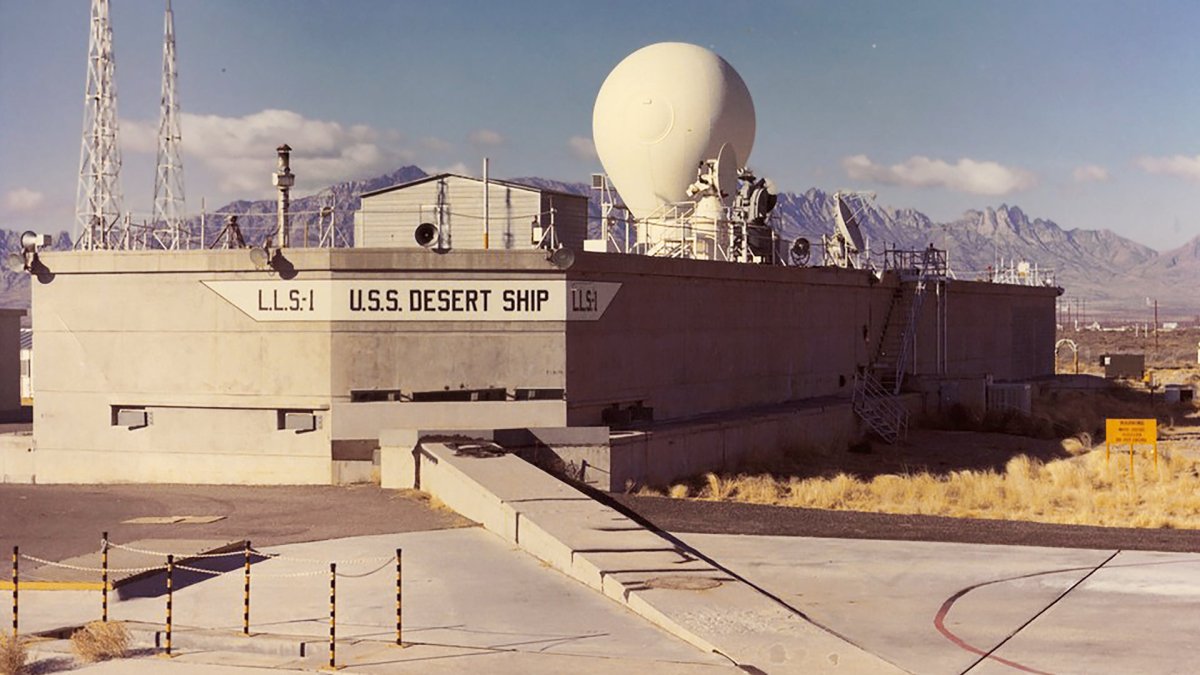
Among the maelstrom of operational and abandoned test sites that speckle the desolate desert on the southern end of White Sands Missile Range sits a peculiar facility that has quietly helped develop the Navy’s most important missile, gun, and fire control technologies for over six decades. The installation with a U.S. Navy ship’s name and culture, but located thousands of miles away from where a ship should be, has put weapon systems that would change warfare forever through their paces. This place is USS Desert Ship, also designated LLS-1, for ‘Land Locked Ship’ number one. It is also known by the adjacent launch site that predates it, Launch Center 35 (LC-35).
LLS-1 is yet another exotic installation that makes up a constellation full of seemingly countless facilities arrayed across the United States that develop, test, and evaluate America’s future combat technologies. LLS-1 is half ship-like concrete bunker and half launch pad. Built in the mid-1950s at the dawn of the guided missile age, its blockhouse was designed to be stuffed with combat systems and to emulate the conditions found on an operational U.S. Navy fighting ship. Its upper deck was fortified to accommodate similar sensors and communications gear found on its seagoing counterparts as well as additional gear needed to support testing efforts and to interface with the highly networked and surveilled White Sands Missile Range complex which extends many miles to the North.
The WSMR Complex area (marked in red) is about 8 miles to the west of USS Desert Ship., WSMR
The facility was originally built to develop and test the massive and ultra-complex and optionally nuclear-armed RIM-8 Talos shipboard surface-to-air missile system. When I say complex and massive it is not for hyperbole’s sake. Read all about this crazy Cold War weapon whose combined magazine and launch system was more akin to a highly armored assembly line at sea than anything else in this recent feature of mine .
The facility from the air, with what looks like a box launcher installed for Sea Sparrow missile tests. Also, note the large trapezoidal building with GO NAVY on the top is the Talon assembly-magazine area just like the ones found on ships (Left image). Talos tests had to very lively affairs back in the 1950s (Right)!, USN
Eventually, the ‘Three Ts’ of the Navy’s SAM ecosystem during the first couple of decade of the Cold War—Terrier, Tartar, and Talos—would be tested at the facility, with all three launchers , including Talos’ missile assembly magazine, being installed in front and just to the east of USS Desert Ship. Gun systems were also tested at the site. A 73,000 pound, Mk39 five-inch gun was used primarily. Tests included the evaluation of rocket-propelled shells back in the 1990s before the gun was removed in 2000.
Before any of this took place, back in 1947, a pad adjacent to where USS Desert Ship sits to today was constructed to launch Aerobee sounding rockets into the upper atmosphere. These rockets gathered important information on atmospheric conditions and cosmic radiation. Two big launch towers were used to send the Aerobees on their way. The name LC-35 comes from this precursor installation to USS Desert Ship.
The large tilting launch rails used for Aerobee rockets at LC-35. These rockets could travel dozens of miles into the upper reaches of Earth’s atmosphere. , UC Boulder
By the mid-1970s, the facility began to slowly migrate away from primarily supporting tests of the ‘Three Ts’ to the doing so for the Standard Missile series and the Aegis Combat System. A large portion of Aegis developmental testing was executed at the site leading up to and after its certification in 1983. Since then, USS Desert Ship has continued to support the development of the latest Navy missile technologies. White Sands Missile Range officially describes the site’s activities as such:
Launch Complex 35, known as the USS Desert Ship LLS-1, is primarily used for live fire testing the Navy´s STANDARD Missile (SM). The Navy is currently testing SM and Evolved Seasparrow Missile (ESSM) at this site. All versions of STANDARD Missile have been tested at the Desert Ship including SM-2 Block II (Terrier, Tartar, AEGIS, and Vertical Launch AEGIS), SM-2 Block III/IIIA/IIIB (Terrier, Tartar, and Vertical Launch AEGIS), and SM-2 Block IV (Extended Range Vertical Launch AEGIS). Testing of SM-2 Blk IVA is in process. Other Navy systems that have been tested here include Sea Lance, NATO Seasparrow Missile (NSSM), and Vertical Launch ASROC (VLA). The Desert Ship functionally duplicates the fire control requirements of a surface ship. Dedicated telemetry, target monitoring, and data extraction and reduction systems Launch Complex 35 “The Desert Ship” complement the extensive instrumentation services provided by the Range… Launch Complex 35 is a Research Rocket facility that includes a block-house, launch control equipment, and a payload assembly building. Current use of this facility is for NASA payload buildup, telemetry pre-launch and launch support, and uplink control of rocket payloads.
Launch Complex 35, known as the USS Desert Ship LLS-1, is primarily used for live fire testing the Navy´s STANDARD Missile (SM). The Navy is currently testing SM and Evolved Seasparrow Missile (ESSM) at this site. All versions of STANDARD Missile have been tested at the Desert Ship including SM-2 Block II (Terrier, Tartar, AEGIS, and Vertical Launch AEGIS), SM-2 Block III/IIIA/IIIB (Terrier, Tartar, and Vertical Launch AEGIS), and SM-2 Block IV (Extended Range Vertical Launch AEGIS). Testing of SM-2 Blk IVA is in process. Other Navy systems that have been tested here include Sea Lance, NATO Seasparrow Missile (NSSM), and Vertical Launch ASROC (VLA). The Desert Ship functionally duplicates the fire control requirements of a surface ship. Dedicated telemetry, target monitoring, and data extraction and reduction systems Launch Complex 35 “The Desert Ship” complement the extensive instrumentation services provided by the Range…
Launch Complex 35 is a Research Rocket facility that includes a block-house, launch control equipment, and a payload assembly building. Current use of this facility is for NASA payload buildup, telemetry pre-launch and launch support, and uplink control of rocket payloads.
Some areas inside LLS-1 look a bit more like a NASA control center than the inside of a fighting ship, while others still supposedly appear similar to what you would see in a combat information center aboard a ship. And even though the facility is over 60 years old, it is still uniquely positioned to test the hardware that will end up on America’s front-line fighting ships in the not so distant future., USN
More recently, in 2016, LLS-1 executed a highly publicized cooperative engagement test in which an F-35 provided targeting information to an SM-6. The facility continues to be an important part of moving improved versions of the hugely versatile SM-6 that feature new capabilities into an operational state, but gone are the eclectic turreted launchers of the past.
A basic concept drawing of the cooperative engagement test over White Sands Missile Range in which an F-35 provided targeting data for a SM-6 fired from USS Desert Ship. , USN
Today, an upright Mark 41 vertical launch system, similar to those used at Aegis Ashore sites overseas, provides the launch interface for missile tests. A relatively new site handles the launches remotely from USS Desert Ship.
There is also a weapons assembly facility across the road from USS Desert Ship that provides munitions to be tested. It was built to make tests more seamless as transporting experimental weapons over long distances was deemed problematic, especially while trying to power through important trials. But by and large, there isn’t anything but a handful of other test sites within about 10 miles of USS Desert Ship, with the closest population center being the tiny town of White Sands that largely exists to support the missile range and its workforce.
Even though only roughly 30 sailors work at the site, along with a number of contractors that can drastically increase or decrease depending on the testing schedule, it seems that some of those who have called the facility home actually enjoyed their time there.
USS Desert Ship and LC-35., Google Earth
A newer remote facility located roughly two and a half miles north of USS Desert Ship is equipped with the vertical launch systems needed to carry out missile tests in conjunction to USS Desert Ship for the Navy., Google Earth
There are a handful of other ship-like structures built on land to help in naval combat systems research and development which we will discuss in a future article, but none are as remote or offer live fire opportunities like USS Desert Ship.
It’s yet another oddity of the sprawling White Sands Missile Range—a place packed with history along with a sprinkling of mystery.
Contact the author: Tyler@thedrive.com
Comments couldn’t be loaded. Please refresh the page.
更新于美国东部时间2021年11月17日上午10:45。
在白沙导弹靶场南端荒凉的沙漠中,星罗棋布着许多仍在运行或已废弃的试验场,其中坐落着一座奇特的设施。六十多年来,它默默地为美国海军最重要的导弹、火炮和火控技术的发展做出了贡献。这座设施拥有美国海军舰艇的名称和文化,却位于距离舰艇通常驻扎地点数千英里之外的地方,它对那些将永远改变战争格局的武器系统进行了严密的测试。这里就是“沙漠之舰”(USS Desert Ship),也被称为LLS-1,即“陆上舰艇”一号。它旁边还有一个比它更古老的发射场——35号发射中心(LC-35)。
LLS-1是众多遍布美国各地、用于研发、测试和评估美国未来作战技术的设施中又一个独特的组成部分。LLS-1一半是类似舰艇的混凝土掩体,一半是发射台。它建于20世纪50年代中期,正值导弹时代初期。其掩体内部设计紧凑,旨在容纳各种作战系统,并模拟美国海军作战舰艇的运行环境。其上层甲板经过加固,可以容纳与海上舰艇类似的传感器和通信设备,以及支持测试工作和与北部延伸数英里、高度联网且监控严密的白沙导弹靶场进行对接所需的其他设备。
WSMR综合区域(红色标记处)位于“沙漠之船”号潜艇以西约8英里处。
该设施最初是为了研发和测试庞大、极其复杂且可选配核弹头的RIM-8“塔洛斯”舰载地对空导弹系统而建造的。我说它复杂庞大绝非夸张。想了解更多关于这款冷战时期疯狂武器的信息吗?不妨阅读我最近撰写的专题文章,它集弹药库和发射系统于一体,与其说像武器,不如说更像一条海上装甲装配线。
从空中俯瞰,该设施似乎安装了用于海麻雀导弹测试的箱式发射架。此外,请注意顶部标有“GO NAVY”(海军加油)字样的大型梯形建筑,它是塔洛导弹的组装弹药库,与舰艇上的类似(左图)。塔洛导弹的测试在20世纪50年代可谓是相当激烈(右图)!美国海军
最终,冷战初期二十年间海军地空导弹系统“三巨头”(Terrier、Tartar 和 Talos)将在该设施进行测试。所有三套发射装置,包括 Talos 的导弹组装弹药库,都安装在“沙漠之舰”号两栖攻击舰的前方和东侧。该基地也曾测试过舰炮系统,主要使用的是一门重达 73,000 磅的 Mk39 型五英寸舰炮。测试内容包括上世纪 90 年代对火箭推进炮弹的评估,该舰炮于 2000 年被拆除。
在这一切发生之前,早在1947年,在如今“沙漠之舰”号航母所在位置附近,就建造了一个发射台,用于将“航空蜂”探空火箭发射到高层大气中。这些火箭收集了有关大气状况和宇宙辐射的重要信息。当时使用了两座大型发射塔来发射“航空蜂”火箭。LC-35的名称就来源于“沙漠之舰”号航母的这个前身设施。
LC-35发射台用于Aerobee火箭的大型倾斜发射导轨。这些火箭可以飞越数十英里,进入地球大气层的上层。——科罗拉多大学博尔德分校
到20世纪70年代中期,该设施开始逐渐从主要支持“三T”(导弹、导弹、导弹、导弹)测试转向支持标准导弹系列和宙斯盾作战系统。宙斯盾系统的大部分研发测试都在该基地进行,直至1983年获得认证。此后,“沙漠之舰”导弹靶场继续支持海军最新导弹技术的研发。白沙导弹靶场对该基地活动的官方描述如下:
35号发射复合体,又称“沙漠之舰”LLS-1,主要用于海军标准导弹(SM)的实弹测试。目前,海军正在该场地测试标准导弹和改进型海麻雀导弹(ESSM)。所有版本的标准导弹都已在“沙漠之舰”进行过测试,包括SM-2 Block II(配备猎犬导弹、鞑靼导弹、宙斯盾导弹和垂直发射宙斯盾导弹)、SM-2 Block III/IIIA/IIIB(配备猎犬导弹、鞑靼导弹和垂直发射宙斯盾导弹)以及SM-2 Block IV(增程型垂直发射宙斯盾导弹)。SM-2 Block IVA的测试正在进行中。其他曾在此进行过测试的海军系统包括海矛导弹、北约海麻雀导弹(NSSM)和垂直发射型ASROC(VLA)。“沙漠之舰”在功能上模拟了水面舰艇的火控要求。 35号发射台(“沙漠之船”)配备了专用遥测、目标监测以及数据提取和处理系统,这些系统与靶场提供的广泛仪器服务相辅相成……35号发射台是一个研究火箭设施,包括一个控制室、发射控制设备和有效载荷组装大楼。目前,该设施用于NASA有效载荷的组装、发射前遥测和发射支持,以及火箭有效载荷的上行链路控制。
35号发射复合体,又称“沙漠之舰”LLS-1,主要用于海军标准导弹(SM)的实弹测试。目前,海军正在该场地测试标准导弹和改进型海麻雀导弹(ESSM)。所有版本的标准导弹都已在“沙漠之舰”进行过测试,包括SM-2 Block II(配备猎犬导弹、鞑靼导弹、宙斯盾导弹和垂直发射宙斯盾导弹)、SM-2 Block III/IIIA/IIIB(配备猎犬导弹、鞑靼导弹和垂直发射宙斯盾导弹)以及SM-2 Block IV(增程型垂直发射宙斯盾导弹)。SM-2 Block IVA的测试正在进行中。其他曾在此进行过测试的海军系统包括海矛导弹、北约海麻雀导弹(NSSM)和垂直发射型ASROC(VLA)。“沙漠之舰”在功能上模拟了水面舰艇的火控要求。 35号发射台“沙漠之船”配备了专用遥测、目标监测、数据提取和处理系统,是对靶场提供的广泛仪器服务的补充……
35号发射综合体是一个研究火箭设施,包括一个控制室、发射控制设备和有效载荷组装大楼。该设施目前用于NASA的有效载荷组装、发射前遥测和发射支持,以及火箭有效载荷的上行链路控制。
LLS-1内部的一些区域看起来更像是NASA的控制中心,而不是作战舰艇的内部,而另一些区域则类似于舰艇上的作战信息中心。尽管该设施已有60多年的历史,但它仍然拥有独特的优势,可以测试不久的将来将装备在美国一线作战舰艇上的硬件。
最近,在2016年,LLS-1进行了一次备受瞩目的协同作战测试,其中一架F-35战斗机向SM-6导弹提供了目标信息。该设施仍然是推动功能强大的SM-6导弹改进型投入使用的重要环节,这些改进型导弹具备了新的功能,但过去那些造型各异的炮塔式发射器已经成为历史。
这是一张在白沙导弹靶场进行的协同交战测试的基本概念图,其中一架F-35战斗机为从“沙漠之舰”号两栖攻击舰上发射的SM-6导弹提供目标数据。
如今,一套与海外陆基宙斯盾系统所使用的类似的Mark 41型垂直发射系统,为导弹试验提供发射接口。一个相对较新的发射场负责从“沙漠之舰”号两栖攻击舰远程操控发射。
在“沙漠之舰”号导弹靶场对面还有一座武器组装厂,为测试提供弹药。该厂的建设旨在简化测试流程,因为长途运输实验性武器被认为十分棘手,尤其是在需要快速完成重要试验的情况下。但总的来说,在“沙漠之舰”号导弹靶场方圆十英里内,除了少数几个试验场外,并没有其他设施。最近的人口中心是白沙小镇,该镇的存在主要是为了支持导弹靶场及其工作人员。
尽管该基地只有大约 30 名水兵工作,还有一些承包商,人数会根据测试计划大幅增加或减少,但似乎一些以该设施为家的人确实很享受在那里度过的时光。
“沙漠号”潜艇和LC-35登陆舰,谷歌地球
位于“沙漠之舰”号潜艇以北约两英里半处的一个较新的远程设施配备了垂直发射系统,用于配合“沙漠之舰”号潜艇为海军进行导弹试验。(谷歌地球)
陆地上还建造了一些其他类似舰船的结构,以帮助进行海军作战系统的研究和开发,我们将在以后的文章中讨论,但没有一个像“沙漠之舰”那样偏远,也没有一个能提供实弹射击的机会。
这是白沙导弹靶场这个庞大基地的又一个奇特之处——这里充满了历史气息,也带有一丝神秘色彩。
联系作者:Tyler@thedrive.com
评论加载失败,请刷新页面。