This Lecture By An F-22 Test Pilot On The Raptor’s Flight Control System Is Bonkers这位F-22试飞员关于猛禽战斗机飞行控制系统的讲座简直太疯狂了。
The video highlights just how much fly-by-wire automation is needed to make the Raptor's super maneuverability a reality.
Updated Jul 11, 2020 5:30 PM EDT
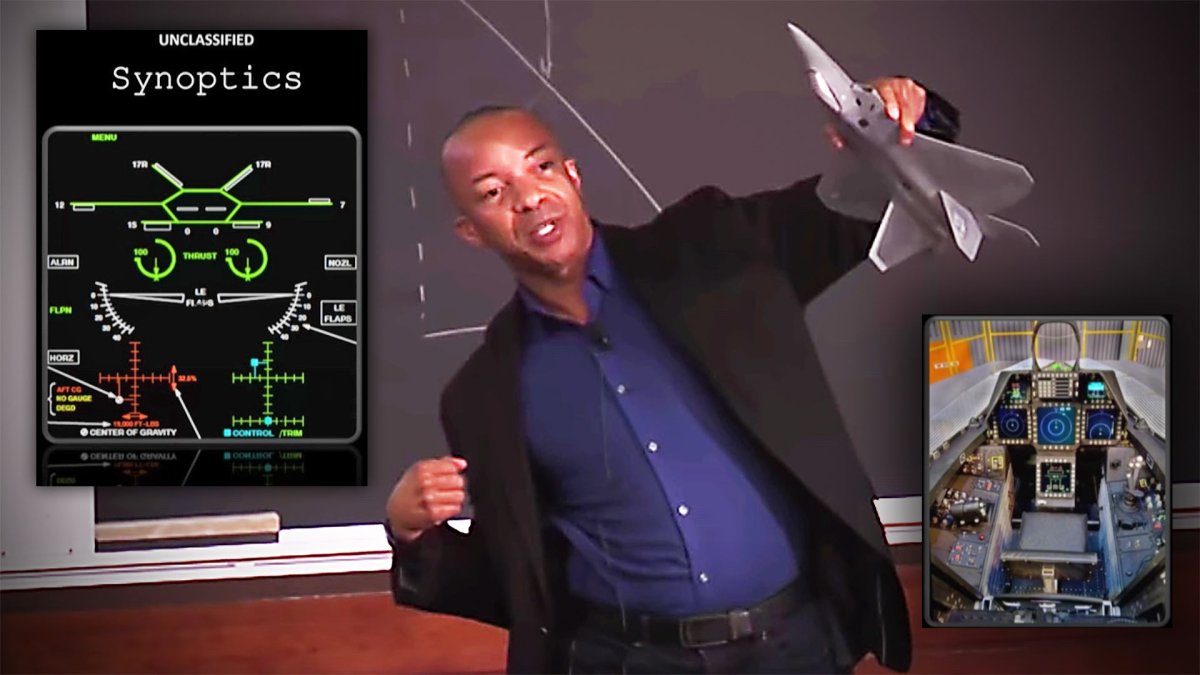
Lt. Col. Randy “Laz” Gordon is an accomplished test pilot, engineer, and F-22 Raptor squadron commander who lent his expertise about all things aviation, and especially about the F-22’s incredible fly-by-wire flight control system, to students taking MIT’s Private Pilot Ground School in 2019. His lecture is astonishingly accessible considering the complexities of the systems and concepts he describes and will give anyone a remarkable appreciation for just how incredible the super-maneuverable Raptor’s flight control system really is.
Gordon covers so much ground in his talk. He talks about the constant tension between low-observability (stealth) and aerodynamics that resulted in the F-22’s design , the massive loads the Raptor’s powerful flight control system and its huge control surfaces have to instantly counteract, how supersonic flight requires unique flight control concepts, and even how permanent magnetic generators keep power running to the F-22’s flight controls just by having the engines windmill.
There is truly an astonishing amount of information in this presentation and it also acts as a great primer for anyone who is new to the concept of fly-by-wire flight control systems.
Some other interesting tidbits include:
Raptor pilots make sure their hands are off the flight controls and visible when ground crews are working around a running jet because one touch of the stick could cause the 4,000psi hydraulic system to send a control surface into deflection which can decapitate a ground crewman.
Although the F-22’s high altitude capabilities, partially a product of its thrust vectoring capabilities, are known, Gordon notes the aircraft flies at altitudes from 60,000-65,000 feet.
He describes the pressure-sensitive sidestick control concept, which moves less than a half-inch, very well. The concept was pioneered by the F-16, with the YF-16’s sidestick not moving at all before changes were made.
The flight controls page on the F-22’s multi-function-display is really well described here. The level of automation and simple symbology to describe complex issues is remarkable.
The F-22 knows it is about to take off and automatically reconfigures the plane for departure. It does the same upon touchdown.
Multiple other automation flight logic modes, in which the flight control system sets to totally different parameters, exist. This is not uncommon on other fly-by-wire aircraft, like airliners, but the F-22’s huge flight envelope makes them far more pronounced.
There is a mode for aerial refueling to give the jet the best fine handling behind the tanker.
In aerial combat mode, you put pressure on the stick and it locks in a G-rate for a turn and stays there even if you take your hand off the stick.
When landing, it goes into a pitch command mode, where the pilot simply directs the pitch of the aircraft and it stays there.
A large number of limiters are used to make sure the jet is not capable of being structurally overloaded and it even automatically unloads individual parts of the aircraft during certain maneuvers by using flight control surfaces non-traditionally.
When an F-22 drops a weapon, namely a 1,000lb JDAM , fuel automatically sloshes forward to maintain center of gravity. There is no fuel panel on the jet to command this, it is all part of the control logic.
Check out the whole video for yourself below:
Although it is not formally talked about in the presentation, as we have discussed in the past , low-observability is also factored into flight control systems on stealthy aircraft. This would be yet another layer to the F-22’s flight control programming.
What parts did you find interesting? Let us know in the comments below!
Author’s note: A big thanks to David Williams for sending this little gem over.
Contact the author: Tyler@thedrive.com
Comments couldn’t be loaded. Please refresh the page.
更新于美国东部时间2020年7月11日下午5:30
兰迪·“拉兹”·戈登中校是一位经验丰富的试飞员、工程师和F-22猛禽战斗机中队指挥官。2019年,他为麻省理工学院私人飞行员地面学校的学员们讲解了他在航空领域的专业知识,特别是F-22令人惊叹的电传飞行控制系统。考虑到他所描述的系统和概念的复杂性,他的讲座却出奇地通俗易懂,会让任何人深刻体会到这款超机动猛禽战斗机的飞行控制系统究竟有多么出色。
戈登的演讲涵盖了非常广泛的内容。他谈到了F-22设计中低可探测性(隐身)和空气动力学之间持续存在的矛盾,猛禽战斗机强大的飞行控制系统及其巨大的控制面必须瞬间抵消的巨大载荷,超音速飞行需要独特的飞行控制理念,甚至还谈到了永磁发电机如何仅通过发动机的旋转运动来维持F-22飞行控制系统的电力供应。
本次演示包含的信息量确实非常惊人,对于任何初次接触电传飞行控制系统概念的人来说,它也是一个很好的入门读物。
其他一些有趣的小细节包括:
猛禽战斗机的飞行员在地面人员在运转中的喷气式飞机周围工作时,会确保自己的双手离开飞行控制装置并处于可见状态,因为哪怕只是轻轻触碰一下操纵杆,都可能导致 4,000 psi 的液压系统使控制面发生偏转,从而可能将地面人员斩首。
尽管F-22的高空飞行能力(部分归功于其推力矢量控制能力)是众所周知的,但戈登指出,该飞机的飞行高度在60000至65000英尺之间。
他对压力感应式侧杆控制概念的描述非常到位,这种控制方式的侧杆行程不到半英寸。F-16战斗机率先采用了这一概念,而YF-16战斗机的侧杆在改进之前根本无法移动。
这里对F-22多功能显示器上的飞行控制页面描述得非常清楚。其自动化程度之高以及用简洁的符号来描述复杂问题的能力令人惊叹。
F-22战机能够感知即将起飞,并自动调整飞机配置以适应起飞状态。着陆时也会进行同样的调整。
还存在多种其他自动化飞行逻辑模式,在这些模式下,飞行控制系统会设置完全不同的参数。这在其他电传操纵飞机(例如客机)上并不罕见,但F-22巨大的飞行包线使得这些模式更加明显。
有一种空中加油模式,可以使喷气式飞机在加油机后方获得最佳的操控性能。
在空中战斗模式下,你向操纵杆施加压力,它会锁定转弯时的 G 值,即使你把手从操纵杆上移开,它也会保持该值。
着陆时,飞机进入俯仰指令模式,飞行员只需控制飞机的俯仰角,飞机就会保持该角度。
为了确保喷气式飞机不会发生结构过载,使用了大量的限制器,它甚至在某些机动过程中通过非常规地使用飞行控制面来自动卸载飞机的各个部件。
当F-22投掷武器,例如一枚1000磅重的联合直接攻击弹药(JDAM)时,燃油会自动向前晃动以保持飞机重心稳定。飞机上没有燃油控制面板来控制这一过程,这完全是控制逻辑的一部分。
请在下方观看完整视频:
虽然本次报告中并未正式提及,但正如我们之前讨论过的,低可观测性也是隐形飞机飞行控制系统的考量因素之一。这将为F-22的飞行控制程序增加又一层复杂性。
你觉得哪些部分有趣?请在下方评论区留言告诉我们!
作者注:非常感谢大卫·威廉姆斯寄来这篇精彩的文章。
联系作者:Tyler@thedrive.com
评论加载失败,请刷新页面。