How The Experimental USS Narwhal Ended Up Being The Navy’s Stealthiest Nuclear Submarine实验型“独角鲸”号核潜艇如何成为海军最隐形的核潜艇
The sub had a range of exotic improvements over previous designs that allowed it to stalk Soviet submarines like no other.
Updated Apr 30, 2020 3:54 PM EDT
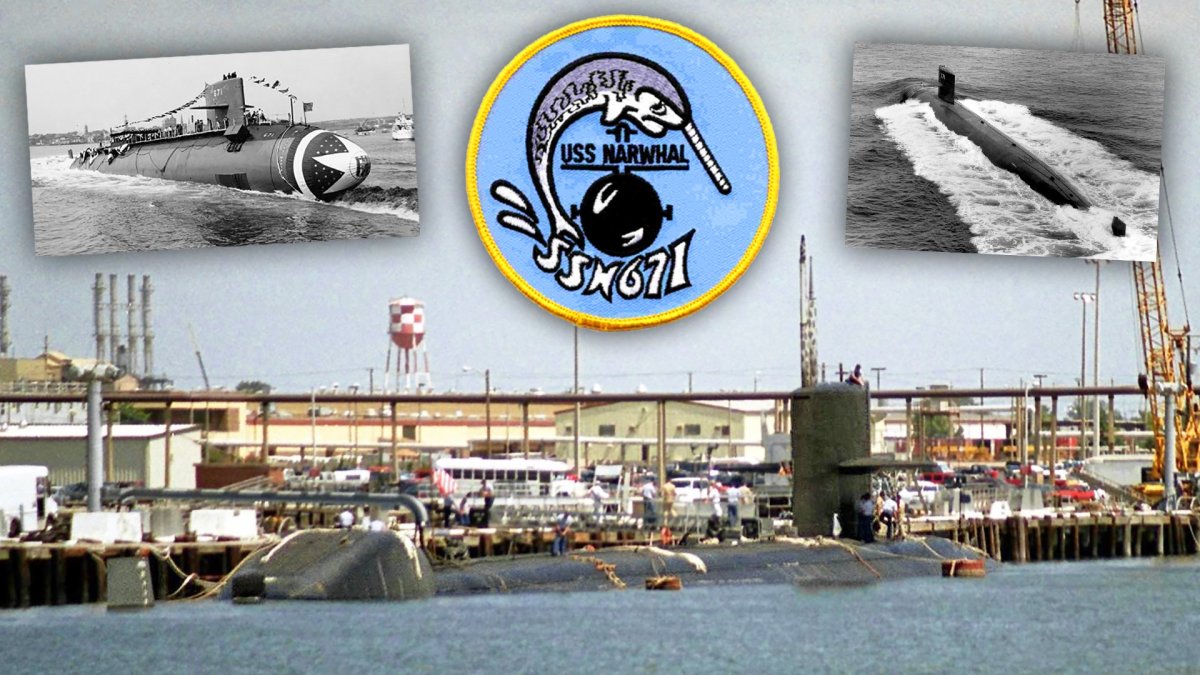
The USS Narwhal , also known by its hull number SSN-671, was a totally unique and experimental nuclear-powered attack submarine and one of the most successful boats of her era. Her unique design made her the quietest attack submarine in the U.S. fleet in the 1970s and she was routinely deployed far and wide to watch Soviet submarines in the Atlantic and around Soviet-supported satellite states in the Mediterranean Sea. In this piece, we will dive deeply into what made her quieter than any other operational nuclear submarine of her era and how the game-changing technology she pioneered was implemented in future United States submarine projects.
In the first half of the 1960s, the U.S. Navy challenged the Electric Boat Division of the General Dynamics Corporation with constructing an operational prototype submarine using elements of the Sturgeon class hull design. It was to be quiet, fast, and lethal, while still leveraging existing technology and construction methods.
To understand what made SSN-671 so special, we must understand what makes nuclear submarines vulnerable to detection and destruction. Any piece of equipment that moves is a potential noise source for a submarine. The heavier and faster it moves, the more energy is being exchanged, thus the more likely it is to become a detection problem.
Some of that energy can be transmitted as vibration, a cyclical energy sonar systems detect. If the engineers can remove or improve these heavy energy loads, they will be successful in building a quieter nuclear submarine.
Electric Boat identified areas that could be improved. The first was the Main Reactor Coolant pumps. These large, high-heat, high-pressure pumps spin under heavy load and can be the most vulnerable acoustic source of any nuclear-powered vessel.
General Electric designed Narwhal’s unique S5G power plant with the reactor vessel situated low in the submarine’s hull and the steam generators situated above the reactor to facilitate a natural flow of the reactor’s primary coolant. This Pressurized-Water Reactor (PWR) design heated its primary loop in the reactor and convection moved the water into the steam generator near the top of the loop where energy is exchanged into the secondary system. With less energy, the primary coolant flows back down towards the reactor vessel in a return loop.
This simple design relies on physics to move the water rather than a mechanical pump. Natural circulation only occurs under specific circumstances, so reactor coolant pumps were still used, but only when necessary.
When the reactor is critical, but in a low power state, it may not have enough energy to maintain a natural circulation of the primary coolant. This is when the primary coolant pumps are used to maintain coolant circulation to prevent runaway heat generation in the reactor vessel. Conversely, in a high energy state, a mechanical coolant pump is necessary to keep up with the coolant demands. There is a wide region of power between these two conditions that allow the main engines and turbines to run normally without main reactor coolant pumps working at all. This portion of the envelope is where Narwhal would be able to operate with unprecedented stealthiness.
Narwhal under construction., USN
The next challenge was addressing the massive reduction gear system used in nuclear submarines. This mechanical complex of pinions and gears is used to convert high energy, high rotations per minute (RPM) main engine steam turbines’ motion into a high-torque, low RPM shaft rotation. Every metal-on-metal joining in this reduction system is a noise source. Collectively it can be very detectable at most speeds.
Electric Boat removed it from the ship’s plans. They installed a revolutionary, direct-drive main engine turbine that was mechanically linked to the shaft. This system was larger than the original reduction gear design, 12 feet in diameter and 30 feet in length , resulting in a slightly wider submarine than the Sturgeon class, but also a significantly quieter submarine overall.
Electric Boat was determined to remove as many noise sources as possible. They tackled the Main Seawater system next. Two seawater scoops were added to the exterior part of the hull that would force water into the main seawater system as the Narwhal moved forward. During low speed, slow approach operations these scoops moved enough water to cool the engine room loads. The main seawater system could be cross-connected to the axillary water systems effectively supplying all engine room seawater demands without pumps.
With these changes planned, USS Narwhal’s keel was laid on 17 January 1966 at the Electric Boat’s yard in Groton, Connecticut with strictly compartmentalized access measures put in place to safeguard her secrets. A quiet, but proud, Admiral Hyman G. Rickover—the ‘father’ of the nuclear Navy —was present at the launch in September 1967 when Mrs. Glynn R. Donaho christened the submarine into Connecticut’s Thames River. His new cutting-edge S5G reactor was officially heading to pier-side trials.
Launch of SSN-671. , USN
The 5,300-ton displacement, 314-foot long, 38-foot wide submarine finished sea trials in 1969 with little rework needed. The crew of about 140 men successfully passed all technical and operational requirements. The sub performed very well and was amazingly quiet.
Narwhal was assigned to Submarine Detachment Two in New London, Connecticut, and deployed to Holy Loch and Faslane, Scotland in 1970 and 1971. The unique submarine’s deployments took her “around the corner,” a term used when a sub enters the Barents Sea from the Norwegian Sea, where she successfully trailed Soviet submarines. She was awarded Meritorious Unit Commendations for these missions.
The specifics of her operations are still classified, but she had a high operational tempo because of her incredible acoustic advantage. The Navy was maximizing her opportunities to collect as much data on the Soviet’s Northern Fleet as possible. Between 1970 to 1974, she deployed six times and was awarded a Meritorious Unit Commendation, Navy Unit Commendation, and Battle Efficiency “E” award. She was a ‘hot boat’ who deployed often and was rewarded for it with extended shore visits in northern Europe.
Narwhal underway., USN
From 1975 to 1979, she deployed to the U.S. Sixth Fleet in the Mediterranean Sea. There she operated with the fleet and independently earned two more Meritorious Unit Commendations, two Battle Efficiency “E” and two Anti-Submarine Warfare Gold “A” awards. The USS Narwhal is one of two remarkably successful submarines during this period for the Navy. The other was the USS Parche , which conducted Operation Ivy Bells in the Pacific , among other highly classified operations.
After a drydock and repair period, SSN-671 was deployed back to the Mediterranean Sea and attached to the Sixth Fleet again. She earned another set of Battle Efficiency “E” and Engineering Red “E” awards between 1982 and ’85. She participated in annual wargames in the Atlantic and wrapped up the 1980s back in the Mediterranean Sea earning another award, the Supply Blue “E”.
Another shot of SSN-671 underway on the surface., USN
She returned to Charleston Naval Base in South Carolina to prepare for an upcoming overhaul period. With her reactor shutdown and diesel fuel offloaded, the sub was in no condition to go to sea when Hurricane Hugo appeared in the Atlantic. The crew doubled the mooring lines and nine wire cables held the submarine fast to the pier and they prepared to ride out the storm in the watertight, but not a seaworthy vessel.
Hurricane Hugo hit Charleston hard and ripped all but one mooring line free. With the winds pushing the Narwhal out into the river, the captain was faced with two outcomes. Let the storm push the sub down the river and into anything that may be in the way or submerge in the river. He chose to dive and ride out the hurricane on the river bottom with the sail still exposed above the waterline. This was perhaps the most unique underway in submarine history.
The captain was awarded a promotion for his quick decisive action in the most unlikely of circumstances. You can read a detailed accounting of these events in this past War Zone article .
Narwhal at the bottom of the Cooper River following Hurrican Hugo. , USN
The subsequent 36-month long refuel and overhaul included a sonar upgrade to the AN/BQQ-5D system. This gave the Narwhal the ability to beamform a new thin-line towed array, the TB-23 . This new towed array was much longer than the previous TB-16 tactical towed array, allowing much more directivity at low frequency. Low-frequency detection and directivity are important because frequencies below 100 Hz are more difficult to prevent at the source. New and well-maintained submarines may only have low-frequency vulnerabilities. Low frequencies also travel much farther in a water medium because they don’t lose as much energy as higher frequencies.
With this in mind, the TB-23 towed array gave the Narwhal a very long-range detection capability. An obvious modification to the hull became known as the ‘turtleback.’ This was a large expansion of the hull topside just forward of the rudder that was made to house equipment. The Navy never officially released what the modification was for, even after decommissioning. Speculation among media sources suggests it sheltered a remotely operated vehicle or was a lockout chamber similar to the one on the USS Parche . It was probably was added to make room for the thin line towed array handling gear, but that has never been confirmed.
A port bow view of the submarine tender USS L.Y. Spear (AS-36) tied up on the north side of one of the Destroyer & Submarine (D&S) piers at Naval Station Norfolk in Virginia. The nuclear-powered attack submarine USS Narwhal (SSN-671) is tied up inboard on the south side of the pier with a Sturgeon class nuclear-powered attack submarine outboard. A red arrow points to the large raised hump added to the Narwhal’s stern., USNA
Revitalized, she returned to the Sixth Fleet in 1994. There she conducted some local operations in 1995 before taking a four-month-long journey around South America in 1996. In 1998, she began her 17th deployment, a six-month tour around the Mediterranean. She concluded a very secretive, but highly awarded career conducting operations in the North Atlantic and supporting operations in local operating areas off the east coast of the United States until her decommissioning in 1999.
Decommissioning a submarine only a few years after refuel and overhaul is rare and suggests that something may have happened causing her early exit from operational status. Of course, this was a time of great drawdowns in end-strength after the end of the Cold War. Nuclear surface combatants were also being retired well before their service lives expired. With the submarine threat largely reduced by the collapse of the Soviet Union, keeping the one-off boat operational was likely a cost the Navy no longer thought was necessary. The cost of the service’s next-generation submarine program had ballooned and those boats would be incredibly capable, as well, further making the Narwhal less of a ‘unicorn,’ so to speak.
The Navy incorporated the technology of the natural circulation in the S5G reactors into the newer S8G powerplants. The ability to cross-connect seawater systems became standard on United States submarines, but the scoops were never used again due to SUBSAFE restrictions. The SUBSAFE program was created in the wake of the USS Thresher disaster , which tragically killed everyone on board. Part of the safety program limited the size of any hull penetrations and the scoops exceeded those limitations. The direct drive was a technological marvel and very quiet, but due to its increased size, the cost in manpower, time, and money required to maintain it, it was not used again in future builds.
Decommissioned submarines at the Puget Sound Naval Shipyard in Bremerton, Washington circa 2016. Narwhal can be seen in the center of the group. , Chris Light/Wikicommons
By the 1980s, a new submarine was on the drawing boards at Electric Boat that would become the most capable and quietest submarine the United States ever built, the USS Seawolf , also known as SSN-21.
Even though she has been eclipsed by newer and more capable submarines, Narwhal will go down in history as one of the ‘hottest’ boats in U.S. Navy history and its experimental nature certainly plays into her unique mystique to this very day.
Aaron Amick is a retired U.S. Navy submarine sonarman. He served in both Atlantic and Pacific Oceans on 688 Los Angles Class Fast Attack and Ohio class ballistic missile submarines. He has published two audiobooks on Cold War-era submarines, Akula SSN Project 971 Sub Brief and USS Nautilus SSN-571 Sub Brief . Now, Aaron manages a small Patreon page and contributes to The War Zone.
Contact the editor: Tyler@thedrive.com
Comments couldn’t be loaded. Please refresh the page.
更新于美国东部时间2020年4月30日下午3:54
“独角鲸”号(USS Narwhal),舷号SSN-671,是一艘独一无二的实验性核动力攻击潜艇,也是其时代最成功的潜艇之一。其独特的设计使其成为20世纪70年代美国舰队中最安静的攻击潜艇,并经常被部署到大西洋和地中海苏联支持的卫星国附近海域,监视苏联潜艇。本文将深入探讨是什么使她比同时代任何其他现役核潜艇都更加安静,以及她开创的这项颠覆性技术是如何应用于美国未来的潜艇项目中的。
20世纪60年代上半叶,美国海军委托通用动力公司电船分部建造一艘可操作的原型潜艇,该潜艇需采用鲟鱼级潜艇船体设计的部分元素。其目标是安静、快速且杀伤力强,同时还要充分利用现有技术和建造方法。
要了解SSN-671的特殊之处,我们必须先了解核潜艇为何容易被探测和摧毁。任何移动的设备都可能成为潜艇的噪声源。设备越重、移动速度越快,能量交换就越多,因此就越容易被探测到。
部分能量会以振动的形式传递,声呐系统可以探测到这种周期性的能量。如果工程师能够消除或改善这些巨大的能量负荷,他们就能成功建造出更安静的核潜艇。
通用动力电船公司确定了一些可以改进的方面。首先是主反应堆冷却剂泵。这些大型、高温、高压泵在高负荷下运转,可能是任何核动力船舶中最脆弱的声源。
通用电气为“独角鲸”号潜艇设计了独特的S5G动力装置,其反应堆压力容器位于潜艇船体底部,蒸汽发生器则位于反应堆上方,以便反应堆主冷却剂自然流动。这种压水反应堆(PWR)设计加热反应堆内的主回路,并通过对流将水输送到回路顶部的蒸汽发生器,在那里能量被传递到副系统。能量减少后,主冷却剂通过回流回路流回反应堆压力容器。
这种简单的设计依靠物理原理而非机械泵来输送水。自然循环仅在特定条件下发生,因此反应堆冷却剂泵仍然使用,但仅在必要时才使用。
当反应堆处于临界状态但功率较低时,其能量可能不足以维持主冷却剂的自然循环。此时,需要启动主冷却剂泵来维持冷却剂循环,以防止反应堆压力容器内产生过热。相反,在高能量状态下,则需要机械冷却剂泵来满足冷却剂的需求。在这两种状态之间存在一个宽广的功率范围,在这个范围内,主发动机和涡轮机可以正常运行,而无需启动主反应堆冷却剂泵。在这个功率范围内,“独角鲸”导弹系统能够以前所未有的隐蔽性运行。
正在建造中的独角鲸,美国海军
下一个挑战是解决核潜艇中使用的庞大减速齿轮系统的问题。这套由齿轮和小齿轮组成的复杂机械装置,用于将高能量、高转速(RPM)的主发动机蒸汽轮机的运动转换为高扭矩、低转速的轴旋转。该减速系统中每一个金属与金属的连接点都会产生噪声。在大多数转速下,这些噪声都非常容易被察觉。
通用动力电船公司从舰艇设计方案中移除了原有的减速齿轮传动装置。他们安装了一台革命性的直驱式主发动机涡轮机,该涡轮机通过机械方式与轴连接。这套系统比原先的减速齿轮设计更大,直径12英尺,长度30英尺,使得潜艇比鲟鱼级略宽,但整体噪音却显著降低。
通用动力电船公司决心尽可能消除噪音源。接下来,他们着手改造主海水系统。他们在船体外部加装了两个海水铲,当“独角鲸”号向前航行时,这两个铲会将海水压入主海水系统。在低速慢速进近作业期间,这些铲会输送足够的海水来冷却机舱设备。主海水系统可以与辅助水系统交叉连接,无需水泵即可有效满足机舱的所有海水需求。
经过这些计划,1966年1月17日,在康涅狄格州格罗顿的通用动力电船公司船厂,美国海军“独角鲸”号潜艇的龙骨正式铺设。为了保护潜艇的秘密,建造过程中采取了严格的隔离措施。1967年9月,在康涅狄格州泰晤士河的下水仪式上,被誉为“核动力海军之父”的海军上将海曼·G·里科弗出席了仪式。格林·R·多纳霍夫人为这艘潜艇举行了命名仪式。里科弗上将当时虽然不张扬,但却十分自豪。他新研制的尖端S5G反应堆也正式进入了码头试验阶段。
美国海军SSN-671号核潜艇下水。
这艘排水量5300吨、长314英尺、宽38英尺的潜艇于1969年完成海试,几乎无需任何返工。约140名艇员顺利通过了所有技术和操作要求。该潜艇性能优异,且运行极其安静。
“独角鲸”号潜艇被分配到位于康涅狄格州新伦敦的第二潜艇分遣队,并于1970年和1971年部署到苏格兰的霍利洛赫和法斯莱恩。这艘独特的潜艇的部署路线使其“绕过拐角”,即潜艇从挪威海进入巴伦支海,在那里它成功地跟踪了苏联潜艇。它因这些任务而荣获功勋部队嘉奖。
她的作战细节至今仍属机密,但由于其卓越的声学优势,她的作战节奏非常快。海军竭尽所能地利用她收集关于苏联北方舰队的大量情报。1970年至1974年间,她六次部署,并荣获功勋部队嘉奖、海军部队嘉奖和战斗效率“E”奖。她是一艘“热门舰艇”,经常部署,并因此获得在北欧长时间的岸上访问。
“独角鲸”号正在航行中。,美国海军
1975年至1979年,她被部署到地中海的美国第六舰队。在那里,她与舰队协同作战,并独立荣获两枚优秀部队嘉奖、两枚战斗效率“E”奖和两枚反潜作战金奖“A”奖。“独角鲸”号是海军在此期间两艘战功卓著的潜艇之一。另一艘是“帕切”号,该潜艇在太平洋执行了“常春藤之铃”行动以及其他高度机密的行动。
经过干船坞维修后,SSN-671号核潜艇重新部署到地中海,再次隶属于第六舰队。1982年至1985年间,她再次荣获战斗效率“E”奖和工程红“E”奖。她参加了在大西洋举行的年度军事演习,并在20世纪80年代末期重返地中海,再次荣获补给蓝“E”奖。
这是SSN-671核潜艇在水面航行时的另一张照片。(美国海军)
她返回南卡罗来纳州查尔斯顿海军基地,为即将到来的大修做准备。由于反应堆已关闭,柴油燃料也已卸载,这艘潜艇根本不适合出海,此时飓风“雨果”却出现在大西洋上。船员们加固了系泊缆绳,九根钢缆将潜艇牢牢固定在码头上,他们准备在这艘虽然水密但并不适合远航的潜艇里度过这场风暴。
飓风“雨果”重创查尔斯顿,几乎将所有系泊缆绳全部扯断,只剩一根还连着。狂风将“独角鲸”号潜艇推入河中,艇长面临两个选择:要么任由风暴将潜艇推向下游,撞上任何障碍物;要么沉入河底。他最终选择下潜,在河底与飓风搏斗,同时让指挥塔仍然露出水面。这或许是潜艇历史上最独特的一次航行。
这位上尉因在极其罕见的情况下迅速果断的行动而获得晋升。您可以在之前的《战区》文章中阅读有关这些事件的详细报道。
飓风“雨果”过后,库珀河底发现一头独角鲸。(美国海军)
随后长达36个月的燃料补给和大修包括将声呐系统升级为AN/BQQ-5D。这使得“独角鲸”号潜艇能够对新型细线拖曳阵列声呐TB-23进行波束成形。这种新型拖曳阵列比之前的TB-16战术拖曳阵列长得多,从而在低频段具有更强的方向性。低频探测和方向性至关重要,因为低于100赫兹的频率更难从源头上防御。新型且维护良好的潜艇可能仅存在低频弱点。此外,低频声波在水介质中传播距离更远,因为它们的能量损失远小于高频声波。
考虑到这一点,TB-23拖曳阵列赋予了“独角鲸”号超远距离探测能力。船体上一个明显的改动被称为“龟背”。这是在舵前方船体上部进行的大幅扩建,用于容纳设备。海军从未正式公布过这一改动的用途,即使在“独角鲸”号退役后也是如此。媒体猜测,它可能是用来容纳遥控潜水器,或者是一个类似于“帕奇”号潜艇上的隔离舱。它很可能是为了给细线拖曳阵列的操作设备腾出空间,但这从未得到证实。
照片从左舷拍摄,展示了停泊在弗吉尼亚州诺福克海军基地驱逐舰和潜艇码头北侧的潜艇补给舰“LY Spear”号(AS-36)。核动力攻击潜艇“独角鲸”号(SSN-671)停泊在码头南侧内侧,一艘鲟鱼级核动力攻击潜艇则停泊在外侧。红色箭头指向“独角鲸”号船尾加装的大型隆起。(图片来源:美国海军学院)
经过整修,她于1994年重返第六舰队。1995年,她在那里执行了一些局部作战任务,随后于1996年进行了为期四个月的南美洲巡航。1998年,她开始了第17次部署,在地中海进行了为期六个月的巡航。在1999年退役之前,她一直在北大西洋执行作战任务,并支援美国东海岸附近海域的局部作战行动,其服役生涯高度保密,但战功卓著。
一艘潜艇在完成燃料补给和大修后仅仅几年就退役实属罕见,这表明可能存在某种原因导致其提前退出作战状态。当然,当时正值冷战结束后海军大规模裁减兵力之际。核动力水面作战舰艇也都在服役期满前就被退役。随着苏联解体,潜艇威胁大幅降低,海军可能认为维持这艘独一无二的潜艇的服役成本不再必要。海军下一代潜艇项目的成本已经飙升,而且这些潜艇的性能也将非常强大,这使得“独角鲸”号潜艇不再像以前那样“稀有”。
海军将S5G反应堆的自然循环技术应用到了新型S8G动力装置中。海水系统的交叉连接成为美国潜艇的标配,但由于“潜艇安全”(SUBSAFE)计划的限制,这种水泵再也没有被使用过。“潜艇安全”计划是在“长尾鲨”号潜艇灾难之后制定的,那次灾难导致艇上所有人员全部遇难。该安全计划限制了所有船体穿孔的尺寸,而水泵的尺寸超过了这些限制。直接驱动装置是一项技术奇迹,而且运行噪音极低,但由于其体积较大,维护所需的人力、时间和资金成本也较高,因此在后来的潜艇建造中没有再次使用。
2016年左右,华盛顿州布雷默顿普吉特海湾海军造船厂的退役潜艇。照片中央可以看到一艘独角鲸潜艇。(图片来源:Chris Light/Wikicommons)
到了 20 世纪 80 年代,通用动力电船公司开始设计一种新型潜艇,它将成为美国建造过的最强大、最安静的潜艇——海狼号(USS Seawolf),也称为 SSN-21。
尽管她已被更新、更强大的潜艇所超越,但“独角鲸”号仍将作为美国海军历史上最“热门”的潜艇之一载入史册,其实验性质无疑也为她至今仍增添了独特的神秘感。
亚伦·阿米克是美国海军退役潜艇声纳兵。他曾在大西洋和太平洋服役,先后在洛杉矶级快速攻击潜艇(688型)和俄亥俄级弹道导弹潜艇上服役。他出版了两本关于冷战时期潜艇的有声读物:《阿库拉号核潜艇971项目简报》和《鹦鹉螺号核潜艇571项目简报》。如今,亚伦运营着一个小型Patreon页面,并为《战区》网站撰稿。
联系编辑:Tyler@thedrive.com
评论加载失败,请刷新页面。