Perry Class Frigates Had These Crazy Pop-Out Auxiliary Propulsion Pods佩里级护卫舰配备了这些奇特的弹出式辅助推进吊舱
Late production Oliver Hazard Perry class frigates had what is akin to the mother of all trolling motors that crews used creatively during multiple phases of the ship's operation.
Updated Jul 5, 2020 7:15 PM EDT
The Oliver Hazard Perry (FFG-7) class has made news lately as the Navy looks to potentially bring the handful of FFG-7 ships it still has in mothballs back out of retirement as part of a larger initiative to field a 355 ship Navy. The hardy FFG-7s were always in the public eye, making up the lower-end of the Navy’s major surface combatant cadre, and their capabilities are well known. But one largely unrecognized, but very innovative feature was present on newer ships in the class—a pair of drop-down, swiveling auxiliary propulsion pods.
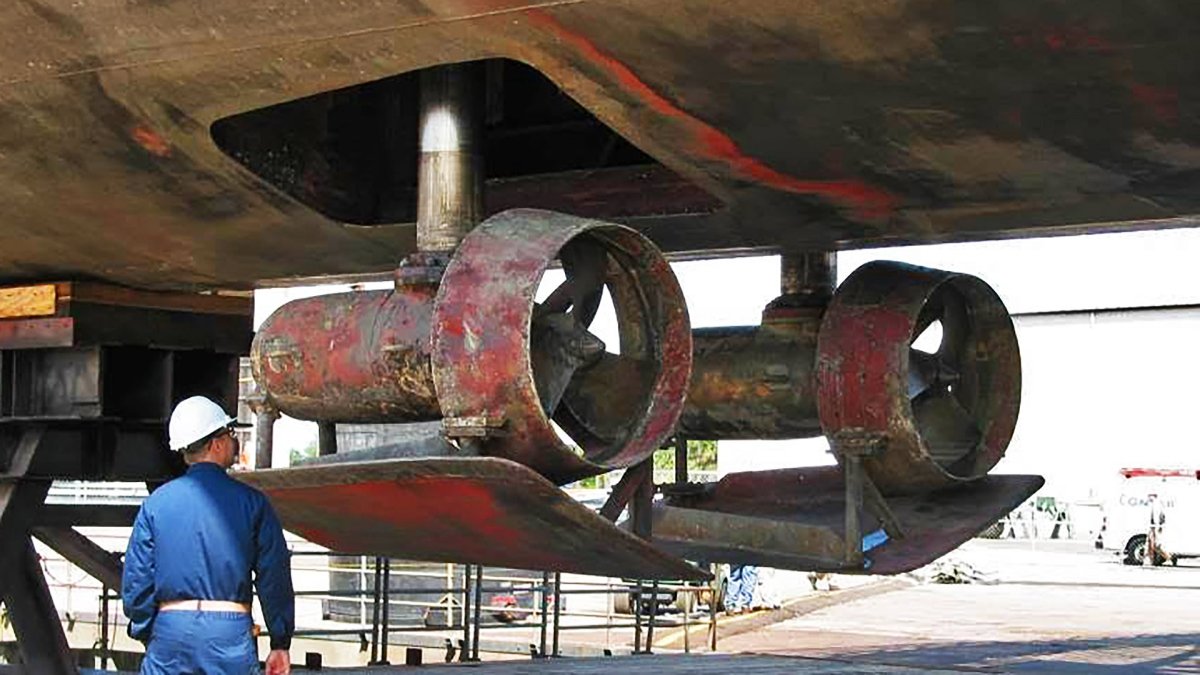
The feature is so obscure in fact, that the Naval History And Heritage Command nor the Navy Sea Systems Command could dig up a single picture or video of the system. In fact, the only photos we could find anywhere were posted by user “Shifter3” some seven years ago in a radio-controlled model forum called RCgroups.com .
Shifter3 via RCgroups.com
Referred to officially as Auxiliary Power Pods (APPs), these sci-fi looking units could be extended to propel the ship at speeds of up to roughly six knots without the main screw providing any thrust and even without the ship’s gas turbines running at all. The APPs run off electrical power from the ship’s diesel generators and are located roughly below the front of the ship’s forecastle.
Seeing that they can rotate through 360 degrees, these secondary drive units were used in conjunction with the ship’s main propulsion and rudder to get in and out of tight berths and harbor areas with little assistance. But above all else, they could work as super-sized trolling motors or sorts, and in an emergency, they could provide a secondary form of propulsion to get the ship out of harm’s way and into safe waters or port. Their inclusion later on in the FFG-7 design made the type’s single shaft and single screw configuration less of a liability. They also may have had some acoustic signature benefits while in use as opposed to the ship’s primary propulsion system.
Oliver Hazard Perry class USS Carr (FFG-52) looking sharp off the coast of Monrovia in 2006. The last of the type was retired from US service in 2015. , USN
An official response from our friends at NAVSEA described the system as such:
The Auxiliary Power Pods (APP) installed on Oliver Hazard Perry-class frigates had two purposes. Because FFGs only had one main propulsion engine ( one prop and shaft ), these pods could be used to maneuver the ship should a casualty be suffered. These pods were also used to help the ship navigate in and out of ports as they provided excellent steering capability. APPs were included on the ships as part of the new construction program and were not back-fitted.”
In many ways, these azimuth thrusters were precursors to the Azipods that serve as many ships’ primary form of propulsion today, including some military vessels. Their hybrid-like propulsion was also ahead of its time for surface combatants, as the concept is something the U.S. Navy is just deploying en masse on its surface fleet today, albeit on a far grander and more powerful scale.
USS Ingraham (FFG 61) displays a huge American flag as it arrives at Naval Station Everett following a deployment. It looks like you can see the ship’s APPs kicking up a little disturbance just aft of stream of water coming from the ship’s bilge system. , USN
The amphibious assault ship USS Makin Island was the first US Navy ship to feature the hybrid-electric propulsion concept when it was commissioned in 2009. Fast forward to today and even older Arleigh Burke class destroyers are being back-fitted with similar systems, and the stealthy Zumwalt class destroyer takes the whole concept to a far more exotic level.
APPs, along with the Oliver Hazard Perry class ships that house them, are still in service with many navies around the world today. Allied countries have taken America’s unwanted frigates and have upgraded them with modern capabilities, like vertical launch systems, advanced sensors, updated combat systems, and even enlarged hangar bays. Many of these vessels will serve for decades to come.
We’ll have to wait and see if the FFG-7s and their quirky Auxiliary Power Pods are regenerated and receive similar capabilities for use once again with the US Navy, but they seem to be by far the most likely type to be returned to service under the 355 ship Navy initiative.
Contact the author: Tyler@thedrive.com
Comments couldn’t be loaded. Please refresh the page.
更新于美国东部时间2020年7月5日晚上7:15
最近,随着海军考虑将目前封存的少量FFG-7级护卫舰重新启用,作为其355艘舰艇海军规模计划的一部分,奥利弗·哈泽德·佩里级(FFG-7)护卫舰再次成为新闻焦点。这些坚固耐用的FFG-7级护卫舰一直备受关注,它们构成了海军主力水面作战舰艇的中低端,其性能也广为人知。然而,该级舰艇较新的舰艇上却配备了一项鲜为人知但极具创新性的功能——一对可折叠旋转的辅助推进吊舱。
这项功能极其罕见,以至于海军历史与遗产司令部和海军海上系统司令部都找不到任何相关的图片或视频。实际上,我们能找到的唯一照片是用户“Shifter3”大约七年前发布在一个名为RCgroups.com的遥控模型论坛上的。
Shifter3 来自 RCgroups.com
这些外形颇具科幻感的装置,官方名称为辅助动力舱(APP),可以在不启动主螺旋桨或燃气轮机的情况下,以最高约6节的速度推动舰船航行。辅助动力舱由舰船柴油发电机提供电力,大致位于舰艏楼前部下方。
由于这些辅助驱动装置可以360度旋转,因此与舰艇的主推进系统和舵配合使用,使舰艇能够轻松进出狭窄的泊位和港口区域。但最重要的是,它们可以作为超大型的拖钓马达或其他类似装置,在紧急情况下,它们可以提供辅助推进力,使舰艇脱离险境,驶入安全水域或港口。在FFG-7型护卫舰的设计中后期加入这些装置,使得该舰的单轴单螺旋桨结构不再那么容易失效。此外,与舰艇的主推进系统相比,这些装置在使用时可能还具有一些声学优势。
2006年,奥利弗·哈泽德·佩里级护卫舰“卡尔”号(FFG-52)在蒙罗维亚海岸附近英姿飒爽。该型护卫舰的最后一艘于2015年从美国海军退役。
美国海军海上系统司令部(NAVSEA)的官方回复是这样描述该系统的:
安装在奥利弗·哈泽德·佩里级护卫舰上的辅助动力吊舱(APP)有两个用途。由于护卫舰只有一台主推进发动机(一个螺旋桨和一根轴),这些吊舱可以在发生故障时用于舰艇的机动。这些吊舱还具有出色的转向能力,有助于舰艇进出港口。辅助动力吊舱是作为新造舰艇的标配而安装的,并非后期加装。
在许多方面,这些方位推进器是如今许多舰船(包括一些军舰)主要推进方式——吊舱式推进器的雏形。它们类似混合动力推进器的技术在当时的水面作战舰艇中也堪称超前,因为美国海军如今才开始在其水面舰队上大规模部署这一概念,尽管规模更大、威力更强。
“英格拉姆”号护卫舰(FFG 61)结束部署抵达埃弗雷特海军基地时,舰上悬挂着一面巨大的美国国旗。照片显示,舰上的自动推进器(APP)似乎在从舰舱排水系统喷出的水流后方激起了一些水花。
两栖攻击舰“马金岛”号是美国海军第一艘采用混合动力推进概念的舰艇,于 2009 年服役。时至今日,就连更老的“阿利·伯克”级驱逐舰也在进行类似的系统改装,而隐形的“朱姆沃尔特”级驱逐舰则将这一概念提升到了一个更加先进的水平。
APP(空中巡逻艇)及其搭载的奥利弗·哈泽德·佩里级护卫舰至今仍在世界许多国家的海军服役。盟国接收了美国不再需要的护卫舰,并对其进行了现代化升级,例如加装垂直发射系统、先进传感器、升级作战系统,甚至扩建机库。其中许多舰艇将在未来几十年继续服役。
我们还要拭目以待,看看 FFG-7 及其独特的辅助动力吊舱是否会被重新改造,并获得类似的功能再次供美国海军使用,但它们似乎是“355 艘舰艇海军计划”下最有可能重新服役的舰艇类型。
联系作者:Tyler@thedrive.com
评论加载失败,请刷新页面。