Inside The World’s Only Privately Owned F-16s That Are Flying As Advanced Aggressors探秘全球唯一两架作为先进侵略者战斗机飞行的私人拥有的F-16战机
Top Aces has used major upgrades to turn some of the oldest F-16s around into the most potent private aggressors on the planet.
新闻视频
Updated Feb 10, 2022 3:00 PM EST
Last year, The War Zone reported on the arrival of the first four former Israeli Air Force F-16s at aerial adversary company Top Aces’ facility in Mesa, Arizona. It was the culmination of a project that started several years earlier to identify aircraft that could fulfill the training requirements for preparing next-generation U.S. fighter pilots flying aircraft like the 5th generation F-35 Lightning II and F-22 Raptor . Less than a year after the first plane was unloaded from an Antonov cargo plane, the company has taken some of the oldest F-16s around and successfully turned them into heavily upgraded adversary jets known as the Advanced Aggressor Fighter, or AAF.
You can read more about the origins of Top Aces’ F-16 Advanced Aggressor Fighter program in this past War Zone feature .
The main component of the Top Aces AAF upgrade package is the Advanced Aggressor Mission System (AAMS), which incorporates an unspecified active electronically scanned array (AESA) radar , Thales Visionix Gen III Scorpion helmet-mounted cueing system , and Link-16 datalink capability, all powered by an open architecture system. AAMS permits the rapid integration of new sensors and functions that a customer wishes to use to improve their air combat readiness, such as IRST and advanced jamming pods .
Kevin “Shaggy” Wilson is the Vice President of Business Development at Top Aces and a former F-16 pilot with over 2,000 hours in the Viper. Wilson is in charge of identifying, pursuing, and securing business for the company, both in the United States and potentially abroad.
In 2019, Top Aces was one of seven companies the US Air Force tapped for a huge $6.4 billion contract for Red Air and Close Air Support training throughout several locations in the United States. Wilson told The War Zone “it’s been quite the journey over the last year since we first got the F-16s in Mesa. It has been 355 days since the aircraft landed on January 28, 2021, till the 18th of January 2022 when we flew a fully operational upgraded F-16 with a brand new AESA radar, Scorpion helmet, fully integrated Link-16, and a multifunction display with our own operational flight program that we developed from scratch that is optimized for the adversary air role. We are very proud of the team that made it happen.” The feat is all the more impressive considering it took some competitors over two years to get their aircraft flying without any major upgrades like an AAMS.
The aircraft being upgraded are 1979 A/B model block 10 F-16s that were exported to Israel in 1980. Most of the aircraft flew in active service until about 2015 when they were retired and kept in preservation status. The Israeli Air Force updated the aircraft throughout their time in service, but because of U.S. Department of State restrictions on what Top Aces was able to re-import, Israel was forced to remove many of the upgrades that were done.
So in reality, Top Aces received a 1979 F-16 with very minor modifications for flight safety, such as an upgraded inertial navigation unit that enables proper air navigation. The only visible difference from the original configuration is the addition of several chaff and flare dispensers to the F-16A/B’s svelte airframe.
The AAMS is not new to Top Aces aircraft. The company has already flown the system on its A-4 Skyhawks for over a year, therefore mitigating risk when incorporating it into the Viper. The AAMS-equipped A-4s are used to fly against the German Air Force Typhoons. You can read more about these advanced Skyhawks and their mission in this past War Zone article . Leveraging this risk reduction, Top Aces has been flying the system as designed in the F-16 over the last few weeks with spectacular results.
It is no secret that the U.S. military is in desperate need of quality adversary aircraft to go up against advanced aircraft like the F-22 and F-35, as well as upgraded 4th generation types. Wilson stated “the entire reasoning behind developing the AAMS was to challenge advanced 4th generation aircraft and 5th generation platforms. There are very few contract adversary aircraft currently out there that can challenge those platforms because of how advanced those U.S. platforms are. By adding AESA to a very maneuverable high performance aircraft, it provides a distinct challenge to the blue forces that they are not used to dealing with. It enables them to evaluate and update their tactics to make sure they can meet the near-peer and peer threat in various theaters.”
Unlike USAF F-16s, which often fly with advanced targeting pods and large external fuel tanks, Top Aces F-16s are currently flown clean with no external pods or tanks. The F-16 was originally envisioned as a lightweight daytime fighter. Wilson stated “flying the F-16 clean is flying it like it was designed. It is a fighter pilot’s aircraft and it’s incredibly rewarding, providing a lower radar cross-section and it is difficult to see head-on at the merge.” In a clean configuration, the F-16 can get an hour and a half airborne time for its customers.
Going forward as Top Aces vies to win more adversary contracts, the advantage of the design of the AAMS is its compatibility with open system architecture and standards that the U.S. Department of Defense is employing. Top Aces does not want to be vendor-locked for a particular pod or system so it is very easy for its F-16s to swap or add systems as time goes on and the threat changes. Wilson added that “threat replication in training has to progress at a commensurate level in order to maintain our edge. So whatever the customer is seeing as a need, whether it be advanced electronic attack or advanced infrared search and track systems or a radar system, we are able to very quickly adapt the system to integrate the changes needed into our system and train our blue forces against it before it becomes a serious threat.”
Top Aces has used Coherent Technical Services Incorporated located outside of the U.S. Navy’s Naval Air Station (NAS) Patuxent River in Maryland as a technology partner which has enabled it to field the AAMS so quickly. CTSI has a lot of experience with the Navy test world and has a working AAF F-16 simulator at its facility.
The number of F-16s that receive the AAMS upgrade has yet to be determined and will largely be customer-driven. Wilson stated “we believe the customer will value what we are bringing to the adversary community with this upgraded F-16 so we are fully prepared with our partners like Elbit M7 Aerospace in San Antonio to produce these upgraded aircraft at a fairly high rate as long as the customer is ready to support it. As of right now, we are currently planning to have a dozen or so of the aircraft ready by the end of the year to begin to support advanced 4th and 5th gen training wherever it is needed.”
A big part of the AAF is the Thales Visionix Gen III Scorpion helmet-mounted display (HMD). The Scorpion is one of the most capable HMDs in the world and used by a wide variety of aircraft, including A-10s, F-16s, AC-130s , and the F-5s from competitor Tactical Air Support, Inc. It has the ability to record HD video right onto the jet’s computer, which then can be shown at a debriefing .
The helmet provides a huge advantage when trying to provide quality advanced aggressor training to 5th generation assets including the ability to replicate high off-boresight missiles like the Russian R-73/74 . The aircraft’s multi-function display, while used for radar targeting and situational awareness, is a great user-friendly system, but when incorporated with the helmet, it allows the pilot to keep their head up and out of the cockpit. This enhanced situational awareness is gained by Scorpion’s ability to present contact information — friendly and enemy — in an augmented reality manner, as well as weapons cueing and targeting information. The monocle also provides the current safety of flight information in terms of altitude, airspeed and G load. Wilson stated that “having the ability to keep our head out of the cockpit is critical to being a proper and effective threat replication to train the blue forces the way they need to be trained.”
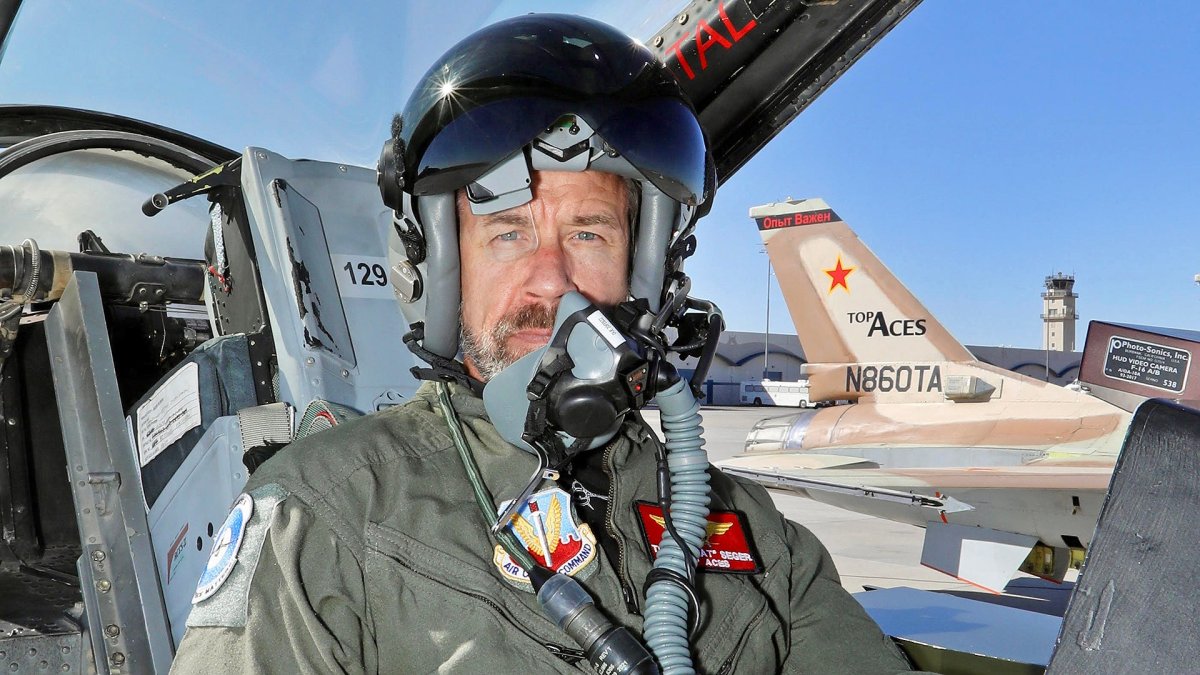
Todd ‘Heat’ Seger (retired USAF Colonel) was the pilot chosen to test fly the AAMS in part because of his work incorporating the Scorpion helmet into the Air National Guard’s F-16s. He sat down with The War Zone to discuss what it’s like flying the AAMS F-16.
Seger served as a developmental test pilot in both active duty and in the reserves. He came to Top Aces with just under 4,000 hours in the F-16 and several combat tours under his belt. Seger spent time as a pilot in the 422nd Test and Evaluation Squadron at Nellis Air Force Base. This squadron performs operational testing of all fighter aircraft and munitions entering and in operational use by Air Combat Command. After that tour, he was offered a chance to fly the F-22, but turned it down because of his affection for the Viper.
While at Nellis, Seger switched to the Air Force reserves and became an instructor pilot in the 16th Weapons Squadron. In 2007, Seger went to Tucson where he worked at the Air National Guard/Air Force Reserve Test Center (AATC). There he became the vice commander before retiring in 2018. AATC thrives on the mantra “80 percent the solution at 20 percent the cost,” which is music to the ears of a CEO of an adversary air support company.
Seger told The War Zone “essentially what we’ve taken is a legacy airplane and we’ve pimped it. So it’s pimp my airplane. The F-16 with an AESA in the nose gives us a very high-quality ability to actively detect the blue air side of the equation and give them a run for their money because we have very good detection capability against low RCS targets like the F-22 and F-35.” AESA radars offer a massive leap in capabilities over mechanically scanned array radars especially in terms of detection range, fidelity, beam agility, and reliability.
Seger added “I can use the AESA radar in three different modes. I can target anybody from right off my nose down to 40-50 miles just with a visual indication on my eyeball [using the Scorpion HMD], which is called a dynamic aiming cue. It’s very lethal and it provides a very formidable challenge because I can now take and point any active or passive sensor, through something I see with the best sensor on the airplane, which is my pilot eyeballs, to be honest with you. So I’ve got a full spectrum of longwave IRST which is a different spectrum than radar energy, which is X Band, which is my AESA radar. And then I got my visual spectrum of my eyeballs all working together to provide a formidable adversary to the Air Force and the Navy.”
“The Scorpion Helmet mounted cueing system allows us to essentially use the airplane like it was designed, so we don’t have to spend too much time looking down, and we can exploit blue air weaknesses like things like being in the contrails and we can point high off bore-sight missiles. We can also take the AESA radar detects right and we see a location in our helmet-mounted cueing system, we can transition from Beyond Visual Range to within visual range very, very well, we can fight within visual range very, very well. I mean, essentially, you just provide a very formidable adversary that’s flexible to their needs.”
The AAMS software brings it all together onto one display that the pilot can see either in his multifunction display or in his eyepiece. Seger said “I see basically a replication of all my sensor targets on both displays. And I get essentially a software package called a FAAC Weapons Employment Zone [WEZ] and essentially it allows me to, without pilot effort, to put in any bad guy missile type, whether Chinese or Russian missile type, and replicate it to provide blue forces shot data.”
“So I go into my aircraft with a planned mission on a little USB stick, I plug it into my mission computer with all those numbers, you know, for what the missiles that I’m going to replicate today. I go up, I fly my mission system that I just described, and it’s all recorded digitally on a solid state digital recorder. And then I come back to the debrief with a series of threat replicable missile parameters that I brought to the fight. And it’s all printed out for me and I take it to the debrief, and I make the pilots better by showing them how I was able to exploit potentially holes in their armor.”
The addition of Link-16 gives the aircraft the ability to exchange its tactical picture with other aircraft in near-real-time. Seger said “Link 16 basically brings the digital world so I get all the targets that I produce, all the targets of my wingman produces, I get them all and I can target them all with a that FAAC WEZ and provide you know, shot data on any single target that myself or my team collects. But I can also tap into what’s called the air surveillance network. So essentially, there are other passive detectors that are either airborne or on the ground where I have access to how they detect things. So in other words, Raptors and F-35s are visible in certain spectrums, you know, and not to get classified, but I essentially get cueing from passive sensors through the Link 16. And so, therefore, I get not only high situational awareness of the blue forces in front of me I also have the ability to have global situational awareness on the entire fight so that I’m more safe.”
An image showing the Advanced Aggressor Fighter F-16’s multi-function display capability screen. It provides high-situational awareness displaying information from the radar and other onboard sensors as well as from other platforms via data-link. Tracks are also projected in the pilot’s Scorpion helmet-mounted display system. It also shows weapons engagement envelopes for threat profile simulation., James DeBoer
Speaking about flying the F-16 and its performance as an adversary aircraft, Seger said “it’s what they [the USAF] need, because an F-16 goes from 100 feet to 50,000 feet in a short period of time. It’s a nine-G airplane that goes Mach 2.05, So it has the kinematic ability to challenge an F-35 or an F-22. It has good legs, both with internal and external fuel. And the ability to adapt any sort of capability or any sort of sensor on the airplane is second to none because Top aces owns the OFP. So they own the operational flight parameter that makes this thing tick. And that’s something nobody else has.”
During our visit, I was able to see the first 4-ship F-16 mission for Top Aces where 3 F-16s went up against the AAF F-16, which was flown by Seger. He told us “I was able to fight one V three, and be very effective at not only detecting all the groups that were coming at me, but also to do sorts within groups of multiple contacts within multiple groups. And I was able to have high situational awareness going into the merge both visually, and with my mission system. And I was also able to employ a series of missiles, replicating the threat against them. I was probably almost as good as a blue fighter could be and so all we need to do is handcuff it appropriately to replicate hopefully what the real threat is, which isn’t as good as the blue threat. But it is as capable as a blue threat airplane right now.”
From a man that has flown 10 different versions of the F-16, Wilson told us “the conventional wisdom in the F-16 community (especially those that flew the original Block 10/15s and more recent versions) is that Block 10/15 Vipers are the best “BFM machines” (dogfighting) ever built. The lighter nose (structurally) combined with the original analog FLCS (fight control system) has always been recognized as superior in pitch onset rate to any subsequent F-16.
Also, the lighter overall aircraft structure combined with the thrust from the PW-220E engine with full DEEC (Digital Electronic Engine Controls) means the Block 10/15 has the best thrust-to-weight ratio of all the F-16s. Our big A models are the sweetest.”
Top Aces sees a bright future ahead and is very confident in the aircraft they have picked. A large advantage for Top Aces going forward is that they are the only adversary company currently cleared to take on fuel from USAF tankers like the KC-10 and KC-135 . This is important as the need continues to rise for adversary support for Pacific and European commanders.
Another advantage is with so many companies in the United States still supporting USAF F-16 operations, parts are often readily available. Another benefit that the F-16 brings is a large group of people that have a great amount of experience maintaining the airplane. The maintainer cadre that Top Aces has put together has over 350 years of F-16 experience so as to continue an enviable safety record with over 95,000 hours of accident-free flying. Maintaining jets that are over 40 years old is no easy task especially after having to put them back together.
This week the company is expected to receive another 4 aircraft from Israel bringing the total to 12 aircraft at its F-16 Center of Excellence. That number will grow to over 20 in the next several months, making it the largest private 4th generation-capable adversary force on earth, at least for now.
Contact the editor: Tyler@thedrive.com
Comments couldn’t be loaded. Please refresh the page.
更新于美国东部时间2022年2月10日下午3:00。
去年,《战区》报道了首批四架前以色列空军的F-16战斗机抵达位于亚利桑那州梅萨市的空中假想敌公司Top Aces的基地。这是一项始于数年前的项目的最终成果,该项目旨在寻找能够满足美国下一代战斗机飞行员训练需求的飞机,这些飞行员将驾驶第五代F-35“闪电II”和F-22“猛禽”等战机。在第一架飞机从安东诺夫运输机上卸下不到一年后,该公司就成功地将一些最老旧的F-16战斗机改装成了经过大幅升级的假想敌战机,即先进假想敌战斗机(AAF)。
您可以在之前的《战区》专题报道中阅读更多关于 Top Aces 的 F-16 先进假想敌战斗机计划起源的信息。
Top Aces AAF升级包的主要组成部分是先进假想敌任务系统(AAMS),该系统集成了未指明型号的有源电子扫描阵列(AESA)雷达、泰雷兹Visionix Gen III Scorpion头盔瞄准系统以及Link-16数据链,所有这些都由开放式架构系统提供支持。AAMS允许客户快速集成其希望用于提升空战准备能力的新型传感器和功能,例如红外搜索跟踪系统(IRST)和先进干扰吊舱。
凯文·“沙吉”·威尔逊是Top Aces公司的业务发展副总裁,也是一名拥有超过2000小时飞行经验的F-16战斗机飞行员。威尔逊负责为公司在美国以及潜在的海外市场寻找、拓展和获取业务。
2019年,Top Aces是美国空军选定的七家公司之一,获得了价值64亿美元的巨额合同,负责在美国多个地点开展红方空中作战和近距离空中支援训练。威尔逊告诉《战区》杂志:“自从我们在梅萨接收F-16战机以来,过去一年可谓是一段漫长的旅程。从2021年1月28日飞机抵达梅萨到2022年1月18日,历时355天,我们终于驾驶着一架完全升级的F-16战机进行了飞行训练。这架战机配备了全新的AESA雷达、蝎式头盔、完全集成的Link-16数据链以及多功能显示器,并搭载了我们从零开始开发的、针对假想敌空中作战优化的作战飞行程序。我们为完成这项工作的团队感到非常自豪。”考虑到一些竞争对手在没有进行任何重大升级(例如AAMS)的情况下,花了两年多的时间才使他们的飞机能够飞行,这一成就就更加令人印象深刻了。
此次升级的飞机是1979年A/B型Block 10 F-16战斗机,于1980年出口到以色列。大部分飞机一直服役到2015年左右退役并被封存。以色列空军在其服役期间对这些飞机进行了升级改造,但由于美国国务院对Top Aces公司重新进口的物品有所限制,以色列被迫拆除了许多已完成的升级部件。
实际上,《王牌飞行员》剧组收到的是一架1979年产的F-16战斗机,仅做了一些飞行安全方面的微小改装,例如升级了惯性导航系统,使其能够进行正确的空中导航。与原版相比,唯一可见的区别是在F-16A/B的流线型机身上加装了几个箔条和干扰弹投放器。
AAMS系统对Top Aces公司的飞机来说并不陌生。该公司已在其A-4“天鹰”攻击机上部署该系统一年多,因此将其集成到F-16“蝰蛇”战斗机上风险较低。配备AAMS系统的A-4攻击机用于对抗德国空军的“台风”战斗机。您可以在之前的《战区》文章中了解更多关于这些先进的“天鹰”攻击机及其任务的信息。凭借这种风险降低的优势,Top Aces公司在过去几周已按照设计在F-16战斗机上进行了AAMS系统的飞行测试,并取得了显著成果。
众所周知,美军急需高质量的假想敌飞机来对抗F-22和F-35等先进战机以及升级后的第四代战机。威尔逊表示:“研发AAMS的初衷就是为了挑战先进的第四代和第五代战机。目前市面上几乎没有合同假想敌飞机能够与之匹敌,因为美军的这些战机实在太先进了。通过在机动性极佳的高性能飞机上加装AESA系统,AAMS能够给蓝军带来他们从未遇到过的独特挑战。这使蓝军能够评估并更新战术,确保他们能够在各种战区应对势均力敌甚至同等水平的对手。”
与美国空军的F-16战斗机不同,后者通常配备先进的瞄准吊舱和大型外挂油箱,Top Aces公司的F-16目前采用的是“干净”配置,不携带任何外挂吊舱或油箱。F-16最初的设计理念是轻型昼间战斗机。威尔逊表示:“以‘干净’配置驾驶F-16,就是按照它的设计初衷来驾驶。这是一款真正为战斗机飞行员打造的战机,驾驶体验非常棒,它能提供更低的雷达反射截面积,并且在交战中很难被正面发现。” 在这种“干净”配置下,F-16可以为客户带来一个半小时的飞行时间。
随着Top Aces公司竞相赢得更多对抗性合同,AAMS系统设计的优势在于其与美国国防部采用的开放系统架构和标准的兼容性。Top Aces公司不希望被特定供应商锁定在某个吊舱或系统上,因此其F-16战机可以非常轻松地随着时间推移和威胁变化更换或添加系统。威尔逊补充道:“为了保持我们的优势,训练中的威胁模拟必须以相应的水平推进。因此,无论客户认为需要什么,无论是先进的电子攻击系统、先进的红外搜索跟踪系统还是雷达系统,我们都能迅速调整系统,将所需的变更集成到我们的系统中,并在其成为严重威胁之前训练我们的蓝军部队应对这些变更。”
Top Aces公司选择位于马里兰州帕图克森特河美国海军航空站附近的Coherent Technical Services Incorporated(CTSI)作为其技术合作伙伴,这使得该公司能够如此迅速地部署AAMS系统。CTSI在海军测试领域拥有丰富的经验,并且其设施内配备了一台正在运行的美国陆军航空兵F-16模拟器。
接受AAMS升级的F-16战机数量尚未确定,主要取决于客户需求。威尔逊表示:“我们相信客户会重视我们通过升级F-16战机为假想敌作战群体带来的价值,因此我们已与位于圣安东尼奥的埃尔比特M7航空航天公司等合作伙伴做好充分准备,只要客户愿意提供支持,我们就能以相当高的速度生产这些升级后的战机。目前,我们计划在年底前交付十几架升级后的战机,以便在任何需要的地方开始支持第四代和第五代战机的高级训练。”
AAF系统的重要组成部分是泰雷兹Visionix公司的第三代“蝎子”头盔显示器(HMD)。“蝎子”是世界上性能最强大的HMD之一,被广泛应用于多种飞机,包括A-10、F-16、AC-130以及竞争对手战术空中支援公司(Tactical Air Support, Inc.)的F-5战斗机。它能够将高清视频直接录制到飞机的电脑上,并在任务汇报时播放。
这款头盔在为第五代战机提供高质量的先进假想敌训练方面具有巨大优势,包括能够模拟俄罗斯R-73/74等高离轴角导弹。飞机的多功能显示器虽然用于雷达瞄准和态势感知,本身就是一个非常人性化的系统,但与头盔结合使用后,飞行员可以保持头部抬起,离开座舱。蝎式头盔能够以增强现实的方式呈现敌我双方的接触信息,以及武器瞄准和目标信息,从而增强态势感知能力。此外,头盔还能提供飞行安全信息,例如高度、空速和过载。威尔逊表示:“能够保持头部抬起,对于进行有效且恰当的威胁模拟至关重要,这样才能以他们所需的方式训练蓝军。”
托德·“希特”·塞格尔(美国空军退役上校)之所以被选中试飞AAMS,部分原因是他曾参与将“蝎子”头盔整合到空中国民警卫队的F-16战斗机上。他接受了《战区》节目的采访,谈到了驾驶配备AAMS的F-16战斗机的感受。
塞格尔曾在现役和预备役部队担任研发试飞员。加入“王牌飞行员”团队时,他驾驶F-16战斗机的飞行时间接近4000小时,并拥有多次作战经验。塞格尔曾在内利斯空军基地的第422测试评估中队担任飞行员。该中队负责对空战司令部所有新加入和正在使用的战斗机和弹药进行作战测试。完成测试后,他有机会驾驶F-22战斗机,但他因为对F-16的喜爱而婉拒了。
在内利斯空军基地服役期间,塞格尔转入空军预备役,成为第16武器中队的教官飞行员。2007年,塞格尔前往图森,在空中国民警卫队/空军预备役测试中心(AATC)工作。他在那里晋升为副指挥官,直至2018年退休。AATC奉行“以20%的成本获得80%的解决方案”的理念,这对于一家假想敌空中支援公司的首席执行官来说,无疑是天籁之音。
塞格尔告诉《战区》杂志:“本质上,我们是在一架老式飞机上进行了改装升级。所以,这算是给我的飞机来个‘改装’。在F-16机头安装AESA雷达后,我们拥有了非常强大的主动探测能力,能够有效地侦测敌方飞机,并让他们付出代价,因为我们对F-22和F-35这类低雷达反射截面积(RCS)目标的探测能力非常出色。” AESA雷达相比机械扫描阵列雷达,在探测距离、精度、波束灵活性和可靠性方面都有着巨大的飞跃。
塞格补充道:“我可以使用三种不同模式的AESA雷达。我只需通过目视指示(使用蝎子头盔显示器),就能锁定从机头前方到40-50英里范围内的任何目标,这被称为动态瞄准提示。这非常致命,也极具挑战性,因为我现在可以通过飞机上最好的传感器——说实话,就是我的飞行员眼睛——来获取和瞄准任何主动或被动传感器。因此,我拥有全频谱的长波红外搜索跟踪系统(IRST),这与雷达能量(X波段,我的AESA雷达)的频谱不同。然后,我的眼睛的视觉频谱也协同工作,为空军和海军构成了强大的威胁。”
“蝎式头盔瞄准系统让我们能够真正按照设计初衷使用飞机,无需花费太多时间向下观察,就能利用蓝方的弱点,例如利用飞机尾迹,并能以高射程偏离瞄准线的方式发射导弹。此外,我们还可以利用AESA雷达探测到的目标位置,并通过头盔瞄准系统进行精确定位,从而非常高效地从超视距空域切换到视距内空域,并在视距内进行有效的作战。总而言之,这相当于打造了一个非常强大且能够灵活应对各种需求的对手。”
AAMS软件将所有信息整合到一个显示屏上,飞行员既可以在多功能显示器上查看,也可以在目镜中查看。塞格尔说:“基本上,我可以在两个显示屏上看到所有传感器目标的复制图像。我还有一个叫做FAAC武器运用区(WEZ)的软件包,它允许我在无需飞行员操作的情况下,输入任何敌方导弹类型,无论是中国导弹还是俄罗斯导弹,并将其复制出来,从而提供蓝军的射击数据。”
“所以我带着装有作战计划的U盘登上飞机,U盘里装着我今天要模拟的导弹的各种参数。我把U盘插到任务电脑里。然后我升空,按照我刚才描述的任务系统飞行,所有数据都会被固态数字记录仪数字化记录下来。之后我带着一系列可模拟的导弹参数回到任务汇报会,这些参数是我在战斗中携带的。所有数据都会打印出来,我带到汇报会上,向飞行员们展示我是如何利用他们装甲上的潜在漏洞的,从而帮助他们提升作战能力。”
Link-16的加入使飞机能够近乎实时地与其他飞机交换战术态势图。塞格尔说:“Link-16基本上把数字世界带了过来,我可以获取我生成的所有目标,以及僚机生成的所有目标,我可以利用FAAC WEZ(前沿空中作战中心)对它们进行瞄准,并提供我或我的团队收集到的任何单个目标的射击数据。此外,我还可以接入所谓的空中监视网络。本质上,还有其他一些被动探测器,它们部署在空中或地面,我可以访问它们探测目标的方式。换句话说,猛禽和F-35在特定频谱范围内是可见的,具体细节需要保密,但我基本上可以通过Link-16从被动传感器获取信息。因此,我不仅能够高度了解前方蓝军的态势,还能掌握整个战斗的全局态势,从而更加安全。”
图片展示了F-16先进假想敌战斗机的多功能显示屏幕。该屏幕提供高度态势感知能力,显示来自雷达和其他机载传感器以及通过数据链从其他平台获取的信息。目标轨迹也会投射到飞行员的“蝎子”头盔显示系统中。此外,它还能显示用于威胁模拟的武器交战包线。——詹姆斯·德博尔
谈到驾驶F-16及其作为假想敌战机的性能,塞格尔表示:“这正是他们(美国空军)所需要的,因为F-16能在短时间内从100英尺爬升到50000英尺。它是一款能承受9G过载、速度达到2.05马赫的飞机,因此它拥有足以挑战F-35或F-22的运动能力。它的续航能力很强,无论使用内部燃油还是外部燃油。而且,它能够灵活地在飞机上加装任何类型的功能或传感器,这是其他任何飞机都无法比拟的,因为顶级王牌飞行员掌握着作战飞行参数(OFP)。也就是说,他们掌握着让这架飞机正常运转的作战飞行参数。这是其他任何飞机都不具备的优势。”
访问期间,我有幸观看了“王牌飞行员”演习的首次四机F-16任务,其中三架F-16与塞格尔驾驶的美国陆军航空队(AAF)F-16交战。他告诉我们:“我成功拦截了一架V3型战斗机,不仅能非常有效地探测到所有来袭的敌机群,还能在多个敌机群内部进行分类拦截。在进入交战阶段,我凭借目视和任务系统都保持了高度的态势感知。我还发射了一系列导弹,模拟了敌方的威胁。我的表现几乎可以媲美友军战机,所以我们现在需要做的就是对其进行适当的限制,使其能够更好地模拟真实威胁——虽然它不如友军战机强大,但就目前而言,它的能力已经与友军战机不相上下了。”
威尔逊曾驾驶过10种不同型号的F-16战斗机,他告诉我们:“F-16飞行员群体(尤其是那些驾驶过最初的Block 10/15型以及后续型号的飞行员)普遍认为,Block 10/15型F-16是迄今为止最好的近距离空战(BFM)战机。其更轻的机头(结构上)加上最初的模拟飞行控制系统(FLCS),一直被公认为比任何后续的F-16战机都具有更优异的俯仰响应速度。”
此外,更轻的整体机身结构,加上配备全套DEEC(数字电子发动机控制系统)的PW-220E发动机的推力,意味着Block 10/15拥有所有F-16战斗机中最佳的推重比。我们的A系列大型机型是最棒的。”
Top Aces对未来充满信心,并对其选择的飞机型号充满信心。Top Aces的一大优势在于,它是目前唯一一家获准从美国空军KC-10和KC-135等加油机接收燃料的假想敌公司。这一点至关重要,因为太平洋和欧洲的指挥官对假想敌支援的需求持续增长。
另一个优势是,由于美国众多公司仍在为美国空军的F-16战机提供支持,零部件通常很容易获得。F-16带来的另一个好处是,有大量经验丰富的维护人员。Top Aces公司组建的维护团队拥有超过350年的F-16经验,从而保持了令人艳羡的安全记录,累计飞行时间超过95,000小时,无事故记录。维护机龄超过40年的喷气式飞机绝非易事,尤其是在需要重新组装的情况下。
本周,该公司预计将从以色列接收另外4架飞机,使其F-16卓越中心的飞机总数达到12架。未来几个月,这一数字将超过20架,使其成为目前地球上规模最大的具备第四代战机能力的私营假想敌部队。
联系编辑:Tyler@thedrive.com
评论加载失败,请刷新页面。