F-35’s Most Sinister Capability Are Towed Decoys That Unreel From Inside Its Stealthy SkinF-35最阴险的能力是从其隐形外壳内部拖曳的诱饵。
These "little buddies" not only protect the jet, but they can be used creatively to goad the enemy into showing itself and dying as a result.
Updated Dec 1, 2019 6:41 AM EST
One of the least talked about, but most potent capabilities that can enhance the survivability of a combat aircraft these days is the ability to deploy towed decoys. Often referred to as “little buddies” by the crews that bet their lives on them, they have existed in miniature form for over two decades on aircraft like the F-16C/D, B-1B, and F/A-18E/F, as well as foreign fighter aircraft. But most wouldn’t think such a system would be included in a 5th generation fighter that was designed from the ground up to evade enemy radars. This isn’t the case. Although it isn’t something touted by the manufacturer or its operators, the F-35 has this capability concealed beneath its curvaceous and stealthy skin.
First off, you are probably thinking that the inclusion of such a system in the F-35’s design is a sign of weakness in its stealth capabilities. Maybe it could be framed in such a manner, but doing so really doesn’t do the topic justice and it wouldn’t be fair to the F-35 either.
Stealth fighters, as we know them today, are not highly optimized to evade a broad range of radar types. Instead, they are optimized to give fire control radars used to actually engage targets, as well as detect them in many cases, a very tough time. The classic appendages of a fighter aircraft—nose, tail surfaces, exhaust nozzles, and even wings—do not lend themselves to broadband radio frequency low-observability, but they are conducive to maneuverability and speed. So, while aircraft like the F-35 are effective at hiding from the most threatening radar types, and especially when viewed by those sensors from certain aspects, with the frontal-hemisphere profile being most optimized, they are less adept from doing the same when it comes to radars operating at lower frequencies or when viewed from rearward angles.
The fusion of information from many types of sensors’ dispersed over a wide area that make up an integrated air defense system also degrades a stealthy aircraft’s ability to remain undetected, although it is key to remember that detection does not equal the ability to engage with weapons that rely on higher-quality and persistent telemetry. So even though a stealthy aircraft may be detected momentarily or even fairly persistently, that does not mean it can be engaged by surface-to-air or air-to-air missiles. The lack of broadband low observability, like that provided by stealthy subsonic flying-wing designs that have minimal smaller appendages and features, also puts a stealthy fighter at greater risk.
No aircraft, not even one that is designed with broadband low-observability as the goal above all else, is totally invisible to radar and other sensors. Stealth means a reduced probability of detection and engagement, not invincibility. Careful route planning and high situational awareness of threats in an aircraft’s vicinity are also essential to the survivability of stealthy aircraft, with the goal being to only provide the most unfavorable (detectable) aspects of the aircraft to a threatening enemy’s sensor view for the least amount of time.
F-35 fires an AIM-120 AMRAAM in testing. , USAF
So, stealth is not some monolithic concept, it has many variables and degrees, and above all else, it relies on a cocktail of measures, with a low-observable design and radar-absorbent coatings being just some ingredients in that cocktail, albeit quite important ones. Other key aspects include reduced infrared signature and the ability to tightly control an aircraft’s own radio frequency emissions so as to not let the enemy know of its presence. Low probability of intercept (LPI) radars and radios allow for reduced chances of being detected while still offering key functionality. They use highly directional emissions, frequency hopping, and wavelength modulation, as well as other clandestine techniques, to allow their operations to remain undetected by the enemy’s surveillance equipment.
All these features are very important, but one of the most essential ingredients in the success of any stealthy combat aircraft is electronic warfare.
Electronic warfare paired with low observability is really a magic potion for survivability over the modern battlefield. Whatever weaknesses a stealthy aircraft has in its shaping and coatings can potentially be offset, to a certain degree, by the ability to wreak havoc on enemy radar and communications systems via electronic attacks. In the past, aircraft like the F-117 Nighthawk had zero electronic warfare capabilities as the technology to make such a system’s emissions undetectable and not self-defeating was very limited. Instead, those aircraft relied on jamming support from other aircraft, such as EF-111 Ravens and EA-6B Prowlers , operating at standoff ranges. In practice, it was very seldom that an F-117 would venture deep into denied territory without robust jamming support. In fact, the one time it did, during Operation Allied Force two decades ago, it was shot down.
F-117 breaking away from the tanker. The aircraft would ‘clean up’ by retracting all its antennas and turning off anything that produces an RF emission before heading into contest territory. The F-117s were largely defenseless and blind to nearby threats and relied heavily on external jamming support. , USAF
The F-35, on the other hand, is designed with its own highly-integrated, highly-advanced AN/ASQ-239 electronic warfare system. It takes advantage of its active electronically scanned array (AESA) radar and the antennas that are buried along the edges of its wings and control surfaces and beneath its skin. This capability allows the F-35 to ‘self-escort’ to the target area and back, taking on enemy emitters electronically that it may have trouble staying far enough away from to evade detection entirely. This same electronic warfare suite and the jet’s high degree of sensor fusion offers F-35 pilots the ability make rapid decisions regarding their survivability on the fly. They can decide to destroy threatening emitters that may pop-up in their way, and new weapons are being developed to do this quickly and over relatively long ranges, or to avoid the threat entirely if possible, or to try to blind and confuse it via electronic attacks, allowing the F-35 to sneak by unscathed.
This electronic warfare capability gives the jet an enhanced degree of survivability and helps offset reliance on its low-observable design alone, which does have its weaknesses. Beyond being optimized to defeat higher-frequency fire control radars, like those that operate on and around the X band, the rear of the F-35 has been a bit controversial as its perceived radar cross-section is larger than some would like, possibly leaving it vulnerable to detection and even engagement from rear aspects. Quite honestly, I haven’t seen this really disputed, but as we discussed above, weaknesses in an aircraft’s low-observable design don’t mean it is totally vulnerable. While the F-35 may have shortcomings in terms of detectability to certain radars and from certain aspects, it seems Lockheed and their partners have come up with novel ways to help fill in the gaps.
One of the Joint Strike Fighter’s tricks that has remained largely in the shadows is the inclusion of an internal towed decoy system—one that has “little buddies” that are wicked smart to boot. We know for a fact that the F-35 is capable of deploying a specially-built version of advanced electronic warfare-enabled towed decoy known as the ALE-70.
The ALE-50 and electronic warfare-enabled ALE-55 are currently in service with the USAF and U.S. Navy. The first generation-variant of the ALE-50 towed decoy was unreeled out behind an aircraft and basically gave threatening air defense systems a much larger and more enticing target to attack than the host aircraft itself. As a result, the missile would home in on the decoy and blow it off its wire instead of destroying jet itself. During various operations, including the invasion of Iraq in 2003, the system worked incredibly well and clearly saved many lives and aircraft. Maybe the best look at the system in action was in Dan Hampton’s memoir Viper Pilot , which I highly suggest you read.
Since then, little buddies have morphed from decoy target to advanced electronic warfare-enabled extensions of the plane’s own self-protection suite. The ALE-55 that is reeled out from the center of the Super Hornet’s belly is capable of jamming enemy emitters in an effort to keeping them from locking onto the aircraft, or directly executing electronic attacks on an emitter that has already locked on, or goading a missile into attacking it instead of the aircraft if an attack is already underway.
ALE-55 system. , BAE Systems (main image), Wikicommons (inset)
Sometimes these modes of operation are aptly referred to suppress, deflect, and seduce. This is done via a range of guileful electronic warfare programs the decoy can employ in concert with the jet’s self-defense suite. An aircraft-mounted control unit sends the specific signals to the decoy over a fiber-optic line. Once at the decoy, those signals are translated into radio frequency emissions. The ALE-50’s electronic systems were self-contained in the expendable decoy itself, making them far less capable.
The towed fiber-optic decoy arrangement makes for a highly capable, fully tailorable, and rapidly adjustable response to a whole range of threats. For instance, the decoy can first try to generally jam a radar that is in search mode, then it can try to attack it directly to break its lock once it locks on. Then, if a missile locks on in flight, the decoy can instantly turn into a juicy target, or even targets, misdirecting the missile away from the aircraft.
Concept art of a Hornet with ALE-50 in tow. , Raytheon
Clearly, these “little buddies” are vicious, but beloved helpers to have along on a mission. Aircraft with ‘doghouses’ built-in to deploy these types of decoys usually carry between four and eight of depending on the design. Other aircraft, like the F-16, have the doghouses built into their weapons pylons.
ALE-50 housing on a Block 50 F-16. , MKFI/wikicommons
A version of the ALQ-184 electronic warfare pod also has towed decoys built in, offering a broader spectrum of tactics for protecting the aircraft it is attached to.
ALQ-184 equipped with towed decoys. , Raytheon
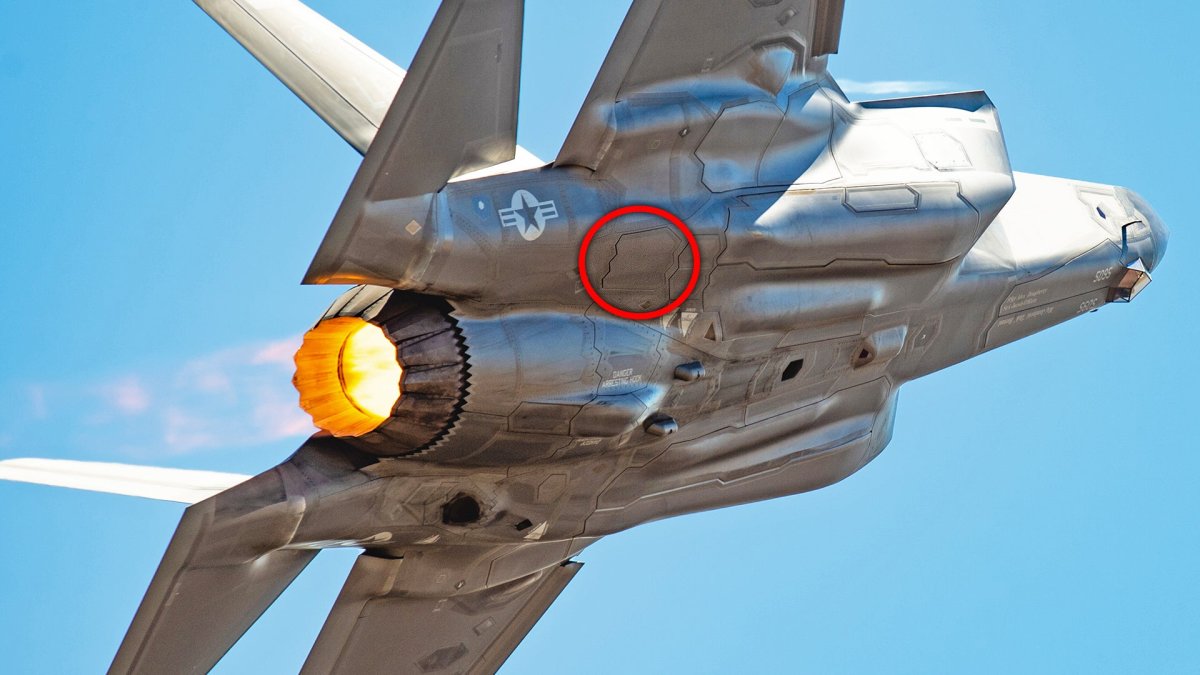
On the F-35, its ALE-70s seem to be deployed via a trapdoor that pops open on the right underside of its fuselage, aft of the weapons bay and infrared countermeasures doors. Supposedly, at least four ALE-70s can be carried at a time in the drop-down enclosure.
The towed decoy deployment door is located just aft of the dual flip-open infrared countermeasures dispenser door. , Lockheed Martin
This rare image appears to show the towed decoy door open. , unknown
Budget documents not only confirm the ALE-70’s existence, but also the fact that it is accommodated internally on the F-35. A line item within the USAF’s 2017 budget states:
“The ALE-70 Towed Decoy is a countermeasures dispenser system designed to fit into the F-35 Joint Strike Fighter (JSF) aircraft. The ALE-70 provides aircraft self-protection against radar guided missiles.”
ALE-70 is also listed in the Navy’s budget from the same year, along with the aircraft’s other countermeasures. It is worth noting that various flares and infrared countermeasures, as well as the ALE-70s, are the aircraft’s only listed expendable countermeasures. Chaff, which is used to blind and confuse enemy radar, is not included in the F-35’s countermeasures suite. This makes some sense as low-observability, the aircraft’s highly advanced and deeply integrated electronic warfare system, and the ALE-70 offers enhanced survivability against radar and radar-guided threats. Still, it is interesting that chaff was indeed omitted.
The budget document reads:
“F-35 COUNTERMEASURES: Includes all unique countermeasures that provide self-protection for the Joint Strike Fighter (JSF) aircraft, specifically ALE-70, MJU-68, MJU-69 and CCU-168. In addition to F-35unique countermeasures, MJU-61 and MJU-64 are also used for F-35 self-protection.”
We also have an updated unit cost for the ALE-70 from the Pentagon’s 2020 budget request, which comes in at $56,375. Not cheap, but hardly expensive compared to the loss of a $100M F-35 and its pilot.
Considering the F-35’s already potent electronic warfare capabilities, you can just imagine how the advanced electronic-warfare capable towed decoy could be used by the jet in combat. If a radar system threatens the aircraft and it cannot be avoided via a course change or attacked directly, reeling out an ALE-70 would probably give the F-35 the best chances of survival, especially if a missile launch was already detected. The decoys could also help when it comes to mitigating the aircraft’s rear radar cross-section. As it flees from a target area, unwinding an ALE-70 would definitely give enemy radar operators a much harder task of successfully targeting the aircraft, let alone bringing it down.
Also, when operating in a non-stealthy configuration with external stores, the advanced towed decoys will give the F-35 a means to better defend itself against pop-up threats, such as road-mobile surface-to-air missile systems or even enemy fighters.
And above all else, towed decoys will be incredibly important when operating in the Wild Weasel role—the mission of taking on enemy air defenses directly—something the F-35 is supposed to be incredibly adept at already.
An astute Wild Weasel F-35 driver could work with his or her wingmen to act as both the hunter and the prey. ALE-70s could be reeled out to turn one stealthy F-35 into the most enticing target imaginable for enemy air defenders. Meanwhile, another F-35, operating in full stealth mode, would be waiting to geolocate the enemy’s radar emissions once they take the bait. At which time that F-35 would proceed to pummel the threatening emitter or air defense system to death.
USAF F-16CJ Wild Weasel pilots were among the first to put the little buddy to work, they know full well how capable it is and how it could be used in concert with a stealthy airframe to really ruin an enemy radar operator’s day. This will allow F-35s to more easily clear a path for other assets, including older and more vulnerable 4th generation fighters and non-stealthy bombers, many of which also have their own towed decoys to watch their backs.
The B-1B was one of the first aircraft to get towed decoys. Notice the doghouses on either side of the tail., Tyler Rogoway/Author
Similar tactics can be used in the air-to-air arena, with the ALE-70 acting to sucker-in enemy fighters or to make phantom formations of aircraft appear on their radar scopes. Then, once they have committed to an engagement, the F-35 reels-in its decoy and disappears and the enemy fighters find themselves outflanked by other F-35s with missiles locked on and inbound.
So, you can see just how awesome a feature this is to have built into a stealthy airframe. It offers maximum tactical flexibility, will keep the enemy guessing, and will even make them outright vulnerable without them ever knowing they had been had before it is too late. Above all else, it gives the F-35 another layer of protection that will keep it survivable even if its stealthy shape and radar-absorbent coatings become less effective on the battlefield in the decades to come.
Little buddies—now quietly paling around with the stealthy F-35 Joint Strike Fighter.
Contact the author: Tyler@thedrive.com
Comments couldn’t be loaded. Please refresh the page.
更新于美国东部时间2019年12月1日上午6:41
如今,提升战斗机生存能力最有效却鲜为人知的一项能力便是拖曳诱饵投放。这些诱饵常被那些将生命押注于它们的机组人员亲切地称为“小伙伴”。二十多年来,F-16C/D、B-1B 和 F/A-18E/F 等战机以及一些外国战斗机都已配备了这种微型诱饵。但大多数人可能不会想到,一款从设计之初就旨在规避敌方雷达的第五代战斗机也会配备这样的系统。然而事实并非如此。尽管制造商和用户并未大肆宣传,但 F-35 确实在其流畅的隐身机身下隐藏着这项能力。
首先,你可能认为在F-35的设计中加入这样的系统意味着其隐身能力的不足。或许可以这样解读,但这并不能真正反映问题的关键,对F-35也不公平。
我们今天所知的隐形战斗机并非针对规避各种雷达类型而进行高度优化。相反,它们的优化目标是使用于实际攻击目标以及在许多情况下用于探测目标的火控雷达难以有效探测。战斗机的传统部件——机头、尾翼、排气喷嘴,甚至机翼——虽然有利于提高机动性和速度,但却不利于宽带射频低可探测性。因此,虽然像F-35这样的飞机能够有效地躲避最具威胁性的雷达类型,尤其是在某些特定角度(例如正面半球视角)下,但它们在面对低频雷达或从后方视角探测时,隐蔽性就逊色不少。
融合来自分布在广阔区域内多种传感器的信息,构成一体化防空系统,这也会降低隐形飞机的隐蔽性。但需要注意的是,被探测到并不等同于能够使用依赖高质量、持续遥测数据的武器进行攻击。因此,即使隐形飞机可能被短暂探测到,甚至被持续探测到,也并不意味着它就能被地空导弹或空空导弹击中。此外,缺乏宽带低可观测性(例如,隐形亚音速飞翼设计由于其附属部件和特征极少而提供的低可观测性)也会使隐形战斗机面临更大的风险。
即使是那些以宽带低可探测性为首要设计目标的飞机,也无法完全躲避雷达和其他传感器的探测。隐身意味着降低被探测和交战的概率,而非无敌。精心规划航线和高度掌握飞机周围威胁态势感知能力对于隐身飞机的生存至关重要,其目标是尽可能缩短敌方传感器探测到飞机最不利(最易被探测到)的部分的时间。
美国空军F-35战机在测试中发射AIM-120 AMRAAM导弹。
因此,隐身并非单一概念,它包含诸多变量和程度,最重要的是,它依赖于多种措施的综合运用。低可探测性设计和雷达吸波涂层只是其中的一些关键要素,尽管它们至关重要。其他关键要素包括降低红外特征以及精确控制飞机自身无线电频率发射的能力,从而避免被敌方察觉。低截获概率(LPI)雷达和无线电设备能够在降低被探测到概率的同时,依然提供关键功能。它们采用高定向性发射、跳频和波长调制等技术,以及其他隐蔽手段,使其行动能够躲避敌方侦察设备的探测。
所有这些特性都非常重要,但对于任何隐形战斗机而言,成功的关键因素之一是电子战。
电子战与低可探测性相结合,堪称现代战场上提升生存能力的灵丹妙药。隐形飞机在外形和涂层方面的任何弱点,都可以通过电子攻击对敌方雷达和通信系统造成严重破坏,从而在一定程度上得到弥补。过去,像F-117“夜鹰”这样的飞机完全不具备电子战能力,因为当时能够使电子战系统的辐射无法被探测到且不会自我抵消的技术非常有限。这些飞机只能依靠其他飞机(例如EF-111“渡鸦”和EA-6B“徘徊者”)在防区外提供的干扰支援。实际上,F-117很少会在没有强大干扰支援的情况下深入敌方控制区。事实上,它唯一一次这样做,是在二十年前的“盟军行动”中,结果被击落了。
F-117脱离加油机。在进入敌方空域之前,这架飞机将收起所有天线并关闭所有产生射频辐射的设备,进行“清理”。F-117基本上没有防御能力,对附近的威胁也视而不见,严重依赖外部干扰支援。
另一方面,F-35 战机配备了高度集成、高度先进的 AN/ASQ-239 电子战系统。该系统利用其有源相控阵雷达 (AESA) 以及埋设在机翼边缘、控制面和蒙皮下的天线。这种能力使 F-35 能够“自主护航”往返目标区域,并以电子方式攻击那些难以保持足够远距离以完全规避探测的敌方发射源。同样的电子战系统和战机高度的传感器融合能力,使 F-35 飞行员能够根据实际情况快速做出关乎自身生存的决策。他们可以选择摧毁可能出现在航线上的威胁发射源(目前正在研发新型武器以实现快速且相对较远距离的打击),或者尽可能完全避开威胁,或者尝试通过电子攻击使其失明和混乱,从而使 F-35 能够毫发无损地通过。
这种电子战能力显著提升了战机的生存能力,并有助于弥补其低可探测性设计本身的不足——低可探测性设计本身也存在缺陷。除了针对高频火控雷达(例如X波段及周边波段的雷达)进行了优化外,F-35的尾部设计也引发了一些争议,因为其雷达反射截面积被认为比某些人预期的要大,这可能使其容易受到来自后方的探测甚至攻击。坦白说,我还没有看到对此提出过真正的异议,但正如我们前面讨论的,飞机低可探测性设计的缺陷并不意味着它完全不堪一击。虽然F-35在某些雷达和某些角度的探测能力方面可能存在不足,但洛克希德·马丁公司及其合作伙伴似乎已经找到了新的方法来弥补这些缺陷。
联合攻击战斗机的一项鲜为人知的绝技是其内置的拖曳式诱饵系统——该系统配备了极其智能的“小伙伴”。我们确切地知道,F-35 能够部署一种名为 ALE-70 的特制先进电子战拖曳式诱饵。
ALE-50 和具备电子战能力的 ALE-55 目前均在美国空军和海军服役。第一代 ALE-50 拖曳式诱饵被拖曳在飞机后方,为敌方防空系统提供了一个比目标飞机本身更大、更具诱惑力的攻击目标。这样一来,导弹就会锁定诱饵并将其从拖曳线上击落,而不是直接摧毁目标飞机。在包括 2003 年伊拉克战争在内的多次行动中,该系统表现出色,显著挽救了许多生命和飞机。丹·汉普顿的回忆录《蝰蛇飞行员》或许是对该系统实际运作的最佳描述,我强烈建议您阅读此书。
自那时起,这些小型诱饵目标已从诱饵目标演变为具备先进电子战能力的飞机自卫系统扩展装置。从超级大黄蜂机腹中央伸出的ALE-55能够干扰敌方发射器,阻止其锁定目标;也能直接对已锁定目标的发射器进行电子攻击;或者在攻击已经开始的情况下,诱使导弹攻击自身而非目标。
ALE-55系统。,BAE系统公司(主图),维基共享资源(插图)
有时,这些作战模式被恰当地称为压制、偏转和诱敌。这是通过诱饵可以与喷气式飞机的自卫系统协同使用的一系列巧妙的电子战程序来实现的。机载控制单元通过光纤线路向诱饵发送特定信号。诱饵接收到信号后,会将这些信号转换成射频辐射。ALE-50的电子系统集成在一次性诱饵本身,因此其性能远逊于其他诱饵。
这种拖曳式光纤诱饵装置能够对各种威胁做出高度有效、完全可定制且快速调整的响应。例如,诱饵可以先尝试干扰处于搜索模式的雷达,然后在雷达锁定目标后尝试直接攻击以解除其锁定。此外,如果导弹在飞行中锁定诱饵,诱饵可以立即变成一个或多个诱饵目标,从而误导导弹偏离目标。
雷神公司出品的“大黄蜂”战斗机拖曳ALE-50的概念图。
显然,这些“小家伙”虽然凶猛,但却是执行任务时不可或缺的得力助手。配备内置“诱饵舱”的飞机通常会携带四到八个,具体数量取决于设计。而像F-16这样的飞机,则将诱饵舱安装在武器挂架上。
ALE-50发动机舱安装在Block 50 F-16战斗机上。,MKFI/wikicommons
ALQ-184 电子战吊舱的一个版本还内置了拖曳诱饵,为保护其所连接的飞机提供了更广泛的战术选择。
ALQ-184 配备拖曳式诱饵。,雷神公司
F-35战斗机上的ALE-70导弹似乎是通过机身右下方、武器舱和红外对抗舱门后方的一个弹开式舱门投放的。据称,这个可折叠舱内一次至少可以携带四枚ALE-70导弹。
拖曳式诱饵投放舱门位于双翻盖式红外对抗装置投放舱门的后方。——洛克希德·马丁公司
这张罕见的照片似乎显示被拖曳的诱饵舱门是打开的。
预算文件不仅证实了ALE-70的存在,还证实了它被安装在F-35战斗机的内部。美国空军2017年预算中的一项内容明确指出:
“ALE-70拖曳式诱饵是一种专为F-35联合攻击战斗机(JSF)设计的对抗投放系统。ALE-70可为飞机提供针对雷达制导导弹的自卫能力。”
ALE-70也出现在同年海军的预算中,与该机的其他对抗措施一同列入。值得注意的是,各种干扰弹和红外对抗措施,以及ALE-70,是该机列出的唯一消耗性对抗措施。用于干扰敌方雷达的箔条并未包含在F-35的对抗措施中。这在某种程度上是合理的,因为低可探测性、该机高度先进且深度集成的电子战系统以及ALE-70已经显著提升了其对抗雷达和雷达制导威胁的生存能力。尽管如此,箔条确实被排除在外,这一点仍然令人费解。
预算文件内容如下:
“F-35 对抗措施:包括所有为联合攻击战斗机 (JSF) 提供自卫的独特对抗措施,具体包括 ALE-70、MJU-68、MJU-69 和 CCU-168。除 F-35 特有的对抗措施外,MJU-61 和 MJU-64 也用于 F-35 的自卫。”
我们还根据五角大楼 2020 年预算申请获得了 ALE-70 的最新单价,为 56,375 美元。这不算便宜,但与损失一架价值 1 亿美元的 F-35 战斗机及其飞行员相比,简直是小巫见大巫。
考虑到F-35本身就具备强大的电子战能力,不难想象这种先进的电子战拖曳诱饵在实战中能发挥怎样的作用。如果雷达系统对飞机构成威胁,而F-35又无法通过改变航向或直接攻击来规避,那么放出ALE-70诱饵或许能最大程度地提高其生存几率,尤其是在导弹发射已被探测到的情况下。此外,这些诱饵还能有效降低飞机的后方雷达反射截面积。当F-35逃离目标区域时,放出ALE-70诱饵无疑会大大增加敌方雷达操作员瞄准目标的难度,更不用说将其击落了。
此外,当 F-35 在非隐身配置下挂载外部武器时,先进的拖曳诱饵将使 F-35 能够更好地防御突发威胁,例如公路机动地对空导弹系统,甚至是敌方战斗机。
最重要的是,拖曳诱饵在执行“野鼬鼠”任务(即直接对抗敌方防空系统)时将极其重要——而F-35在这方面已经非常擅长。
一名精明的“野鼬鼠”F-35飞行员可以与僚机协同作战,同时扮演猎手和猎物的角色。ALE-70雷达可以迅速部署,使一架隐形的F-35成为敌方防空系统最诱人的目标。与此同时,另一架处于完全隐形状态的F-35则伺机而动,一旦敌方上钩,便会立即定位其雷达信号。一旦敌方雷达信号被探测到,这架F-35便会立即对威胁目标或防空系统进行猛烈攻击,直至将其摧毁。
美国空军的F-16CJ“野鼬鼠”战斗机飞行员是最早一批使用这种小型诱饵的飞行员,他们深知其性能,以及如何将其与隐形战机配合使用,从而彻底扰乱敌方雷达操作员的行动。这将使F-35战机能够更轻松地为其他战机开辟道路,包括那些更老旧、更易受攻击的第四代战斗机和非隐形轰炸机,其中许多战机也配备了拖曳式诱饵来掩护自身。
B-1B是最早配备拖曳诱饵的飞机之一。请注意尾翼两侧的机舱。(泰勒·罗戈韦/作者)
类似的战术也可用于空战,ALE-70诱饵可以引诱敌机进入空战,或者在其雷达屏幕上制造出虚假的飞机编队。一旦敌机投入战斗,F-35便会收回诱饵并消失,敌机随即发现自己已被其他F-35包围,导弹已锁定并正向其袭来。
因此,您就能明白将这项功能集成到隐形战机上是多么出色。它能提供最大的战术灵活性,让敌人捉摸不透,甚至在敌人毫无察觉的情况下,让他们在为时已晚之前就暴露自身弱点。最重要的是,它为F-35增添了一层额外的保护,即使其隐形外形和雷达吸波涂层在未来几十年内战场上的效能有所下降,它依然能够保持生存能力。
小家伙们——现在悄悄地跟隐形的 F-35 联合攻击战斗机比肩了。
联系作者:Tyler@thedrive.com
评论加载失败,请刷新页面。