How British Tornados Used A Special Weapon To Ravage Saddam’s Airfields In Daring Desert Storm Raids英国“旋风”战斗机如何使用特殊武器在大胆的沙漠风暴袭击中摧毁萨达姆的机场
Slamming Iraq’s bases at ultra low level with JP233 runway denial weapons was among the riskiest Royal Air Force combat actions since World War II.
新闻视频
Updated Jan 15, 2021 3:17 PM EST
“With just a few seconds to run to the target, we got a red autopilot caption and the Tornado yawed violently after a massive bang on the left-hand side. I shouted to Paul, “We’ve been hit, we’ve been hit,” and he came back, “mark is good, continue.” So I stuffed the nose down, and re-engaged the terrain-following radar [TFR] — we were right at the point of weapon release. As we flew into a wall of tracer fire, Paul said “Committing.” I already had my “commit” button depressed — the weapons were coming off no matter what!”
“I could see the airfield below lit up through the triple-A [AAA, anti-aircraft artillery] as our JP233 started releasing its munitions. Suddenly, as we’d been briefed, there were three massive bangs as the weapon canisters were automatically jettisoned. We came off target and I pulled us up into a climbing left-hand turn. The TFR had disengaged and Paul called “Height,” and by the time our wings were level, we were back down at 200 feet with the TFR on. It had lasted a matter of seconds, but it felt like hours! There was a palpable feeling of relief as we screamed away into the pitch black as fast as we could, leaving it all behind us.”
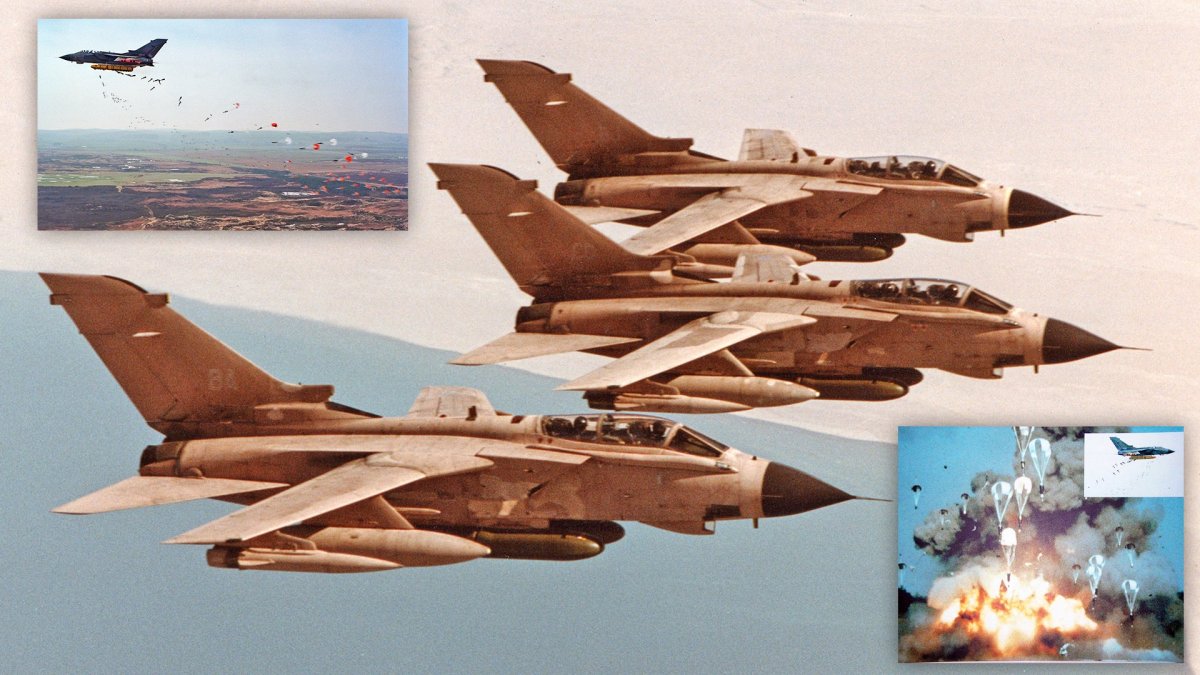
A Royal Air Force Tornado GR1 in the “desert pink” Alkali Removable Temporary Finish (ARTF)., Ian Black
These are the words of Nige Ingle, a young Royal Air Force Tornado GR1 pilot back in 1991, who flew some 15 combat missions in Operation Desert Storm with his navigator Paul McKernan. Exactly 30 years ago, British Tornado aircrews were tasked with some of the most demanding, important, and risky missions of the entire conflict. In particular, screaming in at very low-level over the most defended targets in Iraq and in the black of night to employ an exotic weapon exclusive to the Tornado that was meant to do one thing — tear apart the enemy’s runways and make it very dangerous for them to attempt repairs.
Tornado on the front line
The 1980s was an era in which the focus was on countering the Warsaw Pact threat to the east. The Panavia Tornado Interdictor Strike (IDS) was designed for that time — optimized to fight at low-level on the European front. British Tornado GR1 squadrons based in the U.K. and in Germany plied their trade skimming the treetops, and delivering unguided “dumb” bombs at high speed with great levels of accuracy. It was an environment in which RAF fast jet aircrews excelled, and it’s what they honed their skills for every day.
Few could have expected that when the call to action came, the gray and green-painted Tornados and their aircrews were not plunged into nuclear combat against the vast Soviet war machine. Instead, they had to swiftly adapt to fight an unexpected foe in the deserts of the Middle East.
For British Tornado GR1 pilot and navigator teams, that’s exactly what happened in 1990 as they joined a vast coalition of air assets that was being assembled to tackle Iraq and its tyrannical leader Saddam Hussein.
The first few nights of the ensuing air campaign witnessed bravery in aerial combat in what proved to be the baptism of fire for the British Tornado force, which subsequently notched up an impressive service record on almost constant operations that lasted until the type’s retirement in 2019 . The accounts of the particular Tornado aircrews in this feature bear witness to one of the most incredible chapters in the history of aerial warfare.
Heading to the desert
When Iraqi forces invaded neighbouring Kuwait in the early hours of August 2, 1990, repercussions echoed around the world. With concerns that Saddam Hussein might order his forces to plough on into Saudi Arabia, a path to potential conflict quickly formed. With over 500 fighter and bomber aircraft, Iraq possessed one of the most powerful air forces on the planet. The threat from Iraq and its formidable air force was taken very seriously indeed.
An RAF Tornado GR1 banks away from a Tornado F3 during the work-up period before Desert Storm., Ian Black
To counter Iraqi aggression, a huge air armada began to be assembled in the Persian Gulf, led by the United States. The Tornado GR1s would form the backbone of a British strike force, alongside SEPECAT Jaguar GR1s, and later, veteran Blackburn Buccaneers, supported by tankers, helicopters and transport aircraft. The hastily assembled coalition air force was quickly integrated into a huge plan to stop Saddam’s forces in its tracks, and liberate Kuwait.
The RAF deployed the first squadron of Tornado GR1s to the Gulf on August 27, 1990, as No 14 Squadron departed RAF Brüggen, Germany, for Muharraq, Bahrain, decked out in a new “desert pink” Alkali Removable Temporary Finish (ARTF). RAF Germany (RAFG) supplied the initial bulk of the Tornado assets for Operation Granby — as the U.K.’s part of the massive operation was known.
Once the initial British build-up was complete, three reinforced squadrons each averaging 15 aircraft and 24 crews were in position at Muharraq, as well as at Dhahran and Tabuk in Saudi Arabia.
Steve Warren-Smith was a young Flight Lieutenant on his first frontline tour as a Tornado pilot, assigned to No 17 Squadron at Brüggen, when he and some of his colleagues were swiftly dispatched to Bahrain. “Unlike the Tornado squadrons at RAF Marham, none of the eight Germany-based squadrons were qualified to conduct air-to-air refueling, because we were considered to be close enough to the Cold War front line. So initially, there was a huge push to get the RAF Germany Tornado squadrons qualified to take fuel from the tanker, which in its own right was a mad scramble.”
“One guy got the air refueling drogue down his intake before he managed to slow down enough. Another one sailed straight past the basket and popped out his airbrakes, which the drogue promptly snagged upon. This was closely followed by a hail of ball bearings and springs as he dropped back and the basket disintegrated.”
Once in theater, the Tornado crews took their well-practiced Cold War-era tactics that were honed on the plains of Northern Germany and adapted them to the desert environment. The Tornados generally worked as four-ship teams, training with everything from the Hunting JP233 runway denial bomblet-dispensing weapon, to 1,000-pound general-purpose bombs, the latter in low-level lay-down and loft delivery profiles.
Tornado GR1 ZA354 carrying JP233 test rounds during trials in 1983., BAE Systems
“We did a lot of operational low flying [OLF, flying at 100 feet] and a lot of night work,” recounts Mark Roberts, at that time a Flight Lieutenant junior pilot on No 16 Squadron deployed to Tabuk. “The low-level really prepared us well on the basis that we had no idea what we’d be doing when it came to operations. So, being honed for low-level by day or night was a really good thing for us. The value of the training made us really sharp, which meant we could cope with whatever was thrown at us.”
The Tornado crews intensely practiced using the built-in terrain-following radar (TFR) , which enabled them to fly hands-off on autopilot at 200 feet above the desert floor. Night-vision goggles were available to some crews later in the war, but in the early stages, the Tornado pilots were offered a hand-held system that nobody used. Unlike the forests and plains of northern Europe, the undulating sand dunes of Saudi Arabia didn’t give the TFR a very good radar return, and so the radar altimeter (radalt) became a vital tool for avoiding the ground.
During the work-up period, it became clear that the Tornados could be called upon to tackle Saddam Hussein’s sprawling airfields, mainly due to their excellent low-level skills. The Tornado and JP233 combination was perfectly suited to the task. The Tornados would need to attack at ultra-low level in order to best avoid the ring of air defenses at these bases, and to accurately deliver their highly specialized, runway-destroying weapon.
Using the JP233 was aimed at keeping the feared Iraqi Air Force firmly on the ground as the airfields were taken out of action — better to strand them or kill them on the ground than fight them in the air.
A Tornado GR1 deploys the JP233 system during testing at West Freugh in the U.K. in 1983., BAE Systems
Tornado and the JP233
The Hunting JP233 was one of the Tornado GR1’s primary weapons. During the Cold War, the idea behind it was to close down Soviet airfields, thus nullifying any potential air support for ground forces. Taking out the Soviet bases meant that NATO forces would stand a better chance of holding their ground. The Tornados of the German Luftwaffe and the Italian Aeronautica Militare Italiano opted for a different runway denial system, the MW-1.
Development of the JP233 system dates back to 1977. It consisted of two huge 21-foot 5-inch-long dispenser pods, weighing a combined 5,148 pounds, that were attached to the underside shoulder pylons of the Tornado GR1 fuselage. Each pod consisted of two sections, the rear portion containing 30 SG357 57-pound runway-busting concrete-penetrators, and the front housing 215 HB876 5.5-pound area-denial submunitions, with both types of sub-munitions being retarded by small parachutes.
The larger SG357 two-stage munitions featured a long, smaller-diameter forward section that included a cylindrical high-explosive charge with a hole in the middle. The shorter, larger-diameter, rear section accommodated a shaped charge. A telescopic fuze at the front of the SG357 created the exact detonation distance for the shaped charge. When the submunition impacted the surface, the fuze initiated this shaped charge, which created a molten metal “spear” that shot through the forward portion and the concrete to create an underground void. The cylindrical high-explosive charge followed this down into the ground before exploding, which was intended to create a crater with significant “heave” at the edges, thus resulting in significant damage to the area around the crater that couldn’t be easily repaired.
The JP233’s submunitions falling and wreaking absolute havoc on an improved surface. , Public Domain
The HB876 was a particularly nasty anti-personnel mine — designed to spread across the rubble and detonate at specific intervals, or if disturbed, in order to hinder repair operations. The outside of the HB876 featured sprung steel strips. After landing a small explosive device fired to release the strips, which served to stand the mine upright, with the fragment warhead pointing upwards. When detonated, it would fire anti-personnel fragments in all directions.
The first JP233 test flight was flown over the range at West Freugh, U.K., on February 23, 1982, using a British Aerospace flight trials Tornado (ZA354/BS07). Trials continued throughout 1983 with the release of the munitions, initially from height, and then at lower levels, including against a prepared surface to confirm its concrete-busting performance. The testing also included separation of the JP233 containers, which housed the sub-munitions, and would automatically fall away from the Tornado when the weapon was done spewing out its deadly cargo. JP233 was issued to the RAF front line in April 1985.
Despite operational evaluation trials conducted in the U.S., none of the frontline RAF Tornado squadrons had used JP233 until it was broken out of its crates in preparation to be used in anger over Iraq’s airfields in 1991. Indeed, there weren’t even any training rounds with which to simulate its carriage, they were all live rounds. Practice was restricted to the simulator or to carrying fuel tanks under the fuselage.
The initial tactic for the JP233 was to fly straight down the runway to deploy the bomblets, which floated down on parachutes. However, accurately delivering the weapon was a challenge. If there was any crosswind or if the run was slightly offline, the rain of destruction would be neatly aligned down the side of the runway, leaving it untouched. Moreover, this delivery profile was very predictable. It required the aircraft to be flown in a straight line, wings level, right down the centerline of the runway — usually one of, if not the most highly defended pieces of real estate in the enemy’s entire portfolio.
The weapon had two modes, one for a faster munitions release over a shorter distance, and a slower release that would spread the weapon over a longer stretch of the flight path. The RAF preferred to use the faster release profile, scattering the munitions across runways and taxiways to cut them, instead of along their length, which was considered more predictable and prone to missing the target completely. The Tornado crews became all too aware of how well the Iraqi airfields had been designed and engineered, with multiple parallel taxiways that were also stressed for use as runways.
Putting even a single Iraqi airfield out of action would be a huge undertaking.
A three-ship of JP233-toting Tornados during training in the Gulf in late 1990., Steve Warren-Smith
“We trained to either cross the runway to cut it up, or to fly down it, and it had two delivery modes: 7.6 seconds or 19, for the two rates of spread,” explains Steve Warren-Smith. “JP233 had to be delivered at around 160 feet, wings level, with no G or angle-of-bank. So you had to fly with very precise parameters for it to be delivered effectively. If you were too high some of the sub-munitions could drift off downwind. Over a peacetime range is one thing, but to do it over an airfield in the pitch black where everyone’s firing at you is quite another!”
An added complication was that the TFR was calibrated for 200 feet, and it wasn’t capable of flying the aircraft at the 160-foot height that was optimum for employing the JP233. It meant the pilot needed to deselect terrain following and hand-fly the aircraft with a radar height hold of 160 feet on the radar altimeter, in the pitch black of night, without night-vision goggles or a forward-looking infrared, if they were to achieve an optimum release height.
The three Tornado detachments in the Gulf spent the last months of 1990 engaged in intense work-ups for what lay ahead. One of the specific training requirements was to low-fly with the JP233 pods fitted, both day and night. However, this presented a problem. The RAF only had live rounds, and the explosive lugs that attached the huge weapon system to the aircraft were only stressed for 1.5 missions. It meant each pod could do a takeoff and landing, but a second mission would require the system to be employed or jettisoned — the Tornado couldn’t land back with the JP233 still attached. The solution was to fly each live system once, then park it ready for if hostilities kicked-off.
“At the end of each training mission from Muharraq we would “hoover” down the runway at Sheikh Isa Air Base with the weapons package selected to fly a JP233 delivery profile at 160 feet,” explains Steve Warren-Smith. “Because we couldn’t actually drop the weapon in training, we just had our HUD [head-up display] symbology with a bomb-fall line to go by. We could fly down a runway, but without the weapon actually coming off, you didn’t really know how effective you’d been!”
An RAF Tornado GR1 over the desert with wings swept fully forward., Ian Black
It became apparent that the number of sorties needed to familiarize each Tornado crew with JP233 could have an adverse effect on available live rounds. A solution was developed whereby manufacturer Hunting modified a complete JP233 system with weighted concrete ballast in place of the explosive charges. With beefed-up lugs, this training store would be available for multiple sorties.
“On December 1, 1990, my four-ship was scheduled for a night training sortie,” says Warren-Smith. “My nav and I were allocated the JP233 training round. I had become increasingly aware of the impending conflict, and of making sure we had the training nailed so we didn’t get all the way to the target and then do something wrong. In fact, it was at the forefront of my mind.”
“When you dropped a JP233, rather than going “now” the pilot held the “commit” button on top of the stick and once the bomb-fall line hit the target the computer would release the weapon. The plan is that you commit, the munitions come out at the computed point, and then the containers fall away automatically 1.5 seconds after the dispensing process is complete. We didn’t have any specific briefing on this training round, and as we walked out to the jet we decided that as there was nothing live on it, we should be as realistic as possible and do all the switches and the commit on our run.”
“Our target was a geographical waypoint in a very flat part of the Saudi Arabian desert. We got airborne, in-flight refueled and then dropped into low level at 200 feet on the TFR in the black of night. As we made our run, we went through the switches and committed the “weapon.” Suddenly the explosive release lugs went bang and the whole 5.5 tons of the two pods came off! The autopilot threw us into a 3.5-G pullup as it thought something had gone wrong. We left the whole thing in the desert!”
“That was the end of the JP233 training round.”
A Tornado GR1 from the Muharraq detachment with JP233s loaded., Ian Black
When the RAF initially deployed Tornados into the theater in August 1990, it sent some of its most experienced Qualified Weapons Instructors and Flight Commanders. The policy of a three-month roulement meant that some of the crews that were deployed right at the start — notably those at Muharraq — started to return home despite all the experience and work-ups that had been completed.
Steve Warren-Smith and many of his colleagues in Bahrain — who had spent three months honing their skills in the desert — headed back to Germany in early January. In their place, a fresh influx of personnel arrived, and these new crews, many of which included some very junior officers, had very little time to get up to speed with the challenges of desert operations as conflict loomed.
Nige Ingle was a young Pilot Officer on No 617 Squadron “Dambusters” at RAF Marham, in his first year flying the Tornado GR1. “As all the experienced guys had gone to the Gulf; it left a gene pool of us doing combat work-ups and others who didn’t have the required hours to deploy. I just managed to accrue sufficient hours to get permission from my boss Wg Cdr Bob Iveson to do the Gulf work-up. We flew with heavy weapons [1,000-pound dumb bombs], did night TFR, and operational low flying down to 100 feet. In my heart of hearts, I thought we’d end up deploying, but that Saddam Hussein would call it quits, and I’d come home fully qualified!”
“Our experience of JP233 was that we had the software in the jet, and we knew we needed to fly down the centerline of the runway to use it. That was it,” says Ingle. “They’d worked out that if they put the big 2,250-liter [594 US gallon] tanks on the jet and the two JP233 pods, plus a full load of fuel, the aircraft would be above its maximum take-off weight. I remember the boss of No 617 Squadron proved it could be done by flying a jet in this configuration at Marham.”
A dismantled JP233 pod showing the rear and front sections. , USAF
Wrecking Saddam’s airfields
The day before Operation Desert Storm was launched, the various crews around the Gulf region were told that they were going to war. The Iraqi Air Force was considered to be a formidable opponent, and the RAF entered the conflict with the same level of expectation and preparedness as if it was meeting the Soviet forces in Europe.
Four jets from the Dhahran detachment and eight from Muharraq were the first RAF Tornado GR1s into Operation Desert Storm as the air campaign started in the early hours of January 17, 1991 . Each clutching a pair of JP233s, they were tasked with taking out Iraqi airfields in a bid to keep Saddam’s air force on the ground.
In the dead of night, the Tornados taxied out to their respective runways in radio silence to maintain operational security. “Our objective was to sever access to the runways from the hardened aircraft shelter dispersals at each corner of the airfield, thought to be easier to achieve than putting two runways out of action,” explained Mal Craghill, who was assigned to No 16 Squadron at Tabuk. “In what would become a familiar pattern, we would have “area support” from fighters sweeping a wide area ahead of us for enemy aircraft, electronic attack aircraft jamming surface-to-air missile [SAM] radars, and aircraft capable of shooting anti-radiation missiles at any radars which did threaten us. These aircraft were not dedicated to our formation, but knew where we would be at any given time to ensure they could protect us.”
Led by their respective detachment commanders, the first Tornado “package” launched shortly before 01:00 AM local time headed for Tallil Air Base, near Nasiriyah. This base housed at least one squadron of fighters. Meanwhile, just over an hour later Wg Cdr Travers-Smith led a four-ship of GR1s out of Tabuk towards Al Asad Air Base, to the north of Ramadi, and home to two Iraqi MiG squadrons.
A Royal Air Force Tornado GR1 flying at low level over the Saudi Arabian desert., RAF/Crown Copyright
For Mark Roberts, he was to fly the first of his 26 Desert Storm missions as number three in a four-ship formation. “I flew at the end of the first wave for a JP233 attack on Al Asad. I remember as we were flying low across the desert at a couple of hundred feet, we could see the triple-A lighting up from about 200 miles away. We commented: “Christ, thank goodness we’re not going there,” only to turn onto our final attack heading to realize that it was exactly where we were going.”
“As I approached the target I remember quite vividly that the triple-A was being arc-fired. I disconnected the autopilot and flew low across the airfield into what felt like a wall of lead. We flew right into it and your senses tell you that everything is going upwards, so the visual stimuli is that you’re going downwards. We were doing a coordinated attack and I remember looking across and seeing the JP233 going off [on another jet] and effectively saying ‘I’m here!’ right inside the triple-A ring. Then we went from all the visual stimuli in the world to absolutely nothing. All I could see was the triple-A in my mirrors.”
Nige Ingle and Paul McKernan deployed to Bahrain on January 1, 1991, to complete a No 27 Squadron four-ship, which was attached to No XV Squadron. The timing meant they flew a total of seven work-up sorties in theater, but they had no experience of flying with the JP233. Yet on night two of the campaign, they were preparing to fly their first combat mission, and it was to be a JP233 raid.
Muharraq was to launch eight jets — four to attack Shaibah Air Base, and another four-ship was tasked to hit Ubaydah bin al Jarrah Air Base, near Kut. “We actually lost the toss for the mission, so our formation got the longer flight that required two pre-strike tanker brackets. We were told the best thing to do was to sleep during the day, then stay awake at night to be ready for the attacks in the darkness. Neither Paul or I slept a wink for what must have been 24 hours before the mission — I’ve never felt as tired as I did for that first combat sortie,” Ingle recalls.
A Tornado GR1 on the flight line at Muharraq, Bahrain, armed with live JP233s., Ian Black
Ingle and navigator Flight Lieutenant Paul McKernan were to be the number four aircraft in the four-ship. “Our formation leader planned the sortie, and we pitched up at the brief to hear that we’d be tanking twice with JP233 loaded before we went low level, supported by four F-15Cs , four F-111s, four F-4Gs and two EF-111 Ravens,” McKernan recalls. “The first time we came face-to-face with a JP233 was on the evening of January 17 when we walked out to the jet and it had these two big wardrobes strapped underneath it!”
The al Jarrah formation left Muharraq at midnight local time. “Night formation, flying an overweight jet, and taking JP233 with us to the tanker was a challenge in itself,” says Ingle. “After departing the tanker we dived down into low level and turned our lights out as we went across the border. Paul was very busy operating the kit and getting the navigation fixes, which was the most important thing that we had to do.”
“The airfield itself at al Jarrah had been under attack for a considerable time before we got there,” Paul McKernan continues. “That was most definitely not Tornado Standard Operating Procedure — we liked to sneak in, drop the weapons, and clear off before anyone knew that we were there.”
“Soon after we had tanked, the number three jet had a problem and had to turn back. Shortly after crossing the Iraqi border we were locked and fired upon by a Roland SAM. Nige spotted the missile and did an evasive maneuver and chaff was dispensed. Thanks to the efforts of the SEAD [suppression of enemy air defense] aircraft the target was easily visible as a huge orange glow on the horizon. None of us had seen triple-A before, and we thought how on Earth are we going to get through all of that?”
Flt Lt Paul McKernan (left) and FO Nige Ingle during Operation Granby, as the British participation in Desert Storm was known., Paul McKernan
Ingle picks up the story: “At a range of around 18 miles to go we were told we should select full combat power [afterburner] and leave that in until around six miles to run, then go to max dry power so we were absolutely as fast as possible, but without the reheat “carrots” coming out the back to give away our position as we ran over the target. I decided that speed was what we needed, so when Paul said cut the burners at six miles, I kept them in for a bit longer. For the run, we were given a choice. We could leave the autopilot terrain-following radar in, which would take us over the target at 200 feet, or we could fly manually down to a height we were comfortable with. With very few hours on the Tornado, I elected to stay on autopilot.”
The remaining Tornados in the formation were offset to the right of the lead aircraft, with 20 seconds trail spacing between each jet, hugging the desert floor. As if they didn’t have enough to do, Ingle and McKernan’s final attack run was interrupted with 2.5 miles to run when what was initially thought to be triple-A hit the port wing. “The aircraft rose to 600 feet but we rapidly got back down to 200 feet,” says McKernan. “I was head down in the radar scope, but it was horrendously bright in the cockpit with all the triple-A. Having gone all that way and worked ourselves through that orange dome of fire, we were damn sure we were going to hit what we were aiming for, and we did!”
Ingle recalls that when the JP233 was deploying its sub-munitions it felt like driving a car over cobblestones; another navigator said it was like driving over a cattle grid.
Coming off the target run, with JP233 canisters punched-off, and running south at the speed of heat for the border, Ingle remembered the huge bang and yaw on the final run-in. “We were still flying, so it couldn’t be too bad.” The leading-edge wing slats had stopped working and he couldn’t sweep the Tornado’s wings forward from their 45-degree position. The three jets all landed safely and taxied in after what had been a grueling four-hour and 10-minute mission. As they stepped from the cockpit, a television crew awaited Ingle and McKernan. “How was it?” They filmed the weary pair as they inspected the wing to find that the impact hadn’t been Iraqi bullets, but instead a large bird that they’d hit as they screamed towards al Jarrah.
Back in the temporary squadron building, the three crews got together to debrief what they had just done. The sheer enormity of the task they’d achieved started to sink in. “With the debrief complete, the other formation, which had gone to Shaibah, came to see us. One of the pilots was in bits,” Ingle recalls. “They didn’t tell us until we’d got everything finished that they’d lost one of the Tornados in their formation.” They’d seen the commanding officer of No 27 Squadron, Wg Cdr Nigel Elsdon, and his navigator Flt Lt “Max” Collier, go down during their JP233 attack. Both were tragically killed.
In the early hours of January 19, Ingle and McKernan were back in action. This time, they were part of a package of eight Tornados assigned to No 27 Squadron that were again tasked with attacking the Iraqi airfield at Tallil. The lead four-ship was to loft 1,000-pound dumb bombs into the airfield, which were designed to airburst over the SAM emplacements. Then the JP233-armed four-ship would make their run.
“Our formation was 40 seconds behind the first,” recalls Ingle. “So we could avoid the frag from their bombs. I saw the number two jet in their formation get shot down. It was Dave Waddington and Robbie Stewart, and they’d been hit by a Roland SAM.” Flt Lts Waddington and Stewart were taken prisoner, enduring six weeks of captivity and interrogation in Iraq before being released at the end of the war.
During the first four nights of the war, the Tornado crews flew 53 JP233 raids against Iraqi airfields, expending 106 JP233s. After five days, thanks to a mix of coalition successes, it was decided that the threat from Saddam’s air force had been suitably reduced. The intense low-level raids had taken their toll on the RAF Tornados, with four jets lost during these raids and four aircrew killed. The Tornados were instructed to change tactics to fly at medium level at around 20,000 feet, where only the larger SAMs could cause them problems. Much of this threat had by now been diminished by the activities of the coalition SEAD aircraft.
“Switching to medium-level operations on January 22 took a bit of the intensity out of it,” recounts Mark Roberts. All the Tornado units started flying at medium-level and used 1,000-pound freefall bombs as the Tornado crews took their existing tactics and employed them at higher altitudes. Then came one of the major breakthroughs of the campaign. Both the Muharraq and Dhahran detachments began working with Pave Spike laser designator pod -equipped Buccaneers from February 2 and 5 respectively, before Tornados equipped with TIALD (Thermal Imaging and Laser Designator) pods began arriving at Tabuk on February 10. The advent of laser-guidance enabled the Tornados to attack targets such as bridges and individual hardened aircraft shelters with precision using Paveway II laser-guided bombs .
Three JP233 Tornado GR1s on a mission from Muharraq., Mike Lumb
While JP233 had an important role to play in Desert Storm, its delivery profile resulted in some of the most dangerous missions of the entire air war. Designed in the depths of the Cold War, it was reliant on having a delivery aircraft directly over the target at very low level, making a long and predictable target run. What the RAF Tornado aircrews did on those first few nights of Desert Storm was unbelievably brave.
While the Tornado crews were told whether or not their JP233 attacks had hit their intended targets, the overall success of the employment of the system against Iraqi airfields was subject to a classified report after the war.
SG357 concrete-penetrators spill from the rear portion of the JP233 during testing., BAE Systems
The JP233 was initially planned to remain in service until at least 2005, but the British Landmines Bill of July 1998 put an end to JP233. While the bill didn’t prohibit the use of airfield denial weapons, JP233 was ruled out by the Ottawa Convention and British legislation prohibited the use in any circumstances of any weapon classified as an anti-personnel landmine.
All HB876 bomblets were to be destroyed by January 1, 2000, and the SG357 submunitions (which did not contravene the Ottawa Convention) by the end of 2002. To achieve this timetable, JP233 was planned for withdrawal from service in August 1998.
It was decided that the advent of modern, precision-guided weapons such as the Storm Shadow cruise missile, which was carried by the Tornado operationally from 2003, more than mitigated the removal of JP233 from the British inventory, although clearly these weapons were not specifically designed to take out airfields in the manner of the JP233.
A JP233 on display underneath a Tornado GR1 at the National Museum of the U.S. Air Force., USAF
An era of dramatic change
Operation Desert Storm book-ended the Cold War era of the RAF, which was built around a strict doctrine that was purposely designed to meet the threat from the Warsaw Pact. The RAF Tornados went to war at low level with unguided weapons and emerged versed in smart munitions and pinpoint attacks. Ironically, as the peace dividend brought about huge defense cutbacks, both the British and U.S. military entered a period of sustained combat operations in the Middle East that continue to this day.
When the RAF Tornado crews were sent to the Middle East to confront Iraq, there was very little actual combat experience on the RAF front line. Desert Storm laid the bedrock for a whole new era of warfighting for the modern RAF. One in which the service could strike a point of its choice, at a time of its choosing.
The events of January 1991 heralded a step-change in the way the RAF Tornados conducted business, switching away from the low-level focus towards medium-level tactics with increased use of smart weapons. RAF crews proved that they were able to quickly move away from rigid tactics and that they were highly adaptable and capable of adopting new techniques, even during high-intensity combat operations — making a huge impact on the overall campaign. “When I think about it, it was quite extraordinary what we did when you compare it with the way things are done today — with night-vision goggles, forward-looking infrared, standoff weapons — but actually what we did back then was really advanced for its time,” commented one Tornado pilot.
Overall, six RAF Tornados were lost during combat operations in Desert Storm. These losses were mistaken by some as an indication that the Tornado was incapable of undertaking its intended mission, and that they were forced to switch to medium level. In fact, attacking those Iraqi airfields on the first few nights had to be undertaken at low level. No other aircraft or aircrews were better suited to perform these treacherous missions. Neutralizing Iraq’s airfields played a significant part in the coalition achieving air superiority, which in turn meant the Tornados could safely switch to medium-level operations. One pilot commented: “We knew Iraq had an advanced air defense system and a significant air threat and we believed they’d be up for the fight.”
Ingle and McKernan flew together throughout the air war, completing some 15 incredible combat missions. “Our Qualified Weapons Instructor was experienced and he had a seasoned perspective, and our backs,” says Ingle. “And I’d have followed our formation leader to the end of the Earth.”
Looking back at the events of those nights in the cockpit of a Tornado some 30 years ago, McKernan and Ingle have an impenetrable bond that was forged in the heat of battle. “We set out to do what we were asked to do, and to do it as well as we could.”
It’s easy to see why some retrospectively drew parallels between what the Tornado crews did on those first few nights over Iraq with some of the RAF’s World War II operations, such as the “Dambusters” raid on Germany’s Ruhr Valley. The quietly professional RAF Tornado community was always keen to avoid such comparisons.
Overall, the 61 deployed RAF Tornado GR1s flew some 2,535 sorties in Desert Storm, employing 106 JP233s, and dropping 3,631 unguided 1,000-pound bombs, and 1,079 laser-guided bombs. The Tornados also flew 140 reconnaissance sorties and fired some 113 Air-Launched Anti-Radiation Missiles (ALARMs) on SEAD missions.
The British Tornado story is just one chapter of Desert Storm, an air campaign that helped to shape the face of modern aerial warfare. Some 30 years on, the accounts from aircrews that took part in the massive air war bear testament to the significance of their contributions and their unflinching approach to the missions that they were asked to fly.
Mission markings including two JP233s and nose art applied to Tornado GR1 ZA465 Foxy Killer , seen back in the UK post-war., Ian Black
Contact the editor: Tyler@thedrive.com
Comments couldn’t be loaded. Please refresh the page.
更新于美国东部时间2021年1月15日下午3:17。
“距离目标只有几秒钟的时间了,自动驾驶仪突然亮起红色警报,‘旋风’战斗机左侧传来一声巨响,随后剧烈偏航。我冲着保罗喊道:‘我们中弹了,我们中弹了!’他回应说:‘目标有效,继续。’于是我猛地压低机头,重新启用地形跟踪雷达(TFR)——我们正处于武器发射点。当我们飞入曳光弹的包围圈时,保罗喊道:‘准备发射!’我早已按下‘发射’按钮——无论如何,武器都要发射!”
“透过高射炮的火光,我看到下方的机场亮了起来,我们的JP233飞机开始投弹。突然,正如我们事先被告知的那样,传来三声巨响,武器弹罐自动抛弃了。我们偏离了目标,我拉起飞机向左爬升转弯。临时飞行限制区(TFR)已经解除,保罗喊道“高度”,等我们机翼恢复水平时,我们已经回到了200英尺的高度,TFR也重新生效了。虽然只持续了几秒钟,但感觉却像过了几个小时!我们呼啸着冲进漆黑的夜空,把一切都抛在了身后,那种如释重负的感觉真是难以言喻。”
一架涂有“沙漠粉”碱性可移除临时涂层(ARTF)的英国皇家空军“旋风”GR1战斗机。伊恩·布莱克
这是奈杰尔·英格尔(Nige Ingle)在1991年所说的话。当时,他是一名年轻的英国皇家空军“旋风”GR1战斗机飞行员,与领航员保罗·麦克纳恩(Paul McKernan)一起,在“沙漠风暴”行动中执行了大约15次战斗任务。整整30年前,英国“旋风”战斗机的机组人员被委以重任,执行了整个冲突中最艰巨、最重要、也最危险的任务。特别是,他们要在伊拉克防御最严密的目标上空,在漆黑的夜色中,以极低的高度呼啸而过,使用一种“旋风”战斗机独有的特殊武器。这种武器只有一个目的——摧毁敌方跑道,使其难以进行维修。
前线的龙卷风
20世纪80年代,重点在于应对来自东方的华沙条约组织的威胁。帕纳维亚“旋风”拦截打击战斗机(IDS)正是为应对这一挑战而设计的——它经过优化,能够在欧洲战场上进行低空作战。驻扎在英国和德国的英国“旋风”GR1战斗机中队,经常贴着树梢飞行,以极高的精度高速投掷无制导的“哑弹”。这种作战环境正是英国皇家空军快速喷气式战斗机飞行员大显身手的地方,也是他们日复一日磨练技能的舞台。
几乎没有人会想到,当行动号召下达时,这些涂着灰绿色的“旋风”战斗机及其机组人员并没有被投入到与庞大的苏联战争机器的核战争中。相反,他们必须迅速调整战术,在中东沙漠中与一个意想不到的敌人作战。
对于英国“旋风”GR1战斗机的飞行员和导航员团队来说,1990年他们就加入了一支庞大的空中力量联盟,这支联盟正在集结起来对抗伊拉克及其暴君萨达姆·侯赛因。
在随后的空战中,最初几个夜晚见证了英勇的空中战斗,这对于英国“旋风”战斗机部队来说,无疑是一次实战洗礼。此后,这支部队在几乎不间断的作战行动中取得了令人瞩目的战绩,直至2019年该机型退役。本文中“旋风”战斗机机组人员的亲身经历,见证了空战史上最不可思议的篇章之一。
前往沙漠
1990年8月2日凌晨,伊拉克军队入侵邻国科威特,其影响波及全球。人们担心萨达姆·侯赛因可能会命令军队继续入侵沙特阿拉伯,潜在的冲突形势迅速恶化。伊拉克拥有超过500架战斗机和轰炸机,是当时世界上最强大的空军之一。伊拉克及其强大的空军构成的威胁,确实引起了国际社会的高度重视。
在“沙漠风暴”行动前的训练阶段,一架英国皇家空军的“旋风”GR1战斗机从一架“旋风”F3战斗机旁驶离。(伊恩·布莱克摄)
为了对抗伊拉克的侵略,一支庞大的空军舰队开始在波斯湾集结,由美国领导。英国的“旋风”GR1战斗机将构成打击力量的中坚力量,与SEPECAT“美洲虎”GR1战斗机,以及后来的老式“布莱克本海盗”攻击机并肩作战,并得到加油机、直升机和运输机的支援。这支仓促组建的联军空军迅速融入一项旨在阻止萨达姆军队并解放科威特的庞大计划。
1990年8月27日,英国皇家空军第14中队从德国布吕根皇家空军基地起飞,前往巴林穆哈拉克,这是英国皇家空军向海湾地区部署的首个“旋风”GR1战斗机中队。该中队涂装了全新的“沙漠粉”碱性可移除临时涂装(ARTF)。英国皇家空军德国基地(RAFG)为“格兰比行动”(即英国参与的大规模军事行动)提供了最初大部分的“旋风”战斗机。
英国最初的集结完成后,三个加强中队(每个中队平均配备 15 架飞机和 24 个机组)分别部署在穆哈拉克,以及沙特阿拉伯的达兰和塔布克。
史蒂夫·沃伦-史密斯当时是一名年轻的飞行中尉,驾驶着“旋风”战斗机首次执行前线任务,隶属于驻扎在布吕根的第17中队。他和一些同事很快被派往巴林。“与驻扎在马勒姆皇家空军基地的‘旋风’战斗机中队不同,驻扎在德国的八个中队都没有空中加油的资格,因为我们被认为离冷战前线太近了。所以一开始,我们竭尽全力让驻扎在德国的皇家空军‘旋风’战斗机中队获得空中加油的资格,这本身就是一场混乱的行动。”
“有一架飞机还没来得及减速,空中加油锥就被塞进了进气口。另一架飞机径直飞过加油篮,打开了减速板,结果加油锥立刻钩住了减速板。紧接着,飞机向后坠落,钢珠轴承和弹簧像雨点般落下,加油篮也随之解体。”
进入战区后,“旋风”战斗机机组人员将他们在冷战时期于德国北部平原磨练出的成熟战术,调整以适应沙漠环境。“旋风”战斗机通常以四架飞机为一组进行作战,训练内容涵盖从猎鹰JP233跑道封锁子弹药投放器到1000磅通用炸弹的各种弹药,后者包括低空投放和高空投放两种模式。
1983年,BAE系统公司生产的“旋风”GR1 ZA354战斗机在试射JP233测试弹时的照片。
“我们进行了大量的低空作战飞行(OLF,飞行高度100英尺)和夜间飞行训练,”当时驻扎在塔布克的第16中队的一名飞行中尉飞行员马克·罗伯茨回忆道。“低空飞行训练让我们做好了充分的准备,因为我们对实际作战任务一无所知。所以,无论白天还是夜晚,接受低空飞行训练对我们来说都非常重要。这种训练的价值在于它让我们变得非常敏锐,这意味着我们可以应对任何突发情况。”
“旋风”战斗机的机组人员进行了大量的训练,练习使用内置的地形跟踪雷达(TFR),这使他们能够在距离沙漠地面200英尺的高度,以自动驾驶模式进行无手操控飞行。战争后期,一些机组人员配备了夜视镜,但在战争初期,“旋风”飞行员使用的是手持式夜视系统,但几乎无人使用。与北欧的森林和平原不同,沙特阿拉伯起伏的沙丘地形使得TFR的雷达反射效果不佳,因此雷达高度表(radalt)成为避免触地飞行的关键工具。
在演练阶段,很明显,“旋风”战斗机可以胜任对付萨达姆·侯赛因庞大机场的任务,这主要归功于其卓越的低空作战能力。“旋风”战斗机与JP233火箭炮的组合完美契合这项任务。“旋风”战斗机需要超低空攻击,才能最大程度地避开这些基地的防空系统,并精准投放其高度专业化的跑道破坏武器。
使用 JP233 的目的是让令人畏惧的伊拉克空军牢牢地待在地面上,因为机场已被摧毁——与其在空中与他们作战,不如让他们困在地面上或杀死他们。
1983年,一架“旋风”GR1战斗机在英国西弗鲁格进行测试时部署了JP233系统。(图片来源:BAE系统公司)
龙卷风和JP233
亨廷JP233导弹是“旋风”GR1战斗机的主要武器之一。冷战期间,其设计目的是封锁苏联机场,从而切断地面部队的空中支援。摧毁苏联基地意味着北约部队更有可能守住阵地。德国空军和意大利空军的“旋风”战斗机则选择了另一种跑道封锁系统——MW-1。
JP233系统的研发可以追溯到1977年。它由两个巨大的投放舱组成,每个投放舱长21英尺5英寸(约6.4米),总重5148磅(约2350公斤),安装在“旋风”GR1战斗机机身下方的肩部挂架上。每个投放舱分为两部分:后部装有30枚SG357型57磅(约27公斤)跑道破坏型混凝土穿甲弹,前部装有215枚HB876型5.5磅(约2.3公斤)区域封锁子弹药,两种子弹药均由小型降落伞减速。
SG357型两级子弹药的前端部分较长,直径较小,内含一个中部开孔的圆柱形高爆炸药。后端部分较短,直径较大,内含一个聚能装药。SG357前端的伸缩引信可精确控制聚能装药的引爆距离。子弹药撞击地面后,引信引爆聚能装药,形成一股熔融金属“矛”,穿透前端部分和混凝土,在地下形成一个空洞。圆柱形高爆炸药随后进入地下并爆炸,旨在形成一个边缘隆起明显的弹坑,从而对弹坑周围区域造成难以修复的严重破坏。
JP233的子弹药落下后,在改良型表面上造成了巨大的破坏。(公共领域)
HB876是一种极其危险的反步兵地雷——它被设计成散布在废墟中,并按特定时间间隔引爆,或者在受到扰动时引爆,以阻碍抢修作业。HB876的外部装有弹簧钢条。落地后,一个小型爆炸装置会引爆钢条,使地雷竖立起来,弹头朝上。引爆后,它会向四面八方发射反步兵碎片。
JP233的首次试飞于1982年2月23日在英国西弗鲁格靶场进行,试飞机型为英国宇航公司(British Aerospace)的“旋风”(Tornado)战斗机(ZA354/BS07)。1983年全年持续进行试验,首先从高空投放弹药,然后降低投放高度,包括对着预先准备好的地面投放,以验证其破除混凝土的性能。试验还包括JP233子弹药容器的分离,这些容器用于装载子弹药,当“旋风”战斗机完成致命弹药的投放后,容器会自动脱落。JP233于1985年4月正式列装英国皇家空军前线部队。
尽管美国进行了作战评估试验,但直到1991年准备在伊拉克机场上空实战中使用JP233燃料之前,英国皇家空军一线“旋风”战斗机中队都没有使用过这种燃料。事实上,当时甚至没有任何训练弹药来模拟携带,所有训练用的都是实弹。练习仅限于模拟器或在机身下方携带副油箱。
JP233的最初战术是沿跑道直线飞行投放子炸弹,子炸弹会借助降落伞缓缓降落。然而,精准投放这种武器却极具挑战性。如果遇到侧风或跑道稍有偏差,炸弹就会整齐地沿着跑道边缘落下,而跑道本身却毫发无损。此外,这种投放方式非常容易预测。它要求飞机保持直线飞行,机翼水平,沿着跑道中心线飞行——而这通常是敌方防御最严密的区域之一,甚至可以说是最严密的区域。
这种武器有两种模式:一种是快速投放,弹药散布范围更广;另一种是慢速投放,弹药散布范围更广,覆盖更长的飞行路径。英国皇家空军更倾向于使用快速投放模式,将弹药散布在跑道和滑行道上,而不是沿着跑道和滑行道投放。他们认为沿着跑道和滑行道投放更容易预测目标,也更容易完全脱靶。“旋风”战斗机的机组人员深刻体会到伊拉克机场的设计和工程有多么精良,多条平行的滑行道同时也被用作跑道。
即使瘫痪一个伊拉克空军基地也是一项巨大的工程。
1990 年末,三架携带 JP233 燃料的“旋风”战斗机在海湾进行训练。(史蒂夫·沃伦-史密斯摄)
“我们训练过两种投放方式:一种是横穿跑道切割,另一种是沿跑道飞行。这种燃料有两种投放模式:7.6秒或19秒,对应两种不同的散布速度,”史蒂夫·沃伦-史密斯解释道。“JP233燃料必须在约160英尺(约49米)的高度投放,机翼保持水平,不能过载或倾斜。因此,你必须按照非常精确的参数飞行才能有效投放。如果高度过高,一些子弹药可能会顺风飘散。在和平时期的靶场上空投放是一回事,但在漆黑的机场上空,在所有敌人的炮火下投放则是另一回事!”
另一个复杂之处在于,临时飞行限制区(TFR)的校准高度为200英尺,而它无法让飞机以使用JP233燃料的最佳高度160英尺飞行。这意味着,如果飞行员想要达到最佳投放高度,就必须在漆黑的夜晚,不使用夜视镜或前视红外设备的情况下,通过雷达高度表将高度保持在160英尺,手动操控飞机。
1990 年最后几个月,驻扎在海湾地区的三个“旋风”战斗机分遣队都在为即将到来的战斗进行紧张的训练。其中一项具体的训练要求是携带 JP233 吊舱进行昼夜低空飞行。然而,这却带来了一个问题。英国皇家空军只有实弹,而连接这套庞大武器系统的爆炸吊耳只能承受 1.5 次任务的载荷。这意味着每个吊舱可以进行一次起降,但第二次任务就必须使用或抛弃该系统——“旋风”战斗机无法在 JP233 吊舱仍然连接的情况下返回。解决方案是让每个实弹系统飞行一次,然后将其停放在指定位置,以备战时使用。
“每次从穆哈拉克起飞的训练任务结束后,我们都会驾驶飞机在谢赫伊萨空军基地的跑道上‘盘旋’,飞机携带的武器包会按照JP233投弹剖面,以160英尺的高度飞行,”史蒂夫·沃伦-史密斯解释说。“因为训练中我们无法实际投弹,所以只能依靠抬头显示器(HUD)上的符号和炸弹落点线来判断。我们可以沿着跑道飞行,但如果武器没有实际投放,你就无法真正了解训练的效果如何!”
一架英国皇家空军的“旋风”GR1战斗机飞越沙漠,机翼完全前掠。(伊恩·布莱克摄)
很明显,为了让每架“旋风”战斗机的机组人员熟悉JP233弹药,所需的飞行架次可能会对可用的实弹数量产生不利影响。为此,制造商亨廷公司开发了一种解决方案:他们对一套完整的JP233弹药系统进行改造,用配重混凝土压舱物代替炸药。加固的挂架使得这套训练弹药能够用于多次飞行任务。
“1990年12月1日,我们四架飞机组成的编队计划执行一次夜间训练飞行任务,”沃伦-史密斯说。“我和我的导航员被分配执行JP233训练任务。我越来越意识到即将到来的冲突,必须确保我们把训练做得完美无缺,以免一路飞到目标区域后却出现任何差错。事实上,这件事一直萦绕在我的心头。”
“投掷JP233时,飞行员不是直接按下‘立即’按钮,而是按住操纵杆顶部的‘确认’按钮。一旦弹着点落在目标上,电脑就会自动释放武器。计划是,飞行员按下‘确认’按钮,弹药会在计算出的点位投放,然后弹药容器会在投放完成后1.5秒自动脱落。这次训练我们没有接受任何专门的简报,当我们走到飞机旁时,我们决定既然没有实战,就应该尽可能地贴近实战,在这次飞行中完成所有的切换和确认操作。”
“我们的目标是沙特阿拉伯沙漠中一块非常平坦的区域内的一个地理航路点。我们起飞后进行了空中加油,然后在漆黑的夜里,在临时飞行限制区(TFR)内以200英尺的低空飞行。在执行任务的过程中,我们切换了开关,启动了“武器”。突然,爆炸释放装置发出巨响,两个吊舱共重5.5吨,全部脱落!自动驾驶系统误判了情况,让我们以3.5G的过载拉升。我们把所有东西都留在了沙漠里!”
“JP233训练轮到此结束了。”
一架来自穆哈拉克分队的“旋风”GR1战斗机,装载着JP233燃料。——伊恩·布莱克
1990年8月,英国皇家空军首次将“旋风”战斗机部署到战区时,派出了一些经验最丰富的合格武器教官和飞行指挥官。由于实行三个月轮换制,一些最初部署的机组人员——特别是驻扎在穆哈拉克的机组人员——尽管已经完成了所有必要的训练和经验积累,却不得不开始返回家乡。
史蒂夫·沃伦-史密斯和他在巴林的许多同事——他们在沙漠中磨练了三个月的技能——于一月初返回德国。取而代之的是一批新人员,这些新队伍中许多都是资历尚浅的军官,由于冲突迫在眉睫,他们几乎没有时间熟悉沙漠作战的挑战。
奈杰尔·英格尔是驻扎在马勒姆皇家空军基地第617中队“轰炸水坝者”的一名年轻飞行军官,当时是他驾驶“旋风”GR1战斗机的第一年。“所有经验丰富的飞行员都去了海湾地区,只剩下我们这些进行作战训练的飞行员,还有一些人飞行时间不够,无法部署。我勉强积累了足够的飞行时间,才从我的上司鲍勃·艾弗森中校那里获得了参加海湾地区作战训练的许可。我们携带重型武器(1000磅重的普通炸弹)飞行,进行夜间临时飞行限制区训练,以及低空作战飞行,最低高度可达100英尺。我内心深处一直觉得我们最终会被派往海湾地区,但萨达姆·侯赛因会下台,而我则可以带着合格的飞行员资格凯旋而归!”
“我们对JP233的经验是,飞机上装有相应的软件,我们也知道需要沿着跑道中心线飞行才能使用它。就是这样,”英格尔说。“他们计算过,如果把2250升(594美制加仑)的大油箱和两个JP233吊舱都装到飞机上,再加上满载燃油,飞机的重量就会超过最大起飞重量。我记得617中队的指挥官在马勒姆机场驾驶这种配置的飞机进行了试飞,证明了这是可行的。”
一张已拆解的JP233吊舱照片,展示了其后部和前部。(美国空军)
摧毁萨达姆的机场
在“沙漠风暴”行动发起的前一天,海湾地区各部队都接到了即将开战的通知。伊拉克空军被认为是一支强大的对手,英国皇家空军以应对欧洲战场上苏联军队的同等强度和充分准备投入了这场冲突。
1991 年 1 月 17 日凌晨,空袭行动开始,来自达兰分遣队的 4 架和来自穆哈拉克的 8 架英国皇家空军“旋风”GR1 战斗机率先投入战斗。每架飞机都携带两瓶 JP233 发动机,其任务是摧毁伊拉克机场,以阻止萨达姆空军的行动。
夜深人静之时,“旋风”战斗机悄无声息地滑行到各自的跑道,以确保作战安全。“我们的目标是切断机场每个角落加固的飞机掩体通往跑道的通道,我们认为这比瘫痪两条跑道更容易实现,”驻扎在塔布克的第16中队的马尔·克雷格希尔解释道。“我们将采用一种熟悉的模式:战斗机在我们前方大片区域进行扫荡,搜寻敌机;电子攻击机干扰地对空导弹(SAM)雷达;以及能够发射反辐射导弹攻击任何威胁到我们的雷达的飞机,为我们提供‘区域支援’。这些飞机并非专门负责我们的编队,但它们随时掌握我们的位置,以确保能够保护我们。”
在各自分遣队指挥官的带领下,第一批“旋风”战斗机编队于当地时间凌晨1点前不久起飞,前往纳西里耶附近的塔利勒空军基地。该基地至少驻扎着一个战斗机中队。与此同时,大约一个小时后,特拉弗斯-史密斯中校率领四架GR1战斗机从塔布克起飞,前往拉马迪以北的阿萨德空军基地,该基地驻扎着两个伊拉克米格战斗机中队。
一架英国皇家空军“旋风”GR1战斗机在沙特阿拉伯沙漠上空低空飞行。(英国皇家空军/英国皇家版权所有)
对于马克·罗伯茨来说,他第一次执行“沙漠风暴”行动的任务是作为四机编队中的第三架飞机。“我驾驶飞机执行第一波攻击任务的最后一架,目标是阿萨德空军基地,使用JP233弹药。我记得当时我们低空飞越沙漠,高度只有几百英尺,可以看到大约200英里外的三枚高射炮弹亮了起来。我们当时说:‘谢天谢地,我们不用去那里。’结果当我们转向最终攻击航向时才意识到,那正是我们要去的地方。”
“我清楚地记得,当我接近目标时,高射炮正在发射弧形炮弹。我关闭了自动驾驶仪,低空飞越机场,感觉就像撞上了一堵铅墙。我们径直飞了进去,你的感官告诉你一切都在向上,所以视觉刺激却让你感觉自己在向下坠落。我们当时正在进行协同攻击,我记得我向对面望去,看到另一架飞机上的JP233炸弹正在发射,就像是在说‘我来了!’,就在高射炮弹的环内。然后,我们的视觉刺激从万千瞬间消失。我的后视镜里只能看到高射炮弹。”
1991年1月1日,奈杰尔·英格尔和保罗·麦克纳恩部署到巴林,加入隶属于第15中队的第27中队,组成四机编队。由于时间安排,他们在战区总共进行了七次训练飞行,但他们此前从未驾驶过JP233飞机。然而,在战役的第二个夜晚,他们正准备执行首次作战任务,而这次任务正是使用JP233飞机进行空袭。
穆哈拉克原本要派出八架战机——四架攻击沙伊巴空军基地,另外四架则负责打击库特附近的乌拜达·本·贾拉赫空军基地。“我们实际上输掉了任务的掷硬币决定权,所以我们的编队执行的是需要两架战前加油机支援的长途飞行任务。我们被告知最好的办法是白天睡觉,晚上保持清醒,以便在黑暗中做好攻击准备。我和保罗在任务开始前至少24小时都没合眼——我从未像第一次执行战斗任务时那样感到疲惫,”英格尔回忆道。
一架停在巴林穆哈拉克机场跑道上的“旋风”GR1战斗机,挂载着未爆炸的JP233发动机。(伊恩·布莱克摄)
英格尔和领航员保罗·麦克南中尉将驾驶四架飞机中的第四架。“我们的编队指挥官计划了这次飞行任务,我们在简报会上得知,在低空飞行前,我们将加注两次JP233燃油,由四架F-15C、四架F-111、四架F-4G和两架EF-111‘渡鸦’战斗机提供支援,”麦克南回忆道。“我们第一次见到JP233燃油是在1月17日晚上,当时我们走到飞机旁,发现它下面绑着两个巨大的衣柜!”
阿尔贾拉赫编队于当地时间午夜离开穆哈拉克。“夜间编队飞行,驾驶超重的喷气式飞机,还要携带JP233燃油前往加油机,这本身就是一项挑战,”英格尔说道。“离开加油机后,我们俯冲到低空,并在越过边境时关闭了所有灯光。保罗忙着操作设备和进行导航定位,这是我们最重要的任务。”
“在我们到达之前,贾拉赫机场已经遭受了相当长时间的攻击,”保罗·麦克纳恩继续说道。“这绝对不是‘旋风’战斗机的标准作战程序——我们喜欢悄悄潜入,投放武器,然后在任何人发现我们之前撤离。”
“我们加完油后不久,三号机就出了问题,不得不返航。刚越过伊拉克边境不久,我们就被一枚罗兰地空导弹锁定并开火。奈杰尔发现了导弹,进行了规避机动,并释放了箔条干扰弹。多亏了压制敌方防空系统的飞机,目标清晰可见,在地平线上呈现出巨大的橙色光晕。我们以前谁也没见过三A导弹,当时我们都在想,我们到底该怎么穿过这片火力网?”
保罗·麦克纳恩中尉(左)和第一观察员奈杰尔·英格尔在格兰比行动期间,格兰比行动是英国参与沙漠风暴行动的代号。
英格尔接着说道:“在距离目标大约18英里时,我们被告知要开启全功率战斗模式(加力燃烧室),并保持到距离目标大约6英里时,再切换到最大功率(干功率),这样我们就能以最快的速度飞行,同时又不会因为加力燃烧室尾部喷出的废气暴露我们的位置。我认为我们需要的是速度,所以当保罗说在距离目标6英里时关闭加力燃烧室时,我又让它们保持开启了一段时间。在最后阶段,我们有两个选择。我们可以开启自动驾驶仪的地形跟踪雷达,这样会让我们以200英尺的高度飞越目标;或者我们可以手动降低高度,飞到我们觉得合适的高度。由于我驾驶‘旋风’战斗机的时间还很短,所以我选择了使用自动驾驶仪。”
编队中剩余的“旋风”战斗机偏离领头机右侧,每架飞机之间间隔20秒,紧贴沙漠地面飞行。仿佛任务还不够,英格尔和麦克南的最后一次攻击飞行在距离终点2.5英里处被打断,当时一枚最初被认为是三枚高射炮弹的炮弹击中了左翼。“飞机爬升到600英尺,但我们迅速下降到200英尺,”麦克南说。“我当时低头盯着雷达屏幕,但驾驶舱里被三枚高射炮弹的光芒照得刺眼。我们一路飞来,穿过了那片橙色的火球,我们非常确信能够击中目标,而我们也确实做到了!”
英格尔回忆说,JP233 投放子弹药时,感觉就像开车驶过鹅卵石路;另一位导航员说,感觉就像开车驶过牛栅栏。
完成目标飞行后,飞机上的JP233燃料罐被拆除,正以极快的速度向南飞往边境。英格尔回忆起最后冲刺时那声巨响和飞机的剧烈偏转。“我们当时还在飞行,所以情况应该不算太糟。”前缘缝翼已经停止工作,他无法将“旋风”战斗机的机翼从45度角的位置向前摆动。三架战机安全着陆,滑行进至停机坪,结束了这场艰苦卓绝的4小时10分钟任务。当他们走出驾驶舱时,一个电视摄制组正在等候英格尔和麦克纳恩。“感觉怎么样?”摄制组拍摄了这对疲惫的搭档检查机翼的画面,他们发现撞击点并非伊拉克的子弹,而是一只大鸟,他们在向贾拉赫方向疾驰时撞到了它。
回到临时中队营房后,三个机组人员聚在一起,总结刚刚完成的任务。他们开始意识到这项任务的艰巨性。“总结结束后,另一个前往沙伊巴的编队来看我们。其中一名飞行员情绪崩溃,”英格尔回忆道。“直到我们一切就绪,他们才告诉我们,他们编队中损失了一架‘旋风’战斗机。”他们亲眼目睹了第27中队指挥官奈杰尔·埃尔斯顿中校和他的领航员“马克斯”·科利尔中尉在执行JP233攻击任务时坠毁。两人不幸遇难。
1月19日凌晨,英格尔和麦克纳恩再次投入战斗。这一次,他们隶属于第27中队的八架“旋风”战斗机编队,再次执行攻击伊拉克塔利勒机场的任务。领头的四架飞机将向机场投掷1000磅重的无制导炸弹,这些炸弹的设计目的是在空对空导弹阵地上空爆炸。随后,装备JP233火箭弹的四架飞机将执行后续攻击。
“我们的编队比第一队晚了40秒,”英格尔回忆道,“所以我们躲过了他们炸弹的碎片。我亲眼看到他们编队中的二号机被击落了。那是戴夫·沃丁顿和罗比·斯图尔特,他们被罗兰地空导弹击中了。”沃丁顿和斯图尔特两位飞行中尉被俘,在伊拉克经历了六周的囚禁和审讯,直到战争结束才获释。
战争爆发后的前四个晚上,旋风战斗机机组对伊拉克机场进行了53次JP233轰炸,消耗了106枚JP233导弹。五天后,由于联军取得一系列胜利,人们认为萨达姆空军的威胁已显著降低。密集的低空轰炸给英国皇家空军的旋风战斗机造成了不小的损失,其中四架战机被击落,四名机组人员阵亡。旋风战斗机奉命改变战术,在约20000英尺的中空飞行,只有大型地空导弹才能对它们构成威胁。此时,联军的防空压制飞机已经大大削弱了这种威胁。
“1月22日转为中空作战后,战斗强度有所降低,”马克·罗伯茨回忆道。所有“旋风”战斗机部队都开始进行中空飞行,并使用1000磅重的自由落体炸弹。“旋风”机组人员将他们原有的战术运用到更高的飞行高度。随后,战役迎来了一项重大突破。穆哈拉克和达兰分遣队分别于2月2日和5日开始使用配备“铺路钉”(Pave Spike)激光指示吊舱的“海盗”(Buccaneer)攻击机。2月10日,配备热成像激光指示吊舱(TIALD)的“旋风”战斗机开始抵达塔布克。激光制导技术的出现使“旋风”战斗机能够使用“铺路二型”(Paveway II)激光制导炸弹精确攻击桥梁和单机加固掩体等目标。
三架JP233“旋风”GR1战斗机正在执行从穆哈拉克起飞的任务。——迈克·伦布
尽管JP233在“沙漠风暴”行动中发挥了重要作用,但其投放方式却导致了整个空战中最危险的一些任务。这种燃料是在冷战时期设计的,它依赖于投放飞机以极低的高度直接飞越目标上空,进行一次漫长而可预测的攻击。英国皇家空军“旋风”战斗机机组人员在“沙漠风暴”行动最初几个夜晚的行动堪称英勇无畏。
虽然“旋风”战斗机的机组人员被告知他们的 JP233 攻击是否击中了预定目标,但该系统对伊拉克机场的总体使用效果在战后被列入了一份机密报告。
在测试过程中,SG357混凝土穿透弹从JP233的后部泄漏。(BAE系统公司)
JP233最初计划至少服役到2005年,但1998年7月英国的《地雷法案》终止了JP233的使用。虽然该法案没有禁止使用机场封锁武器,但JP233已被《渥太华公约》排除在外,英国法律也禁止在任何情况下使用任何被归类为反人员地雷的武器。
所有 HB876 子弹药应于 2000 年 1 月 1 日前销毁,SG357 子弹药(不违反《渥太华公约》)应于 2002 年底前销毁。为了实现这一时间表,JP233 计划于 1998 年 8 月退役。
人们认为,现代精确制导武器(例如“风暴阴影”巡航导弹,该导弹自 2003 年起由“旋风”战斗机投入作战使用)的出现,足以弥补英国武器库中 JP233 的移除,尽管这些武器显然并非专门设计用于像 JP233 那样摧毁机场。
美国空军国家博物馆展出了一架“旋风”GR1战斗机下方的JP233发动机。
这是一个剧烈变革的时代。
“沙漠风暴”行动标志着英国皇家空军冷战时代的开始和结束。冷战时期的英国皇家空军建立在一套严格的作战理论之上,这套理论旨在应对华沙条约组织的威胁。皇家空军的“旋风”战斗机最初以低空飞行、使用非制导武器作战,最终却精通了智能弹药和精确打击技术。具有讽刺意味的是,随着和平红利带来国防开支的大幅削减,英美两国军队却在中东地区陷入了持续至今的长期作战行动。
当英国皇家空军“旋风”战斗机机组被派往中东对抗伊拉克时,皇家空军前线几乎没有实战经验。“沙漠风暴”行动为现代皇家空军的作战方式奠定了全新的基础。在这个新时代,皇家空军可以自主选择打击目标和时间。
1991年1月的事件标志着英国皇家空军“旋风”战斗机作战方式的重大转变,其作战重点从低空作战转向中空战术,并更多地使用智能武器。皇家空军机组人员证明,他们能够迅速摆脱僵化的战术,并展现出极强的适应能力和采用新技术的能力,即使在高强度作战行动中也能如此——这对整个战役产生了巨大影响。“现在回想起来,我们当时的行动与如今的作战方式相比确实非同寻常——如今我们拥有夜视镜、前视红外成像仪和防区外武器——但实际上,我们当时的做法在当时是非常先进的,”一位“旋风”战斗机飞行员评论道。
在“沙漠风暴”行动中,英国皇家空军共损失了六架“旋风”战斗机。一些人误以为这些损失表明“旋风”战斗机无法执行预定任务,被迫转为中空飞行。事实上,在行动最初几个夜晚,攻击伊拉克机场必须低空进行。没有其他飞机或机组人员比“旋风”更适合执行这些危险的任务。摧毁伊拉克机场对联军取得制空权至关重要,而制空权的取得也意味着“旋风”战斗机可以安全地转为中空作战。一位飞行员评论道:“我们知道伊拉克拥有先进的防空系统和强大的空中威胁,我们相信他们会全力以赴。”
英格尔和麦克南在整个空战期间并肩作战,完成了大约15次惊心动魄的战斗任务。“我们的合格武器教官经验丰富,眼光老练,而且他很可靠,”英格尔说,“我愿意追随我们的编队指挥官到天涯海角。”
回想起大约30年前在“旋风”战斗机驾驶舱里的那些夜晚,麦克南和英格尔之间建立起了一种牢不可破的友谊,这种友谊是在激烈的战斗中磨砺出来的。“我们当时的目标是完成被要求做的事情,并且尽我们所能做到最好。”
不难理解,为什么有人事后将“旋风”战斗机机组在伊拉克最初几个夜晚的行动与英国皇家空军在二战期间的一些行动相提并论,例如对德国鲁尔区的“炸坝行动”。而行事低调专业的英国皇家空军“旋风”战斗机飞行员群体始终竭力避免此类比较。
总体而言,在“沙漠风暴”行动中,部署的61架英国皇家空军“旋风”GR1战斗机共执行了约2535架次任务,使用了106剂JP233燃油,投掷了3631枚1000磅无制导炸弹和1079枚激光制导炸弹。“旋风”战斗机还执行了140架次侦察任务,并在压制敌方防空系统(SEAD)任务中发射了约113枚空射反辐射导弹(ALARM)。
英国“旋风”战斗机的故事只是“沙漠风暴”行动的一个篇章,这场空袭行动塑造了现代空战的面貌。大约30年后,参与这场大规模空战的机组人员的回忆录,依然印证了他们所做贡献的重要性,以及他们执行任务时毫不动摇的决心。
任务标记包括两枚JP233发动机涂装和涂有机头彩绘的“旋风”GR1 ZA465“狐狸杀手”号战斗机,该机战后返回英国。——伊恩·布莱克
联系编辑:Tyler@thedrive.com
评论加载失败,请刷新页面。