Notoriously Shy RQ-170 Spy Drone Lands At Its Skunk Works Birthplace以谨慎著称的RQ-170间谍无人机降落在其臭鼬工厂的诞生地
It's the second time the stealthy flying-wing drone has appeared in broad daylight at Plant 42 in Palmdale, California in the last two months.
Updated Nov 27, 2020 6:24 PM EST
In a follow-up to our July 25th report about the notoriously shy RQ-170 returning in broad daylight to its birthplace, Lockheed Martin’s Skunk Works ‘ facility at the Air Force’s sprawling Plant 42 in Palmdale, California, we can report that the bat-winged spy drone has shown up there again under similar circumstances.
Aviation Photographer Jeremy Smith, who goes by the handle @KPMD_Spotter on Instagram, encountered the RQ-170 on September 3rd, 2020. He describes the rare moment as such:
At first, I noticed the chase aircraft in the pattern, mostly working on low approaches to Runway 25. So, I assumed it had ‘Johnny 5’ with him. I drove over there and it said on my scanner he needed to pick up a playmate ‘Johnny 05.’ Then he headed northeast to pick him up and he got the ILS for Runway 22 and landed.”
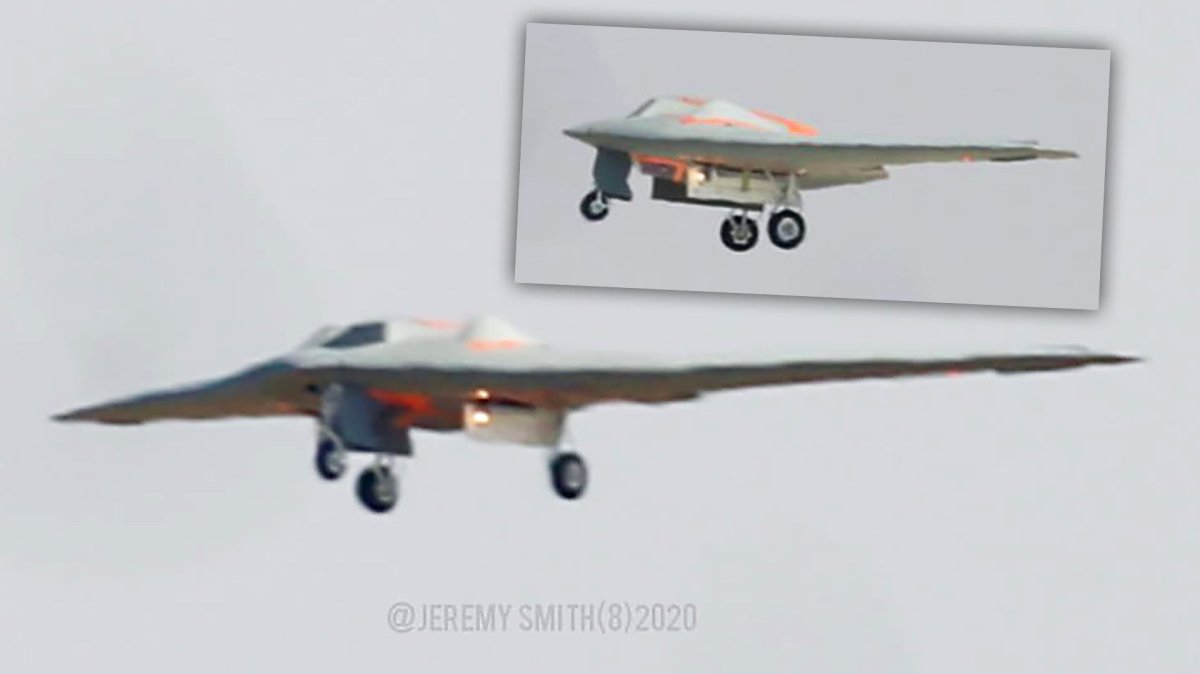
RQ-170 landing at PMD on September 3rd. , Jeremy Smith
The RQ-170 used the same ‘Johnny’ callsign the last time it landed at Plant 42, as well as the same chase plane, a 1981 Beech 55 with the registration N254BC. The aircraft is registered to MH Aviation , located at nearby Fox Field. According to flight-tracking data, the aircraft regularly flies support missions into the Edwards AFB and NAWS China Lake range complexes, as well as to other interesting locales like Beale AFB and Fort Worth, Texas.
The Sentinel had a light gray/cream overall color along with dayglow highlights near where some of its major features exist, such as its SATCOM ‘humps,’ its dorsal area, and around its ventral sensor area, which traditionally holds an electro-optical and infrared camera turret under a faceted window enclosure and a conformal AESA radar behind it. These types of very high visibility modifications to the aircraft exterior are intrinsic of test and development work being done, but the first clear image ever of the RQ-170, which was snapped at Afghanistan’s Kandahar Airfield in 2008, showed a similar arrangement, too.
As to what the aircraft may be up to, we can’t say. There has been an explosion in flight testing over the Mojave in recent months, much of it has to do with low-observable (stealth) technologies and sensors. We also know of major integrated combat testing between various Air Force stealth assets, including the RQ-170, which has occurred recently.
At the same time, the Sentinel is by no means a young aircraft or capability set. Lockheed Martin is now pitching, at least conceptually, an outgrowth of the RQ-170 design to the U.S. Air Force, which is suddenly highly interested in unmanned combat air vehicles (UCAVs) once again. You can read about the Air Force’s bizarre and frankly troubling saga with UCAVs in this past feature of ours .
The closest thing the Air Force has to such a capability, at least that is officially disclosed, is the RQ-170. So, it wouldn’t be surprising at all if it was being used for risk reduction efforts. Beyond that, the RQ-170 itself continues to evolve. We have seen and heard about it in multiple coatings configurations alone, and that doesn’t include potential changes to its mission systems over time. So, Sentinel flight testing has continued, just like any other combat aircraft. Doing it during the day, and especially landing it directly at its birthplace at Plant 42, is a whole lot more efficient than doing it from a highly remote locale and even at night.
Regardless, the second appearance of an RQ-170 flying directly out of Plant 42 in just two months is another sign that the Sentinel transition from out of the shadows seems to be accelerating.
Author’s Note: A big thanks to Jeremy Smith for sharing his photos with us. Make sure to follow him over on Instagram. Also, a big thanks to ADSBExchange.com which continues to be an invaluable tool for what we do.
Contact the author: Tyler@thedrive.com
Comments couldn’t be loaded. Please refresh the page.
更新于美国东部时间2020年11月27日下午6:24。
继我们 7 月 25 日关于出了名的低调 RQ-170 在光天化日之下重返其诞生地——位于加利福尼亚州帕姆代尔空军庞大的 42 号工厂的洛克希德·马丁公司臭鼬工厂——的报道之后,我们可以报道,这款蝙蝠翅膀间谍无人机在类似情况下再次出现在那里。
航空摄影师杰里米·史密斯(Jeremy Smith,Instagram账号为@KPMD_Spotter)于2020年9月3日偶遇了RQ-170无人机。他这样描述这难得一见的时刻:
起初,我注意到一架伴飞飞机在航线上飞行,主要进行25号跑道的低空进近。所以我猜想它带着“约翰尼5号”。我开车过去,扫描仪显示他需要接上他的搭档“约翰尼05号”。然后他向东北方向飞去接他,并获得了22号跑道的仪表着陆系统(ILS)进近,然后降落了。
RQ-170于9月3日降落在PMD。杰里米·史密斯
这架RQ-170上次降落在42号工厂时,仍然使用“Johnny”这个呼号,而且伴飞飞机也是同一架,是一架1981年产的Beech 55,注册号为N254BC。这架飞机注册在MH Aviation公司名下,该公司位于附近的福克斯机场。根据飞行跟踪数据,这架飞机经常执行支援任务,飞往爱德华兹空军基地和中国湖海军航空武器站靶场,以及比尔空军基地和德克萨斯州沃斯堡等其他一些地点。
哨兵无人机的整体颜色为浅灰色/米色,并在其主要特征附近,例如卫星通信“驼峰”、背部区域以及腹部传感器区域周围,涂有荧光高光。腹部传感器区域通常安装有光电和红外摄像机转塔,位于多面体窗口下方,其后方则安装有共形AESA雷达。这种对飞机外部进行的高可见度改装是测试和开发工作的固有特征,但2008年在阿富汗坎大哈机场拍摄的RQ-170首张清晰照片也显示了类似的布局。
至于这架飞机可能在做什么,我们不得而知。近几个月来,莫哈韦沙漠上空的飞行测试活动激增,其中大部分与低可探测性(隐身)技术和传感器有关。我们也了解到,空军近期开展了包括RQ-170在内的多种隐身装备之间的大规模联合作战测试。
与此同时,Sentinel无人机绝非一款新机型,其性能也已相当成熟。洛克希德·马丁公司目前正在向美国空军推介RQ-170设计的衍生机型,至少在概念上是如此。美国空军最近再次对无人作战飞行器(UCAV)表现出浓厚的兴趣。您可以在我们之前的专题报道中了解空军在UCAV项目上这段离奇且令人担忧的历程。
空军目前最接近这种能力的装备,至少是官方公开的RQ-170。因此,如果它被用于降低风险,也并不令人意外。此外,RQ-170本身也在不断发展。单是它的涂层配置,我们就已经见过和听说过,这还不包括其任务系统可能随时间推移而进行的改进。所以,哨兵无人机的飞行测试一直在进行,就像其他任何作战飞机一样。在白天进行测试,尤其是在其位于42号工厂的“诞生地”直接降落,比在偏远地区甚至夜间进行测试要高效得多。
无论如何,RQ-170 在短短两个月内第二次直接从 42 号工厂起飞,这再次表明“哨兵”无人机从幕后走向台前的进程似乎正在加速。
作者注:非常感谢 Jeremy Smith 与我们分享他的照片。请务必在 Instagram 上关注他。同时,也衷心感谢 ADSBExchange.com,它一直是我们工作中不可或缺的宝贵工具。
联系作者:Tyler@thedrive.com
评论加载失败,请刷新页面。