Confessions Of An E-2C Hawkeye Radar Operator一名E-2C“鹰眼”雷达操作员的自白
The life of the often overlooked "quarterback" of the air wing that goes to work in a dimly lit flying tube to coordinate chaotic air wars from above.
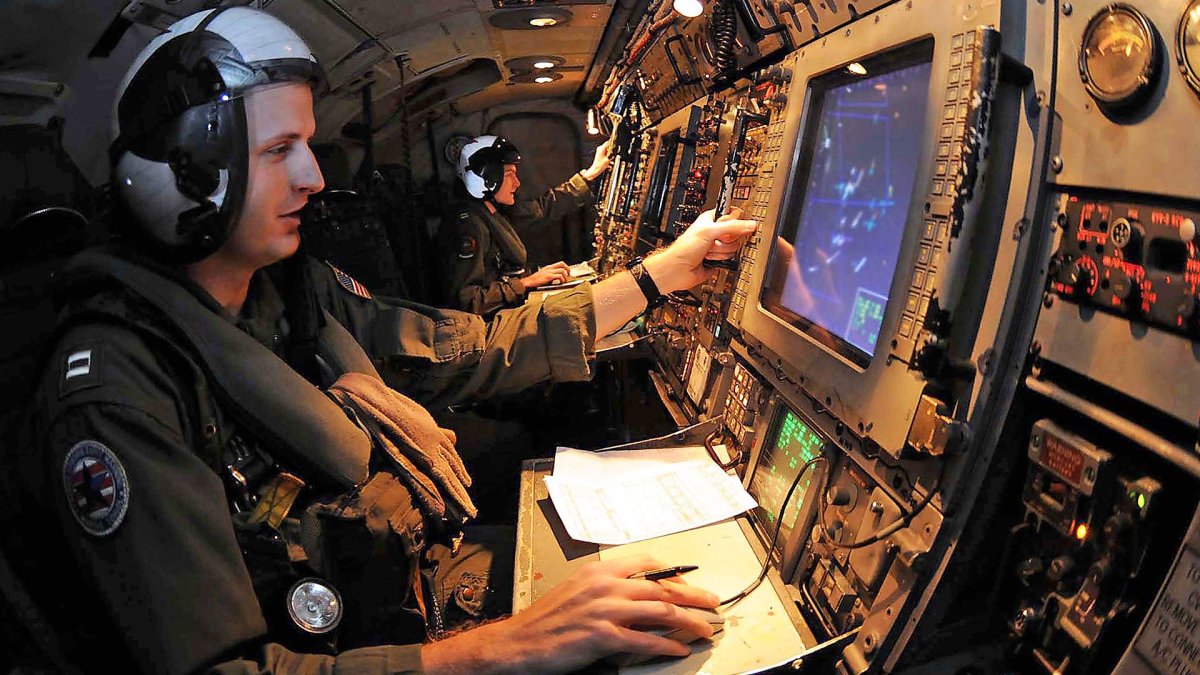
By Craig Picken and Tyler Rogoway
Updated Dec 1, 2019 6:42 AM EST
It may not be glamorous, but the largely misunderstood Grumman E-2 Hawkeye is arguably the most important aircraft deployed aboard America’s supercarriers. It acts as the high-flying eyes of the carrier strike group and provides critical air traffic control and combat management for carrier air wing aircraft, as well as communications relay and other functions. Retired Naval Flight Officer Craig “Slim” Picken worked in the inhospitable confines of the Hawkeye’s fuselage during one of the most interesting times in modern military history, rattling off intercept orders to missile-laden Tomcats and coordinating the ballet of U.S. Navy carrier-borne tactical aircraft as they plied their deadly trade over Iraq.
So come with us as we follow “Slim” into the tight confines of the Hawkeye’s belly, take a seat alongside him in front of one of the glowing radar consoles and get ready to get to catapult off on a voyage that will make you understand the Navy’s vaunted airborne early warning and control plane like never before.
Had Top Gun filmmakers been accurate in their account, the opening scene with Maverick would have been handled completely differently.
Under the powerful radar and watchful eyes of its crew, the E-2 Hawkeye, flying at 27,000 feet, would have spotted the incoming “bogeys” from more than 150 miles away. Maverick’s Tomcat would have been quarterbacked with a real-time picture, accompanied with data-link updates and a familiar voice helping with the “target sorts.”
A surprise 2nd bogey? Not a chance!
Cougar wouldn’t have been jumped and would have kept his wings to fight another day.
Today, the entire dogfight might have be quarterbacked by the E-2 without its controllers even saying a word.
But Top Gun was a movie about fighter pilots, not the cast working tirelessly behind the scenes to support them. The E-2 Hawkeye is like the Offensive Coordinator on an NFL team. He sits high up near the press box and well out of sight from the crowd, but very much in the game. His knowledge, God’s eye view, situational awareness, headset, and microphone are his weapons.
Yes, he is out of sight, but make no mistake who is calling the offensive plays.
Despite its ugly looks and slow and lumbering airframe, the Hawkeye is the most sophisticated airplane on the aircraft carrier flight deck. Its mission is Airborne Early Warning (AEW) and battle management.
Its long-range AN/APS-139/145 radar is capable of spotting and tracking thousands of contacts from hundreds of miles away. Coupled with its complex radio suite that provides secure and satellite communications to other aircraft, surface ships and ground forces, as well as its advanced IFF (Identify Friend or Foe) capability and high-speed data links, the airplane is the go-to tool for battle management and control.
In fact, the air wing, and the (carrier) battle group to some extent, could not function without it.
If you doubt my word, just ask the British Navy regarding their experience in the Falklands 35 years ago, which occurred without the help of Airborne Early Warning.
Oh, and don’t let the E-2’s size fool you. Its five-person crew, two Naval Aviators (pilots) and three Naval Flight Officers (NFOs, the radar operators), are highly trained and skilled, and the reality is that the new E-2D Advanced Hawkeye can do everything its larger cousin, the E-3 Sentry AWACS, can do, but with a whopping 20 fewer people onboard.
I’m not sure how the Grumman engineers came to develop the E-2, because it’s an engineering marvel that got beaten by an ugly stick. Its design also overcomes several extraordinary challenges that needed to be addressed for the airplane to meet its unique mission requirements.
First, the 24-foot wide radar dish is neutral in flight. It provides as much aerodynamic lift as it does parasitic drag.
Second, the engines and propellers provide enough power to allow for engine-out climb capability should the Hawkeye lose an engine mid cat-stroke (catapult launch). The T-56 engines on the E-2C each provided 4,950 shaft horsepower and spin a huge propeller at 1,100 rpm. On the newer versions, the horsepower has been increased to 5,100 horsepower.
Third, both propellers spin counter-clockwise creating a lot of yaw instability, thus, the reason for the four vertical stabilizers and three rudders. The propellers are made of composite material to eliminate interference with the radar’s performance.
Fourth, big airframe needed to hold all the equipment must fit on an aircraft carrier deck. This means that the 80-foot wingspan has to fold so that the airplane can be neatly tucked away.
Like every airplane, the design is a compromise. It does some things well, others not so much. It will never be fast. It will never be pretty. And, because it’s a turboprop it’s limited to about a 28,000-foot ceiling, above which the props become inefficient.
It’s a beast of an airplane that weighs in at more than 26 tons.
Located inside the 24-foot dorsally-mounted dish is the AN/APS-139/145 UHF-band radar that can track targets from well over 200 miles away. The original Hawkeye mission was Airborne Early Warning (AEW)—an airborne platform that could protect the aircraft carrier and battle group assets from Russian bombers carrying long-range missiles, as well as enemy ships and other threats, which it did well.
To enhance its effectiveness as a battle manager, the Hawkeye’s radar picture can be data-linked to multiple destroyers and cruisers located hundreds of miles away, to create a monstrous, virtually impenetrable air defense posture. When coupled with the highly effective Aegis Combat System’s SPY-1 radars found on guided missile cruisers or destroyers, that posture can extend well over 500 nautical miles.
Via Link 4 and Link 16 data links, that same picture can also be transmitted directly into the cockpit of fighter and attack aircraft. Coordinated air intercepts can be done with literally no verbal communications.
But the radar was challenged in that its UHF frequency ranges were optimized for maritime use and its early mission computers were both heavy and, at least by today’s standards, horrifically obsolete. Thus, it was not the most effective platform to detect low flying threats over land or in a high clutter radar environment.
With new radar, systems, and computers, the new E-2D, however, provides game-changing performance in any environment.
The E-2 has three Naval Flight Officers (NFOs) in the back:
RO – Radar Operator. Responsible for maintaining the radar, data-links, and passive detection systems. Will also have aircraft under his or her control. The RO sits in the most forward seat and is often the most junior aircrew. New NFOs in the squadron are only qualified in this seat until deemed ready to move to another.
ACO – Air Control Officer. Guy controlling most of the air wing assets. May have up to 20 airplanes under his control. He’s the furthest aft and stays very busy.
CICO – Combat Information Center Officer. The “Mission Commander” who is usually the most senior person. He’s got the “big picture” and is talking to everyone. To become a CICO is a year or more long process and the qualification is blessed by the other squadron CICOs and the squadron Commanding Officer. As a RO or ACO your every move is monitored and graded. If you can’t cut it in both of those seats, you don’t become a CICO and your Navy career is ruined.
With Desert Storm under my belt, I earned the CICO designation in a fast 10 months.
No matter what seat one is in, each officer is staring into a radar screen and tracking targets.
Before each launch, the CICO does rounds around the ship and meets with the fighter and attack squadrons and the ship’s Combat Information Center to get the overall “big picture.” If large combat missions were occurring, he’d sit in the briefing and discuss the plan.
Additionally, the E-2 crew briefs the flight two hours before launch and mans-up the airplane an hour before.
It takes that long to do pre-flights and get the radar warmed up. Typically, the Hawkeye is the first to launch and the last to land. Not because everyone deems it special, but because its size makes it the most difficult aircraft to maneuver on the flight deck.
This means a four to five-hour flight is really an 8 or 9 hour day when factoring in the brief, flight, and debrief.
The Hawkeye-Tomcat Team
For three decades, the Hawkeye-Tomcat combination was an intimidating duo that could pack a hell of a punch. The Hawkeye’s long-range radar coordinating the Tomcat’s payload of Sidewinder, Sparrow, and, most notably, AIM-54 Phoenix radar-guided missiles gave carrier air wings an anti-air capability unmatched anywhere in the world.
The AIM-54 Phoenix proved the most fearsome as it allowed the F-14 to engage multiple targets simultaneously from long distances. Had the Russians launched multiple Tu-95 Bear, Tu-16 Badger, or Tu-22M Backfire bombers to attack the battlegroup, they would have surely been detected by the carrier’s Hawkeye and shot down by a Tomcat from distances over 100 nautical miles away.
Until the demise of the USSR in 1991, the Russians constantly practiced their attacks on the aircraft carrier, and the air wings continually practiced their defensive profiles. It was a never-ending cat and mouse game that both sides got very good at playing
There were two occasions where my crews tracked Russian Bears – once while transiting out of Subic Bay the Philippines in early 1991. The second time we launched off a 30 minute alert in the Northern Pacific when the Bears decided to visit us from their home in the Kamchatka Peninsula. Each time they were intercepted by our Tomcat brethren, with a Phoenix under their bellies.
The E-2 is a bit like Rodney Dangerfield. It rarely gets the respect it deserves.
This fact was pointedly made at Fightertown USA—Naval Air Station Miramar—by one of our squadron pilots, Westin “Son of Sam” (SOS) Richardson, or “Sauce” for short.
Upon landing one afternoon, SOS promptly radioed “Tower, Sun King is clear of the duty. Taxi to the Leper Colony.”
At the time, all the Hawkeyes were quartered in Hangar 6, at the very west end of the airfield, about as far away from TOPGUN as they could possibly get.
Judging from the hysterical laughter coming from the tower, they fully understood our intent!
Throughout my Navy career, never did a reporter or news crew ask us what we did or the importance of the mission. If we took an airplane to an airshow, we lived a lonely existence.
When CNN came onboard the USS Ranger , and they occasionally did, they just wanted film the glamorous Tomcats launching in full afterburner. “ TOP GUN!”
If anyone ever asked me if I was TOP GUN , my answer was “no, I’m more like the anonymous Key Grip from the movie. I just make sure the shit shows up.”
The NFOs in the back, who do their jobs in a darkened tube, are often referred to as “Moles.” I’m not sure anyone joins the Navy to become a “Mole.”
I say that “respect is earned” in a somewhat tongue-in-cheek manner. Within my Air Wing (CVW-2) we held a unique standing. We never got the glory or attention that the fighter and attack pilots got, but we were held in high esteem on the pecking order.
Everyone, at some point, was going to ask for our help.
As a squadron, we were a group of 25 highly competitive, disciplined Naval Aviators and Naval Flight Officers led by squadron commanders who drove us hard.
From the day you arrived on the squadron quarterdeck you put on your flak jacket. Any sense of weakness you showed, at any time, was exploited in every manner possible. The ready room atmosphere could be brutal!
We carried this attitude with us every day. Our Air Wing brethren saw we were hard playing, hardworking, competitive officers and aviators, which carried a lot of weight.
After a while, the VAW-116 Sun Kings became known on the west coast as the “Fun Kings.”
Upon arrival to the squadron on you realized that nobody really chose to be there.
In my squadron, VAW-116, I don’t think one Junior Officer signed up to fly an ugly lumbering turboprop. The pilots were top players in flight school who got drafted into the Hawkeye pipeline. Most were frustrated fighter or attack wannabes. The NFOs in the back were all the same.
Nonetheless, almost all the pilots were some of the best you’d ever find—outstanding “ball flyers,” outstanding in helping out with the mission when needed, and outstanding in an emergency when one arose.
“Cowpie” was a professional rodeo bull rider before joining the Navy. He would entertain us with his hilarious stories about driving his van across West Texas and Oklahoma, going from rodeo to rodeo.
Another, “Gordo”, learned to fly gliders in his youth. Today, he is a world-champion glider pilot. Cowpie went on to become the Commodore of the entire west coast E-2 Hawkeye and C-2 Greyhound wing.
The NFOs were often brilliant. Intimidatingly so.
Several squadron mates who didn’t make the Navy a career have gone on to become highly successful CEOs, CFOs, lawyers, and entrepreneurs. Others who did make it a career went on to become aircraft carrier commanders, air wing commanders and admirals.
Getting respect within the air wing is not a given. It’s often hard work and to get it, many of us became fully integrated with our fighter and attack brethren.
The respect earning phase started during “work-up” cycles—the various at-sea training periods when we’d all learn how to work together. For junior A-6 or F-14 crews, it was the first time ever they’d work alongside a Hawkeye.
During these cycles, several of our officers would be in another squadron’s ready room. They could be bullshitting on a friendly basis or deep in the manual of an F-14 or A-6. Or, we’d simply connect in the ship gym or over a meal in the wardroom.
It was the little gestures of “we’ve got your back” that solidified the relationship between the E-2 crews and everyone else. Trust is monumental.
As an example, during our transit to Desert Storm, our CAG (the Carrier Air Wing Commander) became obsessed that coded Mode 4 IFF (Identify Friend or Foe) transponder worked in every airplane for every mission.
If we were going to fly combat, he wanted to ensure no friendly-on-friendly engagements occurred.
To prove his point, any aircraft that launched without operable Mode 4 was sent to the “penalty box”—an area 20,000 feet directly above the carrier—and forced to hold in a pattern until the end of the cycle. Usually 90 minutes or so.
It sucked and the crews hated it.
After each airplane launched, its IFF was interrogated by the ship looking for positive Mode 4 response. If it was “sweet,” the aircraft could proceed to its mission. If “sour,” to the “box” they went.
As the airborne commander, however, we could override the ship. We had an IFF interrogator too, and who was to say we were wrong?
“Strike, King has Wolf 101 sweet, sweet. 101, head 090 to the tanker, Angels 20.”
I’d then follow up the call a few minutes later on the tanker frequency, “Wolf, get your gadget fixed.”
They got it and appreciated the gesture.
During my squadron tenure, I was dating a Delta Airlines flight attendant and every so often I’d get a care package complete with a few dozen mini-bottles of vodka.
Because alcohol is strictly forbidden on the ship, we’d keep it stashed in a space under the bottom rack in our stateroom, which I shared with two other officers.
The empties? We’d take them to the usually empty ship’s forecastle and drop them into the ocean via the anchor-chain openings.
No, we never got crazy, but it was something to take the edge off after a long day or extended period at sea. We’d mix the vodka with “bug juice” taken from the officer’s mess and, sometimes, have a small gathering with the crews from VF-1 who lived along the same passageway.
One night, our CO banged on our door, which sent us scrambling to hide the evidence.
We let him in and we could tell he’d had a really bad day.
“I need a drink” he proclaimed.
With amused looks on our faces we responded, “sorry, Skipper, wrong place…”
“Fuck you! I need a drink.”
We gave him two bottles.
Nothing was ever spoken of it. It was just another trust-building exercise.
It Isn’t Flying First Class
The Hawkeye is a very uncomfortable airplane.
The three Naval Flight Officers (NFO) in the back sit sideways for four-plus hours in a dark tube, on a de-armed ejection seat, with the nose of the airplane slanted 12 degrees nose-up. The vibration of the then four monstrous (now eight) propeller blades was loud and exhausting.
The air conditioning never worked well, either. Thus, the guy furthest aft always froze his ass off while the NFO closest to the radar boxes burned up.
There were five radios with constant chatter, 20 or more airplanes to control, and radar systems that required constant attention, and so on.
I was always thankful that the airplane didn’t have in-flight refueling capability ( that’s changing now ). The torture was limited to five hours. A single flight was tiring. Two in the same day was exhausting!
E-2D undergoing aerial refueling testing., Northrop Grumman
The Downsides Of No Aerial Refueling Capability
Not having aerial refueling capability had its downsides, too.
Late in a six-month cruise, the ship was in the Bay of Bengal, a few hundred miles away from land. We were about four hours into a very rough night training mission and it was time to come “home.”
Our pilots put the airplane into the holding pattern at 15,000 or 20,000 feet, 15 miles from the ship with about an hour’s worth of fuel left onboard. As always, we’d be last aircraft to recover
Burning holes in the sky, the Air Boss announces on the radios, “all aircraft max conserve, deck is foul.”
“How long, Boss?” from an anonymous voice.
At the end of a very busy cruise, the non-skid coating on the aft portion of the flight deck had worn down. An F-14 being steered onto one of the waist catapults and slid off the deck and settled on a 45-degree angle in the catwalk below the deck’s edge. The crash and salvage crews were working hard to extract it.
We, in the meantime, started looking at Bingo fuel (minimum safe fuel quantity to return to a landing place) and distance to Thailand. We were in a box. Not enough fuel to hang out, not enough fuel to find land.
But land still seemed like the best option.
I gave the pilots vectors to Phuket, Thailand. They started on a Bingo profile while my crew started working the radios to get clearance into Thai airspace.
Twenty minutes later, the flight deck opened for recoveries again, but we were still Bingo fuel. Now, the ship became the best option.
It was the first and only time that I can remember the mighty Hawkeye being the first aircraft to recover.
The Hawkeye is a typical Grumman airplane with a good safety record. But good does not mean perfect.
Without ejection seats bailing out is a difficult evolution, even in a controlled flight scenario. In an uncontrolled flight situation, it is impossible.
Personally, I got nervous during night time cat shots. If the catapult went “cold,” there was very little chance, if any, that all five crewmen would be able to safely get out before beings run over by an 80,000-ton ship traveling at 20 knots. The sole escape route consisted of an aft hatch, on top of the fuselage, that we kept open during launch and recovery.
Also, the flight controls are operated via a redundant 3,000 psi hydraulic system. The two reservoirs are in the same area as the radar boxes and fed by multiple lines. Any leak would spray high-pressure hydraulic fluid onto a hot radar box and a raging fire could ensue.
If this happened, the airplane was doomed. The crew could blow the main door hatch and bailout, but they’d get cooked in the process. Or the airplane would just lose all use of flight controls and crash.
In 1992, this very scenario happened to a Hawkeye operating from the USS John F. Kennedy (CV 67), killing all five on board including one of my flight school friends, LT(JG) Tom Plautz and a previous instructor, LCDR Al McLachlen.
Ironically, I was informed of that mishap the night I was manning up an airplane and flying to the USS Ranger to start a 6-month cruise.
In the cockpit, pilots had the demands of an unstable airframe, the torque of two large propellers, and no Heads Up Display. Landing on the ship could be a challenge, to say the least.
Several crews have had to bail out of the airplane over the years. There are few occasions where all make it out alive.
When Disaster Strikes
On one occasion, my airplane launched at roughly 21:00 for a routine four hour, “double cycle” flight. The carrier was “Blue Water Ops,” 1,000 miles from nowhere, deep in the Pacific Ocean with nowhere else to land.
As we launched, there were 15 airplanes stacked above us, the previous “cycle,” waiting to come aboard.
About a minute off the catapult there was a piercing voice on the launch/recovery frequency: “BOSS, 602. We gotta land NOW!”
The Air Boss’s calm response was “Roger we’re clearing the deck.” And, they were.
Amongst my crew, the questions were already starting, “Fire?” I asked…
Nobody had a real answer.
We immediately went to work. We fired up the radar and began searching for our mates.
I then called to an F-14 “Wolf, shine west. West. Angels 10 or higher. You see the Hawkeye?” Shine was a term for the Tomcat to point his radar in an indicated direction, looking for a contact.
We were immensely concerned! “What the fuck?”
A few minutes later the boss announced a clear deck followed by the calming voice of the CAG Landing Signal Officer, Commander John “Bug” Roach.
Somehow and miraculously, the airplane, flown by Erik “Wart” Holtkamp, found the ship from more than 10 miles away on a really dark night.
A few moments after that we heard the LSOs call the trap. But here’s the kicker:
The airplane did, indeed, have an electrical fire in the panel behind Wart’s seat. It burned through everything.
The call to the flight deck was made on a PRC-90 handheld radio by one of the NFOs.
Because Wart had no electrics, he had no radios, cockpit lights or navigation aids. The whole approach was made with a stand-by wet compass and a flashlight, which his co-pilot, John Irvin, held.
Without electrics, the airplane’s rudder stops became inoperative, leaving only two degrees of rudder to control the aircraft. With only two degrees of rudder, Wart had no ability to bolter, or go around. There was not enough yaw control to counter the torque of the 4,950 horsepower engines and two large spinning propellers. A large power addition would simply torque-roll the airplane into the ocean.
To make a long story short, Wart had one shot at the deck. He grabbed the four-wire!
For the next month, the whole squadron was wary. We drove the mechanics crazy, writing up every little squawk. Nitpicking every loose screw!
Not long after that night, I had a radar box burn out, which put a bunch of smoke into the cabin—a fairly benign scenario. Scared the crap out of me, nonetheless!
Wart earned an Air Medal for his outstanding airmanship.
The afternoon of January 17, 1991, I was standing on the flight deck looking into Iran as the USS Ranger transited the Strait of Hormuz thinking “holy shit… this is it.” Soon it would hit the fan, and a few hours later, it did.
That night the USS Ranger and Air Wing 2 were a major part of the first air raids over Iraq, focusing on the southern cities and ports.
The A-6 Intruders we had on our flight deck provided the Navy’s only true all day, all night, all-weather attack capability. The Tomcats flew Combat Air Patrol (CAP). We Hawkeye guys quarterbacked it all, keeping a close look-out for Iraqi air opposition, monitored the air wing’s assets, and preventing “blue-on-blue” (friendly fire) engagements. With so many airplanes in the sky, and highly caffeinated aircrews on high alert, blue-on-blue incidents were a very real possibility.
The first nights over Iraq were pure, unadulterated, controlled chaos!
During each mission, the NFOs had their hands full. Each controlled a bunch of airplanes, updated surface combatants, kept the radar profile and data links optimized. It was exhausting.
We’d do it for two hours, get a 10-minute break as a new round of attack aircraft entered the fray, and then do it all again for another two hours. Once relieved by the next Hawkeye, we’d head back to the ship, mentally spent.
Once relieved on station, we’d start the journey back to the ship. During the half hour transit, someone would fall asleep. Once, that someone was me and I forgot to lock my harness. Upon snagging the arresting gear, the airplane rapidly slowed to a stop… But I didn’t.
My momentum threw me into the bulkhead circuit board 18 inches in front of the RO seat. That woke me up and hurt too.
Because the A-6’s were optimized for nighttime attacks, that is when we flew. Thus, our day started at 4pm and ended late morning the next day. Breakfast was dinner, dinner was breakfast.
Sometime during the hostilities, the ship’s Captain took mercy upon us and turned one wardroom around 12 hours so that breakfast was served at 17:00.
Ranger photographed shortly after Desert Storm with her “Grumman Air Wing” deployed ., Seaforces.org
When You Not Sleeping Or Flying You Are Training
Our Commanding and Executive Officer during Desert Storm, Commanders Pat Madison and Paul Hauser, were big on training.
During transit to the Persian Gulf, they had every officer in the ready-room every day for hours at a time. Topics included aircraft systems, emergency procedures, geography, divert airfields, and everything else we could discuss.
At the time it seemed ad nauseam, but it got us sharp.
Of particular importance were ROE (Rules of Engagement). As the “eyes in the sky” and battlefield commanders, we were expected to know the complicated ROE cold ! Again, we spent hours discussing it and working through hundreds of scenarios.
We knew our shit and became the air wing experts. It was our job to be just that.
At one point I was sent to Saudi Arabia to fly with an E-3 Sentry AWACS crew with the goal of understanding how the E-3 operated. The night I got there, there was a USAF General discussing ROE and the crews didn’t know it nearly as well as us. It wasn’t necessarily their fault. The USAF had been on station for several months and were highly tasked. Highly tasked meant little time to do anything but fly. Seeing that I did know the ROE, the General made me do an hour training session and then asked me why I knew it so well. My response was simple:
“If we’re not flying, we’re training.”
There isn’t anywhere to hide on an aircraft carrier. If the CO says, “we’re training,” then you were training!
The follow-on CO and XO were the same. “You will train until you drop!”
And we did, every night.
Once it was determined during Desert Storm that the Iraqi air force was defeated, the words “bogey” and “bandit” were eliminated from our vocabulary. That is unless it was confirmed that the target of interest was, indeed, a bad guy we were told to never say those words.
At the tail end of the hostilities, we had a section of VF-2 Tomcats flying TARPS reconnaissance in eastern Iraq. The profile was for them to hit the tanker around Baghdad and then fly low towards Basra, take their pictures, and head back to the USS Ranger in the northern Persian Gulf.
Flying above them was a section of VF-1 Tomcats.
I was flying in the ACO seat during the mission, casually watching and listening to the E-3 AWACs control a section of capping F-15s. I start hearing its controller spouting out:
“Bogey, Bullseye south, 50 miles”
Me : “Bulldog, King. Negative. Positive Mode 2 (Military IFF). Coalition aircraft.”
AWACS : “Roger, friendly” followed by an affirmative by the Eagles.
AWACS: “Bogey, northwest bullseye, 60 miles heading south.”
Me : “Negative Bulldog. I’ve got positive ID. Navy Hornets.”
AWACS : “Roger, friendly.”
Every time the controller called bogey, the Eagles got spooled up. It probably happened five or six times. I looked over at my CICO, Bob Roth, and chuckled “WTF is up with these guys? Bogies all over the place.”
I couldn’t get the comment out when I heard “bandits, east bullseye 40 miles. Flight of two flying low heading south!”
Shit! The Eagles turned on a dime and started calling their sorts, determining which F-15 would shoot which target. Dash 1 had the lead F-14 and his wingman had targeted the second Tomcat.
In combat terms, “bandit” meant confirmed bad guy. Shoot first, ask questions later. And the frequency got jammed between the E-3 calling out the “bandits” and the Eagles sorting their targets.
All I could do was scream out on the guard frequency (frequency 243.0) “Eagles engaged, King… knock it off, knock it off, knock it off. Friendlies. Knock it off .”
Thankfully, the F-15s heard the calls and immediately disengaged. A few minutes later the voice from the E-3 changed as a new controller took over.
I think someone got their ass chewed.
What was funny is that the TARPS F-14s never knew what was happening. They were on a different frequency talking to the RO in my aircraft. It wasn’t until we were back on the ship when I asked one of them “hey, did you guys get some tones?”
“Yeah, briefly. Came and went, quick.”
We told them the story, and everyone laughed. “Holy Shit! Really?”
Nobody thought anything of it, but someone overheard us talking. From there it made the Admiral’s briefing and got elevated further to General Schwarzkopf who put out a “let’s not go crazy” message to the entire theater.
I got a “good Job” from above, which made me feel good.
On the flip side, a week or so previous the quick thinking of AWACS crew prevented a Navy blue-on-blue when an F-14 mistakenly identified an A-6 as hostile.
Despite inter-service rivalries, everyone had each other’s back.
Towards the end of February, 1991, it was a Sun King Hawkeye, led by Lt. Jack Kennedy, that quarterbacked the final raids on Iraq, known as the “Highway of Death” when USS Ranger ’s A-6 Intruders discovered and attacked a massive retreating Iraqi convoy.
Another one of my squadron mates leveraged surveillance assets to target a Silkworm missile launch site. Once located, he controlled several Ranger A-6s and guided them to the area where they dropped a trash load of Rockeye cluster bombs .
To this day, I think the guy who invented Rockeye must have been one sick dude. It is devastating to every living organism in its path.
Just After The Storm Had Passed
Five months into the cruise, the USS Ranger was now heading east towards home, but we got tasked with one more exercise along the way. A B-52 would fly from Guam and try to attack the ship. The goal was to “shoot it down” outside of its missile launch range, which was roughly inside 200 miles. Probably 20 or more airplanes were involved.
We set up our stations with another Hawkeye a few hundred miles away, a bunch of CAP F-14s for fighter protection, EA-6Bs for electronic warfare and S-3s and A-6s to provide gas.
Nobody really cared. It was end of cruise and we were exhausted.
For hours we sat there. Nothing…
At one point, I saw a blip on the radar, far away from any F-14, and well inside the defensive perimeter. I vectored an S-3 Viking to look.
Shazaam! About 20 miles from the ship the S-3 reports a visual on a B-52 flying very low . At about the same time the bomber calls the ship “ Ranger , B-52 from the south. Requesting a fly-by.”
Five minutes later, with pictures to prove it, the B-52 flies by the Ranger at an altitude below the flight deck, probably 50 feet off the water. Literally, it had been flying at 100 feet or less for several hundred miles, its Electronic Warfare Officer did a great job at detecting and evading our radars.
Oh, boy! We got yelled at and our CO got called into the CAGs office and got yelled at, too.
Later that night we were having cocktails in my stateroom when one of the F-14 RIOs stopped by for a drink. “Yeah, we saw the thing on our radar. We were just screwing around. Didn’t feel like chasing it.”
As I said, the air wing was tired. Nobody cared. We took the heat, but it eventually blew over.
I’m sure we didn’t do our CO any favors, though.
This photo shows the exact flyby described above. , USN
Late into my second six-month USS Ranger deployment, we left the Persian Gulf for Somalia and Operation Restore Hope. Nobody knew what we were supposed to do, but we went anyway.
Our missions started simply as a radio relay for the Marines on the ground. Boring stuff. But, a day or two into it we saw that there were literally hundreds of NGO (non-government organization) and military relief airplanes trying to land in Mogadishu all at the same time.
Now that the Americans secured the airport, it was safe to bring in supplies.
It was crazy! Hundreds of airplanes ranging from USAF C-5s to a guy in a Piper Chieftain all converging on a single runway next to the coast.
I was the CICO on the mission and started speaking to my crew. We were going to input an oft-used tactic and modify it for civilian use.
Looking at my RO I said “you start directing airplanes to here,” putting a waypoint on our radar screens. “Stack them 1,000 feet starting a 5,000. Set them up for an approach. Give them push times a few minutes apart.”
Looking at my ACO I said “you keep control of this thing. When one of these guys lands, tell the next to start his approach, then drop the stack down 1,000 feet. Everyone starts their approach at 5,000 feet.”
They got it! We just took charge and began barking orders to the flock of airplanes. Soon we started to sound like New York air traffic control!
The civilian pilots loved it too, as did the military support on the ground. The chaos was getting controlled and we kept it up for nearly five hours straight.
When we got relieved by the next crew, we told them what we did. They carried on the same plan, modified it a little bit more and made it even better.
Upon landing, we debriefed the ship’s Combat Information Center.
Damn if we didn’t start something great!
A day later the Admiral moved an Aegis cruiser closer to the coastal airport and manned it with Ranger air traffic controllers. The Aegis radar is accurate to a gnat’s ass and this now became Approach Control.
The Air Force put some of its folks in the tower with hand-held radios.
The Hawkeye now became Center. We handed off airplanes to the cruiser, who was now Approach Control. They, in turn, handed it off to Tower.
Rudimentary and makeshift, but we now had a fully functioning air traffic control system that stayed in place for several months with the next carrier group, long after we left Somalia for a port visit in Australia.
I was heartbroken when I learned of the Black Hawk Down fiasco several months later.
During the Summer of 1991, a few months after returning from Iraq, my squadron was sent to Panama to do three months of counter-narcotics missions. The airplanes were parked at Howard Air Force Base. The crews were relegated to Rodman Naval Base, located on the banks of the Panama Canal.
For those senior enough there were accommodations in base housing. If not, and I wasn’t, we were sent to a neighborhood of steel Quonset huts furnished with surplus hospital beds and salvaged furniture. The walls in my hut were decorated with Playboys courtesy of the squadrons before us.
Our cooking facilities? An old Weber grill. We had to buy our own food, paper plates, and picnic supplies.
What sucked even worse was the flying. We’d fly at night and head either west to a waypoint in the Pacific or Northeast into the Atlantic. The entire time we’d data-link our radar picture to a Navy frigate. On the occasions we’d see a drug runner, and we did, we’d vector USAF F-16s or other assets to intercept.
The mission was mindlessly boring and it could be dangerous.
Flying 500 miles over open ocean at night is dangerous enough, but we were used to it. What we weren’t used to were huge thunderstorm buildups.
One night, a crew was flying back from a Pacific mission only to run into a line of thunderstorms.
With no onboard weather radar, they had to pick their way through the lines via ambient moonlight. It took them at least an hour to do so and by then they were dangerously low on fuel. In between landing and taxi, the low fuel lights came on. They may have had another 20 minutes of flying time, at most.
Just like the cockpit fire did, we got concerned and started abbreviating the missions a bit.
After three years, two cruises and two full workup cycles, I transitioned out of VAW-116 with well over 1,000 hours of flight time and 325 carrier landings, the vast majority of which occurred at night.
I also flew more than 100 missions total over Iraq and accomplished what I had set out to do.
At the end of our second cruise, I was a senior Lieutenant, so my CO allowed me to fly home to San Diego commercially from our last port call in Hawaii. The ship needed the space for the onslaught of “Tiger Cruisers,” family of the crew who wanted to experience what their kids experience in the Navy. I think he was ready to get rid of me, too.
When I got on the Northwest Airlines DC-10 in Oahu, I knew I’d experienced my last Cat and Trap.
A month later I transitioned to NATO in Germany where I would spend the last two years of my Navy career. From there, I would choose to enter civilian life.
No, it wasn’t my first choice, but the Hawkeye was a rewarding airplane to crew.
I’m forever grateful to the Navy for giving me the opportunity to do so.
Contact the editor: Tyler@thedrive.com
Comments couldn’t be loaded. Please refresh the page.
作者:克雷格·皮肯和泰勒·罗戈韦
更新于美国东部时间2019年12月1日上午6:42
格鲁曼E-2“鹰眼”预警机或许并不光鲜亮丽,但这款常被误解的飞机可以说是美国超级航母上部署的最重要的飞机。它如同航母打击群的空中之眼,为航母舰载机提供关键的空中交通管制和作战管理,同时还承担通信中继和其他功能。退役海军飞行军官克雷格·“斯利姆”·皮肯曾在现代军事史上最激动人心的时期之一,在“鹰眼”飞机狭小的机舱内工作,向携带导弹的“雄猫”战斗机发出拦截指令,并协调美国海军舰载战术飞机在伊拉克上空执行致命任务时的精彩飞行。
所以,请跟随我们,跟随“瘦子”进入鹰眼战机的狭小机腹,坐在他旁边,在其中一个发光的雷达控制台前,准备好开始一段旅程,这将让你以前所未有的方式了解海军引以为傲的空中预警和控制飞机。
如果《壮志凌云》电影制作人的描述属实,那么“独行侠”的开场戏将会完全不同。
在强大的雷达和机组人员的密切监视下,飞行高度为27000英尺的E-2“鹰眼”预警机能够从150英里以外发现来袭的“目标”。“独行侠”的“雄猫”战机将获得实时图像的指挥,同时还能收到数据链更新和熟悉的语音提示,帮助进行目标识别。
意外吞下第二个柏忌?绝不可能!
美洲狮就不会遭到袭击,还能保住翅膀,为来年再战。
今天,整场空战可能都由 E-2 指挥,而它的操控人员甚至无需开口说话。
但《壮志凌云》是一部关于战斗机飞行员的电影,而不是关于幕后默默付出、支持他们的演员们。E-2“鹰眼”预警机就像NFL球队的进攻协调员。他坐在媒体席附近的高处,远离人群的视线,但却始终身处其中。他的知识、上帝视角、态势感知、耳机和麦克风就是他的武器。
是的,他现在不在镜头里,但不要搞错是谁在指挥进攻。
尽管外形丑陋、机身缓慢笨重,“鹰眼”无人机却是航母飞行甲板上最先进的飞机。它的任务是空中预警和战场管理。
其远程AN/APS-139/145雷达能够从数百英里外发现并跟踪数千个目标。此外,该机还配备了复杂的无线电系统,可与其他飞机、水面舰艇和地面部队进行安全通信和卫星通信;同时,其先进的敌我识别(IFF)能力和高速数据链也使其成为战场管理和控制的首选工具。
事实上,如果没有它,航空联队以及(航母)战斗群都无法运作。
如果你不相信我的话,就去问问英国海军35年前在福克兰群岛的经历吧,当时他们并没有空中预警的帮助。
哦,别被E-2的尺寸迷惑了。它的五名机组人员,两名海军飞行员和三名海军飞行军官(雷达操作员),都训练有素、技术精湛。事实上,新型E-2D先进鹰眼预警机可以完成其更大的同系机型E-3哨兵预警机所能做的一切,但机上人员却少了整整20人。
我不太清楚格鲁曼公司的工程师们是如何研发出E-2的,因为它堪称工程奇迹,可惜外形实在不敢恭维。它的设计还克服了诸多非凡的挑战,才能满足其独特的任务需求。
首先,24英尺宽的雷达天线在飞行中保持中性姿态。它提供的空气动力升力与寄生阻力相等。
其次,即使“鹰眼”预警机在弹射起飞过程中失去一台发动机,其发动机和螺旋桨也能提供足够的动力,使其具备单发爬升能力。E-2C 上的 T-56 发动机每台可提供 4,950 轴马力,并以 1,100 转/分的速度驱动一个巨大的螺旋桨。在较新的型号中,马力已提升至 5,100 马力。
第三,两个螺旋桨都逆时针旋转,造成严重的偏航不稳定性,因此需要四个垂直尾翼和三个方向舵。螺旋桨采用复合材料制成,以消除对雷达性能的干扰。
第四,容纳所有设备所需的庞大机身必须能够停放在航空母舰甲板上。这意味着80英尺翼展的飞机必须能够折叠,以便整架飞机可以整齐地收纳起来。
和所有飞机一样,它的设计也是一种妥协。它有些方面表现出色,有些方面则差强人意。它永远不会很快,也永远不会很漂亮。而且,由于它是涡轮螺旋桨飞机,它的飞行高度被限制在约28000英尺(约8500米)的高度,超过这个高度螺旋桨的效率就会降低。
这是一架庞然大物般的飞机,重量超过26吨。
位于背部24英尺(约7.3米)天线罩内的是AN/APS-139/145超高频雷达,能够追踪200英里(约320公里)以外的目标。“鹰眼”最初的任务是空中预警(AEW)——一种能够保护航空母舰和战斗群免受携带远程导弹的俄罗斯轰炸机、敌方舰艇和其他威胁的空中平台,而它也出色地完成了这项任务。
为了增强其作为作战管理系统的效能,鹰眼系统的雷达图像可以与数百英里外的多艘驱逐舰和巡洋舰进行数据链接,从而构建起强大且几乎坚不可摧的防空体系。当与导弹巡洋舰或驱逐舰上高效的宙斯盾作战系统SPY-1雷达配合使用时,该防空体系的覆盖范围可远超500海里。
通过Link 4和Link 16数据链,同样的图像也可以直接传输到战斗机和攻击机的座舱内。协同空中拦截行动几乎无需任何口头交流即可完成。
但该雷达也面临挑战,其超高频频段是针对海上应用优化的,而且早期的任务计算机既笨重,又以今天的标准来看极其过时。因此,它并非探测陆地上空低空飞行目标或高杂波雷达环境下最有效的平台。
凭借全新的雷达、系统和计算机,新型 E-2D 在任何环境下都能提供颠覆性的性能。
E-2飞机后部有三名海军飞行军官(NFO):
RO——雷达操作员。负责维护雷达、数据链和被动探测系统。同时,也负责指挥飞机。RO坐在最前面的座位上,通常是机组中最年轻的成员。中队新入职的NFO(导航飞行官)只能在这个座位上进行训练,直到被认为可以调到其他座位为止。
空中管制官(ACO)——负责指挥大部分航空联队的资产,最多可指挥20架飞机。他的位置最靠后,工作非常繁忙。
作战信息中心军官(CICO)是“任务指挥官”,通常是级别最高的人。他掌握全局,与所有人沟通。成为一名CICO需要一年或更长时间的培训,资格由其他中队CICO和中队长共同认可。作为无线电操作员(RO)或空中通信操作员(ACO),你的一举一动都会受到监控和评估。如果你无法胜任这两个职位,就无法成为CICO,你的海军生涯也就此终结。
凭借在沙漠风暴行动中积累的经验,我在短短 10 个月内就获得了 CICO 认证。
无论坐在哪个位置,每位警官都在盯着雷达屏幕追踪目标。
每次发射前,作战信息中心主任都会巡视舰艇,并与战斗机和攻击机中队以及舰艇作战信息中心会面,以了解整体情况。如果执行大型作战任务,他会参加简报会并讨论计划。
此外,E-2 机组人员会在起飞前两小时进行飞行简报,并在起飞前一小时完成飞机人员配备。
进行飞行前检查和雷达预热需要那么长时间。通常情况下,“鹰眼”雷达是第一个起飞、最后一个降落的。这并非因为大家都认为它特殊,而是因为它的体积使其成为飞行甲板上最难操控的飞机。
这意味着,如果把简报、飞行和汇报的时间都算进去,原本四到五个小时的飞行实际上要花八到九个小时。
鹰眼-雄猫队
三十年来,“鹰眼”和“雄猫”的组合堪称一对令人生畏的利器,威力无比。“鹰眼”的远程雷达能够协调“雄猫”的有效载荷,包括“响尾蛇”、“麻雀”以及最重要的AIM-54“不死鸟”雷达制导导弹,这使得航母舰载机联队拥有了世界上任何其他舰载机都无法比拟的防空能力。
AIM-54“不死鸟”导弹威力最为强大,它使F-14能够从远距离同时攻击多个目标。如果俄罗斯派出多架图-95“熊”式、图-16“獾”式或图-22M“逆火”式轰炸机攻击该战斗群,它们肯定会被航母上的“鹰眼”雷达系统探测到,并被F-14“雄猫”战斗机从100海里以外的距离击落。
在1991年苏联解体之前,俄军不断演练攻击航空母舰的战术,而俄舰舰载机联队也持续进行防御演练。这是一场永无休止的猫鼠游戏,双方都玩得炉火纯青。
我的机组人员曾两次追踪到俄罗斯熊式战斗机——一次是1991年初从菲律宾苏比克湾过境时;另一次是在北太平洋,当时这些熊式战斗机从堪察加半岛飞来,我们立即启动了30分钟的警戒程序。每次都被我们装备了凤凰导弹的“雄猫”战斗机拦截。
E-2有点像罗德尼·丹杰菲尔德,它很少得到应有的尊重。
这一点在美国战斗机之城——米拉马尔海军航空站——由我们中队的一名飞行员韦斯汀·“山姆之子”(SOS)·理查森,或简称“酱汁”明确指出。
一天下午,SOS 飞机降落后立即用无线电报告:“塔台,太阳王已解除任务。乘出租车前往麻风病疗养院。”
当时,所有“鹰眼”战斗机都驻扎在机场最西端的 6 号机库,距离 TOPGUN 战斗机基地尽可能远。
从塔楼上传来的歇斯底里的笑声来看,他们完全明白了我们的意图!
在我整个海军生涯中,从来没有记者或新闻摄制组问过我们具体做什么,或者任务的重要性。如果我们乘飞机去参加航展,那也是孤独的。
CNN偶尔会登上“游骑兵”号航空母舰,他们只是想拍摄那些魅力十足的“雄猫”战斗机全速升空的画面。“壮志凌云!”
如果有人问我是不是《壮志凌云》里的主角,我的回答是“不,我更像是电影里默默无闻的灯光师。我只是确保道具能按时到位。”
在后舱昏暗的舱室里工作的海军飞行军官们,常常被称为“鼹鼠”。我不确定是否有人加入海军是为了成为“鼹鼠”。
我半开玩笑地说“尊重是赢得的”。在我的航空联队(CVW-2)里,我们地位特殊。我们从未获得过战斗机和攻击机飞行员那样的荣耀和关注,但我们在等级制度中却备受尊敬。
每个人,在某个时候,都会向我们寻求帮助。
作为一个中队,我们是由 25 名极具竞争力、纪律严明的海军飞行员和海军飞行军官组成的团队,由中队长领导,他们对我们要求严格。
从你踏上中队甲板的那天起,你就得穿上防弹背心。你任何时候流露出的任何软弱,都会被对方想方设法地利用。战备室里的气氛简直残酷无比!
我们每天都秉持着这种态度。我们的空军战友们看到我们是勤奋好学、积极进取的军官和飞行员,这对我们来说意义重大。
过了一段时间,VAW-116 太阳王轰炸机在西海岸被称为“欢乐之王”。
到达中队后,你会发现没有人是真心想待在那里的。
在我所在的VAW-116中队,我想没有哪个初级军官会报名去驾驶那种笨重丑陋的涡轮螺旋桨飞机。飞行员都是飞行学校的佼佼者,被选入“鹰眼”预警机的培养体系。他们中的大多数人原本想开战斗机或攻击机,却未能如愿。后排的导航员也都一样。
尽管如此,几乎所有的飞行员都是你所能找到的最优秀的飞行员——他们都是杰出的“飞行高手”,在需要时能够出色地协助完成任务,并且在紧急情况下也能表现出色。
“考皮”在加入海军之前是一名职业牛仔竞技骑牛选手。他经常给我们讲他开着面包车穿越西德克萨斯州和俄克拉荷马州,辗转于各个牛仔竞技比赛之间的趣事,逗得我们哈哈大笑。
另一位名叫“戈尔多”的人,年轻时就学会了驾驶滑翔机。如今,他已是世界滑翔机冠军飞行员。考皮后来成为了整个西海岸E-2“鹰眼”和C-2“灰狗”运输机联队的指挥官。
NFO们往往才华横溢,令人敬畏。
一些没有选择在海军服役作为职业的中队战友,后来成为了非常成功的首席执行官、首席财务官、律师和企业家。而另一些选择在海军服役作为职业的人,则成为了航空母舰舰长、航空联队指挥官和海军上将。
在空军联队中获得尊重并非理所当然。这往往需要付出艰辛的努力,为了赢得尊重,我们中的许多人都与战斗机和攻击机部队的战友们完全融合在一起。
赢得尊重的阶段始于“训练”周期——也就是各种海上训练阶段,在那段时间里,我们所有人都要学习如何协同作战。对于初级的A-6或F-14机组人员来说,这是他们第一次与“鹰眼”无人机并肩作战。
在这些轮换期间,我们的一些军官会待在其他中队的准备室里。他们可能在闲聊,也可能在认真研读F-14或A-6的飞行手册。或者,我们也会一起在舰上的健身房里,或者在军官餐厅里边吃边聊。
正是那些“我们支持你”的小举动,巩固了E-2机组人员与其他人之间的关系。信任至关重要。
例如,在我们前往沙漠风暴行动的途中,我们的舰载航空联队指挥官(CAG)非常执着于确保每架飞机在每次任务中都能正常工作,包括使用编码模式 4 IFF(识别敌我)应答器。
如果要进行空战,他希望确保不会发生友军误伤友军的情况。
为了证明他的观点,任何起飞时未具备可用模式4的飞机都会被送往“惩罚区”——位于航母正上方20000英尺的区域——并被迫盘旋等待直到飞行周期结束。通常大约需要90分钟。
那地方糟透了,船员们都恨透了。
每架飞机起飞后,舰艇都会对其敌我识别系统进行询问,以寻找积极的4型模式响应。如果响应“正常”,飞机即可继续执行任务;如果响应“异常”,则飞机将被送回“隔离箱”。
但作为空降指挥官,我们可以凌驾于舰艇之上。我们还有敌我识别仪,谁又能说我们错了呢?
“突击队,国王有狼101号,真棒。101号,前往090油轮,天使20号。”
几分钟后,我会通过油轮频率跟进通话:“沃尔夫,把你的装置修好。”
他们收到了,并且很感激这份心意。
在我服役于飞行中队期间,我曾与一位达美航空公司的空姐约会,她时不时会给我寄来包裹,里面装着几十瓶迷你伏特加。
由于船上严禁饮酒,我们会把酒藏在船舱最下面的架子下面的空间里,我和另外两名船员共用一个船舱。
空瓶子?我们会把它们带到通常空无一人的船首楼,然后通过锚链开口扔进大海。
不,我们从没疯过,但这确实是结束漫长的一天或长时间海上航行后放松一下的好方法。我们会把伏特加和从军官餐厅弄来的“啤酒”混在一起,有时还会和住在同一条通道上的VF-1中队的船员们小聚一下。
一天晚上,我们的狱警猛敲我们的门,吓得我们赶紧藏起了证据。
我们让他进来了,看得出来他今天过得很糟糕。
“我需要喝一杯,”他大声说道。
我们脸上带着好笑的表情回答说:“对不起,船长,走错地方了……”
“去你的!我需要喝一杯。”
我们给了他两瓶酒。
这件事从未被提及。这只不过是又一次建立信任的举措。
这可不是头等舱飞行。
鹰眼飞机非常不舒服。
后排的三名海军飞行军官侧身坐在黑暗的管状舱内,在已解除武装的弹射座椅上,连续四个多小时,飞机机头向上倾斜12度。当时巨大的四个(现在是八个)螺旋桨叶片的震动声震耳欲聋,令人精疲力竭。
空调也一直不好使。因此,最靠后的那个人总是冻得瑟瑟发抖,而离雷达箱最近的海军飞行军官却被烧死了。
当时有五部无线电通讯设备不停地通话,需要控制 20 多架飞机,雷达系统也需要时刻关注,等等。
我一直很庆幸这架飞机没有空中加油功能(现在这种情况正在改变)。这样一来,煎熬的时间就被限制在五个小时以内。单次飞行就已经很累了,一天两次简直是精疲力竭!
E-2D正在进行空中加油测试。,诺斯罗普·格鲁曼公司
缺乏空中加油能力的弊端
不具备空中加油能力也有其不利之处。
六个月的航程接近尾声时,这艘船停泊在孟加拉湾,距离陆地几百英里。我们刚刚完成了一次非常艰苦的夜间训练任务,大约四个小时后,就到了“回家”的时候了。
我们的飞行员将飞机控制在距离母舰15英里、15000或20000英尺的高空盘旋等待,机上还剩大约一小时的燃油。和往常一样,我们将是最后一架返回的飞机。
空中火力全开,空中指挥官通过无线电宣布:“所有飞机最大限度节省燃料,甲板上污秽不堪。”
“老板,还要多久?”一个匿名声音问道。
在一次繁忙的巡航结束后,飞行甲板后部的防滑涂层已经磨损。一架F-14战斗机正准备从腰部弹射器起飞,却滑落甲板,以45度角倾斜在甲板边缘下方的走道上。救援人员正在全力抢救这架飞机。
与此同时,我们开始计算宾果燃料(返回着陆点所需的最低安全燃料量)以及到泰国的距离。我们陷入了绝境。燃料不够,无法停留,也不够找到陆地。
但土地似乎仍然是最佳选择。
我指示飞行员飞往泰国普吉岛。他们开始按宾果航线飞行,而我的机组人员则开始通过无线电联系,请求进入泰国空域的许可。
二十分钟后,飞行甲板再次打开进行回收,但我们仍然只剩下燃料。现在,舰艇成了最佳选择。
那是我记忆中唯一一次强大的“鹰眼”战机成为第一个回收目标的飞机。
鹰眼是一款典型的格鲁曼飞机,拥有良好的安全记录。但良好并不意味着完美。
如果没有弹射座椅,即使在可控飞行情况下,跳伞逃生也是一项艰巨的任务。在不可控飞行情况下,跳伞逃生则是不可能的。
就我个人而言,夜间弹射起飞时我总是很紧张。如果弹射器“失灵”,五名船员几乎没有机会在被一艘以20节航速行驶的8万吨级巨轮碾压之前安全逃生。唯一的逃生通道是机身顶部的后舱门,我们在发射和回收过程中都会保持舱门敞开。
此外,飞行控制系统由一套冗余的3000磅/平方英寸液压系统驱动。两个储液罐与雷达箱位于同一区域,并由多条管路供液。任何泄漏都会将高压液压油喷溅到高温的雷达箱上,从而引发熊熊大火。
如果这种情况发生,飞机就完了。机组人员可以炸开主舱门跳伞逃生,但他们会在过程中被烤死。或者飞机将完全失去飞行控制,坠毁。
1992 年,一架从约翰·F·肯尼迪号航空母舰 (CV 67) 起飞的鹰眼无人机就遭遇了同样的事故,机上五人全部遇难,其中包括我的飞行学校朋友汤姆·普劳茨少尉和以前的教官阿尔·麦克拉克伦中校。
具有讽刺意味的是,就在我登上飞机准备飞往“游骑兵”号航空母舰开始为期 6 个月的巡航的当晚,我得知了那起事故。
在驾驶舱内,飞行员要应对不稳定的机身、两个大型螺旋桨的扭矩,而且没有抬头显示器。毫不夸张地说,在这艘船上着陆绝对是个挑战。
多年来,曾有好几起机组人员被迫跳伞逃生的事故。所有人员都能生还的情况寥寥无几。
当灾难来袭
有一次,我的飞机大约在晚上9点起飞,执行一次例行的四小时“双循环”飞行。航空公司是“蓝水行动公司”,位于太平洋深处,距离任何地方都有1000英里,没有其他降落点。
当我们起飞时,有 15 架飞机堆叠在我们上方,那是上一“周期”的飞机,正等待登机。
飞机离开弹射器大约一分钟后,发射/回收频率上传来一个尖锐的声音:“BOSS,602。我们必须立即着陆!”
空军指挥官冷静地回应道:“收到,我们正在清理甲板。”然后,他们就这么做了。
我的船员们已经开始问东问西了,“着火了吗?”我问道……
没有人能给出真正的答案。
我们立即行动起来。我们启动雷达,开始搜寻我们的同伴。
然后我呼叫一架F-14战斗机:“狼,向西照射。西边。目标高度10或更高。看到鹰眼雷达了吗?” “照射”是F-14用语,意思是让“雄猫”战斗机将雷达指向指定方向,寻找目标。
我们当时非常担心!“这他妈到底是怎么回事?”
几分钟后,上司宣布甲板上空无一物,随后传来CAG着陆信号官约翰·“巴格”·罗奇指挥官沉稳的声音。
奇迹般地,埃里克·“沃特”·霍尔特坎普驾驶的飞机在一个漆黑的夜晚,从 10 英里外找到了这艘船。
片刻之后,我们听到伦敦交响乐团喊出了陷阱。但关键在于:
飞机上沃特座位后面的控制面板确实发生了电气火灾,所有东西都被烧毁了。
一名海军飞行军官使用 PRC-90 手持无线电向驾驶舱发出呼叫。
由于沃特号飞机没有电子设备,所以它没有无线电、座舱灯或导航设备。整个进近过程都依靠备用的湿式罗盘和手电筒,由他的副驾驶约翰·欧文拿着。
由于电力系统瘫痪,飞机的方向舵限位器失效,仅剩两度方向舵可以控制飞机。仅凭两度方向舵,沃特无法紧急起飞或复飞。偏航控制不足以抵消4950马力发动机和两个大型旋转螺旋桨产生的扭矩。如果大幅增加动力,只会使飞机因扭矩过大而坠入大海。
长话短说,沃特只有一次机会登上甲板。他抓住了四根钢丝!
接下来的一个月,整个中队都提心吊胆。我们把机械师们都快逼疯了,把每一个小问题都记录下来,连一颗松动的螺丝钉都要仔细检查!
那天晚上之后不久,我的雷达盒烧毁了,机舱里冒出了很多烟——情况还算安全。尽管如此,还是把我吓得魂飞魄散!
沃特因其杰出的飞行技术而获得航空奖章。
1991年1月17日下午,我站在飞行甲板上,望着霍尔木兹海峡上的伊朗,当时“游骑兵”号航空母舰正在穿越海峡,我心想“我的天……就是这儿了”。很快,灾难就要降临了,几个小时后,灾难果然降临了。
当晚,游骑兵号航空母舰和第2航空联队是伊拉克首次空袭行动的主要力量,重点打击了南部城市和港口。
我们飞行甲板上的A-6“入侵者”攻击机是海军唯一真正意义上的全天候、昼夜不停的攻击力量。“雄猫”战斗机则执行战斗空中巡逻(CAP)任务。我们这些“鹰眼”系统人员负责统筹全局,密切监视伊拉克空中力量,监控航空联队的资产,并防止“蓝对蓝”(友军误伤)事件的发生。由于空中飞机众多,而且机组人员高度戒备,因此“蓝对蓝”事件的发生极有可能发生。
在伊拉克上空的最初几个夜晚,一片纯粹的、不受干扰的、可控的混乱!
每次任务中,海军飞行观察员都忙得不可开交。他们每个人都要操控多架飞机,更新水面作战舰艇的情报,并保持雷达剖面和数据链路的优化。这令人筋疲力尽。
我们会连续工作两个小时,然后趁着新一轮攻击机投入战斗的空档休息十分钟,接着再重复两个小时。等下一架“鹰眼”侦察机接替我们后,我们便会筋疲力尽地返回舰艇。
换岗之后,我们便开始返回舰船。半小时的航程中,总会有人睡着。有一次,那个睡着的人就是我,我忘了锁好安全带。飞机被阻拦装置钩住后,迅速减速停了下来……但我却没停。
惯性让我撞到了驾驶座前方18英寸处的隔板电路板上。这让我醒了过来,而且也很疼。
由于A-6攻击机是为夜间攻击而优化设计的,所以我们也都是在夜间飞行。因此,我们每天下午4点开始飞行,一直到第二天上午晚些时候才结束。早餐就是晚餐,晚餐就是早餐。
在战争期间的某个时候,船长对我们仁慈了,将一个军官餐厅的营业时间提前了 12 小时,以便早餐在 17:00 供应。
这张照片拍摄于“沙漠风暴”行动结束后不久,照片中的“游骑兵”号航母正与其部署的“格鲁曼航空联队”在一起。(Seaforces.org)
当你不在睡觉或飞行时,你就是在训练。
在沙漠风暴行动期间,我们的指挥官和执行官帕特·麦迪逊和保罗·豪瑟非常重视训练。
在前往波斯湾的途中,他们每天都让所有军官在准备室里待上几个小时。讨论的内容包括飞机系统、应急程序、地理知识、备用机场,以及其他所有我们能想到的话题。
当时觉得没完没了,但却让我们变得敏锐。
交战规则(ROE)尤为重要。作为“空中之眼”和战场指挥官,我们必须对复杂的交战规则了如指掌!我们再次花费数小时讨论交战规则,并演练了数百种场景。
我们对自己的工作了如指掌,成为了空军联队的专家。我们的职责就是如此。
我曾被派往沙特阿拉伯,与一架E-3“哨兵”预警机机组一同飞行,目的是了解E-3的操作方式。我抵达当晚,一位美国空军将军正在讲解交战规则,而机组人员对交战规则的了解远不如我们。这未必是他们的错。美国空军已经在驻地待了几个月,任务繁重。任务繁重意味着除了飞行之外几乎没有时间做其他事情。将军见我熟悉交战规则,便让我进行了一小时的训练,然后问我为什么如此了解。我的回答很简单:
“如果我们不飞行,我们就在训练。”
在航空母舰上根本没有藏身之处。如果舰长说“我们在训练”,那你就是在训练!
后续的指挥官和副指挥官还是那两个人。“你们要训练到筋疲力尽!”
我们每晚都这样做。
在“沙漠风暴”行动期间,一旦确定伊拉克空军战败,“假想敌”和“匪徒”这两个词就从我们的词汇表中消失了。除非确认目标确实是坏人,否则我们被告知永远不要说这些词。
在战争末期,我们派出一个VF-2“雄猫”战斗机中队在伊拉克东部执行TARPS侦察任务。他们的任务是袭击巴格达附近的加油舰,然后低空飞向巴士拉,拍摄照片,最后返回波斯湾北部的“游骑兵”号航空母舰。
在他们上方飞行的是一队 VF-1 雄猫战斗机。
任务期间我坐在空中控制官(ACO)的位置上,随意地看着E-3预警机控制着一队负责掩护的F-15战斗机。突然,我听到它的控制员大声说道:
“博吉,靶心以南,50英里”
我:“斗牛犬,国王。否定。肯定模式 2(军用敌我识别)。联军飞机。”
预警机:“收到,友好”,随后老鹰队发出肯定的回应。
预警机:“目标,西北方向,正对目标,向南 60 英里。”
我:“斗牛犬队没戏。我的身份信息是肯定的。海军大黄蜂队。”
预警机:“收到,友军。”
每次管制员喊“转向架”的时候,鹰式发动机就启动了。这种情况大概发生了五六次。我看了看我的首席信息官鲍勃·罗斯,笑着说:“这些家伙到底是怎么回事?到处都是转向架。”
我还没来得及发表评论,就听到“匪徒,东边靶心40英里处。两架飞机低空向南飞行!”
糟了!老鹰战机们迅速调整战术,开始互相呼叫,决定哪架F-15攻击哪个目标。1号机指挥着领头的F-14,他的僚机则瞄准了第二架雄猫战机。
在战斗术语中,“匪徒”指的是已确认的坏人。先开枪,后问话。E-3预警机报告“匪徒”信息和鹰式战斗机识别目标之间的频率发生了干扰。
我只能对着警戒频道(频率243.0)大喊:“老鹰队交战了,国王……住手,住手,住手。友军。住手。”
幸好,F-15战机听到了呼叫并立即脱离战斗。几分钟后,E-3预警机的声音变了,新的指挥员接管了指挥。
我觉得有人被狠狠训了一顿。
有趣的是,TARPS的F-14战机根本不知道发生了什么。它们和我的飞机上的无线电操作员用的是不同的频率。直到我们回到船上,我才问其中一架:“嘿,你们收到信号了吗?”
“是啊,短暂地待过。来得快,去得也快。”
我们把事情经过告诉了他们,大家都笑了。“我的天!真的吗?”
当时没人觉得这有什么不对劲,但有人无意中听到了我们的谈话。事情就这样传到了海军上将的汇报会上,并最终传到了施瓦茨科普夫将军那里,他随即向整个战区发布了“别太紧张”的命令。
我得到了上天的“嘉奖”,这让我感觉很好。
另一方面,大约一周前,预警机机组人员的快速反应阻止了一起海军误判事件,当时一架 F-14 战斗机错误地将一架 A-6 攻击机识别为敌机。
尽管各军种之间存在竞争,但每个人都互相支持。
1991 年 2 月底,由杰克·肯尼迪中尉率领的“太阳王”鹰眼攻击机指挥了对伊拉克的最后突袭,即所谓的“死亡公路”。当时,美国海军“游骑兵”号航空母舰上的 A-6“入侵者”攻击机发现并袭击了一支庞大的伊拉克撤退车队。
我的另一位中队战友利用侦察资源锁定了一个“蚕”导弹发射场。定位之后,他操控了几架A-6“游骑兵”攻击机,引导它们飞到该区域,投下了一大堆“岩眼”集束炸弹。
时至今日,我仍然觉得发明洛克眼虫的人肯定是个变态。它对沿途所有生物都具有毁灭性的影响。
暴风雨刚过之后
航行五个月后,“游骑兵”号航空母舰正向东驶往母港,但途中我们又接到一项任务:一架B-52轰炸机将从关岛起飞,试图攻击该舰。目标是在B-52导弹射程之外将其击落,射程大约在200英里以内。可能至少有20架飞机参与了此次演习。
我们在几百英里外设立了另一个“鹰眼”无人机站,配备了一批用于战斗机保护的 CAP F-14 战斗机、用于电子战的 EA-6B 电子战飞机以及用于提供燃料的 S-3 和 A-6 攻击机。
没人真正在意。游轮之旅即将结束,我们都筋疲力尽。
我们在那儿坐了好几个小时,什么也没发生……
有一次,我在雷达上看到一个光点,它远离任何F-14战机,而且完全位于防御圈内。我立即指示一架S-3“维京”反潜巡逻机前去查看。
沙赞!距离舰艇约20英里处,S-3侦察机报告目视发现一架B-52轰炸机低空飞行。几乎同时,轰炸机呼叫舰艇:“游骑兵号,南方有B-52轰炸机,请求低空通场。”
五分钟后,在照片的佐证下,B-52轰炸机以低于飞行甲板的高度飞过“游骑兵”号,大概离水面只有50英尺。事实上,它已经以100英尺甚至更低的高度飞行了数百英里,其电子战军官在探测和规避我们的雷达方面做得非常出色。
哎呀!我们被训斥了,我们的指挥官也被叫到参谋长办公室训斥了一顿。
当晚晚些时候,我们在我的舱房里喝鸡尾酒,这时一名F-14的雷达拦截官过来喝了一杯。“是啊,我们在雷达上看到了那东西。我们当时只是在瞎转悠,没兴趣追它。”
正如我所说,空军联队已经疲惫不堪。没人关心。我们承受了压力,但最终风头过去了。
不过,我敢肯定我们没帮上指挥官什么忙。
这张照片展示了上述飞越的精确画面。(美国海军)
在我第二次为期六个月的“游骑兵”号航空母舰部署接近尾声时,我们离开波斯湾前往索马里,参加“恢复希望行动”。没人知道我们应该做什么,但我们还是去了。
我们的任务最初只是为地面上的海军陆战队做无线电中继。很枯燥。但是,一两天后,我们发现竟然有数百架非政府组织和军方的救援飞机同时试图降落在摩加迪沙。
美国人控制了机场后,运送物资就安全了。
太疯狂了!数百架飞机,从美国空军的C-5运输机到一架Piper Chieftain飞机,全都汇聚到海岸边的一条跑道上。
我是这次任务的首席信息控制官(CICO),我开始和我的队员们谈话。我们打算采用一种常用的战术,并对其进行修改以适应民用环境。
我看着我的飞行管制员说:“你开始引导飞机飞往这里,”同时在雷达屏幕上标记了一个航路点。“让它们以1000英尺的高度堆叠起来,从5000英尺的高度开始。做好进近准备。给它们设置几分钟的间隔。”
我看着我的空中控制操作员说:“你控制好这一切。当其中一个人着陆后,告诉下一个人开始进近,然后把飞机高度降低1000英尺。所有人的进近高度都从5000英尺开始。”
他们明白了!我们接管了指挥权,开始向机群发出指令。很快,我们听起来就像纽约空中交通管制中心一样!
民航飞行员们也很喜欢这种方式,地面上的军方支援人员也一样。混乱的局面逐渐得到控制,我们连续进行了近五个小时。
下一批船员接替我们后,我们把我们的做法告诉了他们。他们沿用了同样的计划,并在此基础上做了一些改进,使之更加完善。
着陆后,我们向舰上的作战信息中心汇报了情况。
我们竟然开启了一项伟大的事业!
一天后,海军上将把一艘宙斯盾巡洋舰调往更靠近沿海机场的地方,并配备了游骑兵空中交通管制员。宙斯盾雷达的精度极高,这里现在成了进近管制中心。
空军派了一些人员带着手持无线电进入塔台。
鹰眼指挥机现在变成了中心指挥机。我们把飞机交给巡洋舰,巡洋舰现在负责进近管制。他们又把飞机交给塔台。
虽然简陋且临时,但我们现在拥有了一个功能齐全的空中交通管制系统,该系统在我们离开索马里前往澳大利亚港口访问后,仍然为下一个航母战斗群保留了数月之久。
几个月后,当我得知“黑鹰坠落”事件的惨状时,我感到非常伤心。
1991年夏天,从伊拉克返回几个月后,我的中队被派往巴拿马执行为期三个月的禁毒任务。飞机停放在霍华德空军基地,机组人员则被调往位于巴拿马运河岸边的罗德曼海军基地。
军衔够高的人可以住在基地宿舍。军衔不够的人(我就是)则会被安排到一排钢制半圆形营房里,里面摆放着多余的病床和回收的家具。我住的营房墙上贴满了前几批中队留下的《花花公子》杂志。
我们的烹饪设备?一台老旧的韦伯烧烤炉。我们得自己买食物、纸盘和野餐用品。
更糟糕的是飞行。我们夜间飞行,要么向西飞往太平洋的某个航点,要么向东北飞往大西洋。全程我们都会把雷达图像与海军护卫舰进行数据链传输。一旦发现毒贩(这种情况确实发生过),我们就会引导美国空军的F-16战斗机或其他战机进行拦截。
这项任务枯燥乏味,而且可能很危险。
夜间飞越500英里开阔海域已经够危险了,但我们已经习以为常。真正让我们不习惯的是巨大的雷暴云团。
一天晚上,一个机组人员从太平洋执行任务返回途中,遭遇了一场雷暴。
由于没有机载气象雷达,他们只能借助月光辨认航线。这至少花了一个小时,而此时他们的燃油已经所剩无几。在着陆和滑行之间,低油量指示灯亮起。他们最多可能还能再飞20分钟。
就像驾驶舱起火事件一样,我们开始担心,并开始缩短任务时长。
经过三年、两次巡航和两个完整的训练周期,我从 VAW-116 中队退役,飞行时间超过 1000 小时,航母着陆次数达 325 次,其中绝大多数是在夜间进行的。
我还总共执行了 100 多次飞越伊拉克的任务,完成了我既定的目标。
第二次航程结束时,我已经晋升为高级中尉,所以我的指挥官允许我从夏威夷的最后一个停靠港搭乘民航飞机返回圣地亚哥的家。船上需要腾出空间来接待大量“虎巡洋舰家属”,也就是那些想体验子女海军生活的船员家属。我想他当时也想把我打发走。
当我登上瓦胡岛西北航空公司的 DC-10 飞机时,我就知道我最后一次体验了“猫与陷阱”游戏。
一个月后,我调往位于德国的北约部队,在那里度过了我海军生涯的最后两年。之后,我选择退役,进入平民生活。
不,它不是我的首选,但驾驶鹰眼战斗机很有成就感。
我永远感激海军给予我这样的机会。
联系编辑:Tyler@thedrive.com
评论加载失败,请刷新页面。