Aircraft Carrier “Bow Prongs” and Why They Are Disappearing航空母舰“船首尖刺”及其消失的原因
The supercarrier’s silhouette hasn’t changed much over the past 50 years, but one utilitarian staple of the flight deck has gone the way of the dodo bird.
新闻视频
Updated Jul 3, 2020 3:46 AM EDT
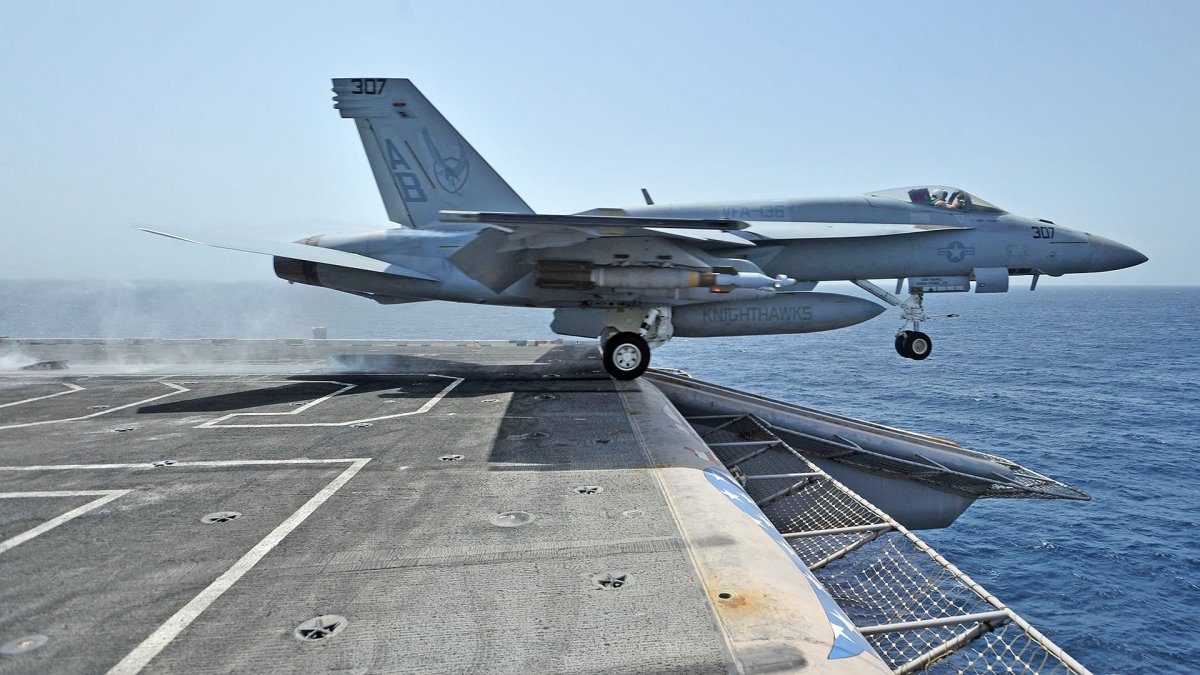
It was a common poster on the wall of boys growing up, and it probably still is today—the imposing heading-on view of a fully loaded American supercarrier bristling with fighters and support aircraft. On the bow of these most complex of fighting ships, two prong-like structures stuck out over the water, ramped downward as if to give the aircraft riding along the ship’s catapult tracks a few extra feet of help before leaping into the air. The strange protrusions gave these ship’s an ever more menacing appearance, but over the last few decades they have disappeared from American supercarriers. So what were they and where did they go?
The USS John F. Kennedy (CV-67) AKA “Big John” seen underway from an impressive angle (Huntington Ingalls image):
Enter the “bridle catch,” also known as a “bridle arrestment sponson,” a utilitarian structure used to catch the slinging bridles that attached carrier-borne naval aircraft of yesteryear to their host ship’s catapults. A bridle was a heavy-duty cable-like lanyard that attached to rearward facing hooks on either side of the aircraft, and would then run down toward the deck in a “v” to be attached to a single-point notch in the catapult’s shuttle. A similar single line device was also used on some aircraft like the S-2 Tracker, it was called a pendant.
A VF-111 Sundowner F-4B seen being strapped in via a bridle before launch aboard the USS Coral Sea during the Vietnam War:
Once the green shirts hooked the aircraft up to the catapult and it fired ( read all about this process here ), the bridle or pendant that links the shuttle to the aircraft would pull it down the catapult track at increasing speed. At the end of the deck the aircraft would depart into the air. The bridle or pendant would then be flung out into the sea, or if the carrier was so equipped, it would whip down onto the sloped bridle catcher so that it could be recovered and used again and again. In essence the bridle catcher was a feature of economy more than anything else. The reason for angling the bridle carrier extension downward was so the bridle would not bounce up and strike the aircraft as it left the deck.
A TBM Avenger (left) seen with a bridle attached while sailing aboard the USS Cape Gloucester in 1945. A FM-2 Wildcat (right) seen launching off the deck of the USS Makin Island, bridle being hurling into the ocean, in 1945:
The bridle and pendant system got Navy carriers into the catapult business, but the system was more complex and time consuming than it had to be. There were always concerns over broken bridles and connection points, and the wellbeing of carrier deck crews that had to strap the big aircraft in before each launch was of an even greater concern. It wasn’t until the early 1960s and the introduction of the E-2 Hawkeye (W2F-1 at the time) that the bridle was replaced by the integral catapult launch-bar attached to the aircraft’s nose gear.
Diagrams detailing and comparing the two systems:
The first launch by an E-2 using the system occurred on the 19th of December, 1962. Tests were largely successful and substantial gains in safety and efficiency were realized by the new system. Going forward every new US Navy aircraft designed for carrier operations would be equipped with a similar nose gear mounted launch bar.
An E-2A being launched via its integral launch bar from the USS Oriskany in the early 1960s (San Diego Air & Space Museum photo):
Over time, as older aircraft that used bridles and pendants were retired, bridle catchers would begin to disappear from America’s aircraft carriers. The last carrier built with bridle catchers was the third Nimitz class nuclear supercarrier, the USS Carl Vinson (CVN-70) , which began construction in 1975 and was officially commissioned into the fleet in 1982.
The Royal Navy’s Audacious class carriers featured bridle catchers on both the bow and the waist catapults, as seem on the HMS Ark Royal (R09) below:
Towards the end of the millennium, American supercarriers that had bridle catchers began having them removed during deep maintenance and overhaul periods. The last active US carrier to have them was the USS Enterprise (CVN-65) which pulled into Naval Station Norfolk for inactivation with her bridle catchers still intact on November 4th, 2012.
Just last July, the last NATO fixed-wing carrier aircraft to use a bridle, the French Super Étendards Mordernise (SEM), was retired once and for all . The carrier these aircraft operated from, the Charles De Gaulle (R91), was never built with bridle catchers. For many years SEMs slung bridles into the sea with reckless abandon.
A SEM launching off the deck of the Charles De Gaulle:
Today, really the only aircraft that may see the bridle once again are Brazil’s handful of upgraded AF-1 Skyhawks . Their antique carrier, the surplus French Clemenceau class carrier Foch , now named São Paulo , is supposedly finally getting the upgrades it needs to be operational again. If this indeed comes to pass, its bridle catcher will see use once again—as the last of its kind and a monument to naval aviation’s heritage.
An AF-1 being hooked up to one of the Sao Paulo’s catapults. The carrier has not supported aircraft for nearly a decade but the Brazilian Navy still hopes to return it to service (Photo credit Rob Shleiffert/Wikicommons):
Some videos showing both the bridle and the launch bar in action:
Contact the author Tyler@thedrive.com
Comments couldn’t be loaded. Please refresh the page.
更新于美国东部时间2020年7月3日凌晨3:46
这曾是男孩们成长过程中常见的海报,或许至今仍是如此——一艘满载战斗机和支援飞机的美国超级航母,气势磅礴地迎面驶来。在这些结构极其复杂的战舰舰艏,两个尖锐的凸起结构伸出水面,向下倾斜,仿佛是为了给沿着弹射轨道滑行的飞机提供额外的助力,使其在腾空而起前能够更轻松地跃出水面。这些奇特的凸起赋予了这些战舰更加威猛的外表,但在过去的几十年里,它们却从美国超级航母上消失了。那么,它们究竟是什么?又去了哪里?
从令人印象深刻的角度拍摄的约翰·F·肯尼迪号航空母舰(CV-67),又名“大约翰”(图片由亨廷顿·英格尔斯提供):
“系索钩”,也称“系索阻拦舷侧翼”,是一种实用结构,用于钩住将昔日舰载机与母舰弹射器连接的系索。系索是一种类似缆绳的重型绳索,连接到飞机两侧朝后的钩子上,然后呈“V”字形向下延伸至甲板,连接到弹射器滑轮上的单点凹槽中。一些飞机,例如S-2“追踪者”侦察机,也使用类似的单线装置,称为吊索。
越战期间,一架VF-111“日落者”中队的F-4B战斗机在“珊瑚海”号航空母舰上起飞前,正通过吊索进行固定:
当水兵们将飞机连接到弹射器并启动后(点击此处阅读完整过程),连接弹射器和飞机的吊索或连接线会将飞机沿着弹射轨道拉动,速度逐渐加快。飞机到达甲板末端后便会腾空而起。吊索或连接线随后会被抛入海中,或者,如果航母配备了相应的装置,它会被甩到倾斜的吊索收集器上,以便回收并重复使用。本质上,吊索收集器的主要作用是节约成本。吊索连接线向下倾斜的原因是为了防止吊索在离开甲板时弹起并撞击飞机。
1945年,一架TBM复仇者式鱼雷轰炸机(左)在“格洛斯特角”号两栖攻击舰上航行时,被拍到系着吊索。同年,一架FM-2野猫式战斗机(右)从“马金岛”号两栖攻击舰甲板上起飞,吊索被抛入大海。
海军航母采用吊索式弹射系统,但该系统过于复杂且耗时。人们一直担心吊索和连接点容易断裂,而每次弹射前必须将大型飞机固定到位的航母甲板人员的安全更是令人担忧。直到20世纪60年代初E-2“鹰眼”(当时的型号为W2F-1)投入使用,吊索才被连接在飞机前起落架上的一体式弹射杆所取代。
详细展示并比较这两个系统的图表:
1962年12月19日,一架E-2预警机首次使用该系统进行了弹射。测试总体上非常成功,新系统在安全性和效率方面都取得了显著提升。此后,所有为航母作战而设计的新型美国海军飞机都将配备类似的安装在前起落架上的弹射杆。
20 世纪 60 年代初,一架 E-2A 预警机通过其一体式发射杆从“奥里斯卡尼”号航空母舰上发射升空(圣地亚哥航空航天博物馆照片):
随着使用系绳和吊索的老式飞机陆续退役,美国航空母舰上的系绳捕手也开始消失。最后一艘配备系绳捕手的航母是第三艘尼米兹级核动力超级航母“卡尔·文森”号(CVN-70),该舰于1975年开始建造,并于1982年正式服役。
英国皇家海军的“大胆”级航空母舰在舰艏和舰腰弹射器上都装有牵引钩,如下图所示的皇家方舟号航空母舰(R09):
千禧年末,美国超级航母上那些装有系缆钩的舰载机开始在深度维护和大修期间将其拆除。最后一艘仍在服役且配备系缆钩的美国航母是“企业”号(CVN-65),该舰于2012年11月4日驶入诺福克海军基地退役,当时其系缆钩仍然完好无损。
就在去年七月,最后一架使用系绳的北约固定翼舰载机——法国的“现代军旗”(Super Étendards Mordernise,简称SEM)——彻底退役。这些飞机所服役的航母“戴高乐”号(R91)从未配备过系绳收集器。多年来,“现代军旗”战机肆无忌惮地将系绳甩入大海。
一架SEM从戴高乐号航母甲板上发射升空:
如今,真正有可能再次见到牵引索的飞机恐怕只有巴西那几架升级后的AF-1“天鹰”战斗机了。他们的老旧航母——法国克莱蒙梭级退役航母“福煦”号(现更名为“圣保罗”号)——据说终于要进行必要的升级改造,重新投入使用。如果一切顺利,它的牵引索捕手将再次发挥作用——作为同类设备的最后一台,也将成为海军航空兵历史的见证。
一架AF-1战斗机正在与“圣保罗”号航母的弹射器对接。该航母已近十年未搭载飞机,但巴西海军仍希望使其恢复服役。(图片来源:Rob Shleiffert/Wikicommons)
以下是一些展示牵引索和发射杆实际操作的视频:
联系作者:Tyler@thedrive.com
评论加载失败,请刷新页面。