Why the B-2 Stealth Bomber Was Used to Strike ISIS Camps in Libya为什么B-2隐形轰炸机被用于打击利比亚境内的ISIS营地
Using America's most valuable stealth combat aircraft over a country that supposedly had its air defenses neutered in 2011 may seem like an odd choice, but it really isn't.
新闻视频
Updated Jul 3, 2020 3:47 AM EDT
Six years ago, US-backed coalition airpower tore down Libyan strongman Muammar Gaddafi’s air defenses. Since then the dictator has been killed. So have a US Ambassador and three other Americans, and thousands of Libyans. Libya, in general, descended into chaos following the death of Gaddafi and the winding-down of coalition air operations over the country. Today, militant factions of varying levels of extremism are aligning themselves to suit their political, tribal and religious ties. Terror groups like ISIS found the chaos of the Libyan civil war a rich incubator for their ideology and operational goals, while at the same time small glimmers of hope have emerged under the Libyan unity government—but for now let’s just say the country has a long way to go before being considered a stable state.
In the last half decade following the fall of Gaddafi, the US has quietly leveraged a minimalist brand of air power in an attempt to hunt and kill high-value targets inside the country. Primarily this included using F-15Es on sporadic long-range missions from the UK , and a constant presence of Predator and Reaper drones in Libyan skies. Last Summer this policy changed, and a Marine Amphibious Group’s Cobra attack helicopters and Harrier attack jets began pounding ISIS-aligned militants that had flooded Gaddafi’s hometown—the central coastal city of Sirte. These missions wrapped up early last Winter, when ISIS elements were finally pushed from the city.
Now, both figuratively and literally out of the black, America’s most capable and deadly aerial weapon, the B-2A Spirit stealth bomber, has laid waste to a pair of training camps south of that city. Which begs an interesting question: Over a country that remains in disarray with air defenses supposedly neutered years ago, why would stealthy B-2s be needed for such a mission?
Yesterday at around 2AM local time, three B-2A Spirits (two primary, one spare) took off from Whiteman AFB and headed east. Under callsigns CLIP11, CLIP12, CLIP13 the stealth bombers crossed the Atlantic, sometime after which two of the jets “cleaned up,” pulling in all their antennas to make the aircraft as stealthy as possible. The two black jets then began their run into Libyan airspace, towards a pair of terrorist training encampments located about 30 miles southwest of Sirte, in an area of relatively open desert. It was here that a large group of ISIS affiliated militants had assembled after Sirte fell—and where the US Secretary of Defense said the fighters were planning attacks on Europe and US interests abroad.
Long before the B-2s arrived over their targets, special operations personnel and a flock of armed MQ-9 Reaper drones were surveilling the camps at a distance, providing real-time updates as to the alert posture of those inside. Then—over half a day after they had left Missouri—the B-2s’ weapons bay doors opened and unleashed dozens of individually targeted joint direct attack munitions on pre-selected targets around the encampments.
A still from a short clip shown by the DoD during a Pentagon press briefing of ISIS fighters at one of the targeted camps unloading munitions from a pair of technicals:
In a ferocious crescendo of fire and shockwaves, the B-2s’ cargo obliterated fixed targets at both sites. Anyone or anything who ran was likely to be quickly engaged by the loitering Reaper drones armed with AGM-114 Hellfire missiles and 500lb GBU-12 Paveway laser guided bombs. The lion and the vulture, the Lion takes down the big game, and the vultures come in to pick up the scraps and poke at the bones.
A short clip showing a small portion of the airstrikes near Sirte that was presented during a Pentagon media briefing:
Reports state that the installation was obliterated and around 100 ISIS fighters fell under the crosshairs of an incredible 100 individual air-to-ground munitions during the strike. The B-2s made it back safely to their master base in America’s heartland after nearly 34 hours in the air, facilitated by a slew of aerial refueling. Remember: Nobody kicks ass without tanker gas—not even ultra long-ranged B-2s.
A strengthening Spirit
The shear amount of surgically applied death and destruction a single B-2 can unleash on one pass is really unprecedented in the history of air combat. Each B-2 airframe can carry up to 80 individually targeted, GPS-guided 500lb GBU-38 Joint Direct Attack Munitions (JDAMs).
Basically, take a satellite image of an airfield (or a town) and pick out the 80 things you want to make into a crater. Then load the coordinates of those things onto the jet and weapons and fly the mission. With the GBU-38’s accuracy rate just a few points off 100 percent, there is a very good chance a well trained B-2 crew and targeteers will make those targets selected in the photo disappear. Not just that, but mixed loads can also be carried, including bunker buster BLU-109s, 2,000lb and 1,000lb JDAMs alongside their 500lb counterparts—so larger targets and bunkers can be attacked alongside smaller ones on the same mission.
And the B-2 can dump its whole bomb load in a single run over a localized area—or it can make multiple drops along a route. This helps with survivability, as surprise is a key element of the aircraft’s effectiveness, and once its bay doors open the jet is no longer stealthy. When it comes to attack runs on targets, “one and done” has been optimal operating procedure for the B-2A over the last two decades.
In recent years the B-2 has been on the receiving end of much-needed upgrades as part of an ongoing effort that will run into the 2020s. These include plans to enhance the jet’s defensive systems and electronic surveillance measures, boosting its crew’s situational awareness and ability to adapt to changing threats drastically during combat. Cockpit interfaces and mission computers (which remained ‘80s high-tech till recently) are also being upgraded , allowing for retargeting of smart munitions on the fly. The jet’s huge twin electronically scanned array radars are also getting a major boost in capabilities. But one of the most exciting upgrades is to “The Beast’s” communications systems, which will include high-frequency satellite data connectivity, as well as the inclusion of other high-volume data-link modems that will allow the jet to receive real-time targeting information and battlefield data—and even video feeds from third parties like Reaper and most likely RQ-170 drones.
It seems very possible that a portion of this new communications and re-targeting capability was tested during this mission, where instead of having the B-2s quickly exit the theatre after their drop, they may have loitered with weapons still available to provide re-attacks on targets that need a little extra help dying. The MQ-9’s real-time streaming video can provide nearly immediate bomb damage assessment (BDA) imagery to intelligence folks, and could, using the B-2’s enhanced communication suite, convey instant coordinates to the jets’ crews to make follow up attacks on not fully destroyed targets. The B-2 can also help in verifying its coordinates via the use of their increasingly high-fidelity synthetic aperture radar.
So did the Spirit try a few of its new bag of tricks on this mission? Considering the circumstances and their overt interoperability with the drones and special operations forces below their flight paths, it seems possible. A report from the Air Force Times also mentions an interesting quote from outgoing Secretary of Air Force Deborah James that seems to support this theory:
“The B-2s were dispatched from Whiteman Air Force Base in Missouri, flying 34 hours to conduct the attack, James said. The bat-shaped bombers were chosen, she added, because they are capable of carrying a large number and variety of weapons, and because they’re able to loiter afterwards — to “mop up” if necessary.”
As mentioned earlier, loitering around after the fact is not the B-2’s traditional calling card, especially considering that it is meant to penetrate deep into contested airspace, strike targets by surprise and get out alive. That mission really doesn’t call for hanging around over a recently appearing hellscape of its own creation. But in low to medium-threat environments, the ability to target on the fly and work alongside other platforms or ground units is clearly going to change tactics.
The reasoning for its use
So why not send the B-52H or B-1B to do the job? Those jets have the added benefit of toting around their own targeting pod that can lase targets, moving or stationary, for the laser guided bombs they drop, and they also carry the JDAM like the B-2.
First off, no other force in the Pentagon’s portfolio is more trained and ready for complex global strike missions than the B-2 Spirit community. It’s very much a silver bullet force of just 20 aircraft—of which just a handful are available for conventional attack operations at any given time. They train arduously for missions that can last as long as two days; missions where human factors can become almost as big a threat as the enemy. Additionally, the B-2 community is not committed all around the globe and worn down from over fifteen years of perpetual combat operations like the B-52H and B-1B communities are. They are almost entirely a single-garrison force, one that is unleashed for select missions only.
The B-2’s stealth capabilities, though not nearly as relevant over Libya today as they were during their attack runs as part of the opening strikes of Operation Odyssey Dawn in 2011, still offer something other platforms cannot—volume of fire and the best chance of surprise.
Radar sites are active in Libya today, mainly at the country’s larger airports concentrated along the coastline—just a couple dozen miles from the camps that were struck. There is a chance that the detection of an unidentified aircraft, even just as primary returns, could have been passed along to ISIS affiliated fighters, sending them scattering. For such an attack to be most effective, the targets need to be asleep in their beds. All it takes is one ISIS sympathiser working in relation with Libyan airport staff or the military, or even someone monitoring radio communications chatter about incoming aircraft, to realize something is up. The B-2 largely ensures the element of surprise remains intact.
There are also a mishmash of MiGs still prowling the skies over Libya . Although an encounter at night with a B-2 would be highly unlikely, why take the chance? And while Gaddafi’s massive MANPADS arsenal —which was notoriously looted during the uprising against him—may get the most press, heavier SAM systems have began appearing in Libya in recent months. Specifically these include the SA-3—the same type that took down a USAF F-117 during Operation Allied Force. Although there is a low chance that one of these missiles or their operators could take down a B-2, or would even be able to detect it in the first place, it’s still a possible threat—especially considering the questionable command and control organization within even US-friendly military factions in Libya. Overall it’s not like Libyan airspace is totally permissible and deconflicted.
It is also unclear how much the recognized Libyan government knew about the strike prior to its execution. Though lower-flying drones and smaller tactical aircraft buzz around the country daily, large bombers don’t. By using an aircraft that gives no warning of its arrival, the element of surprise could be ensured and there would be no need to pass potentially compromising information about the strike to Libyan officials in advance.
The B-2 also allows the Pentagon to deal out incredible amounts of destruction with an amazingly small footprint. For most missions the jet is better off going it alone than being part of a massive strike package. This means the normal armada of suppression of enemy air defenses, counter-air, and in some cases electronic warfare aircraft, along with an array of standoff support assets like tankers, combat search and rescue packages, airborne early warning aircraft, and other assets, are not needed or are needed in far smaller numbers. Were fighters were used instead of heavy bombers, the strike package might include dozens of strike aircraft alone, not counting all their support assets. In essence, using the B-2 means less assets and lives put at risk against an objective. It also means the whole battle plan can be simplified, executed faster, and with fewer avenues for disruption.
Maybe the most compelling reason to use the B-2 for this mission was to try out some of the jet’s new capabilities as described earlier, and to put to use the B-2’s evolving joint operations doctrine that has been trained for but not tested in combat. If anything else, this may have been our first “preview” look at “B-2 2.0” in combat, and by what we are being told it was brutally effective.
Finally, this was almost certainly the very last major military operation executed by outgoing President Barack Obama and his national security staff, including Secretary of Defense Ashton Carter, as well as the Secretary of Air Force and others in political leadership within the Pentagon’s five walls. There is risk in any operation, no matter how high-end the hardware used is and what the enemy’s capabilities are. Going with the very best possible asset that can provide the lowest overall risk, even outside of the normal rationale, and was likely a major factor in the B-2’s appearance over Libya yesterday evening. Having a “Black Hawk Down” type of incident on the last day of your Presidency would be a disaster of epic proportions. In fact, I give Obama credit for approving this mission at all, with that in mind. And hey, nobody can say that he didn’t go out with a bang, right?
Contact the author Tyler@thedrive.com
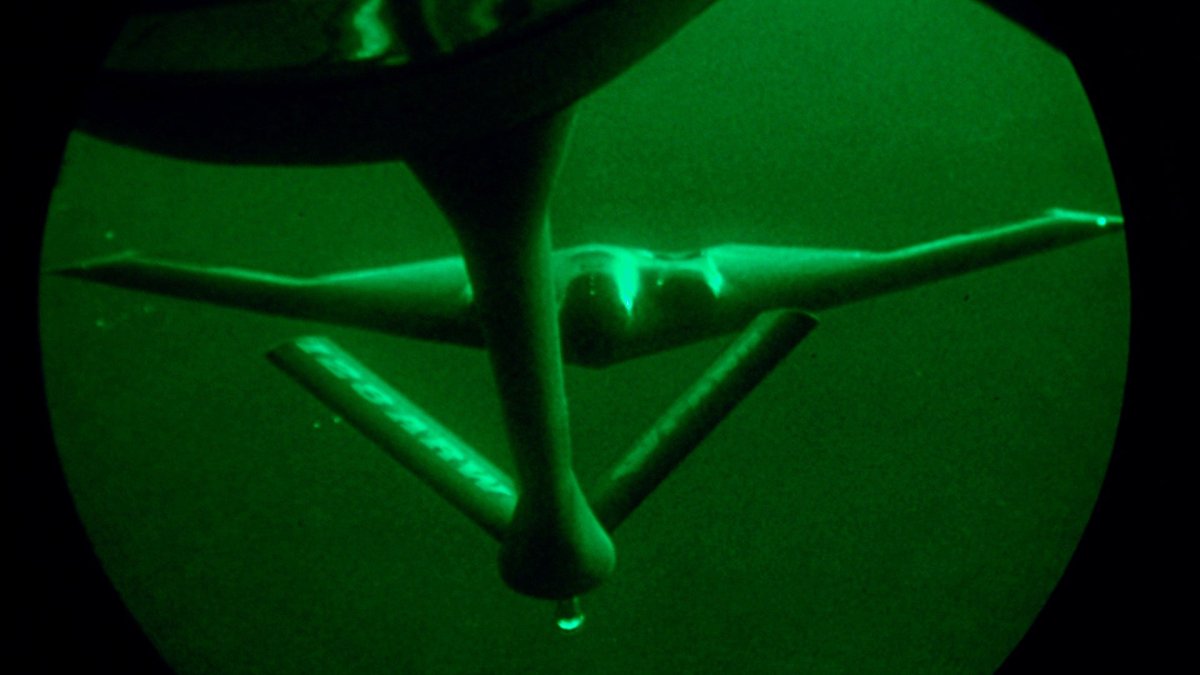
Update: 1/20/2016, 11:35AM PST- Here is a pic taken from a KC-135R during the mission:
Comments couldn’t be loaded. Please refresh the page.
更新于美国东部时间2020年7月3日凌晨3:47
六年前,美国支持的联军空袭摧毁了利比亚强人穆阿迈尔·卡扎菲的防空系统。此后,这位独裁者被杀,一名美国大使和三名其他美国人以及数千名利比亚人也丧生。卡扎菲死后,随着联军在利比亚上空空袭行动的结束,利比亚整体陷入混乱。如今,不同极端程度的武装派别正根据各自的政治、部落和宗教背景结盟。像“伊斯兰国”这样的恐怖组织发现,利比亚内战的混乱局面为其意识形态和行动目标提供了绝佳的温床。与此同时,在利比亚联合政府的领导下,也出现了一线希望——但就目前而言,利比亚距离成为一个稳定的国家还有很长的路要走。
在卡扎菲政权倒台后的五年里,美国一直悄然运用一种极简主义的空中力量,试图在利比亚境内猎杀高价值目标。这主要包括从英国派遣F-15E战斗机执行零星的远程任务,以及在利比亚上空持续部署“捕食者”和“死神”无人机。去年夏天,这一策略发生了改变,美国海军陆战队两栖作战群的“眼镜蛇”攻击直升机和“鹞”式攻击机开始猛烈打击涌入卡扎菲家乡——中部沿海城市苏尔特的“伊斯兰国”武装分子。这些行动在去年冬天初结束,当时“伊斯兰国”残余势力最终被逐出了这座城市。
如今,美国最强大、最具杀伤力的空中武器——B-2A“幽灵”隐形轰炸机,无论从字面意义还是比喻意义上来说,都如同从黑暗中凭空而来,摧毁了该市南部的两处训练营。这不禁引出一个有趣的问题:在一个防空系统多年前就被削弱、仍处于混乱状态的国家,为何需要隐形的B-2轰炸机来执行这样的任务?
昨天凌晨2点左右(当地时间),三架B-2A“幽灵”隐形轰炸机(两架主力,一架备用)从怀特曼空军基地起飞,向东飞行。这三架隐形轰炸机分别以CLIP11、CLIP12和CLIP13的呼号飞越大西洋,之后其中两架进行了“清理”,收起了所有天线,以尽可能地提高隐蔽性。随后,这两架黑色飞机开始进入利比亚领空,飞往位于苏尔特西南约30英里处、地处相对开阔沙漠地带的两处恐怖分子训练营地。苏尔特陷落后,一大批与“伊斯兰国”有关联的武装分子聚集于此——美国国防部长曾表示,这些武装分子正计划袭击欧洲和美国在海外的利益。
在B-2轰炸机抵达目标上空之前很久,特种作战人员和一群武装的MQ-9“死神”无人机就已在远处监视营地,实时更新营地内的警戒状态。随后,在离开密苏里州半天多之后,B-2轰炸机的武器舱门打开,向营地周围预先选定的目标投放了数十枚精确制导的联合直接攻击弹药。
这是美国国防部在五角大楼新闻发布会上播放的一段短片中的截图,画面显示ISIS武装分子在其中一个目标营地从两辆技术卡车上卸载弹药:
在熊熊烈焰和冲击波的猛烈冲击下,B-2轰炸机的弹药摧毁了两个地点的所有固定目标。任何逃跑的人或物都可能迅速遭到盘旋的“死神”无人机的攻击,这些无人机装备有AGM-114“地狱火”导弹和500磅GBU-12“铺路”激光制导炸弹。狮子和秃鹫,狮子捕杀大型猎物,而秃鹫则前来捡拾残羹剩饭,啃食骨头。
一段短片,展示了五角大楼媒体简报会上播放的苏尔特附近空袭的一小部分:
报道称,该设施被彻底摧毁,约100名ISIS武装分子在空袭中被100枚空对地炸弹击毙。经过近34小时的空中飞行,B-2轰炸机在多次空中加油的帮助下安全返回位于美国中部地区的母港。记住:没有空中加油,谁也发挥不出威力——即使是超远程的B-2轰炸机也不例外。
增强精神
一架B-2轰炸机一次飞行所能造成的精准杀伤力和破坏力,在空战史上可谓前所未有。每架B-2飞机最多可携带80枚500磅重的GBU-38联合直接攻击弹药(JDAM),这些弹药均由GPS制导,可单独锁定目标。
简单来说,就是先拍摄一张机场(或城镇)的卫星图像,然后从中选出80个你想炸成弹坑的目标。接着把这些目标的坐标加载到飞机和武器上,执行任务。GBU-38的精度几乎达到100%,训练有素的B-2机组人员和目标瞄准员很有可能将照片中选定的目标炸成弹坑。不仅如此,B-2还可以携带混合载荷,包括BLU-109钻地弹、2000磅和1000磅的JDAM以及500磅的同类炸弹——这样,在同一次任务中,既可以攻击大型目标和小型目标,也可以攻击大型目标和小型目标。
B-2轰炸机可以一次性将全部炸弹倾泻到局部区域,也可以沿航线多次投弹。这有助于提高生存能力,因为出其不意是该机作战效能的关键要素,一旦弹舱门打开,飞机就失去了隐身性能。在过去二十年中,对于B-2A轰炸机而言,“一次性投弹”一直是其最佳作战程序。
近年来,B-2轰炸机一直在进行亟需的升级改造,这项持续到2020年代的计划旨在提升其防御系统和电子监视能力,从而增强机组人员的态势感知能力,并使其能够在战斗中迅速适应不断变化的威胁。驾驶舱界面和任务计算机(直到最近才摆脱80年代的高科技水平)也在进行升级,使其能够实时重新瞄准智能弹药。该机巨大的双电子扫描阵列雷达的性能也得到了大幅提升。但最令人兴奋的升级之一是对“野兽”通信系统的升级,其中包括高频卫星数据连接,以及其他大容量数据链调制解调器,这将使该机能够接收实时目标信息和战场数据,甚至还能接收来自“死神”无人机和RQ-170无人机等第三方提供的视频信号。
此次任务很可能测试了部分新型通信和重定向能力。B-2轰炸机在投弹后并未立即撤离战区,而是可能停留在空中,携带剩余武器对尚未完全摧毁的目标进行再次攻击。MQ-9无人机的实时视频流能够为情报人员提供近乎即时的炸弹损毁评估(BDA)图像,并可利用B-2轰炸机增强的通信系统,将即时坐标传递给机组人员,以便对未完全摧毁的目标进行后续攻击。B-2轰炸机还可以通过其日益精密的合成孔径雷达来验证这些坐标。
那么,幽灵战机是否在这次任务中尝试了一些新招式呢?考虑到当时的情况以及它与下方无人机和特种作战部队的明显协同作战能力,这似乎很有可能。《空军时报》的一篇报道也提到了即将卸任的空军部长黛博拉·詹姆斯的一段引述,这段引述似乎支持了这一理论:
詹姆斯说:“这些B-2轰炸机从密苏里州的怀特曼空军基地起飞,飞行了34个小时执行了这次袭击任务。”她补充说,之所以选择这种蝙蝠形状的轰炸机,是因为它们能够携带大量且种类繁多的武器,而且事后还能盘旋——必要时进行“扫尾”。
如前所述,事后徘徊并非B-2轰炸机的传统作战方式,尤其考虑到它的任务是深入敌方控制空域,出其不意地打击目标并安全撤离。这样的任务显然不需要在刚刚被它亲手摧毁的废墟上空长时间停留。但在低威胁或中等威胁环境下,能够即时锁定目标并与其他平台或地面部队协同作战的能力,显然会改变其战术。
使用它的理由
那么为什么不派B-52H或B-1B去执行任务呢?这些战机还有一个额外的优势,那就是它们自带激光瞄准吊舱,可以对移动或静止的目标进行激光制导,以便投放激光制导炸弹;而且它们也像B-2一样携带JDAM弹药。
首先,在五角大楼的众多部队中,没有哪一支比B-2“幽灵”轰炸机部队更训练有素、更能胜任复杂的全球打击任务。这支部队堪称一支“银弹”部队,仅有20架飞机,而任何时候只有少数几架可用于常规攻击行动。他们为可能持续长达两天的任务进行艰苦训练;在这些任务中,人为因素的威胁几乎与敌人不相上下。此外,与B-52H和B-1B部队不同,B-2部队不像B-52H和B-1B部队那样部署在全球各地,经历了超过15年的持续作战行动而疲惫不堪。他们几乎完全是一支驻扎在单一基地的部队,只在特定任务中才会出动。
虽然 B-2 的隐身能力在今天的利比亚战场上远不如 2011 年“奥德赛黎明行动”初期打击行动中那么重要,但它仍然提供了其他平台无法提供的东西——火力密度和最佳的突袭机会。
如今利比亚境内的雷达站仍在运作,主要集中在沿海的大型机场——距离遭到袭击的营地仅几十英里。即使只是初步回波,探测到不明飞行物的信息也可能被传递给与“伊斯兰国”有关联的武装分子,导致他们四散奔逃。为了使此类袭击最为有效,目标必须正在睡梦中。只需一名与利比亚机场工作人员或军方有联系的“伊斯兰国”同情者,甚至只需有人监听有关来袭飞机的无线电通讯,就能察觉到异常。B-2轰炸机在很大程度上确保了袭击的突然性。
利比亚上空仍然盘旋着各种型号的米格战机。虽然夜间遭遇B-2轰炸机的可能性极低,但何必冒险呢?尽管卡扎菲庞大的便携式防空导弹库——在反抗他的起义期间遭到臭名昭著的洗劫——可能最受媒体关注,但近几个月来,更重型的防空导弹系统也开始出现在利比亚。具体来说,其中包括SA-3导弹——正是这种导弹在“盟军行动”中击落了一架美国空军的F-117战斗机。虽然这些导弹或其操作人员击落B-2轰炸机的可能性很低,甚至可能根本无法探测到它,但这仍然是一个潜在的威胁——尤其考虑到利比亚境内即使是亲美军事派别内部也存在着令人质疑的指挥控制体系。总而言之,利比亚领空并非完全畅通无阻。
目前尚不清楚利比亚官方认可的政府在空袭行动执行前对此事了解多少。虽然低空飞行的无人机和小型战术飞机每天都在利比亚上空盘旋,但大型轰炸机却很少出没。使用不会提前发出预警的飞机,可以确保行动的突然性,也无需事先向利比亚官员传递任何可能泄露行动信息的机密信息。
B-2轰炸机使五角大楼能够以极小的占地面积造成惊人的破坏。对于大多数任务而言,B-2单独行动比作为庞大打击编队的一部分更为有效。这意味着通常用于压制敌方防空系统、反空袭以及在某些情况下使用电子战飞机的庞大机队,以及一系列远程支援力量(例如加油机、战斗搜救编队、空中预警机和其他装备)都不再需要,或者只需要极少量即可。如果使用战斗机而非重型轰炸机,打击编队可能仅包含数十架攻击机,还不包括所有支援力量。本质上,使用B-2意味着在执行任务时投入的资源和人员生命更少。这也意味着整个作战计划可以简化,执行速度更快,并且更容易受到干扰。
或许此次任务使用B-2轰炸机的最主要原因在于测试该机此前所述的一些新能力,并运用B-2不断演进的联合作战理论——该理论虽已接受过训练,但尚未在实战中得到检验。即便没有其他意义,这或许也是我们首次在实战中“预览”了“B-2 2.0”的威力,而据我们所知,其效果极其显著。
最后,这几乎可以肯定是即将卸任的总统巴拉克·奥巴马及其国家安全团队(包括国防部长阿什顿·卡特、空军部长以及五角大楼内的其他政治领导人)执行的最后一次重大军事行动。任何行动都存在风险,无论使用的装备多么高端,敌人的能力如何。即使不按常理出牌,选择能够将总体风险降到最低的最佳装备,很可能是昨晚B-2轰炸机出现在利比亚上空的一个主要原因。在总统任期的最后一天发生类似“黑鹰坠落”的事件,将是一场史诗级的灾难。事实上,考虑到这一点,我赞赏奥巴马批准这次任务的勇气。而且,谁也不能说他的谢幕不够精彩,对吧?
联系作者:Tyler@thedrive.com
更新:2016年1月20日上午11:35(太平洋标准时间)——以下是任务期间从KC-135R飞机上拍摄的照片:
评论加载失败,请刷新页面。