Army Pacific general to aggressors: we’re battle ready in Asia太平洋陆军将领对侵略者说:我们在亚洲已做好战斗准备。
Maj. Gen. Joseph Ryan said a network of treaty alliances and partnerships provides a regional safeguard.
MANILA, Philippines — American forces and their allies in Asia are ready for battle after years of joint combat exercises, a United States general said Wednesday, adding that Russia’s setbacks in Ukraine should serve as a warning to potential Asian aggressors like China and North Korea.
U.S. treaty allies such as the Philippines , Japan and Australia, among others, “have shown that they will band together, that they will not stand for aggression from these nations that have decided they want to change the world order out here,” Maj. Gen. Joseph Ryan said.
Although Asia has no counterpart to NATO, the 30-nation military alliance whose mostly European members vow to defend each other against external attacks, a network of U.S. treaty alliances and defense partnerships upholding the international order provides a regional safeguard, he said.
“I’m personally very buoyed by what I see by our allies and partners in this region and the way we’ve come together in response to aggression by the PRC, by North Korea to say, ‘We will not let that stand,’” Ryan told The Associated Press in an interview Wednesday, using the acronym for China’s official name, the People’s Republic of China.
Ryan, Commanding General of the U.S. Army’s 25th Infantry Division based in Hawaii, is in Manila partly for talks with Philippine counterparts ahead of two annual largescale combat exercises that would include live-fire exercises and ground, sea and air assault maneuvers involving thousands of U.S. and Filipino troops in March and April.
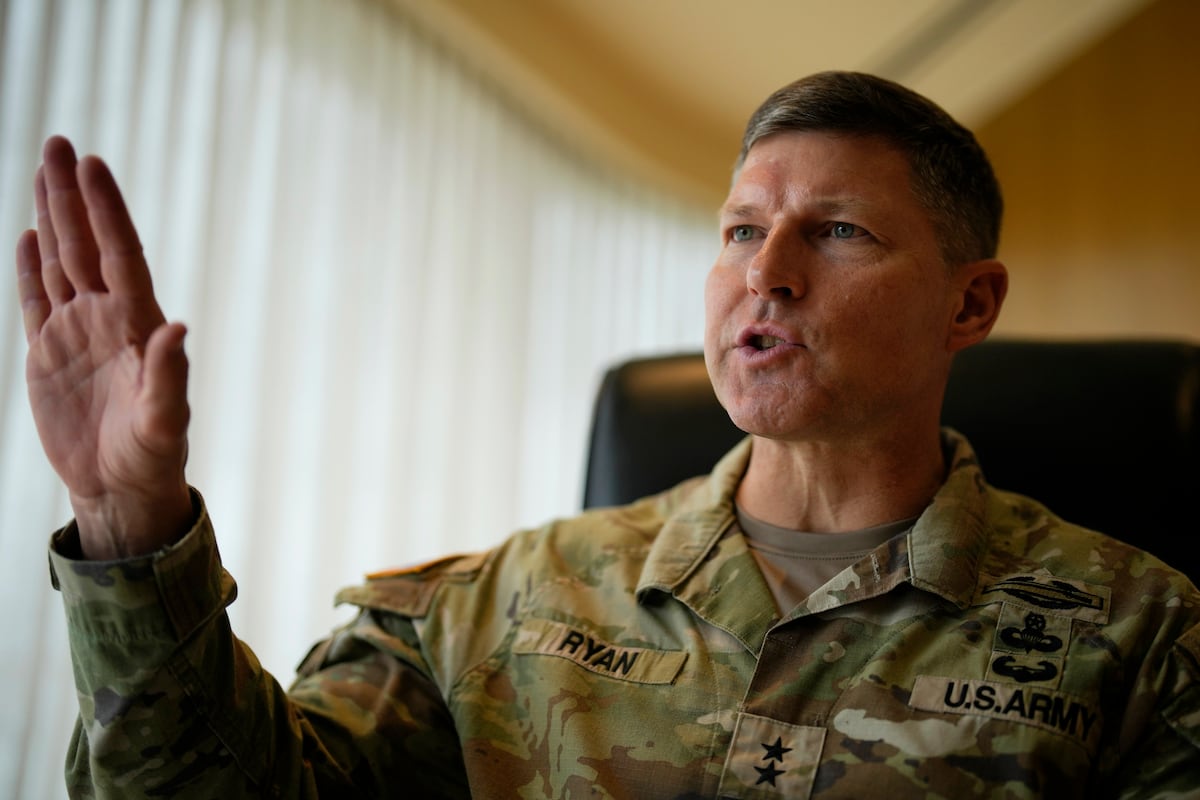
Commanding General of the 25th Infantry Division based in Hawaii, Maj. Gen. Joseph Ryan gestures said American forces and their allies in Asia, including the Philippines, are ready for battle (Aaron Favila/AP)
The Philippines, America’s oldest treaty ally in Asia that used to host the largest U.S. naval and air force bases outside the American mainland, has allowed larger numbers of visiting U.S. forces to stay in rotating batches and preposition weapons and combat equipment in at least nine Philippine military camps under a 2014 defense pact. The Philppine decision to allow a broader American military presence was announced during a visit last week to Manila by U.S. Secretary of Defense Lloyd Austin.
In the broader Asia-Pacific region, Washington has reinforced an arc of alliances to counter what it says are threats posed by an increasingly belligerent China and North Korea.
China has frowned on combat exercises involving the Americans in coastal areas facing the South China Sea, which Beijing claims virtually in its entirety, and has accused Washington of meddling in Asian disputes and dangerously militarizing the region by regularly deploying U.S. Navy warships and jet fighters.
More recent venues of large-scale exercises by American and Filipino forces included coastal Philippine provinces close to the disputed South China Sea, where China has taken increasingly assertive actions to cement its territorial claims, and in the northern Luzon region, which lies across a narrow sea border from Taiwan.
Combat-readiness exercises hopefully would make potential aggressors think twice, Ryan said.
The United States and the Philippines have agreed to hold about 500 small and major combat exercises in 2023 and expand annual military drills following disruptions caused by two years of coronavirus lockdowns, according to Philippine military officials.
“That does provide some deterrent effect against an adversary in the region, who would look at that and say, ‘I don’t want to take a step that may cause a government, a politician, to decide to go because I don’t know that I can win if I’ve got to face that trained, ready force,’” Ryan said.
While military commanders say the joint exercises are not directed against any particular country, Ryan said China’s increasingly aggressive actions were an alarming reality the region should brace for.
“Does the backdrop of PRC aggression enter our minds when we train? Absolutely,” he said, and in the case of the Philippines, U.S. forces needed to be ready to fulfill their obligations under the 1951 Mutual Defense Treaty.
“We feel duty-bound to ensure that the Philippines can maintain and will maintain their sovereignty,” Ryan said. “So aggression from the People’s Republic of China that makes our treaty ally uncomfortable makes us uncomfortable.”
The Philippines filed nearly 200 diplomatic protests in 2022 alone against China’s aggressive actions in the South China Sea, a resource-rich and busy waterway where Vietnam, Malaysia, Taiwan and Brunei also lay overlapping territorial claims.
Asked if U.S. forces and their Asian allies were ready to respond if a major crisis similar to Russia’s invasion of Ukraine breaks out in the region, Ryan said, “Absolutely.”
“I’m very comfortable that we’re ready but that doesn’t mean I’m satisfied. We can always get better,” said Ryan, who commands about 12,000 soldiers under his infantry division.
He said experts would be flown in from Hawaii to train American and Filipino army troops in jungle survival and combat tactics during the Salaknib, the first of two major combat-readiness exercises starting next month in the Philippines.
Ryan said America’s adversaries should consider political dialogue and diplomacy because “war is complicated … it’s violent, it can go a number of different ways. Russia found that out. They continue to find that out.”
“We thought that Ukraine would quickly succumb to Russian military power. That didn’t happen,” he said. “The most important reason in my view, by far, was the will of the Ukraine people to fight.”
It was also crucial that the United States and NATO had helped train Ukrainian troops and enhanced their capabilities to deal with security contingencies for years before Russia launched a large-scale invasion of Ukraine on Feb. 24, 2022, he said.
“I think our allies in the region value their sovereignty, value their freedom, value their independence. And no adversary should take that lightly,” Ryan said.
Associated Press journalists Aaron Favila and Joeal Calupitan contributed to this report.
菲律宾马尼拉——一位美国将军周三表示,经过多年的联合作战演习,美国军队及其在亚洲的盟友已经做好战斗准备。他还补充说,俄罗斯在乌克兰的挫败应该对中国和朝鲜等潜在的亚洲侵略者起到警示作用。
美国条约盟友,如菲律宾、日本和澳大利亚等,“已经表明他们会团结起来,不会容忍这些决心改变世界秩序的国家的侵略,”约瑟夫·瑞安少将说。
他表示,虽然亚洲没有像北约那样由30个国家组成的军事联盟(该联盟的成员国大多为欧洲国家,誓言互相保卫免受外部攻击),但美国通过条约联盟和防务伙伴关系维护国际秩序,从而为亚洲提供了区域保障。
“我个人对我们在这个地区的盟友和伙伴们的表现感到非常鼓舞,我们团结起来应对中华人民共和国和朝鲜的侵略行为,表明‘我们绝不容忍这种情况’,”瑞安周三在接受美联社采访时表示,他使用了中华人民共和国的缩写。
驻扎在夏威夷的美国陆军第25步兵师司令瑞安此次到访马尼拉,部分原因是与菲律宾同行进行会谈,为即将于3月和4月举行的两次年度大规模作战演习做准备。这两次演习将包括实弹演习以及涉及数千名美菲士兵的地面、海上和空中突击演习。
驻扎在夏威夷的第25步兵师师长约瑟夫·瑞安少将表示,包括菲律宾在内的美国军队及其在亚洲的盟友已做好战斗准备。(Aaron Favila/AP)
菲律宾是美国在亚洲历史最悠久的条约盟友,曾拥有美国本土以外最大的海军和空军基地。根据2014年签署的一项防务条约,菲律宾允许更多美军部队轮流驻扎,并在至少九个菲律宾军事营地预先部署武器和作战装备。美国国防部长劳埃德·奥斯汀上周访问马尼拉期间宣布了菲律宾允许美军扩大驻扎规模的决定。
在更广泛的亚太地区,华盛顿加强了一系列联盟,以应对其所说的日益好战的中国和朝鲜构成的威胁。
中国对美国在南海沿岸地区举行的军事演习表示不满,北京声称对南海几乎全部拥有主权。中国指责华盛顿干涉亚洲争端,并通过定期部署美国海军军舰和喷气式战斗机,使该地区危险地军事化。
最近,美菲军队举行大规模演习的地点包括靠近有争议的南海的菲律宾沿海省份(中国在南海采取了越来越强硬的行动来巩固其领土主张)以及与台湾隔海相望的吕宋岛北部地区。
瑞安表示,希望战斗准备演习能够让潜在的侵略者三思而后行。
据菲律宾军方官员称,美国和菲律宾已同意在 2023 年举行约 500 次小型和大型作战演习,并在经历了两年新冠疫情封锁造成的干扰后扩大年度军事演习。
瑞安说:“这确实对该地区的一个对手起到了一定的威慑作用,他们会看着说,‘我不想采取任何可能导致某个政府或政治家决定出兵的行动,因为我不知道如果面对这样一支训练有素、随时待命的部队,我能否获胜。’”
尽管军方指挥官表示,联合演习并非针对任何特定国家,但瑞安表示,中国日益咄咄逼人的行动是一个令人担忧的现实,该地区应该为此做好准备。
“我们在训练时是否会想到中华人民共和国的侵略背景?当然会,”他说。就菲律宾而言,美军需要做好准备,履行其在 1951 年《共同防御条约》下的义务。
瑞安表示:“我们有责任确保菲律宾能够并将继续维护其主权。因此,中华人民共和国的任何侵略行为,如果令我们的条约盟友感到不安,也会令我们感到不安。”
仅在 2022 年,菲律宾就针对中国在南海的侵略性行为提出了近 200 项外交抗议。南海是一条资源丰富且繁忙的水道,越南、马来西亚、台湾和文莱也在此提出了重叠的领土主张。
当被问及如果该地区爆发类似俄罗斯入侵乌克兰的重大危机,美国军队及其亚洲盟友是否准备好做出应对时,瑞安说:“当然。”
“我很有信心我们已经准备就绪,但这并不意味着我感到满意。我们总能做得更好,”瑞安说道,他指挥着一个步兵师,麾下约有12000名士兵。
他表示,专家将从夏威夷空运而来,在萨拉克尼布演习期间训练美国和菲律宾军队的丛林生存和作战战术。萨拉克尼布演习是下个月在菲律宾开始的两项重大战备演习中的第一项。
瑞安表示,美国的对手应该考虑政治对话和外交手段,因为“战争很复杂……它充满暴力,而且可能出现多种不同的结果。俄罗斯已经体会到了这一点。他们还在不断体会这一点。”
“我们原以为乌克兰会很快屈服于俄罗斯的军事力量。但这种情况并没有发生,”他说。“在我看来,最重要的原因,也是迄今为止最重要的原因,是乌克兰人民的战斗意志。”
他还表示,至关重要的是,在俄罗斯于 2022 年 2 月 24 日对乌克兰发动大规模入侵之前,美国和北约多年来一直在帮助训练乌克兰军队,并提高其应对安全突发事件的能力。
“我认为我们在该地区的盟友珍视他们的主权、自由和独立。任何对手都不应轻视这一点,”瑞安说。
美联社记者亚伦·法维拉和乔尔·卡卢皮坦对本报道亦有贡献。