Norway special operators field pitches on fresh, Arctic-capable gear挪威特种部队队员使用全新的、适合北极环境的装备进行野外作战。
Drones reign supreme in the desired equipment for small teams in remote and inhospitable locales.
MILAN, Italy — Norwegian special operators staged the Arctic Warrior Experiment recently, inviting participants from eight countries to test their latest cold-weather gear in rugged terrain.
Modeled after similar experiments sponsored by U.S. Special Operations Command, the drill in late January assembled industry officials and military researchers under the banner “Remote effects delivery” in Arctic conditions – meaning, maximizing the combat utility of equipment while keeping a small footprint.
Torgeir Mørkved, research manager at the Norwegian Defense Research Establishment, one of the sponsoring organizations, told Defense News the theme was chosen because the stresses of the Arctic locale translate well into requirements for other areas of operations.
In attendance were a combination of military and industry members, a total of 50 companies represented, from the United States, U.K., Canada, Australia, New Zealand, Sweden, Denmark, and Finland.
Event organizers were especially interested in loitering munitions, from small hand-held to portable for a four-man team as well as unmanned vehicle platforms for all domains.
Nordic Drones CEO Pietari Sorri, a Finland-based participant, explains that one of the challenges of Arctic climate is that it “often makes it impossible, or at least very difficult, to transport large equipment, which is why our goal is to develop UAV systems that can be packed into a small space and are easily transportable while being high-performance.”
The company demonstrated its latest SkyDrone7 series, capable of flying for up to 74 minutes while carrying a 2.5-kilogram payload, as well as its new OW Striker UAV designed for shorter operations but with the ability to transport heavier cargo (maximum 4kg). Sorri says that the two models proved highly successful at the event and generated considerable interest.
In a similar fashion, Edge Autonomy responded to one of the key specifications listed by the Norwegian military: vertical take off and landing (VTOL) drones. The company’s single-operator VXE30 was developed to provide long-endurance imaging capabilities. It relies on either a solid oxide fuel cell, providing over 8 hours of endurance, or a rechargeable battery with 4 hours endurance.
Experiment organizers also had flagged as areas of interest the fields of battery and power supply in remote locations. On this, Sylvain Lhuissier, vice president of international operations at U.S.-based Bren-Tronics, says low temperatures impair battery components, resulting in reduced life cycle, performance and capacity.
The company displayed its tactical Light Universal Charger (LUC), which drew interest from participants for its innovative approach in allowing soldiers to recharge batteries while on mission through connection to a snowmobile battery or a fuel cell, Lhuissier said.
The experiment also called on manufacturers to present ideas for autonomous sensor operations and detection. For this category, Saab showcased its new passive electronic warfare sensor system, the Sirius Compact, in a stand-alone mast configuration. The system is able to detect, classify and prioritize radar as well as datalink signals without emitting signals of its own, which increases users’ situational awareness and early-warning capabilities.
Saab spokesman Conal Walker said the company’s focus for such systems is on low energy consumption, ease of use and ability to operate in all temperatures. “The Sirius Compact performed well in the cold environment, although we had wished for even colder weather during the test period,” he said.
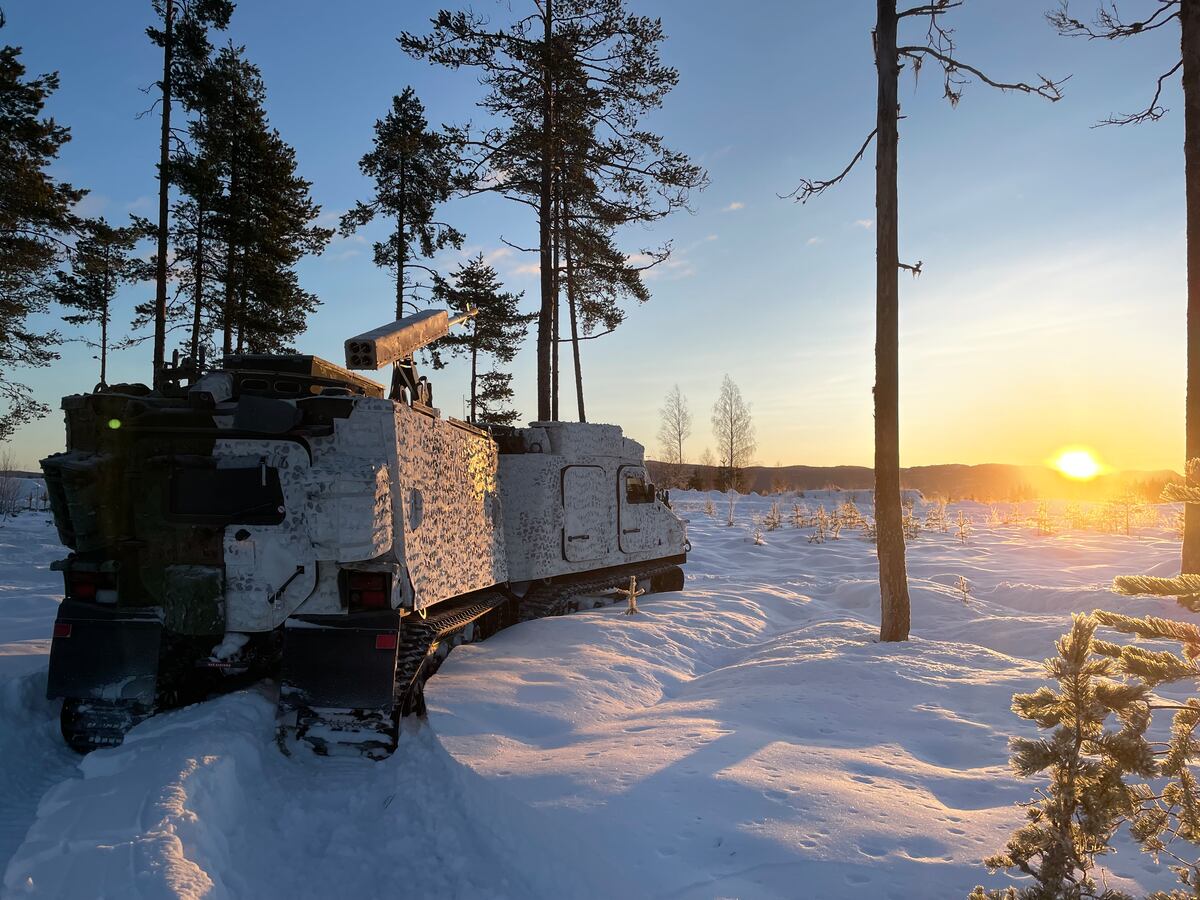
BAE Systems Hägglunds was also among the participating companies, presenting the all-terrain BvS10 Protected Articulated Tracked Vehicle. “This specific vehicle was chosen due to its design for operations in the harshest and most remote environment,” said company spokesman Ola Thorén. “We successfully demonstrated its optimal maneuverability across varying terrains (snow, ice, rock as well as steep mountain forest environments), and the vehicle’s extreme mobility as well as modular design to be reconfigured for varying missions were found very interesting by attending countries,” he wrote in an email.
The vehicle found recent success in December 2022, when the U.K., Sweden and Germany signed an agreement to jointly procure 436 units, with deliveries beginning in 2024.
Elisabeth Gosselin-Malo was a Europe correspondent for Defense News. She covers a wide range of topics related to military procurement and international security, and specializes in reporting on the aviation sector. She is based in Milan, Italy.
意大利米兰——挪威特种部队最近举行了北极勇士实验,邀请来自八个国家的参与者在崎岖的地形中测试他们最新的御寒装备。
此次演习以美国特种作战司令部赞助的类似实验为蓝本,于 1 月下旬召集了行业官员和军事研究人员,在北极条件下开展“远程效应投放”演习——这意味着在保持最小占地面积的同时,最大限度地发挥装备的作战效用。
挪威国防研究机构(赞助机构之一)的研究经理托尔盖尔·莫克维德告诉《防务新闻》,之所以选择这个主题,是因为北极地区的压力可以很好地转化为其他作战领域的要求。
出席者包括军方和工业界人士,共有 50 家公司代表,分别来自美国、英国、加拿大、澳大利亚、新西兰、瑞典、丹麦和芬兰。
活动组织者对巡飞弹特别感兴趣,从小型手持式到四人小组使用的便携式巡飞弹,以及适用于所有领域的无人驾驶车辆平台。
来自芬兰的 Nordic Drones 首席执行官 Pietari Sorri 解释说,北极气候带来的挑战之一是“它常常使得运输大型设备变得不可能,或者至少非常困难,因此我们的目标是开发可以压缩到很小的空间内、易于运输且性能优异的无人机系统。”
该公司展示了其最新的SkyDrone7系列无人机,该系列无人机能够携带2.5公斤的有效载荷飞行长达74分钟;同时还展示了其新型OW Striker无人机,该无人机专为短途飞行而设计,但能够运输更重的货物(最大4公斤)。Sorri表示,这两款机型在展会上大获成功,引起了广泛关注。
同样,Edge Autonomy公司响应了挪威军方列出的一项关键技术要求:垂直起降(VTOL)无人机。该公司开发的单人操作型VXE30无人机旨在提供长续航成像能力。它采用两种供电方式:一种是固体氧化物燃料电池,续航时间超过8小时;另一种是可充电电池,续航时间4小时。
实验组织者还将偏远地区的电池和电源供应领域列为重点研究方向。对此,总部位于美国的Bren-Tronics公司国际运营副总裁Sylvain Lhuissier表示,低温会损害电池组件,导致电池寿命、性能和容量下降。
该公司展示了其战术轻型通用充电器 (LUC),该充电器因其创新性而引起了参与者的兴趣,它允许士兵在执行任务时通过连接到雪地摩托电池或燃料电池来为电池充电,Lhuissier 表示。
此次实验还邀请制造商提出自主传感器运行和探测方面的方案。萨博公司在此类别中展示了其新型被动电子战传感器系统“天狼星紧凑型”(Sirius Compact),该系统采用独立桅杆配置。该系统能够在自身不发射信号的情况下,探测、分类并优先处理雷达和数据链信号,从而提升用户的态势感知和预警能力。
萨博发言人科纳尔·沃克表示,该公司此类系统的研发重点在于低能耗、易用性和全温度运行能力。“尽管我们希望测试期间天气更加寒冷,但Sirius Compact在寒冷环境下的表现依然出色。”他说道。
BAE系统公司哈格隆德分部也参与了此次展会,并展示了其全地形BvS10防护铰接式履带车。“之所以选择这款车辆,是因为它专为在最恶劣、最偏远的环境中作业而设计,”公司发言人奥拉·托伦表示。“我们成功演示了它在各种地形(雪地、冰面、岩石以及陡峭的山地森林环境)上的卓越机动性,与会各国代表对该车辆的超强机动性和可根据不同任务重新配置的模块化设计表现出了浓厚的兴趣,”他在一封电子邮件中写道。
该车型在 2022 年 12 月取得了成功,当时英国、瑞典和德国签署了一项协议,共同采购 436 辆,并将于 2024 年开始交付。
伊丽莎白·戈斯林-马洛曾任《防务新闻》欧洲通讯员。她的报道涵盖军事采购和国际安全等广泛领域,尤其擅长航空领域的报道。她常驻意大利米兰。