Boeing machinists reject labor contract, extending strike波音公司机械师拒绝接受劳动合同,罢工延长
The labor standoff comes during an already challenging year for Boeing, which became the focus of multiple federal investigations earlier this year.
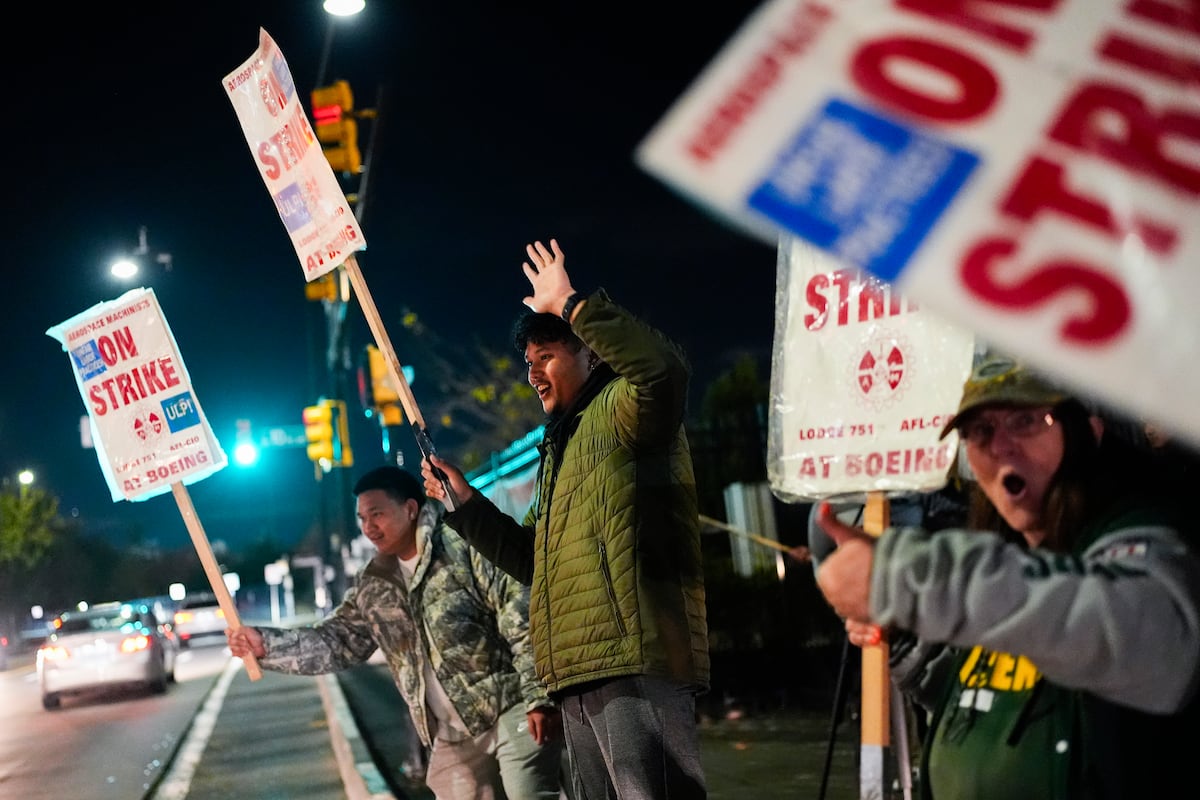
SEATTLE — Boeing factory workers voted against the company’s latest contract offer and remain on the picket lines six weeks into a strike that has stopped production of the aerospace giant’s bestselling jetliners.
Local union leaders in Seattle said 64% of members of the International Association of Machinists and Aerospace Workers who cast ballots Wednesday voted against accepting the contract offer .
“After 10 years of sacrifices, we still have ground to make up, and we’re hopeful to do so by resuming negotiations promptly,” Jon Holden, the head of the IAM District 751 union, said in a statement Wednesday evening. “This is workplace democracy — and also clear evidence that there are consequences when a company mistreats its workers year after year.”
A spokesperson for Boeing said officials didn’t have a comment on the vote.
The labor standoff comes during an already challenging year for Boeing, which became the focus of multiple federal investigations after a door panel blew off a 737 Max plane during an Alaska Airlines flight in January.
The strike has deprived the company of much-needed cash that it gets from delivering new planes to airlines. On Wednesday, the company reported a third-quarter loss of more than $6 billion.
Union machinists assemble the 737 Max , Boeing’s best-selling airliner, along with the 777 or “triple-seven” jet and the 767 cargo plane at factories in Renton and Everett, Washington.
The latest rejected offer included pay raises of 35% over four years. The version that union members rejected when they voted to strike last month featured a 25% increase over four years.
The union, which initially demanded 40% pay boosts over three years, said the annual raises in the revised offer would total 39.8%, when compounded.
Boeing has said that average annual pay for machinists is currently $75,608.
Boeing workers told Associated Press reporters that a sticking point was the company’s refusal to restore a traditional pension plan that was frozen a decade ago.
“The pension should have been the top priority. We all said that was our top priority, along with wage,” Larry Best, a customer-quality coordinator with 38 years at Boeing, said on a picket line outside a Boeing factory in Everett, Washington. “Now is the prime opportunity in a prime time to get our pension back, and we all need to stay out and dig our heels in.”
Theresa Pound, a 16-year Boeing veteran, also voted against the deal. She said the health plan has gotten more expensive and her expected pension benefits would not be enough, even when combined with a 401(k) retirement account.
“I have put more time in this place than I was ever required to. I have literally blood, sweat and tears from working at this company,” the 37-year-old said. “I’m looking at working until I’m 70 because I have this possibility that I might not get to retire based on what’s happening in the market.”
The strike started Sept. 13 and has served as an early test for Boeing CEO Kelly Ortberg, who became chief executive in August .
In his first remarks to investors, Ortberg said earlier Wednesday that Boeing needs “a fundamental culture change,” and he laid out his plan to revive the aerospace giant after years of heavy losses and damage to its reputation .
Boeing CEO Kelley Ortberg, shown here in August, said Wednesday that the company needs “a fundamental culture change.” (Marian Lockhart/Boeing via AP)
Ortberg repeated in a message to employees and on the earnings call that he wants to “reset” management’s relationship with labor “so we don’t become so disconnected in the future.” He said company leaders need to spend more time on factory floors to know what is going on and “prevent the festering of issues and work better together to identify, fix, and understand root cause.”
Ortberg, a Boeing outsider who previously ran Rockwell Collins, a maker of avionics and flight controls for airline and military planes, said Boeing is at a crossroads.
“The trust in our company has eroded. We’re saddled with too much debt. We’ve had serious lapses in our performance across the company, which have disappointed many of our customers,” he said.
But Ortberg also highlighted the company’s strengths, including a backlog of airplane orders valued at a half-trillion dollars.
“It will take time to return Boeing to its former legacy, but with the right focus and culture, we can be an iconic company and aerospace leader once again,” he said.
In recent weeks, Ortberg announced large-scale layoffs — about 17,000 people — and a plan to raise enough cash to avoid a bankruptcy filing.
Boeing hasn’t had a profitable year since 2018, and Wednesday’s numbers represented the second-worst quarter in the manufacturer’s history. Boeing lost $6.17 billion in the period ended Sept. 30, with an adjusted loss of $10.44 per share. Analysts polled by Zacks Investment Research had expected a loss of $10.34 per share.
Revenue totaled $17.84 billion, matching Wall Street estimates.
The company burned nearly $2 billion in cash, in the quarter, weakening its balance sheet, which is loaded down with $58 billion in debt. Chief Financial Officer Brian West said the company will not generate positive cash flow until the second half of next year.
Boeing’s fortunes soured after two of its 737 Max jetliners crashed in October 2018 and March 2019, killing 346 people. Safety concerns were renewed this January, when a panel blew off a Max during an Alaska Airlines flight.
Ortberg needs to convince federal regulators that Boeing is fixing its safety culture and is ready to boost production of the 737 Max — a crucial step to bring in much-needed cash. That can’t happen, however, until the striking workers return to their jobs.
Early in the strike, Boeing made what it termed its “best and final” offer . The proposal included pay raises of 30% over four years, and angered union leaders because the company announced it to the striking workers through the media and set a short ratification deadline.
Boeing backed down and gave the union more time. However, many workers maintained the offer still wasn’t good enough. The company withdrew the proposed contract on Oct. 9 after negotiations broke down, and the two sides announced the latest proposal on Saturday.
Charles Fromong, a mechanic who has worked at Boeing for 38 years, said Wednesday night after the results were announced that the company needs to take care of its workers.
“I feel sorry for the young people,” he said. “I’ve spent my life here and I’m getting ready to go, but they deserve a pension and I deserve an increase.”
The last Boeing strike, in 2008, lasted eight weeks and cost the company about $100 million daily in deferred revenue. A 1995 strike lasted 10 weeks.
Koenig reported from Dallas. Lindsey Wasson in Everett, Washington, contributed to this report.
西雅图——波音工厂的工人们投票反对公司最新的合同提议,罢工已持续六周,导致这家航空航天巨头最畅销的喷气式客机停产,工人们仍然在纠察线上。
西雅图当地工会领导人表示,周三投票的国际机械师和航空航天工人协会成员中有 64% 的人投票反对接受合同提议。
“经过十年的牺牲,我们仍有许多工作要做,我们希望通过尽快恢复谈判来实现这一目标,”国际机械师协会(IAM)751区工会主席乔恩·霍尔顿周三晚间在一份声明中表示。“这才是工作场所的民主——也清楚地表明,如果一家公司年复一年地虐待员工,必将承担后果。”
波音公司发言人表示,公司官员对投票结果不予置评。
这场劳资纠纷发生在波音公司本已充满挑战的一年里。今年1月,一架737 Max飞机在阿拉斯加航空公司的航班上发生门板脱落事故,波音公司因此成为多项联邦调查的焦点。
罢工使该公司失去了急需的现金收入,而这笔收入原本来自向航空公司交付新飞机。周三,该公司公布第三季度亏损超过60亿美元。
工会机械师在华盛顿州伦顿和埃弗雷特的工厂组装波音公司最畅销的客机 737 Max,以及 777 或“三七”喷气式飞机和 767 货机。
最新被否决的方案包括在四年内加薪35%。而工会成员上个月投票决定罢工时否决的方案则是在四年内加薪25%。
工会最初要求三年内加薪 40%,而现在表示,修订后的方案中,每年的加薪幅度累计将达到 39.8%。
波音公司表示,目前机械师的平均年薪为 75,608 美元。
波音公司员工告诉美联社记者,症结在于该公司拒绝恢复十年前冻结的传统养老金计划。
“养老金本应是重中之重。我们都说过,养老金和工资一样,是我们的首要任务,”在华盛顿州埃弗雷特一家波音工厂外的纠察线上,拥有38年波音公司客户质量协调员经验的拉里·贝斯特说道。“现在是争取养老金的最佳时机,我们必须坚持到底,坚决捍卫我们的权益。”
在波音公司工作了16年的老员工特蕾莎·庞德也投了反对票。她说,医疗保险计划的费用越来越高,即使加上401(k)退休账户,她预期的养老金福利也不够用。
“我在这里投入的时间远远超过了公司要求。我为这家公司付出了血汗和泪水,”这位37岁的男子说道。“我打算工作到70岁,因为根据目前的市场状况,我可能无法退休。”
罢工始于 9 月 13 日,对 8 月份上任的波音公司首席执行官凯利·奥特伯格来说是一次早期考验。
奥特伯格周三早些时候在首次对投资者发表讲话时表示,波音公司需要“根本性的文化变革”,并阐述了他重振这家航空航天巨头的计划,此前该公司经历了多年的巨额亏损和声誉受损。
波音公司首席执行官凯利·奥特伯格(如图,摄于8月)周三表示,公司需要“根本性的文化变革”。(玛丽安·洛克哈特/波音公司,图片来自美联社)
奥特伯格在给员工的信息和财报电话会议上重申,他希望“重塑”管理层与员工之间的关系,“以免未来双方关系进一步疏远”。他表示,公司领导需要花更多时间在生产车间,了解实际情况,“防止问题恶化,并更好地合作,找出、解决问题并理解问题的根本原因”。
奥特伯格曾是波音公司的外部人士,他之前执掌过罗克韦尔柯林斯公司,该公司是为民用和军用飞机生产航空电子设备和飞行控制系统的制造商。他表示,波音公司正处于十字路口。
他说:“客户对我们公司的信任度已经下降。我们背负了太多的债务。公司各部门的业绩都出现了严重下滑,这让很多客户感到失望。”
但奥特伯格也强调了该公司的优势,包括价值五千亿美元的飞机订单积压。
“波音要重回昔日辉煌还需要时间,但只要方向正确,企业文化营造得当,我们就能再次成为一家标志性企业和航空航天领域的领导者,”他说道。
最近几周,奥特伯格宣布了大规模裁员计划——约17000人——并制定了筹集足够资金以避免申请破产的计划。
自2018年以来,波音公司一直未能实现盈利,周三公布的业绩是该公司历史上第二糟糕的季度业绩。截至9月30日的季度,波音公司亏损61.7亿美元,经调整后每股亏损10.44美元。Zacks投资研究公司调查的分析师此前预期每股亏损为10.34美元。
营收总计178.4亿美元,与华尔街的预期相符。
该公司本季度消耗了近20亿美元现金,使其资产负债表雪上加霜,该公司目前背负着高达580亿美元的债务。首席财务官布莱恩·韦斯特表示,公司要到明年下半年才能实现正现金流。
波音公司在2018年10月和2019年3月两架737 Max客机相继坠毁,造成346人死亡后,处境急转直下。今年1月,阿拉斯加航空公司一架737 Max客机在飞行途中发生面板脱落事故,再次引发了人们对飞机安全的担忧。
奥特伯格需要说服联邦监管机构,波音公司正在改善其安全文化,并准备提高737 Max的产量——这是获得急需资金的关键一步。然而,在罢工工人复工之前,这一切都无法实现。
罢工初期,波音公司提出了所谓的“最终报价”。该方案包括在四年内加薪30%,但由于公司通过媒体向罢工工人宣布了这一消息,并设定了较短的批准期限,因此激怒了工会领导人。
波音公司做出让步,给予工会更多时间。然而,许多工人仍然认为该方案不够好。10月9日,谈判破裂后,该公司撤回了此前提出的合同方案,双方于周六公布了最新方案。
在波音公司工作了 38 年的机械师查尔斯·弗罗蒙在周三晚间结果公布后表示,公司需要照顾好员工。
“我为年轻人感到难过,”他说。“我在这里生活了一辈子,现在也准备离开了,但他们应该得到养老金,而我应该得到加薪。”
波音公司上一次罢工发生在2008年,持续了八周,每天给公司造成约1亿美元的递延收入损失。1995年的罢工持续了十周。
科尼格从达拉斯报道。华盛顿州埃弗雷特的林赛·沃森对本报道亦有贡献。