France, Germany to hammer out next steps for delay-prone FCAS warplane法国和德国将敲定屡屡延误的FCAS战机项目的后续步骤。
A top French acquisition official stresses the aircraft's envisioned role in nuclear deterrence.
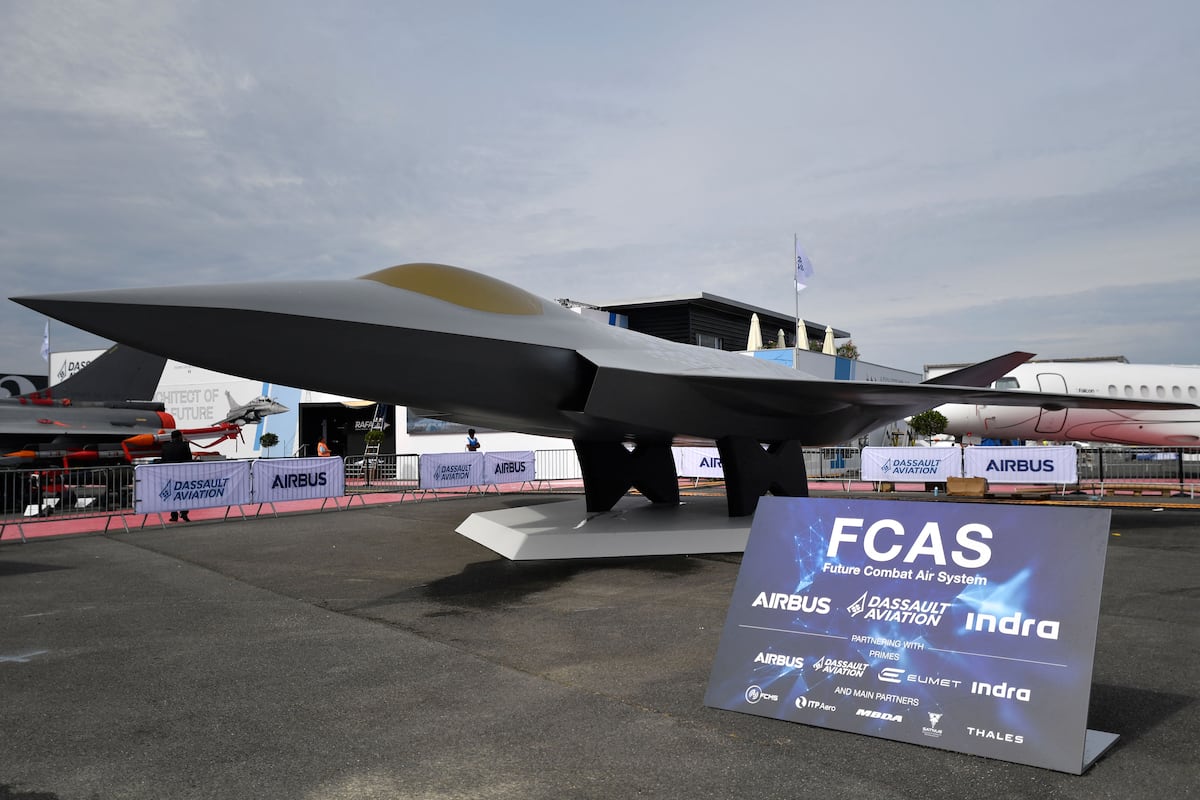
PARIS — France, Germany and Spain will refine the scope of their future sixth-generation fighter jet and its associated combat systems at a summit in December, before the joint project moves to the demonstrator phase, the head of the French armaments office said.
France has included funding for the second phase of the Future Combat Air System in its 2025 defense budget, Emmanuel Chiva, the head of the General Directorate for Armament, told lawmakers in the National Assembly’s defense on Wednesday, though he hinted at possible delays for the program.
“I can’t guarantee that this date will be met, as it will depend in particular on the electoral deadlines of certain state partners,” Chiva said. Program partner Germany is scheduled to hold federal elections in September next year.
FCAS has previously seen negotiations on Phase 1B of the program drag on for most of 2022 due to squabbling between Dassault Aviation and Airbus, two of the three main partners. Dassault Aviation makes the Rafale fighter in use with the French Air and Space Force, while Airbus builds the Eurofighter that equips the German Air Force.
The French armaments directorate said last year it expected Phase 2 to start early 2026. Dassault Aviation represents France in the FCAS program, while Airbus represents Germany, with Indra the Spanish partner.
French doctrine requires the future fighter to be able to carry nuclear weapons as part of the country’s deterrence program, as well as be able to operate from an aircraft carrier, and have export potential, Chiva said.
France earlier this month kicked of development of the future F5 standard for the Rafale fighter, which includes an air-combat drone that will serve as an uncrewed wingman, and capability to carry the future hypersonic nuclear missile SNA4G.
“Today, the FCAS is an object that has yet to be defined,” Chiva said. “In any case, there will be a successor to the Rafale F5, since our deterrence needs and those of the new airborne component, the SNA4G, will have to be taken into account.”
The French-German project to develop a future land combat system based around a main battle tank, called the Main Combat Ground System, is also facing some delays, according to Chiva.
Setting up the joint project company between KNDS Germany, KNDS France, Rheinmetall and Thales “is taking a bit of time,” Chiva said. That means the first development orders, which had been expected early 2025, will “no doubt” be later next year, according to the directorate head, who didn’t say what is causing the delay.
Meanwhile, France is willing to act as a backstop for shipbuilder Naval Group that would allow the company to target export markets with its defense and intervention frigate, Chiva said. The directorate is working on a “bare hull” strategy that would allow Naval Group to keep its workforce at its yards in Lorient occupied by building two frigates a year there, when France would be happy with one frigate a year.
“We’re ready to work with the manufacturer, for example, to bring forward the order of certain frigates for France, betting on export, and thinking that these frigates can be delivered to the various countries that are interested today,” Chiva said.
The French Navy is scheduled to take delivery of the first defense and intervention frigate, the Amiral Ronarc’h, in 2025, with hulls 2 to 5 following in 2027, 2028, 2031 and 2032, respectively.
France is currently in the process of negotiating the price tag for its future aircraft carrier with Naval Group, Chantiers de l’Atlantique and TechnicAtome, though Armed Forces Minister Sebastian Lecornu has already said the future carrier will be in the €10 billion euro range. The armament directorate expects to order the next-generation ship toward the end of 2025.
The current carrier Charles de Gaulle is scheduled for a major overhaul in 2027-2028, and France will use the maintenance stop to inspect the nuclear-propulsion boilers. The Navy will also study at that time whether it would be possible to prolong the life of the vessel beyond 2038, should that be necessary due to some setback with the future carrier project, according to Chiva.
Rudy Ruitenberg is a Europe correspondent for Defense News. He started his career at Bloomberg News and has experience reporting on technology, commodity markets and politics.
巴黎——法国军备办公室负责人表示,法国、德国和西班牙将在12月举行的峰会上完善未来第六代战斗机及其相关作战系统的范围,之后该联合项目将进入演示验证阶段。
法国军备总局局长埃马纽埃尔·奇瓦周三在国民议会为法国辩护时告诉议员们,法国已将未来作战空中系统第二阶段的资金纳入其 2025 年国防预算,但他暗示该计划可能会被推迟。
“我无法保证一定能按时完成,因为这尤其取决于某些伙伴国的选举截止日期,”奇瓦说道。项目伙伴德国计划于明年9月举行联邦选举。
由于三大主要合作伙伴中的两家——达索航空和空客——之间的争执,FCAS项目第一阶段B部分的谈判此前已在2022年大部分时间里陷入僵局。达索航空为法国空军和航天部队生产“阵风”战斗机,而空客则为德国空军生产“台风”战斗机。
法国军备管理局去年表示,预计第二阶段将于 2026 年初启动。达索航空代表法国参与未来空中作战系统 (FCAS) 项目,空客代表德国,而西班牙的合作伙伴是 Indra 公司。
奇瓦表示,法国的作战理论要求未来的战斗机能够携带核武器,作为该国威慑计划的一部分,同时还应能够从航空母舰上起飞作战,并具有出口潜力。
法国本月初启动了未来阵风战斗机F5标准的研发,其中包括一款可作为无人僚机的空中作战无人机,以及携带未来高超音速核导弹SNA4G的能力。
“如今,未来空中作战系统(FCAS)仍是一个尚未明确定义的目标,”奇瓦说道。“无论如何,阵风F5战斗机终将迎来继任者,因为我们的威慑需求以及新型空中作战部队SNA4G的需求都必须纳入考量。”
据奇瓦称,法德合作开发以主战坦克为基础的未来陆地作战系统的项目(称为“主战地面系统”)也面临一些延误。
奇瓦表示,KNDS德国公司、KNDS法国公司、莱茵金属公司和泰雷兹公司之间成立合资项目公司“需要一些时间”。这意味着原定于2025年初的首批开发订单“无疑”要等到明年晚些时候才能下达,这位负责人并未说明造成延误的原因。
与此同时,法国方面表示,愿意为法国海军集团(Naval Group)提供支持,使其能够凭借其防御和干预型护卫舰开拓出口市场。奇瓦表示,法国海军集团正在制定一项“裸船体”战略,该战略将允许法国海军集团在洛里昂船厂每年建造两艘护卫舰,从而保障其员工的就业,而法国方面则只需每年建造一艘即可。
“例如,我们准备与制造商合作,提前向法国订购某些护卫舰,押注出口,并认为这些护卫舰可以交付给目前对此感兴趣的各个国家,”奇瓦说。
法国海军计划于 2025 年接收第一艘防御和干预护卫舰“阿米拉尔·罗纳尔克”号,第 2 至 5 号舰艇将分别于 2027 年、2028 年、2031 年和 2032 年交付。
法国目前正与法国海军集团、大西洋造船厂和原子技术公司就未来航母的价格进行谈判,不过武装部队部长塞巴斯蒂安·勒科尔努此前已表示,这艘未来航母的造价将在100亿欧元左右。法国军备局预计将于2025年底订购这艘新一代航母。
现役“戴高乐”号航母计划于2027-2028年进行大修,法国将利用此次维护停航时间检查核动力锅炉。据奇瓦称,届时海军还将研究是否有可能将该舰的服役寿命延长至2038年以后,以防未来航母项目出现任何延误。
鲁迪·鲁伊滕贝格是《防务新闻》的欧洲记者。他的职业生涯始于彭博新闻社,拥有报道科技、大宗商品市场和政治方面的经验。