China test-fires intercontinental ballistic missile into Pacific Ocean中国向太平洋试射洲际弹道导弹
The ICBM carried a dummy warhead and fell into a designated area of the sea, the Defense Ministry said in a statement posted to social media.
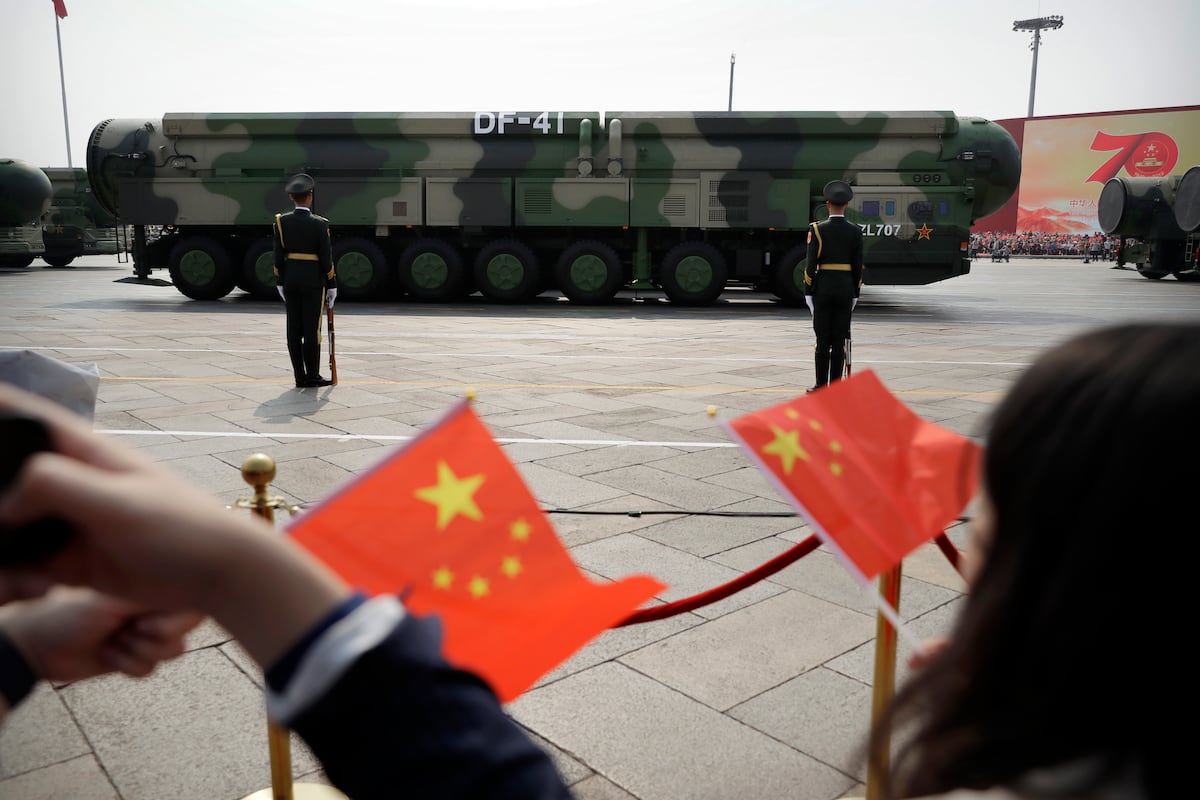
TAIPEI, Taiwan — China test-fired an intercontinental ballistic missile into the Pacific Ocean on Wednesday, stirring security concerns in the region already tense over Beijing’s territorial claims and rivalry with the U.S.
The ICBM carried a dummy warhead and fell into a designated area of the sea, the Defense Ministry said in a statement posted to social media.
The launch by the People's Liberation Army's Rocket Force was part of routine annual training, complied with international law and was not directed against any country or target, according to the statement.
It is unclear how often China conducts tests over such a distance. In 1980, China launched an ICBM into the South Pacific.
A map published in Chinese newspapers at the time showed the target area as roughly a circle in the center of a ring formed by the Solomon Islands, Nauru, the Gilbert Islands, Tuvalu, western Samoa, Fiji and the New Hebrides.
The U.S. and nongovernmental organizations have said China has been building up its missile silos, but it’s unclear how many missiles and nuclear warheads it has added to its arsenal.
The People’s Liberation Army, which functions as the ruling Communist Party’s military wing, runs China’s space program, which has established an orbital station and has ambitions to set up a moon base and land a spacecraft on Mars.
Rocketry has long been part of China’s development into a major global power, spurring nationalism and growth that has made China the world’s second-largest economy .
The U.S. remains China’s main global rival , although Japan , Taiwan , the Philippines and others have territorial disputes with Beijing that occasionally threaten to develop into military clashes.
China maintains a “no first use” of nuclear weapons policy, even as its desire for regional predominance grows.
Tests of China’s intercontinental ballistic missiles into international waters are rare. Experts and a historical survey of China’s program by the Washington-based Nuclear Threat Initiative suggest the last occurred in May 1980. That test saw China launch its DF-5 missile into the South Pacific.
China typically launches missiles toward its western deserts from its east coast, said James Acton, the co-director of the Nuclear Policy Program and a senior fellow at the Carnegie Endowment for International Peace. The fact that China launched a test that splashed down in international waters was unusual but mirrors testing that the United States does for its own ballistic missile fleet.
"When they haven’t done something for 44 years and then they do it, that’s significant,” Acton told The Associated Press. “It’s China’s way of telling us, ‘Like you, we’re not ashamed we have nuclear weapons and we’re going to behave like a great nuclear power.’”
The launch came amid the ongoing United Nations General Assembly in New York. China is one of five veto-holding permanent members of the U.N.'s Security Council and has sought to gain influence over its key departments involving human rights and that align with its authoritarian system.
A series of corruption arrests this year ensnared several leading officers in the Rocket Force, alongside the detentions of two previous defense ministers amid allegations of misconduct.
A test launch now could both provide assurances to China's population amid an economic downtown and a signal to the world that the party remains firmly in control and is determined to rise to global prominence.
“We’re entering a new age. We’re entering an age where the U.S. and China are engulfed in what feels like an arms race,” said Jeffrey Lewis, a missile expert at the James Martin Center for Nonproliferation Studies at the Middlebury Institute of International Studies in the U.S.
“The Chinese government always prioritized diplomatic issues over operational readiness. It’s just a different China. It’s a China that does not feel constrained,” he said.
“There’s a renewed emphasis on assuring themselves these systems work and demonstrating to others they work,” Lewis added.
Meanwhile, tensions remain high over Taiwan, and with the Philippines, where the U.S. Army has deployed its new mid-range missile system , known as Typhon, to Northern Luzon. On Wednesday, two Filipino officials said the U.S. and the Philippines have agreed to keep the system there indefinitely to deter China.
“I don’t know what’s the plan, but if I were to be followed, if I were given the choice, I would like to have the Typhon here in the Philippines forever because we need it for our defense,” said Gen. Romeo Brawner Jr., the head of the Philippines’ military.
Defense officials in Japan and Taiwan declined to comment directly on the Chinese announcement. Both, along with South Korea, maintain robust defenses against Chinese moves, including early warning systems and air raid shelters.
Associated Press writers Jon Gambrell in Dubai, United Arab Emirates, Jim Gomez in Manila, Philippines and Mari Yamaguchi in Tokyo contributed to this report.
台北,台湾——中国周三向太平洋试射了一枚洲际弹道导弹,加剧了该地区本已因北京的领土主张和与美国的竞争而紧张的安全局势。
国防部在社交媒体上发表声明称,这枚洲际弹道导弹携带了一枚模拟弹头,落入了指定的海域。
声明称,中国人民解放军火箭军的这次发射是例行年度训练的一部分,符合国际法,并非针对任何国家或目标。
目前尚不清楚中国进行如此远距离试验的频率。1980年,中国曾向南太平洋发射了一枚洲际弹道导弹。
当时中国报纸上刊登的一张地图显示,目标区域大致呈圆形,位于所罗门群岛、瑙鲁、吉尔伯特群岛、图瓦卢、西萨摩亚、斐济和新赫布里底群岛构成的环的中心。
美国和非政府组织表示,中国一直在扩建导弹发射井,但目前尚不清楚中国在其武库中增加了多少导弹和核弹头。
中国人民解放军是执政的共产党的军事部门,负责中国的太空计划。该计划已经建立了一个轨道空间站,并雄心勃勃地想要建立月球基地,并将航天器送上火星。
火箭技术长期以来一直是中国发展成为全球主要强国的一部分,它刺激了民族主义和经济增长,使中国成为世界第二大经济体。
尽管日本、台湾、菲律宾和其他一些国家和地区与北京存在领土争端,这些争端偶尔有演变为军事冲突的危险,但美国仍然是中国的主要全球竞争对手。
尽管中国对地区主导地位的渴望日益增长,但它仍然坚持“不首先使用核武器”的政策。
中国向国际水域试射洲际弹道导弹的次数很少。专家和总部位于华盛顿的“核威胁倡议”组织对中国导弹计划的历史调查表明,最近一次试射发生在1980年5月。那次试射中,中国向南太平洋发射了东风-5导弹。
卡内基国际和平研究院核政策项目联席主任、高级研究员詹姆斯·阿克顿表示,中国通常从东部沿海向西部沙漠发射导弹。此次中国进行的导弹试验落入国际水域,虽然不同寻常,但与美国对其弹道导弹舰队进行的试验类似。
“当他们44年来都没做过某件事,然后突然做了,这意义重大,”阿克顿告诉美联社。“这是中国在告诉我们,‘和你们一样,我们并不羞于拥有核武器,我们将像一个强大的核大国那样行事。’”
此次发布正值联合国大会在纽约召开之际。中国是联合国安理会五个拥有否决权的常任理事国之一,一直试图影响安理会中涉及人权且与其威权体制相符的关键部门。
今年一系列的腐败逮捕行动牵连了火箭军的几名高级军官,同时还有两名前国防部长因涉嫌行为不端而被拘留。
现在进行试射,既可以安抚经济低迷时期的中国民众,也可以向世界发出信号,表明中国共产党仍然牢牢掌控着政权,并决心走向全球舞台。
“我们正在进入一个新时代。我们正进入一个美中两国似乎陷入军备竞赛的时代,”美国米德尔伯里国际研究学院詹姆斯·马丁防扩散研究中心导弹专家杰弗里·刘易斯说道。
他说:“中国政府始终将外交问题置于作战准备之上。如今的中国与以往不同,它不再感到受到束缚。”
刘易斯补充说:“人们更加重视确保这些系统有效,并向他人证明这些系统有效。”
与此同时,台湾问题以及与菲律宾的关系依然高度紧张。美国陆军已在菲律宾北部吕宋岛部署了名为“台风”(Typhon)的新型中程导弹系统。周三,两名菲律宾官员表示,美国和菲律宾已同意无限期地保留该系统,以威慑中国。
“我不知道他们的计划是什么,但如果让我来决定,如果让我选择,我希望‘台风’永远留在菲律宾,因为我们需要它来进行防御,”菲律宾军方首脑罗密欧·布劳纳将军说道。
日本和台湾的国防官员均拒绝就中国的声明直接置评。日本、台湾以及韩国都对中国的行动保持着强大的防御措施,包括预警系统和防空洞。
美联社驻阿联酋迪拜记者乔恩·甘布雷尔、驻菲律宾马尼拉记者吉姆·戈麦斯和驻日本东京记者山口真理对本报道亦有贡献。