Germany receives first IRIS-T antimissile system for its own forces德国为其军队接收了首套IRIS-T反导系统。
IRIS-T has "served as a bulwark against the countless missiles that Russia shoots at Ukraine every day,” Chancellor Olaf Scholz said.
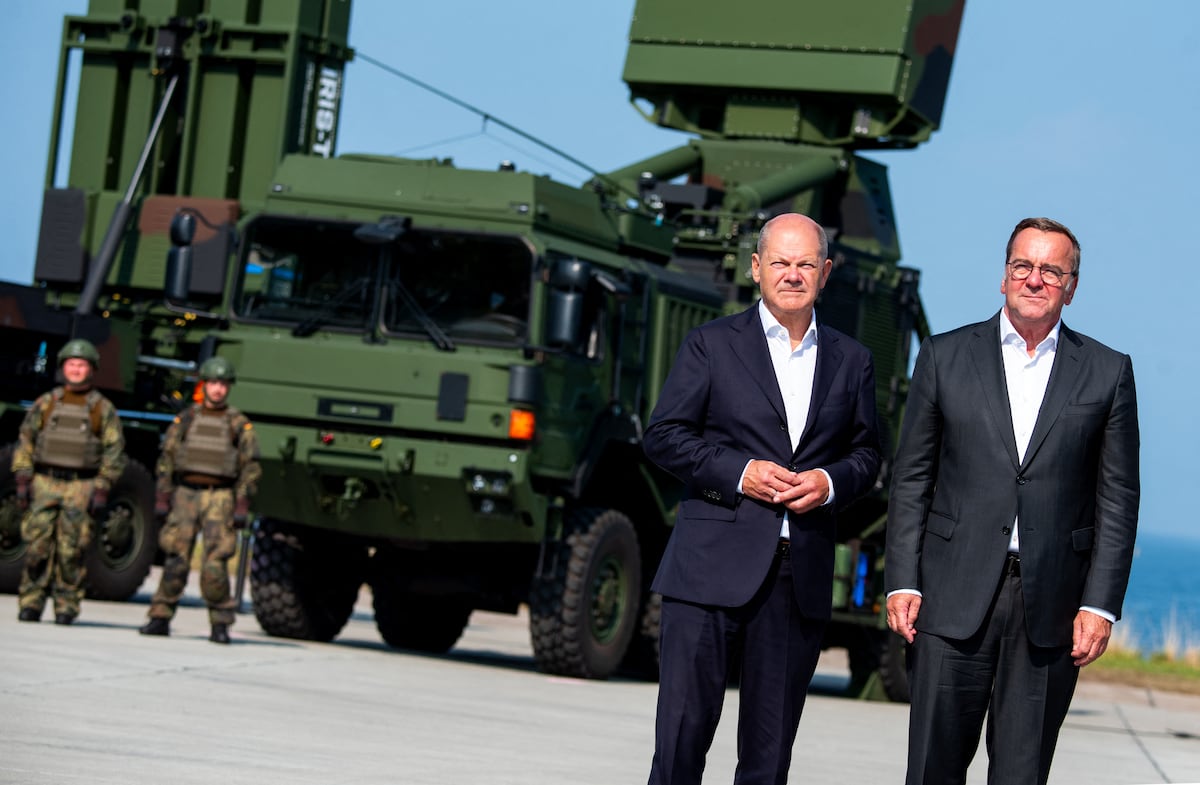
BERLIN — Germany’s military has received the first IRIS-T SLM air defense system for its own forces after prioritizing the weapon’s production for Ukraine since the Russian invasion in 2022.
“A new chapter of European air defense is shaping up,” Chancellor Olaf Scholz said at an inauguration ceremony for the equipment on a military base in Todendorf, northern Germany. “This is, without exaggeration, about maintaining security and peace in Europe,” he added, using the occasion to defend a decision from the summer to deploy American intermediate-range missiles to Germany.
The system inaugurated on Wednesday marked the first of six IRIS-T SLMs to be delivered to the Bundeswehr. It is part of an effort by the German government to fill in a longstanding gap in the air defense capabilities of the country’s military – and the European continent more broadly.
IRIS-T has proven itself in Ukraine, the chancellor said, where “it has served as a bulwark against the countless missiles that Russia shoots at Ukraine every day,” having shot down over 250 projectiles of various sorts. Scholz claimed a hit rate of 95% and expressed hope that the system would become the backbone of European air defense beyond Germany’s borders.
Originally developed as an air-to-air missile, IRIS-T was modified for air defense with the Surface Launch Standard (SLS) variant and the Surface Launched Missile (SLM) version, which is significantly altered.
Ukraine has received four IRIS-T SLM and three IRIS-T SLS to date. A further 17 IRIS-T systems are yet to come, four of which are still scheduled to arrive in 2024.
Taking steps to strengthen European air defenses had been “long overdue,” Scholz said, pointing to Russia’s full-scale invasion of Ukraine. The attack sparked renewed focus on military and dense under the banner of term “Zeitenwende” in Germany – the dawn of a new era.
One of the products of this new era is the German-led European Sky Shield Initiative , which strives to coordinate the procurement and operation of air defense systems throughout the continent. First announced by Scholz just months after Russia’s invasion, 22 countries now participate – including Switzerland and Austria, which are outside of NATO, and Turkey, which is not a part of the European Union.
Another response will be the deployment of American intermediate-range missiles to Germany starting in 2026, a move announced during the NATO summit in Washington in July. This class of weapons had been banned by a Cold War-era disarmament treaty between Washington and Moscow until recently. The U.S. withdrew from the pact during the Trump administration, alleging Russian violations going back almost a decade.
“[Putin] has deployed rockets to Kaliningrad,” said Chancellor Scholz, “just 530 kilometers from Berlin. Not reacting adequately would be negligent.”
Just this past weekend, Kremlin-friendly opposition parties of the extreme right and left, critical of the missile plans, won landslide electoral victories in two east German states, Thuringia and Saxony.
Scholz emphasized that the deployment decision has been enshrined in the national security strategy since last year and will be implemented as a gesture of deterrence. “Every attack on us must mean a risk for the attacker,” he said.
Linus Höller is Defense News' Europe correspondent and OSINT investigator. He reports on the arms deals, sanctions, and geopolitics shaping Europe and the world. He holds master’s degrees in WMD nonproliferation, terrorism studies, and international relations, and works in four languages: English, German, Russian, and Spanish.
柏林——自 2022 年俄罗斯入侵乌克兰以来,德国军方一直优先为乌克兰生产 IRIS-T SLM 防空系统,如今终于收到了首套供其部队使用的该系统。
“欧洲防空的新篇章正在形成,”德国总理奥拉夫·朔尔茨在德国北部托登多夫的一个军事基地举行的装备启用仪式上说道。“毫不夸张地说,这关乎维护欧洲的安全与和平,”他补充道,并借此机会为今年夏天向德国部署美国中程导弹的决定辩护。
周三启用的这套系统标志着交付给德国联邦国防军的六套IRIS-T SLM系统中的第一套正式投入使用。这是德国政府为填补该国乃至整个欧洲大陆防空能力长期存在的空白而采取的举措之一。
德国总理朔尔茨表示,IRIS-T系统已在乌克兰证明了自身的价值,“它就像一道屏障,抵御了俄罗斯每天向乌克兰发射的无数导弹”,并已击落超过250枚各类导弹。朔尔茨称该系统的命中率高达95%,并表示希望它能成为德国境外欧洲防空体系的中坚力量。
IRIS-T 最初是作为空对空导弹开发的,后来经过改进用于防空,出现了地面发射标准型 (SLS) 和地面发射导弹型 (SLM),后者进行了重大改进。
乌克兰迄今已接收四套IRIS-T SLM和三套IRIS-T SLS系统。另有17套IRIS-T系统尚未交付,其中四套计划于2024年交付。
舒尔茨指出,加强欧洲防空力量的措施“早就应该实施了”,并提及俄罗斯全面入侵乌克兰。此次袭击在德国引发了对军事和高密度防御的重新关注,并以“时代转折点”(Zeitenwende)一词来指代新时代的曙光。
这一新时代的产物之一是德国主导的“欧洲天空之盾”倡议,该倡议旨在协调整个欧洲大陆的防空系统采购和运行。该倡议最初由朔尔茨在俄罗斯入侵后几个月内提出,目前已有22个国家参与其中,包括非北约成员国瑞士和奥地利,以及非欧盟成员国土耳其。
另一项应对措施是美国将从2026年开始向德国部署中程导弹,这一举措是在7月于华盛顿举行的北约峰会上宣布的。此类武器此前一直被华盛顿和莫斯科在冷战时期签署的裁军条约所禁止,直到最近才被解除。美国在特朗普政府时期退出了该条约,并指责俄罗斯近十年来一直违反该条约。
“普京已经向加里宁格勒部署了火箭弹,”总理朔尔茨说,“那里距离柏林只有530公里。不做出适当反应是失职的。”
就在上周末,对导弹计划持批评态度的极右翼和极左翼、亲克里姆林宫的反对党在德国东部的两个州——图林根州和萨克森州——赢得了压倒性的选举胜利。
舒尔茨强调,这项部署决定自去年以来就已纳入国家安全战略,并将作为一种威慑手段来实施。“每一次对我们的攻击都必须意味着攻击者自身也面临风险,”他说道。
林努斯·霍勒是《防务新闻》的欧洲记者和开源情报调查员。他报道影响欧洲乃至全球的军火交易、制裁和地缘政治。他拥有大规模杀伤性武器不扩散、恐怖主义研究和国际关系三个硕士学位,并精通英语、德语、俄语和西班牙语四种语言。