Fixing the machine: Inside the Navy’s race to rebuild its aviator pipeline修复机器:海军重建飞行员培养体系的竞赛内幕
An in-depth discussion with the service's chief of Naval Air Training Command.
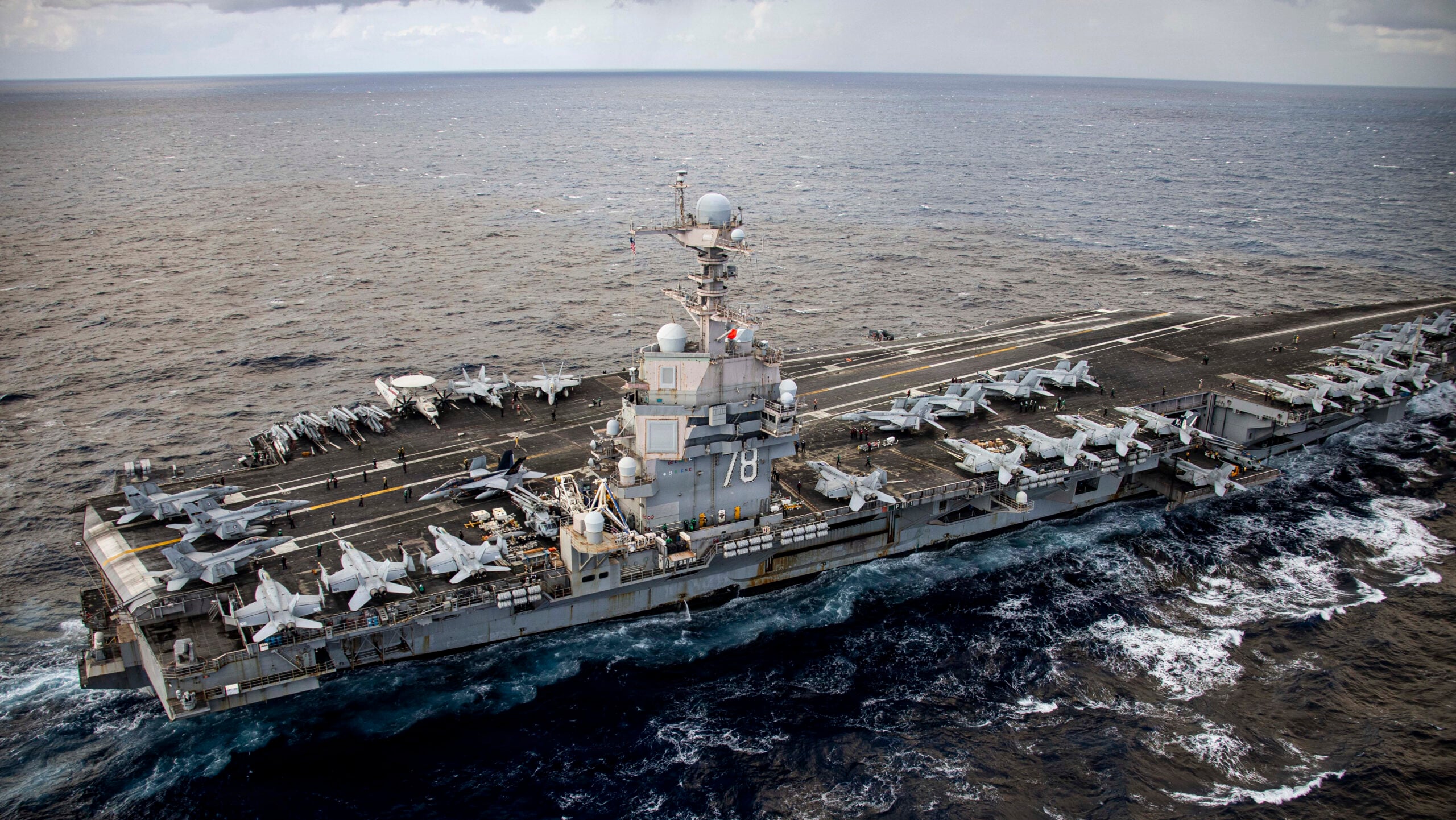
The world’s largest aircraft carrier, USS Gerald R. Ford (CVN 78), transits the Eastern Mediterranean Sea, March 22, 2026. Gerald R. Ford is on a scheduled deployment in the U.S. 6th Fleet area of operations to support the warfighting effectiveness, lethality and readiness of U.S. Naval Forces Europe Africa, and defend U.S., Allied and partner interests in the region. (U.S. Navy photo by Mass Communication Specialist 2nd Class Tajh Payne)
This is the latest in a series of semi-regular columns by Robbin Laird , where he will tackle current defense issues through the lens of more than 45 years of defense expertise in both the US and abroad. The goal of these columns: to look back at how questions and perspectives of the past should inform decisions being made today.
Rear Adm. Max “Pepper” McCoy, the Chief of Naval Air Training, describes the system he runs as a factory conveyor belt: the test of whether it is working is whether it flows smoothly, without pools forming anywhere along the line.
And right now, by his own account, pools are forming in several places at once, and the Navy is running triage and modernization at the same time.
I sat down with McCoy, who commands the Naval Air Training Command (CNATRA), on August 10, 2026 to talk through what it takes to fix a training pipeline from the inside while operational demands on the aviators coming out the other end keep escalating. McCoy and I go back to the F-35 community’s stand-up and his time commanding Carrier Strike Group Four, so the conversation ran less like a briefing than an admiral thinking out loud about a training system that must be sustainable and repeatable to deliver combat-ready naval aviators.
CNATRA has been underproducing against fleet requirements for the better part of ten years, driven largely by problems with the T-45. Students kept entering the pipeline faster than it could move them through, creating a growing backlog of newly commissioned officers waiting just to begin flight training. Public accounts have tracked this bottleneck for years as the ‘pre-NIFE pool’ which is shorthand for the queue that forms before students even reach NIFE, the eight-and-a-half-week screening program at Pensacola that is the pipeline’s first stage.
According to CNATRA’s Naval Aviation 2025 Playbook, Rear Admiral Richard T. Brophy Jr, McCoy’s predecessor, drove production back up to 105 percent of requirement across every type-model-series. But fixing one stage exposed the constraint at the next.
The Fleet Replacement Squadrons (FRS) are now underproducing, creating a new logjam just before a winged aviator becomes useful to the fleet. Students arrive late to their first tour, and because career milestones do not move to accommodate that delay, the Navy is not getting a full production tour out of junior officers before pulling them for disassociated sea tours or to fill gaps elsewhere. The junior officers who would otherwise be back at the training command or FRS generating the next cohort are the ones being diverted. The system, in McCoy’s words, feeds on itself.
Project Talon Portfolio puts mission autonomy at the center of future CCA operations
Truly autonomous aircraft can make decisions without continuous human input.
That is why McCoy frames his goal not as a production percentage but as time-to-train against entitlement, the interval between commissioning and fleet arrival a student is entitled to under the training pipeline. Compress it and first-tour officers complete their sea tours on schedule, roll into full length production tours prior to disassociated sea tours, and the self-feeding cycle starts to reverse.
McCoy’s framework for the constraint is a production stool with three legs: airplanes, instructors and students. None, he told me, are where they need to be; not enough airplanes, not enough instructors and, paradoxically, too many students in the pipeline at once, not because CNATRA is over-accessing but because time-to-train has stretched out so far that students are sitting in pools rather than flowing through.
McCoy is the single accountable flag officer for “Street to Fleet” across the Naval Aviation Enterprise, but his authority is not uniform across the pipeline: the schools command sits under the Naval Education and Training Command, rather than CNATRA directly. Everything inside CNATRA, he owns; once a winged aviator reaches the FRS, they belong to a Type Wing commander. His job is to take the strategic view across the enterprise and decide which levers to pull and in what order to get back to entitlement fastest. On aircraft, CNATRA runs entirely on contracted logistics support, so a large share of his time goes into getting to what the command calls “North Star,” the number of ready-for-training aircraft needed to execute the daily flight schedule or surge production if required while managing aircraft service life.
The instructor leg is where the shortage is most acute. McCoy’s active-duty cadre is built from first-sea-tour rollers, supplemented by permanent flight instructors off the normal command track, a reserve component, Marine Corps instructors and, in some cases, Coast Guard personnel. Layered on top is a tool he is leaning on more heavily than before: “SERGRADs,” selectively retained graduate wingers held in an instructor role while awaiting an FRS seat.
McCoy currently has 15 Marine SERGRADs flying jet training at Kingsville and Meridian, freeing experienced instructors for advanced-phase work. He is also expanding contract instructor pilots — former Navy and Marine Corps jet aviators, many with T-45 experience — into the primary phase. The strategy is to pull the levers CNATRA has, so that instructor manning at the FRSs, where qualified first-tour rollers are scarcer, can be prioritized.
We spent a long time discussing Live Virtual Constructive training. McCoy described LVC as complementary to flight time rather than a replacement for it: using ground-based systems to build habits and get students to a “right training, right cost” starting point, so that when they climb into an aircraft they achieve first-pass yield rather than needing to re-fly events they were not ready for. He was careful to distinguish this from an add-on — his view is that LVC only delivers real value when it is woven into the curriculum, not treated as a separate module bolted onto an otherwise unchanged syllabus.
That distinction matters because of what McCoy called the age of urgency: a security environment with no clean line between crisis and peacetime, where a training system built on the assumption that there will be time to catch up later is no longer viable. What the fleet needs, in his words, is a dynamic training system, not a custodial one. He was explicit that fixing CNATRA’s current production shortfall is a necessary precondition, not a substitute, for that shift. You cannot build a dynamic, threat-responsive training architecture on top of a pipeline that is still struggling to produce enough aviators to fill fleet seats.
The part of the conversation McCoy returned to most was standards, and here his framing departs most clearly from the production-percentage logic of the previous decade.
His response has been to tighten up the front end of the training pipeline: faster triggers to attrition in NIFE and Primary training. Attrition at advanced training will still happen, he told me, but at meaningfully lower rates, because the students reaching that stage will already have cleared a higher bar.
McCoy came into the job, in his words, as a TOPGUN graduate, former NAWDC and CSG-4 commander with a laser focus on upholding training standardization. He described his obligation to students as a reciprocal contract: he owes them the best training environment he can provide and clarity about what is expected of them; what they owe him is full effort every day, not perfection. He cited a “firm, fair and consistent” motto and was explicit about why it matters: expectations on a winged aviator escalate sharply the moment they reach the fleet, and the pipeline’s job is to condition them for that jump before it happens. When asked how CNATRA hits 105 percent of requirement without enough airplanes or instructors, his answer is that the instructor cadre flies seven days a week — one of the hardest jobs in naval aviation, he said, with no finish line and no offseason.
McCoy’s own method, applied at every command he has held, is reverse engineering: starting from what a first-tour junior officer needs to do at the fleet and working backward through the FRS, then advanced, then primary training, so each stage builds toward the next.
McCoy also drew a firm line on culture. He does not want to outsource large parts of the training enterprise. Naval aviation is not a generic air force, and flying from ships imposes requirements a contracted model does not capture on its own. The Contract Operated Primary Training-Rotary program is his clearest example of squaring that circle: students are supervised by a Navy O-5, and CNATRA sends personnel through at elevated frequency so students see officers in Navy and Marine Corps flight suits who can reinforce cultural content a syllabus alone will not carry. The contract instructor pilots he is expanding into primary training will be former Navy and Marine Corps pilots; they simply do not wear rank.
McCoy flagged one development not yet visible in the public record: aviators returning from recent deployments as genuine combat veterans, who will move into the instructor cadre in the near term. There is no substitute, he told me, for a student naval aviator sitting across a briefing table from someone who has employed weapons in combat.
Overall, came through in this discussion was less a modernization narrative than triage performed with an eye already on what comes after it. McCoy was candid that a system in crisis makes innovation challenging, because so much of the available time and energy goes into simply making the machine run.
However, CNATRA continues to innovate in parallel on initiatives to deliver production efficiencies, uphold standardization and improve training quality. His stated ambition is to hand his successor a pipeline with the right number of airplanes, the right number of instructors and time-to-train at entitlement, so the next Chief of Naval Air Training can accelerate modernization with a fully operational production line.
2026年3月22日,世界最大的航空母舰“杰拉尔德·R·福特”号(CVN 78)航行于东地中海。“杰拉尔德·R·福特”号正在美国第六舰队作战区域进行例行部署,以支持美国海军驻欧洲非洲部队的作战效能、杀伤力和战备状态,并捍卫美国、盟国和伙伴国在该地区的利益。(美国海军二级大众传播专家塔吉·佩恩摄)
这是罗宾·莱尔德(Robbin Laird)系列专栏的最新一篇,他将以自己在美国和海外超过45年的国防经验为视角,探讨当前的国防问题。这些专栏旨在回顾过去的问题和观点,思考它们如何能够为今天的决策提供借鉴。
海军航空训练司令部司令马克斯·“佩珀”·麦考伊少将把他管理的这套系统比作工厂的传送带:检验它是否运转良好的标准是,传送带是否运转顺畅,沿途任何地方都没有积水。
据他自己所说,目前多个地方同时出现了伤员池,海军正在同时进行伤员分流和现代化改造。
2026年8月10日,我与海军航空训练司令部(CNATRA)司令麦考伊(McCoy)进行了一次深入的会谈,探讨如何在飞行员作战需求不断攀升的情况下,从内部改进训练体系。我和麦考伊的交情可以追溯到F-35项目启动之初,以及他担任第四航母打击群司令时期。因此,与其说这是一次简报,不如说是一位海军上将畅谈如何构建一个可持续且可重复的训练体系,以培养出具备作战能力的海军飞行员。
近十年来,CNATRA的飞机产量一直无法满足机队需求,这主要是由于T-45教练机的诸多问题。学员人数持续增长,远远超过了培训进度,导致大量新晋军官积压,只能等待开始飞行训练。多年来,公众一直关注着这一瓶颈,并将其称为“NIFE预备学员池”。“NIFE”是位于彭萨科拉的为期八周半的筛选项目,也是整个培训流程的第一阶段。
根据美国海军航空技术司令部(CNATRA)的《海军航空2025战略手册》,麦考伊的前任理查德·T·布罗菲少将曾将所有型号系列的产量提升至需求的105%。但解决一个阶段的问题却暴露了下一个阶段的瓶颈。
舰队补充中队(FRS)目前培养能力不足,导致飞行员即将服役之际出现新的人员积压。学员们往往迟到,无法按时完成首次服役任务,而职业发展里程碑的调整又无法弥补这一延误,因此海军无法让初级军官完成完整的训练任务,就不得不将他们调往其他岗位执行海上任务或填补空缺。原本应该回到训练司令部或FRS培养下一批学员的初级军官,现在却被调离了岗位。正如麦考伊所说,这套系统陷入了自我循环。
Talon 项目组合将任务自主性置于未来 CCA 运营的核心位置。
真正自主的飞机无需持续的人工干预即可做出决策。
因此,麦考伊的目标并非以生产率百分比来衡量,而是以训练时间与应有权利的时间之比来衡量,即学员从委任到抵达舰队这段时间,这是学员根据训练流程应享有的权利。缩短这段时间,首批服役的军官就能按计划完成海上轮换,在进行非任务性海上轮换之前,顺利进入完整的生产轮换,从而扭转这种自我循环的局面。
麦考伊对制约因素的解释框架就像一个三脚凳:飞机、教员和学员。他告诉我,这三者都未能达到应有的水平:飞机不够,教员不够,而且矛盾的是,同时在岗的学员数量过多,这并非因为加拿大国家航空培训学院(CNATRA)招生过度,而是因为培训时间被拉得太长,导致学员们像在游泳池里排队等候,而不是按部就班地完成培训。
麦考伊是整个海军航空兵“从地面到舰队”体系的唯一负责人,但他的权限并非在整个体系内统一:学校指挥部隶属于海军教育训练司令部,而非直接隶属于海军航空训练司令部(CNATRA)。CNATRA内部的一切事务都由他负责;一旦飞行员进入飞行训练学校(FRS),他们就归所属机型联队指挥官管辖。他的职责是从战略角度审视整个体系,并决定采取哪些措施以及采取何种顺序,以最快地恢复正常飞行。在飞机方面,CNATRA完全依赖外包的后勤保障,因此他的大部分时间都花在确保达到司令部所谓的“北极星”目标上,即满足日常飞行计划或在必要时进行紧急生产所需的训练用飞机数量,同时还要管理飞机的使用寿命。
教官岗位的短缺最为严重。麦考伊的现役教官队伍由首次海上飞行任务的飞行员组成,辅以非正规指挥晋升途径的常驻飞行教官、预备役人员、海军陆战队教官,以及在某些情况下,海岸警卫队人员。此外,他还比以往更加依赖一种工具:“SERGRADs”,即经过筛选留任的毕业飞行员,他们在等待正式飞行员晋升(FRS)期间担任教官。
麦考伊目前在金斯维尔和梅里迪恩拥有15架海军陆战队SERGRAD教练机进行喷气式飞机训练,这使得经验丰富的教官可以腾出精力从事高级阶段的教学工作。他还将合同制教官飞行员——这些前海军和海军陆战队喷气式飞机飞行员,其中许多人拥有T-45教练机的飞行经验——纳入初级阶段的教学工作。其策略是充分利用CNATRA(海军航空训练司令部)的各项资源,以便优先保障飞行训练学校(FRS)的教官配备,因为这些学校合格的首批飞行员较为稀缺。
我们花了很长时间讨论实时虚拟构造训练(LVC)。麦考伊认为LVC是对飞行时间的补充,而非替代:它利用地面系统来培养习惯,使学员达到“合适的训练,合适的成本”的起点,这样当他们登上飞机时,就能一次性成功完成飞行任务,而无需重飞那些他们尚未准备好的项目。他特别强调LVC并非附加内容——他认为,只有将LVC融入课程体系,而不是将其作为一个单独的模块生硬地附加到其他不变的教学大纲上,LVC才能真正发挥其价值。
这种区别至关重要,因为正如麦考伊所说,我们正处于一个“紧迫时代”:安全环境不再有清晰的危机与和平时期界限,基于“以后有时间弥补”假设而建立的训练体系已不再可行。用他的话说,舰队需要的是一个动态的训练体系,而不是一个被动的维护体系。他明确指出,解决加拿大国家航空训练司令部(CNATRA)目前的人员短缺问题是实现这一转变的必要前提,而非替代方案。你不可能在一个仍在努力培养足够飞行员以填补舰队空缺的体系之上,构建一个动态的、应对威胁的训练架构。
麦考伊反复提及的话题是标准,而在这方面,他的论述与前十年的生产百分比逻辑截然不同。
他的应对措施是收紧培训流程的前端环节:加快NIFE和初级培训阶段的淘汰速度。他告诉我,高级培训阶段仍然会出现淘汰,但比例会显著降低,因为达到该阶段的学生已经达到了更高的标准。
麦考伊上任时,正如他自己所说,他毕业于TOPGUN项目,曾任海军航空武器发展中心(NAWDC)和第四航母打击群(CSG-4)指挥官,并始终专注于维护训练标准化。他将自己对学员的责任描述为一种互惠契约:他有义务为他们提供最佳的训练环境,并明确告知他们应尽的职责;而他们则有义务每天全力以赴,而非追求完美。他引用了“坚定、公平、始终如一”的座右铭,并明确阐述了其重要性:飞行员一旦进入舰队,所面临的期望就会急剧上升,而这条人才培养体系的作用就在于让他们在真正进入舰队之前做好充分的准备。当被问及在飞机和教员不足的情况下,海军航空训练司令部(CNATRA)如何达到105%的训练量时,他的回答是,教员队伍每周七天都在飞行——他表示,这是海军航空兵中最艰苦的工作之一,没有终点,也没有淡季。
麦考伊自己的方法,在他担任过的每一个指挥岗位上都应用了,那就是逆向工程:从一名初级军官在舰队中需要做什么开始,然后反向进行舰队预备役训练、高级训练、初级训练,这样每个阶段都为下一个阶段奠定了基础。
麦考伊在文化方面也划清了界限。他不想将大部分训练工作外包。海军航空兵并非普通的空军,舰载飞行对训练的要求很高,单靠外包模式无法完全满足。他提出的“合同运营初级训练-旋翼机项目”正是他试图解决这一难题的最佳例证:学员由海军上校(O-5)指导,海军航空兵训练与培训中心(CNATRA)会定期派遣人员,让学员有机会见到身着海军和海军陆战队飞行服的军官,从而强化课程大纲无法涵盖的文化内容。他正在初级训练中推广的合同教官飞行员都是退役的海军和海军陆战队飞行员;他们只是不佩戴军衔。
麦考伊指出了一项尚未公开记录在案的发展:近期从海外部署归来的飞行员都是真正的战斗老兵,他们将在不久的将来加入教官队伍。他告诉我,没有什么能替代让海军飞行员学员与一位曾在实战中使用过武器的人面对面交流。
总的来说,这次讨论与其说是阐述现代化进程,不如说是着眼于后续问题的紧急应对。麦考伊坦言,危机中的系统会使创新充满挑战,因为大量的时间和精力都耗费在维持系统运转上。
然而,海军航空训练司令部(CNATRA)在提高生产效率、维护标准化和提升培训质量方面持续推进创新举措。他明确表示,希望为继任者打造一条拥有充足飞机、教员和充足培训时间的人才储备体系,以便下一任海军航空训练司令能够利用一条全面运转的生产线加速现代化进程。