The Soviet’s ‘Golden Fish’ Missile Submarine Still Holds The Record As The World’s Fastest苏联的“金鱼”导弹潜艇仍然保持着世界最快潜艇的纪录。
The only Project 661 boat ever made was extremely fast underwater, but was also costly and complex to build and operate.
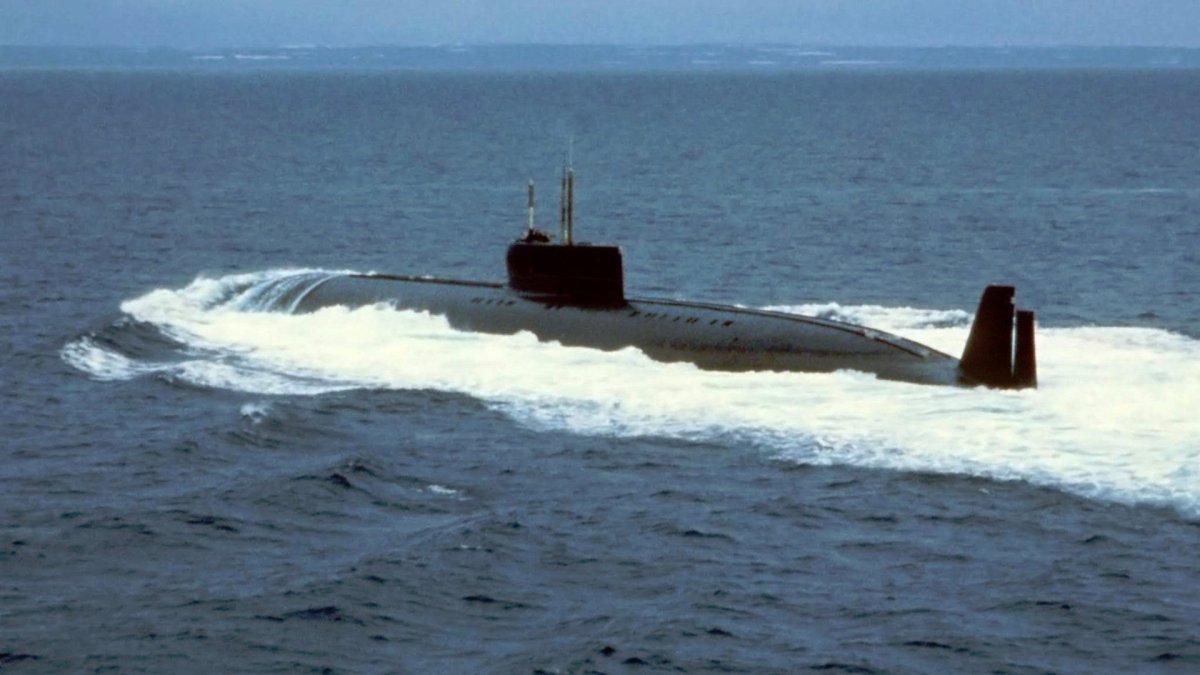
By Joseph Trevithick
Updated Dec 1, 2019 6:36 AM EST
Sixty years ago, Soviet engineers began developing a new submarine under strict orders to eschew previous design decisions in favor of innovative concepts wherever possible. The resulting boat, a guided missile submarine that was known first as K-162 and eventually as K-222, established a still-unbeaten underwater speed record and was the first titanium-hulled submarine ever, but also proved too expensive and complicated to be anything more than a one-off, earning the nickname “Golden Fish.”
K-162/K-222, the only Project 661 submarine ever built, was the product of a direct order from the Central Committee of the Communist Party of the Soviet Union and country’s Council of Ministers on Aug. 28, 1958. The directive called for a new “high-speed submarine” and development began the following year. The Project 661 design was also known as the Anchar -class in the Soviet Union and NATO referred to it as the Papa -class, even though there was only ever one boat.
The immediate impetus for the development of the Project 661 design was the limited capabilities and poor performance of the first generation of Soviet diesel-electric guided missile submarines, or SSGs. These early boats were conversions of Whiskey -class submarines , which were themselves derived from World War II-era Nazi U-boat designs.
When work on the Project 661 submarine started, the Soviets had already separately begun development of new classes of purpose-built conventionally-powered guided missile submarines (SSGs) and nuclear-powered guided missile submarines (SSGNs), the Project 651s and Project 659s respectively, which were also known as the Juliett – and Echo -classes in the West. But the goal for the new project was to produce an entirely novel cruise missile-carrying submarine that would be even more capable than either of these interim designs.
The Soviet Project 651 or Juliett -class guide missile submarine K-77., USN
The first major decision the designers made was to use titanium alloys for the submarine’s external and internal hulls rather than steel or aluminum. Titanium offered benefits in terms of its general strength and resistance to corrosion.
Though titanium is also only weakly magnetic, this did not render the Project 661 immune to detection by aircraft with magnetic anomaly detectors (MAD) or magnetic mines. This is due to the presence of more magnetic metals in the alloy, as well as various other components inside the submarine itself.
Compared to earlier Soviet submarines that still showed the influence of World War II-era designs, the hullform of the Project 661 was significantly different, featuring a rounded bow and a streamlined “split-feed” stern with twin propellers. The 1970s-era Project 949 SSGNs, or Oscar -class , would also use this same general arrangement.
A Cold War-era photo of K-162/K-222 showing its rounded nose., USN
A still from a Soviet-era film about the Project 661 submarine showing its twin screws. The shrouds around the propellers were no longer in place when the submarine entered service., Public Domain
The Soviets had never had to build such large titanium alloy components. So, while fabrication of the first components for the Project 661 submarine began in 1962, the need to devise entirely new and complex manufacturing processes meant the submarine was not officially laid down until December 1963. Years later, during construction of the titanium alloy hulled Project 705 submarines, also known variously as the Lira -class or Alfa -class , workers reportedly had to craft the hull sections inside a shed filled with inert argon gas, requiring the use of cumbersome “moon suits” with their own air supply.
For the Project 661 submarine, the Soviets also developed an advanced nuclear pressure water reactor, as well as a prototype lead-bismuth eutectic (LBE) cooled design. LBE reactors have greater thermal efficiency and can operate at higher temperatures than water-cooled designs without risk of the coolant boiling off.
Unlike other liquid metal-cooled reactor types, such as sodium or sodium-potassium designs, LBE does not react spontaneously with air or water, reducing the size and complexity of the entire coolant system and eliminating the risk of an explosion in the event of a leak. Unfortunately, LBE is also much more corrosive and has a higher melting point.
This means this type of reactor typically has a shorter overall lifespan and there is a risk of the coolant solidifying if the reactor drops below a certain temperature, requiring significant power to keep it sufficiently warm at all times. Furthermore, as the coolant becomes irradiated over time, it forms highly radioactive polonium-210 – a substance dangerous enough to work as an assassination weapon – as a byproduct, making it especially hazardous to refuel the system or otherwise handle any contaminated components.
K-162/K-222 underway., USN
The Soviets ultimately opted to install two highly compact VM-5 pressure water reactors, despite their lower performance. Even so, each one of them produced up to 177 megawatts of power. By comparison, the Echo -class SSGNs had a single, earlier VM-A that only generated a maximum of 70 megawatts.
The immense power from these reactors, combined with its lightweight, but strong titanium hulls, helped give the submarine a relatively blistering speed underwater. The Project 661 boat could cruise submerged at just shy of 44 miles per hour. It broke the world speed record for a submarine traveling undersea during its sea trials, reaching a maximum speed of more than 51 miles per hour.
The U.S. Navy’s Los Angeles -class nuclear-powered attack submarines, improved variants of which remain service today , have an official top speed of 23 miles per hour when submerged. There have been reports that these boats can actually get up to around 35 miles per hour underwater. The latest American Virginia -class attack submarines have a publicly stated top submerged speed of around 29 miles per hour, but this is still significantly slower than the Project 661 design.
The Soviet-era film below, though in Russian only, still offers an interesting look at K-162/K-222, its development, and the submarine in action.
The main armament of the Project 661 submarine was 10 anti-ship cruise missiles. At the time construction of K-162 began, the Soviets did not have a weapon of this type that a submarine could fire while concealed underwater. Existing SSGs and SSGNs had to surface first, making them vulnerable during the firing sequence.
So, they initiated the development of a new missile in parallel, which resulted in the P-70 Ametist , also known as the SS-N-7 Starbright. This weapon had a range of more than 35 miles and could carry a high explosive or nuclear warhead.
A P-70 anti-ship missile on a display stand with its rocket booster on a separate rack in the foreground., Public Domain
With these missiles and its extreme speed, the Soviets expected to use the Project 661 boats to intercept American carrier groups. Since the submarines could not reload their missile tubes, slotted into tubes between inner and outer hulls, at sea, they would have had to return to port to rearm. The design also had four torpedo tubes and room for a dozen torpedoes, primarily for self-defense.
Unfortunately, the benefits of the Project 661’s design came at the price of extremely high cost and complexity. It took the Soviets almost six years from when they laid down K-162 in 1963 to get her commissioned.
While the first Project 661 was under construction, the Soviets were also able to design the simpler steel-hulled, single-shaft Project 670 SSGN, or Charlie -class , lay down the first example in 1964, and have it commissioned in 1967. The Soviet Navy had commissioned five of these submarines before K-162 even entered service.
An Indian Navy Charlie -class SSGN., USN
The Soviets ultimately decided not to produce any additional Project 661 submarines. But despite being the only ship of her class, K-162 did enter operational service. However, she proved to be just as problematic at sea as she was to build. Her high speed exposed problems that other submarines have never experienced.
At speeds over 40 miles per hour, turbulence along the hull created excessive noise, reportedly up to 100 decibels in some cases, louder than a truck driving by you , in certain places. For submarines, silence is key to survival . At its top speed, K-162 would also begin to suffer actual external damage from the force exerted on the hull.
So, after joining the Soviet Union’s Northern Fleet in 1971, K-162 made relatively few operational patrols. For unspecified reasons, in 1978, the Soviets changed her hull number to K-222.
It wasn’t until September 1981 that a U.S. Navy carrier-based anti-submarine warfare squadron even spotted the submarine during a cruise. The S-3 Vikings of now-inactivated Sea Control Squadron Three Zero (VS-30), the Diamondcutters, flying from the deck of USS Forrestal at the time, hold that honor .
A pair of VS-30 Vikings in flight in September 1981, the same month they spotted the only Project 661 submarine out at sea., USN
Given the Soviet’s own concerns about her acoustic signature, it seems unlikely that this was entirely a product of her going undetected for a decade. In July 1981, P-3 Orions of Patrol Squadron One Zero (VP-10), flying from Naval Air Station Keflavik in Iceland had also detected the submarine after it sailed into an area where NATO naval forces were conducting an exercise . This earned that unit a Meritorious Unit Commendation from the Secretary of the Navy.
The lone Project 661 submarine saw the most action on the pages of Tom Clancey’s 1986 novel Red Storm Rising . The boat briefly appears in the book to conduct anti-convoy operations.
The submarine’s biggest contribution appears to have been laying the groundwork for subsequent titanium-hulled nuclear-powered Soviet attack submarines, primarily the aforementioned Project 705 and the Project 945 , or Sierra -class. The Alfas also used LBE-cooled reactors derived from the design originally intended for the Project 661.
The Alfa class boats were also capable of extremely high speeds, topping out around 47 miles per hour. But, while they were more successful than the sole Papa -class boat, they suffered from many of the same limitations, which you can read about in more detail here . They spent most of their time in port, poised to dart into the North Atlantic during a crisis.
A Soviet Project 705 Alfa -class submarine., USN
K-222 was gone from the active rolls of the Northern Fleet before the collapse of the Soviet Union. In 1999, she was formally stricken and set to get scrapped.
In a final testament to her effectively experimental design, in 2010 , the Zvezdochka Ship Repair Center, part of Russian shipbuilder Sevmash in Severodvinsk, began dismantling the submarine without removing her reactor or its reactive fuel first. At the time, the Russians were still in the midst of a selecting a consultant, via the European Bank for Reconstruction and Development (EBRD), to determine the best way of disposing of the boat’s radioactive components.
K-162/K-222 inside a floating drydock ahead of scrapping in 2008., via u/ak-pk1 /Reddit
The Kremlin reportedly went ahead with breaking down K-222 before worrying about what to do with the reactor or its fuel because the submarine’s design did not have any specific provisions for removing the reactor for servicing or other purposes, to begin with. It’s not clear what happened to either the reactor plant or any other components of the boat in the end.
After more than six decades, the Project 661 design still holds the world record for the top submerged speed of any submarine. The boat was certainly an impressive feat of engineering, but given the problems it exposed with sailing this fast under the water, it seems unlikely that this record will get broken any time soon.
Contact the author: jtrevithickpr@gmail.com
Comments couldn’t be loaded. Please refresh the page.
作者:约瑟夫·特雷维西克
更新于美国东部时间2019年12月1日上午6:36
六十年前,苏联工程师奉命严格摒弃以往的设计理念,尽可能采用创新方案,开始研发一种新型潜艇。最终研制出的这艘导弹潜艇最初代号为K-162,后更名为K-222,创造了至今无人能破的水下航行速度纪录,也是世界上第一艘采用钛合金船体的潜艇。然而,由于造价过高、结构过于复杂,最终只能建造一艘,因此被戏称为“金鱼”。
K-162/K-222是苏联唯一建造的661型潜艇,它是苏联共产党中央委员会和部长会议于1958年8月28日直接下令建造的。该指令要求建造一种新型“高速潜艇”,并于次年开始研制。661型潜艇在苏联被称为“安查尔”级,北约则称之为“爸爸”级,尽管该型潜艇仅有一艘。
661型潜艇设计的直接推动力在于第一代苏联柴电导弹潜艇(SSG)性能有限且表现不佳。这些早期潜艇是由威士忌级潜艇改装而来,而威士忌级潜艇本身又源自二战时期纳粹德国的U型潜艇设计。
在661型潜艇项目启动之时,苏联已经分别开始了新型常规动力导弹潜艇(SSG)和核动力导弹潜艇(SSGN)的研发工作,即651型和659型潜艇,它们在西方也分别被称为朱丽叶级和回声级。但新项目的目标是建造一种全新的巡航导弹潜艇,其性能将超越上述两种过渡型潜艇。
苏联651型或朱丽叶级导弹潜艇K-77,美国海军
设计人员做出的首要决定是,潜艇的内外壳体采用钛合金而非钢或铝。钛合金在强度和耐腐蚀性方面都具有优势。
尽管钛的磁性也很弱,但这并没有使661型潜艇免受配备磁异常探测器(MAD)的飞机或磁性水雷的探测。这是因为合金中含有其他磁性金属,以及潜艇内部的其他各种部件。
与早期仍带有二战时期设计风格的苏联潜艇相比,661型潜艇的艇体外形显著不同,其特点是圆弧形艇艏和流线型的“分体式”艇艉,并配备双螺旋桨。20世纪70年代的949型SSGN(奥斯卡级)也采用了类似的布局。
一张冷战时期拍摄的K-162/K-222照片,显示了其圆形机头。(美国海军)
一张苏联时期关于661型潜艇的电影剧照,展示了其双螺旋桨。潜艇服役时,螺旋桨周围的护罩已经拆除。(公共领域)
苏联此前从未制造过如此大型的钛合金部件。因此,尽管661型潜艇的首批部件于1962年开始制造,但由于需要设计全新且复杂的制造工艺,该潜艇直到1963年12月才正式开工建造。多年后,在建造钛合金船体的705型潜艇(也称“里拉”级或“阿尔法”级)时,据报道,工人们必须在充满惰性氩气的棚内制造船体部件,这需要穿着笨重的、带有独立供气系统的“月球服”。
苏联为661型潜艇还研发了一种先进的核压水反应堆,以及一种铅铋共晶(LBE)冷却原型设计。LBE反应堆具有更高的热效率,并且比水冷反应堆可以在更高的温度下运行而不会出现冷却剂沸腾的风险。
与其他液态金属冷却反应堆类型(例如钠冷或钠钾冷却)不同,液态铅铋合金(LBE)不会与空气或水发生自发反应,从而减小了整个冷却系统的尺寸和复杂性,并消除了泄漏时发生爆炸的风险。然而,LBE 的腐蚀性也更强,熔点也更高。
这意味着这类反应堆的整体寿命通常较短,而且如果反应堆温度低于一定值,冷却剂就有凝固的风险,因此需要消耗大量电力来始终保持足够的温度。此外,随着时间的推移,冷却剂会受到辐射,并产生高放射性的钋-210——一种足以用作暗杀武器的危险物质——作为副产品,这使得为系统补充燃料或处理任何受污染的部件都格外危险。
K-162/K-222 正在航行中,美国海军
尽管性能较低,苏联最终还是选择了安装两座高度紧凑的VM-5型压水反应堆。即便如此,每座反应堆的发电量也高达177兆瓦。相比之下,Echo级SSGN潜艇仅配备了一座早期型号的VM-A型反应堆,最大发电量仅为70兆瓦。
这些反应堆产生的巨大能量,加上轻巧而坚固的钛合金船体,使这艘潜艇在水下拥有惊人的速度。661型潜艇的水下巡航速度接近每小时44英里。在海试期间,它打破了潜艇水下航行的世界速度纪录,最高速度超过每小时51英里。
美国海军的洛杉矶级核动力攻击潜艇(其改进型至今仍在服役)官方公布的水下最高航速为每小时23英里。但有报道称,这些潜艇的实际水下航速可达每小时35英里左右。最新的美国弗吉尼亚级攻击潜艇公开公布的水下最高航速约为每小时29英里,但这仍然比661型潜艇慢得多。
下面这部苏联时期的电影虽然只有俄语版本,但仍然为我们提供了一个有趣的视角,了解 K-162/K-222 潜艇的研发过程以及潜艇的作战情况。
661型潜艇的主要武器是10枚反舰巡航导弹。在K-162型潜艇开始建造时,苏联还没有潜艇能够在水下隐蔽发射的此类武器。当时的巡航导弹艇(SSG)和核动力巡航导弹艇(SSGN)必须先浮出水面,这使得它们在发射过程中很容易受到攻击。
因此,他们同时启动了一种新型导弹的研发,最终研制出了P-70“紫水晶”(Ametist),也称为SS-N-7“星光”(Starbright)。这种武器射程超过35英里,可以携带高爆炸药弹头或核弹头。
一枚P-70反舰导弹置于展示架上,其火箭助推器则放置在前景中单独的支架上。(公共领域)
凭借这些导弹和极高的速度,苏联计划利用661型潜艇拦截美国航母战斗群。由于这些潜艇无法在海上重新装填导弹(导弹发射管位于内外船体之间的发射管内),因此它们必须返回港口重新装弹。该型潜艇还配备了四个鱼雷发射管,可容纳十二枚鱼雷,主要用于自卫。
遗憾的是,661工程设计的优势是以极高的成本和复杂性为代价的。从1963年K-162号舰开工建造到正式服役,苏联花了近六年时间。
在第一艘 661 型潜艇建造期间,苏联还设计出了结构更简单的钢壳单轴 670 型 SSGN 潜艇,即查理级潜艇,并于 1964 年开工建造了第一艘,1967 年正式服役。在 K-162 型潜艇服役之前,苏联海军就已经拥有了五艘这种潜艇。
印度海军查理级SSGN(攻击型核潜艇),美国海军
苏联最终决定不再建造任何661型潜艇。尽管K-162是同级唯一一艘,但它还是投入了作战使用。然而,事实证明,它在海上航行中和建造时一样问题重重。它的高速暴露出其他潜艇从未遇到过的问题。
当速度超过每小时40英里时,船体周围的湍流会产生过大的噪音,据报道在某些情况下噪音高达100分贝,在某些地方甚至比卡车驶过时还要响亮。对于潜艇而言,保持安静是生存的关键。K-162号潜艇在最高速度下,船体也会因受到的冲击力而开始遭受实际的外部损伤。
因此,K-162号潜艇于1971年加入苏联北方舰队后,执行的作战巡逻任务相对较少。出于不明原因,苏联于1978年将其舷号改为K-222。
直到1981年9月,美国海军一支航母反潜作战中队才在一次巡航中发现了这艘潜艇。当时从“福莱斯特”号航空母舰甲板上起飞的、现已解散的第30海上控制中队(VS-30,绰号“钻石切割者”)的S-3“维京”反潜机,获得了这项殊荣。
1981年9月,两架VS-30“维京”战斗机正在飞行,同月,它们在海上发现了唯一一艘661型潜艇。(美国海军)
考虑到苏联自身对这艘潜艇声学特征的担忧,这不太可能是它十年未被发现的结果。1981年7月,驻扎在冰岛凯夫拉维克海军航空站的美国海军第10巡逻中队(VP-10)的P-3“猎户座”反潜巡逻机也曾发现这艘潜艇,当时它驶入了北约海军部队正在进行演习的区域。该中队因此获得了海军部长颁发的“功勋部队嘉奖”。
661型潜艇是该型潜艇中唯一一艘在汤姆·克兰西1986年小说《红色风暴》中出场最多的潜艇。这艘潜艇在书中短暂出现,执行反护航任务。
该潜艇最大的贡献似乎在于为后续的钛合金船体苏联核动力攻击潜艇奠定了基础,主要包括前文提到的705型和945型(或称“塞拉”级)。“阿尔法”级潜艇也采用了源自最初为661型潜艇设计的液铋冷却反应堆。
阿尔法级潜艇也拥有极高的速度,最高时速可达约47英里/小时。虽然它们比唯一的帕帕级潜艇更为成功,但也存在许多相同的局限性,详情请点击此处阅读。它们大部分时间都停泊在港口,随时准备在危机时刻冲入北大西洋。
苏联705型阿尔法级潜艇,美国海军
K-222号驱逐舰在苏联解体前就已从北方舰队的现役舰艇名单中移除。1999年,该舰正式除籍,准备拆解。
为了最终证明其实验性设计的局限性,2010年,位于北德文斯克的俄罗斯造船厂“北方机械制造厂”(Sevmash)旗下的“星辰”号潜艇修理中心在未先拆除反应堆及其反应燃料的情况下,就开始拆解这艘潜艇。当时,俄罗斯方面仍在通过欧洲复兴开发银行(EBRD)遴选顾问,以确定处置潜艇放射性部件的最佳方案。
2008年拆解前,K-162/K-222飞机停放在浮动干船坞内。(图片来自Reddit用户u/ak-pk1)
据报道,克里姆林宫在考虑如何处理K-222潜艇的反应堆或燃料之前,就先将其拆解,因为该潜艇的设计本身就没有为拆卸反应堆进行维修或其他用途预留任何具体空间。最终,反应堆装置或潜艇的其他部件的下落尚不清楚。
六十多年过去了,661型潜艇仍然保持着水下最高航速的世界纪录。这艘潜艇无疑是一项令人叹为观止的工程壮举,但考虑到它在水下高速航行时暴露出的问题,这项纪录似乎不太可能在短期内被打破。
联系作者:jtrevithickpr@gmail.com
评论加载失败,请刷新页面。