Night Stalker MH-47D Chinooks Once Snatched A Libyan Hind Gunship From Chad“夜行者”MH-47D“支奴干”直升机曾从乍得手中夺取一架利比亚“雌鹿”武装直升机。
Eager to get ahold of one of the Soviet helicopters largely intact, the U.S. military sent the elite Army aviators on an unusual covert mission.
新闻视频
By Joseph Trevithick
Published May 16, 2018 12:40 PM EDT
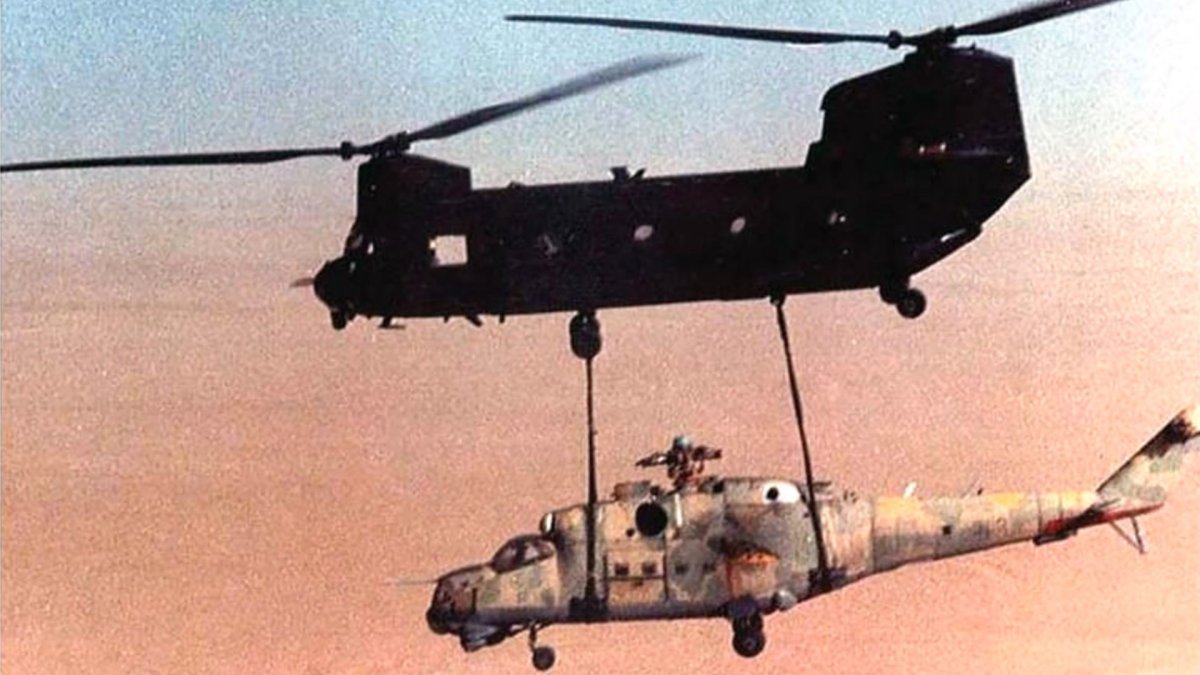
Recently, the U.S. Marine Corps announced its interest in hiring contractors to fly a Russian-made Mi-24 Hind gunship as a mock enemy during training exercises. It wasn’t always this easy to get access to one of the helicopters. Near the end of the Cold War, in an operation that seems made for a major Hollywood movie, a U.S. Air Force C-5 Galaxy transport plane discreetly flew U.S. Army special operators and a pair of MH-47D Chinooks from the 160th Special Operations Aviation Regiment to the African country of Chad in order to steal one of the big attack choppers.
On May 21, 1988, the U.S. military had ordered the start of the mission, known as Operation Mount Hope III, with the relatively simple objective of having the elite Army aviators get to northern Chad and extract a Mi-25 Hind D – the export designation for Mi-24. Libyan forces had abandoned the aircraft, and a host of other equipment, as they retreated after suffering a major defeat at the hands of the Chadian military under the leadership of then-President Hissen Habré .
The preparations for and execution of the operation were anything but easy, though. It was “one of the 160th Special Operations Aviation Regiment’s earliest successes and the first major operation utilizing the mighty Chinooks,” an officer from the unit subsequently wrote in a brief history of the mission, which The Black Vault , a repository for previously classified government documents, subsequently posted online.
The circumstances that led the Hind to be sitting abandoned at the Ouadi Doum Air Base in northern Chad go back decades earlier. After seizing control of Libya in 1969, strongman Muammar Gaddafi sought to spread his influence and revolutionary ideology across north and central Africa. In addition, he was eager to take control of a contested border region known as the Aouzou Strip , which had become part of Chadian territory after that country gained its independence from France in 1960.
A map of Chad from an official historical briefing on Operation Mount Hope II showing Ouadi Doum in the northeast and the capital N’Djamena in the southwest., US Army via The Black Vault
For nearly a decade starting in 1978, Gaddafi launched interventions into his southern neighbor and otherwise sought to meddle in the country’s affairs, supporting various rebel groups over the years. In December 1986, the last of these groups, an umbrella organization known as the Transitional Government of National Unity, or GUNT , upset with the Libyan dictator attempts to undermine its leadership and failure to provide economic support in regions under its control, turned on him.
Habré seized the opportunity to launch an offensive to regain control of the northern portion of his country. His forces predominantly employed pickups and other light wheeled vehicles and the ensuing conflict became known as the Toyota War . With support from the United States, France, and what was then known as Zaire – now called the Democratic Republic of Congo – the Chadians routed the Libyans and had driven them from the country entirely by the end of 1987.
The U.S. Intelligence Community, particularly the Central Intelligence Agency , was already heavily invested in the country and became aware of the Mi-25 in Ouadi Doum. The U.S. government was eager to get its hands on one of the Soviet’s then most advanced helicopter designs.
The process of acquiring foreign military equipment to analyze its capabilities and weaknesses, known as Foreign Materiel Exploitation, or FME, remains an important mission for the U.S. military and the U.S. Intelligence Community. At the time, getting a Hind was especially important since the gunships were already participating in a number of conflicts where the United States had active interests, including the Soviet intervention in Afghanistan, the Iran-Iraq War, and Nicaraguan Civil War.
Below is an old Cold War-era US Army training video covering the Hind and other Soviet helicopters.
Though Habré was not necessarily opposed to the United States taking the Hind out of Ouadi Doum, he had no interest in being seen delivering the aircraft to the Americans himself. It took months of negotiation to get Chadian authorities to finally agree to the Mount Hope III plan, which was likely more complex than it had to be due to the political considerations. According to another story of the operation from War Is Boring , the United States sweetened the deal with a $2 million payment and a shipment of FIM-92 Stinger shoulder-fired, man-portable, surface-to-air missiles.
Even as the debate with the government of Chad continued, the 160th Special Operations Aviation Regiment was conducting exercises just to see if the basic idea was feasible. In March 1988, the unit performed a largely written study, possibly known as Operation Mount Hope, which concluded the MH-47D would be able to lift the Hind and still carry the required fuel load, according to a now declassified historical briefing The Black Vault also obtained.
The next month, the special operations aviators performed a complete dry run, known as Mount Hope II. They first loaded two Chinooks onto a C-5 at Fort Campbell in Kentucky and flew to a simulated forward operating site at White Sands Missile Range in New Mexico.
The crews from the 160th then took a route spanning 490 miles to a mock target site where one of the two Chinooks lifted six collapsible bladders, or blivets, filled with water simulating the weight of the Soviet helicopter. They then returned to the staging base, stopping twice to refuel at temporary Forward Arming and Refueling Points, or FARPs . The early model MH-47Ds the 160th employed on the mission did not have an in-flight refueling capability.
US Army soldiers sling a water blivet underneath a Chinook during a training exercise. In 1988, a single MH-47D carried six of these to prove it could carry a Hind., US Army
After receiving the formal order to begin the mission in May 1988, an advance party went first to Germany and then on to the Chadian capital N’Djamena to prepare for the arrival of the main force. On June 10, 1988, Mount Hope III began when a C-5 with two MH-47Ds from Company E, 160th Special Operations Aviation Regiment, as well as approximately 75 additional personnel, flew from Fort Campbell to N’Djamena.
Censors redacted the names of these individuals and what units they were assigned to in the briefing The Black Vault posted online. Given the secret nature of the operation, it is possible the additional manpower came from other secretive special operations forces units such as the Army’s Delta Force. U.S. Air Force pararescuemen and a flight surgeon were also part of the task force that actually traveled out to Ouadi Doum.
A heavily redacted briefing slide showing the personnel onboard the two MH-47D helicopters during Operation Mount Hope III., US Army via The Black Vault
The next day, June 11, the Americans flew nearly 500 miles straight from N’Djamena to the air base, with an escort of French forces, including Mirage F.1 fighter jets. The situation there was tense with reports of increased Libyan activity on the other side of the Aouzou Strip. Months before Gaddafi’s forces had sent his own aircraft to try and destroy abandoned planes, helicopters, and other equipment in the area.
When they arrived, the Mi-25 was more or less ready to go. Other American and French personnel had been at the site and elsewhere in northern Chad for months, salvaging other aircraft and equipment. They had tucked the Hind away at the base until the U.S. military could figure out how best to get it out of the base.
A rare and grainy shot of the MH-47D picking up the Hind at Ouadi Doum, likely shot using the forward looking infrared video camera on the other Chinook., US Army via The Black Vault
With the gunship slung below one of the MH-47Ds, the American force then left for the return flight to the Chadian capital. The helicopters stopped at Faya Largeau and Mousorro to refuel at FARPs that a crew of a U.S. Air Force C-130 transport plane had established for the mission.
The U.S. personnel conducted the entire mission under some extreme weather conditions. The peak heat the task force encountered that day was reportedly 130 degrees Fahrenheit.
Another redacted slide showing the flight path the MH-47Ds took to Ouadi Doum and back., US Army via The Black Vault
More worryingly, as the helicopters got close to their final destination, the crews found themselves in the middle of a massive sandstorm. Trying to keep a tight schedule, the two MH-47Ds reportedly flew at speeds less than 50 miles per hour and within visual sight of each other until they emerged on the other side.
The sand followed them to N’Djamena, though, and they had to sit in the safety of their Chinooks for more than 20 minutes until the weather cleared and they could begin loading everything back onto two C-5s. In total, the American force spent less than 70 hours in Chad before returning to the United States with their prize.
US personnel load the Mi-25 onto a C-5 in N’Djamena., US Army via Arnaud Delalande
For the 160th, which the Army had first begun to form in 1981, it was a major achievement that involved complex mission planning and long-distance staging and operational movements. It also proved that the unit could perform heavy-lift operations under unusual and demanding conditions.
It is almost certain that the organization put some of the lessons learned into action in 1989 during Operation Just Cause in Panama, which involved the long-range self-deployment of MH-47s, including over-water flight, into the country using FARPs. In 1991, the 160th was called upon to demonstrate its capabilities in a desert environment again during Operation Desert Storm in Kuwait and Iraq.
The 160th has since become the U.S. military’s premier special operations helicopter unit , taking part in a host of different missions around the world in more than three decades since Mount Hope III – and likely more that we may never hear about . Separately, CH-47 and MH-47 Chinooks from across the U.S. Army have increasingly become a go-to platform for air assault operations, especially for still-ongoing operations in Afghanistan .
Unfortunately, we don’t know if any of 160th’s MH-47s have grabbed any more foreign aircraft covertly. Chinooks have certainly shown off their ability to carry helicopters and aircraft since the mission in Chad.
A CH-47D from the Nevada Army National Guard prepares to lift a GF-15A maintenance trainer at Nellis Air Force Base in 2009., USAF
The central African country, and U.S. military involvement in Africa more broadly, is back in the news , too, but without many of the players from 1988. In 2016, a special African Union court in Senegal convicted Hissen Habre – who had been living there in self-imposed exile since insurgents unseated him in 1990 – of gross human rights violations and other crimes , including mass rape and ordering the murder of more than 40,000 people during his tenure as leader of Chad, and sentenced him to life imprison. Libyan rebels executed Muammar Gaddafi in 2011 after his regime collapsed in the face of a U.S.-led intervention. That country remains mired in violence the better part of a decade later.
If the U.S. military needs to go out and snatch a helicopter again, the 160th is probably still up for the job. But if it needs more Hinds, it’d be much easier to just call up private firms in the United States now to get them.
Contact the author: jtrevithickpr@gmail.com
Comments couldn’t be loaded. Please refresh the page.
作者:约瑟夫·特雷维西克
发布于美国东部时间2018年5月16日下午12:40
近日,美国海军陆战队宣布有意雇佣承包商,在训练演习中驾驶俄制米-24“雌鹿”武装直升机作为模拟敌机。但并非一直如此容易就能获得这种直升机。冷战末期,在一次堪比好莱坞大片的行动中,一架美国空军C-5“银河”运输机秘密运送美国陆军特种作战人员和两架来自第160特种作战航空团的MH-47D“支奴干”直升机前往非洲国家乍得,成功窃取了一架大型攻击直升机。
1988 年 5 月 21 日,美国军方下令开始执行代号为“希望山行动 III”的任务,其目标相对简单,即让精锐的陆军飞行员抵达乍得北部,取回一架米-25“雌鹿”D型直升机(米-24的出口型号)。利比亚军队在被时任总统希森·哈布雷领导的乍得军队击败后撤退时,遗弃了这架飞机和许多其他装备。
然而,行动的准备和执行却绝非易事。该部队的一名军官后来在一份关于此次任务的简史中写道,这是“第160特种作战航空团早期取得的成功之一,也是首次使用强大的奇努克直升机执行的重大行动”。这份简史随后被“黑金库”(The Black Vault,一个存放此前被列为机密政府文件的资料库)发布到了网上。
这架“雌鹿”直升机被遗弃在乍得北部瓦迪杜姆空军基地的原因可以追溯到几十年前。1969年夺取利比亚政权后,强人穆阿迈尔·卡扎菲试图将其影响力及革命思想传播至北非和中非。此外,他还渴望控制被称为奥祖地带的争议边境地区。该地区在乍得于1960年脱离法国独立后成为乍得领土的一部分。
一张乍得地图,出自美国陆军关于“希望山行动II”的官方历史简报,图中显示了东北部的瓦迪杜姆和西南部的首都恩贾梅纳。(图片来自美国陆军,经由The Black Vault网站提供)
从1978年开始的近十年间,卡扎菲不断干预其南部邻国利比亚的内政,并多年来支持各种反叛组织。1986年12月,这些组织中最后一个——一个名为“民族团结过渡政府”(简称GUNT)的伞式组织——因不满卡扎菲试图削弱其领导地位以及未能向其控制区提供经济支持,转而反对他。
哈布雷抓住机会发动攻势,试图重新控制乍得北部地区。他的部队主要使用皮卡和其他轻型轮式车辆,由此引发的冲突被称为“丰田战争”。在美国、法国以及当时的扎伊尔(现刚果民主共和国)的支持下,乍得军队击溃了利比亚军队,并在1987年底将其彻底驱逐出境。
美国情报机构,特别是中央情报局,当时已在苏联投入巨资,并在瓦迪杜姆发现了米-25直升机。美国政府渴望获得苏联当时最先进的直升机设计之一。
获取外国军事装备并分析其性能和弱点的过程,即所谓的“外国物资利用”(FME),仍然是美国军方和情报部门的一项重要任务。当时,获取一架米-24“雌鹿”武装直升机尤为重要,因为这种武装直升机已经参与了美国积极参与的多起冲突,包括苏联入侵阿富汗、两伊战争和尼加拉瓜内战。
下面这段视频是冷战时期美国陆军的训练视频,内容涵盖了米-24雌鹿直升机和其他苏联直升机。
尽管哈布雷并非一定反对美国从瓦迪杜姆撤走米-24雌鹿直升机,但他并不想被人看到他亲自将飞机交付给美国人。经过数月的谈判,乍得当局最终才同意“希望山三号”计划,而由于政治因素,该计划可能比实际需要的要复杂得多。根据“战争很无聊”(War Is Boring)网站对此次行动的另一则报道,美国为了促成交易,支付了200万美元,并交付了一批FIM-92“毒刺”肩扛式单兵便携式地对空导弹。
即便与乍得政府的争论仍在继续,第160特种作战航空团仍在进行演习,以验证这一基本构想的可行性。1988年3月,该部队开展了一项主要以书面形式进行的研究,可能被称为“希望山行动”。根据一份现已解密的历史简报(《黑金库》也获得了这份简报),该研究得出结论:MH-47D能够吊运“雌鹿”直升机,并携带所需的燃料。
次月,特种作战飞行员进行了一次完整的演习,即“希望山二号”演习。他们首先在肯塔基州坎贝尔堡将两架奇努克直升机装载到 C-5 运输机上,然后飞往新墨西哥州白沙导弹靶场的模拟前沿作战地点。
第160直升机大队的机组人员随后飞行了490英里(约750公里)到达一个模拟目标地点。在那里,两架“支奴干”直升机中的一架吊起了六个装满水的可折叠水囊(或称“水袋”),以模拟苏联直升机的重量。之后,他们返回集结基地,途中两次在临时前沿武器和加油点(FARP)加油。第160大队执行此次任务时使用的早期型号MH-47D直升机不具备空中加油能力。
在一次训练演习中,美国陆军士兵将一个水弹吊挂在奇努克直升机下方。1988年,一架MH-47D直升机曾携带六个这样的水弹吊挂装置,以证明其能够搭载米-24雌鹿直升机。
1988年5月接到正式任务命令后,先遣队首先前往德国,然后前往乍得首都恩贾梅纳,为主力部队的到来做准备。1988年6月10日,“希望山行动III”正式开始,一架C-5运输机搭载着第160特种作战航空团E连的两架MH-47D直升机以及约75名其他人员,从坎贝尔堡飞往恩贾梅纳。
在“黑金库”(The Black Vault)网站发布的简报中,审查人员隐去了这些人的姓名以及他们所属的部队。鉴于此次行动的秘密性质,增援人员很可能来自其他秘密特种作战部队,例如陆军三角洲部队。美国空军伞降救援人员和一名飞行外科医生也参与了前往瓦迪杜姆的特遣部队。
一张经过大量删减的简报幻灯片,显示了“希望山行动III”期间两架MH-47D直升机上的人员。(图片来自美国陆军,经由The Black Vault网站发布)
第二天,6月11日,美军在法国部队(包括幻影F.1战斗机)的护航下,从恩贾梅纳直飞近500英里抵达空军基地。当时局势紧张,有报道称奥祖地带另一侧的利比亚活动日益频繁。几个月前,卡扎菲的部队曾派出飞机试图摧毁该地区的废弃飞机、直升机和其他装备。
他们到达时,米-25直升机基本已经准备就绪。其他美法人员已在现场及乍得北部其他地区待了数月,抢救其他飞机和设备。他们把这架米-24“雌鹿”直升机暂时存放在基地,等待美军找到将其运出基地的最佳方案。
一张罕见的、画面模糊的照片,显示一架MH-47D直升机在瓦迪杜姆机场发现一架米-24“雌鹿”直升机,照片很可能是由另一架“奇努克”直升机上的前视红外摄像机拍摄的。(图片来自美国陆军,经由The Black Vault网站提供)
美军将武装直升机吊挂在其中一架MH-47D直升机下方,随后启程返回乍得首都。途中,直升机在法亚拉尔戈和穆索罗停留,在美军C-130运输机机组为此次任务预先设立的前沿空中加油点(FARPs)进行加油。
美军人员在极端天气条件下完成了整个任务。据报道,特遣部队当天遇到的最高温度达到了华氏130度。
另一张经过涂黑处理的幻灯片显示了MH-47D直升机往返瓦迪杜姆的飞行路线。(美国陆军,图片来自The Black Vault)
更令人担忧的是,当直升机接近最终目的地时,机组人员发现自己身处一场巨大的沙尘暴之中。据报道,为了赶上紧凑的飞行计划,两架MH-47D直升机以低于每小时50英里的速度飞行,并始终保持彼此的目视距离,直到飞越沙尘暴区域。
然而,沙子也跟着他们来到了恩贾梅纳,他们不得不待在安全的奇努克直升机里超过20分钟,直到天气放晴,才能开始把所有东西装回两架C-5运输机上。美军在乍得总共停留不到70个小时,便带着战利品返回了美国。
在恩贾梅纳,美军人员将米-25直升机装载到C-5运输机上。(图片来自美国陆军,经Arnaud Delalande提供)
对于陆军于1981年开始组建的第160部队而言,这是一项重大成就,涉及复杂的任务规划、长途集结和作战行动。这也证明了该部队能够在特殊且严苛的条件下执行重型运输任务。
几乎可以肯定的是,该组织在1989年巴拿马“正义事业行动”中运用了部分经验教训,该行动涉及MH-47直升机的远程自主部署,包括利用前沿空中巡逻点(FARPs)进行跨海飞行,进入巴拿马境内。1991年,第160直升机联队在科威特和伊拉克的“沙漠风暴行动”中再次被召集,以展示其在沙漠环境中的能力。
自“希望山III”行动以来,第160特种作战直升机联队已成为美军首屈一指的特种作战直升机部队,在过去三十多年里参与了世界各地众多不同的任务——而且很可能还有更多我们永远不会知道的行动。与此同时,来自美国陆军各部队的CH-47和MH-47“支奴干”直升机也日益成为空中突击行动的首选平台,尤其是在阿富汗仍在进行的行动中。
遗憾的是,我们尚不清楚第160飞行大队的MH-47是否还秘密劫持过其他外国飞机。自乍得任务以来,奇努克直升机无疑已经展现了其运载直升机和飞机的能力。
2009年,一架隶属于内华达州国民警卫队的CH-47D直升机在内利斯空军基地准备吊运一架GF-15A维护训练器。(美国空军)
这个中非国家以及美国在非洲更广泛的军事行动也再次成为新闻焦点,但1988年事件中的许多参与者已不再出现。2016年,塞内加尔一家非洲联盟特别法庭判处希森·哈布雷(自1990年被叛军推翻后一直自我流放至此)犯有严重侵犯人权罪和其他罪行,包括在担任乍得领导人期间实施大规模强奸和下令谋杀超过4万人,并判处其终身监禁。利比亚反叛分子在2011年处决了穆阿迈尔·卡扎菲,此前他的政权在美国领导的干预下垮台。近十年过去了,利比亚仍然深陷暴力冲突之中。
如果美军需要再次采购直升机,第160航空联队可能仍然能够胜任。但如果需要更多米-24“雌鹿”直升机,现在直接联系美国国内的私营公司采购要容易得多。
联系作者:jtrevithickpr@gmail.com
评论加载失败,请刷新页面。