Chinese ballistic missile test is said to undermine nuclear weapons-free zone in South Pacific据称,中国的弹道导弹试验破坏了南太平洋无核武器区。
China has repeatedly called out the AUKUS nuclear submarine deal between Australia, the U.S. and the U.K. as violating the treaty.
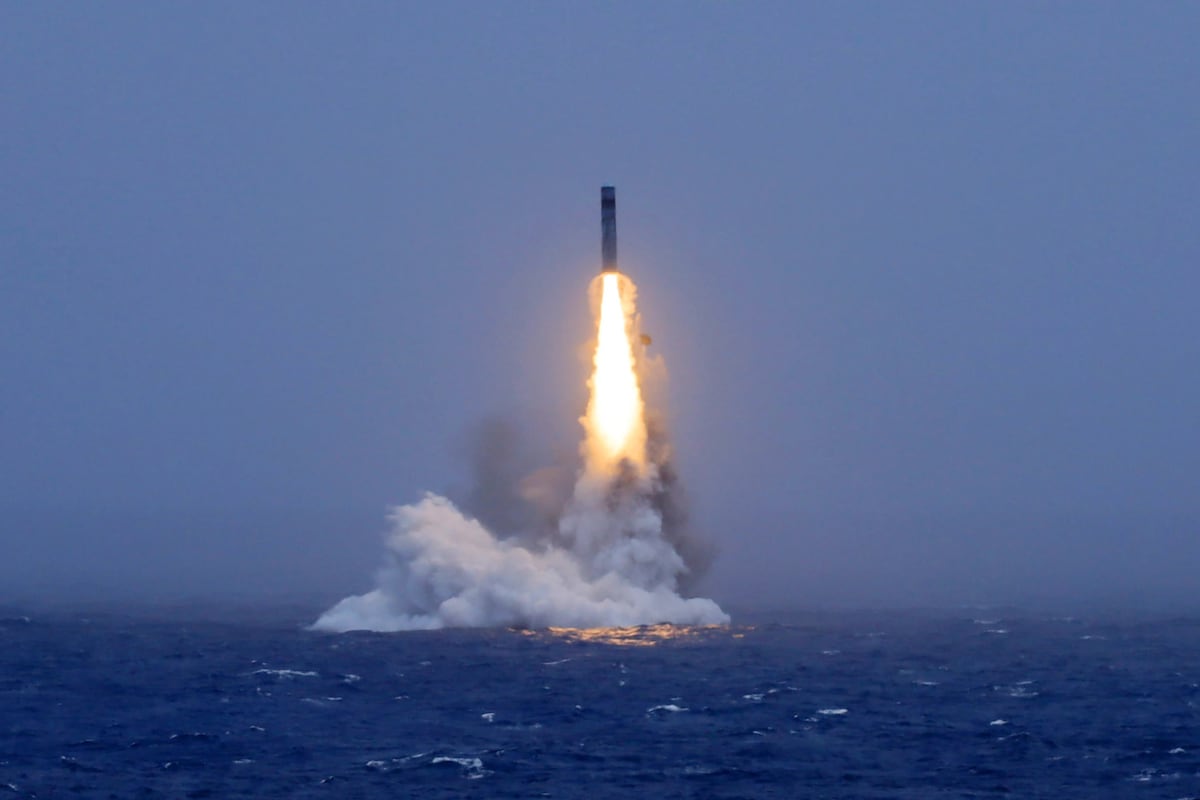
VIENNA — China’s test this week of a submarine-launched ballistic missile follows a growing trend of nuclear powers hollowing out the integrity of nuclear weapons-free zones such as the South Pacific, analysts say.
The People’s Liberation Army Navy launched a ballistic missile from a submarine off its coast on Monday, which subsequently flew southeast over the Pacific for about 7,000 kilometers (4,350 miles), according to a map released by the Taiwan National Security Council, before splashing down near the island nations of Nauru and Tuvalu.
Both archipelago countries are part of the South Pacific Nuclear Weapons Free Zone, which was established by the Treaty of Rarotonga in 1986 and prohibits the stationing and testing of nuclear weapons on islands or in waters of the South Pacific, as well as threatening the countries in the region with the use of these weapons.
China, as well as Russia, the U.S., U.K., and France, have signed onto protocols committing them to the treaty.
A missile test doesn’t technically violate the text of the treaty, so long as the missile is not nuclear-tipped. In the case of the Chinese test, the rocket was carrying a dummy warhead for testing purposes. However, southern Pacific nations were quick to accuse China of violating the spirit of the zone, which goes beyond the core legal definition.
New Zealand’s foreign minister said the test “goes against the object and intent of that treaty,” referring to Rarotonga. Australia publicly raised similar concerns.
“We have seen a growing trend of nuclear weapons-armed states exerting pressure on nuclear weapons free zones for their geostrategic interests,” said Olamide Samuel, a network and engagement specialist at the Vienna-based Open Nuclear Network. “We’ve seen it with the U.S. pressuring the U.K. over Diego Garcia, the island in the Indian Ocean; with Russia pushing Kazakhstan to allow missile testing; and now with China conducting a missile test in the South Pacific.”
China has called the test routine. China’s Foreign Ministry spokesperson Mao Ning stated that “the launch activity was conducted safely, systematically, and professionally throughout,” and urged other countries not to “over-interpret it.” Beijing had given several hours of early notice to key governments in the region.
Tensions have been high over the spirit of Rarotonga since 2021, with China having repeatedly called out the AUKUS nuclear submarine deal between Australia, the U.S. and the U.K. as violating the treaty, to which Australia is a party. Under the AUKUS deal, Australia will receive up to eight nuclear submarines along with highly-enriched uranium for their onboard reactors.
“China has been quite public in voicing its support for nuclear weapons free zones, most recently indicating support for Southeast Asia’s. And then they turn around and do this,” said Samuel.
China’s action, combined with pressures from the U.S., Australia and other regional players, may lead to a “slow spiral” and a “race to the bare minimum” of what the treaty demands, he said, rather than furthering more aspirational, peace-oriented goals.
Aside from the South Pacific NWFZ, similar structures exist across Africa, Southeast Asia, Latin America, and Central Asia, plus Mongolia. Antarctica, outer space and the ocean floor are similarly off-limits for the stationing of nukes, as agreed by the international community.
China last fired a ballistic missile into the Pacific in September 2024. The U.S. conducted a comparable ballistic missile test in March of this year, though its missile splashed down in a part of the Pacific Ocean not covered by any nuclear-weapon-free zone treaties.
Linus Höller is Defense News' Europe correspondent and OSINT investigator. He reports on the arms deals, sanctions, and geopolitics shaping Europe and the world. He holds master’s degrees in WMD nonproliferation, terrorism studies, and international relations, and works in four languages: English, German, Russian, and Spanish.
维也纳——分析人士称,中国本周试射潜射弹道导弹,延续了核大国日益削弱南太平洋等无核武器区完整性的趋势。
据台湾国家安全委员会公布的地图显示,中国人民解放军海军周一从其海岸附近的一艘潜艇发射了一枚弹道导弹,该导弹随后向东南方向飞越太平洋约7000公里(4350英里),最终在瑙鲁和图瓦卢岛国附近溅落。
这两个群岛国家都是南太平洋无核武器区的一部分。该无核武器区是根据 1986 年《拉罗汤加条约》建立的,禁止在南太平洋的岛屿或水域部署和试验核武器,以及以核武器威胁该地区的国家。
中国以及俄罗斯、美国、英国和法国都签署了相关议定书,承诺遵守该条约。
只要导弹不携带核弹头,导弹试验在技术上并不违反条约文本。就中国此次试验而言,导弹携带的是用于测试的模拟弹头。然而,南太平洋国家迅速指责中国此举违背了该区域的精神,而这种精神超越了条约的核心法律定义。
新西兰外交部长表示,此次试验“违背了该条约的宗旨和意图”,他指的是拉罗汤加岛。澳大利亚也公开表达了类似的担忧。
“我们看到,拥有核武器的国家为了自身地缘战略利益,对无核武器区施加压力的趋势日益明显,”总部位于维也纳的开放核网络(Open Nuclear Network)的网络与参与专家奥拉米德·塞缪尔(Olamide Samuel)表示。“例如,美国就印度洋上的迪戈加西亚岛问题向英国施压;俄罗斯敦促哈萨克斯坦允许进行导弹试验;而现在,中国又在南太平洋进行了导弹试验。”
中国称此次试验为例行测试。中国外交部发言人毛宁表示,“发射活动全程安全、有序、专业地进行”,并敦促其他国家不要“过度解读”。北京方面已提前数小时通知了该地区的主要国家政府。
自2021年以来,围绕拉罗汤加精神的紧张局势一直居高不下。中国多次指责澳大利亚、美国和英国签署的“奥库斯”核潜艇协议违反了澳大利亚作为缔约国的《英法海底条约》。根据该协议,澳大利亚将获得至多八艘核潜艇以及用于其舰载反应堆的高浓缩铀。
“中国一直公开表示支持无核武器区,最近还表示支持东南亚的无核武器区。结果他们却转过头来做这种事,”塞缪尔说。
他表示,中国的行动,再加上来自美国、澳大利亚和其他地区国家的压力,可能会导致“缓慢的螺旋式恶化”和“竞相满足条约要求的最低限度”,而不是推进更具抱负、以和平为导向的目标。
除了南太平洋无核武器区外,类似的区域还遍布非洲、东南亚、拉丁美洲、中亚以及蒙古。根据国际社会的共识,南极洲、外层空间和海底同样禁止部署核武器。
中国上一次向太平洋发射弹道导弹是在2024年9月。美国今年3月也进行了一次类似的弹道导弹试验,不过其导弹溅落在太平洋中部,而该区域并未受到任何无核武器区条约的约束。
林努斯·霍勒是《防务新闻》的欧洲记者和开源情报调查员。他报道影响欧洲乃至全球的军火交易、制裁和地缘政治。他拥有大规模杀伤性武器不扩散、恐怖主义研究和国际关系三个硕士学位,并精通英语、德语、俄语和西班牙语四种语言。