USAF Mini-Documentary Takes You Behind The Scenes Of Its Top Secret Cold War MiG Squadron美国空军迷你纪录片带你深入了解其冷战时期绝密米格战斗机中队的幕后故事
For more than a decade, the unit flew enemy aircraft against America's best fighters from a secretive and desolate base near Tonopah, Nevada.
新闻视频
By Joseph Trevithick
Updated Dec 1, 2019 6:37 AM EST
Just over 30 years after the U.S. Air Force officially shuttered the super-secret 4477th Test and Evaluation Squadron , or Red Eagles, and its fleet of Russian MiGs, the service has released a little film about the unit’s activities, also known as Project Constant Peg. It’s short, but it’s still full of interviews with pilots and ground crews about their work, as well as images and video of the squadron’s unique fleet of foreign planes. It offers additional insight into the world of U.S. military units charged with what is known as “ Foreign Materiel Exploitation ,” or FME, a service that the latest incarnation of the Red Eagles continues to provide to this day .
The brief documentary, titled Red Eagles – Constant Peg, 1977-1988 , first appeared on social media accounts linked to Nellis Air Force Base in Nevada. Nellis is presently home to some of the Air Force’s premier test and evaluation and research and development units, including the 57th Wing and 53rd Test and Evaluation Group . The base has also long served as an official home for units conducting top-secret work at various outlying installations, including the Tonopah Test Range Airport and Groom Lake, also known as Area 51 .
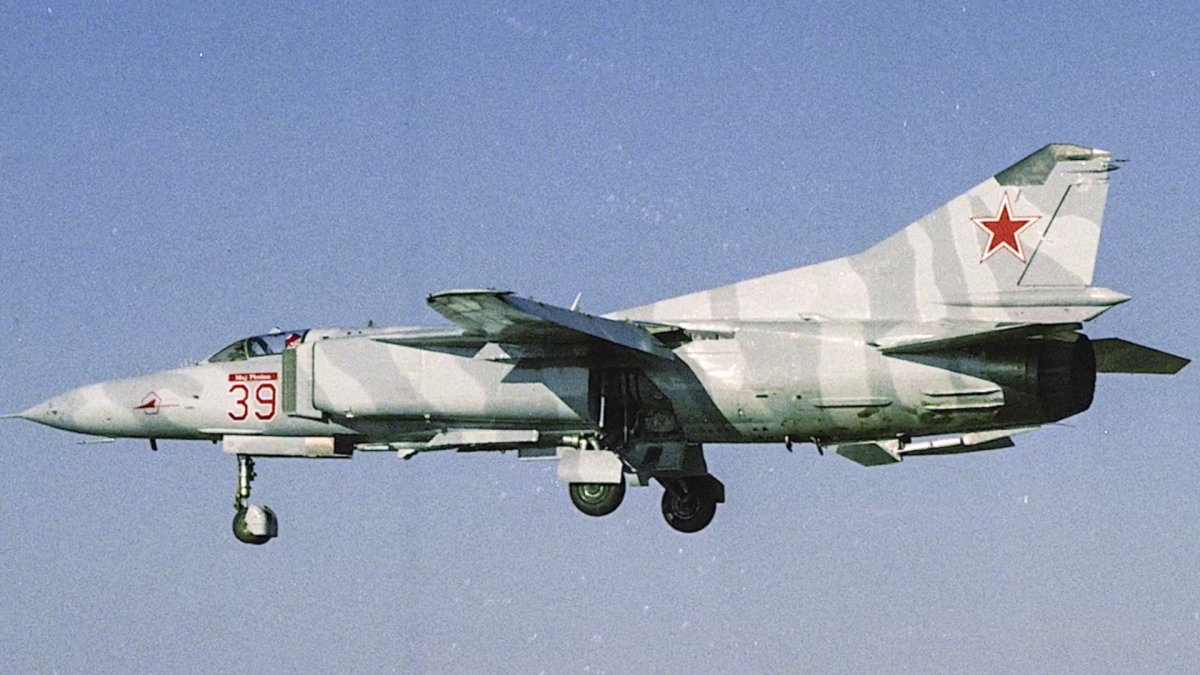
The 4477th officially stood up at an airfield near the remote Tonopah Test Range on April 1, 1977, eventually bringing MiG-17 Fresco , MiG-21 Fishbed , and MiG-23 Flogger jets that the U.S. government had acquired by various means to the base. The squadron also acquired Chinese Chengdu J-7Bs , which are license-built MiG-21 copies.
The squadron also flew T-38 Talon trainers , which acted, in part, as chase planes. They would’ve offered the Air Force an additional way to cover and obscure what the squadron was actually doing, as well. The Air Force initially had to expand the size of the airport at Tonopah to handle all of the new aircraft.
“The whole idea of building an airfield was an overwhelming challenge,” retired U.S. Air Force Colonel Gail Peck, who commanded the 4477th between 1977 and 1978, says in the Air Force documentary. “I got to thinking about it and so I pulled out a ballpoint pen and a napkin off the airliner and I sketched out a little drawing of extending the runway and putting a pad there for three hangars and stuff like that. And I’d convinced myself that Tonopah was the right place for this project.”
Colonel Peck’s napkin drawing of his proposed expanded base of operations at Tonopah., USAF capture
The future home of the 4477th Test and Evaluation Squadron under construction., USAF capture
Another shot of the construction at Tonopah at a more advanced state., USAF capture
Peck says the site offered a host of advantages, including being remote to help conceal the squadron from prying eyes, but still in close proximity to Nellis, home of what was then the Air Force Fighter Weapons School, which is now known simply as the Weapons School . This basing decision was a direct product of the discussions that led to the unit’s creation, which revolved around the desire for a more established capability to both evaluate the capabilities of the Russian aircraft and give American fighter pilots regular opportunities to square off against them in dissimilar air combat training .
Before the establishment of the 4477th at Tonopah, the Foreign Technology Division (FTD) of Air Force Systems Command had been primarily responsible for the MiGs. This organization performed FME on flyable and non-flyable foreign aircraft at Area 51 in cooperation with intelligence agencies such as the Defense Intelligence Agency (DIA).
A separate document the Air Force had previously declassified and posted online shows that this work included projects such as Have Foam and Have Pad, which involved the examination of the characteristics of the a crashed Sukhoi Su-20 Fitter and an airworthy MiG-23, respectively. This process included gathering intelligence about the performance of both aircraft and their various systems, as well as collecting information about the Soviet Union’s general industrial capabilities through metallurgical analysis of selected parts.
Partially redacted descriptions of Projects Have Foam and Have Pad., USAF
At the same time, as reports of mediocre performance on the part of U.S. Air Force and Navy fighter pilots against North Vietnamese MiGs began to flow in, flight operations out of Groom Lake eventually expanded to include limited aggressor training for U.S. Air Force and Navy fighter pilots, but as part of specific test programs. Have Drill , which pitted American aviators against an ex-Syrian Air Force MiG-17 captured in Israel, and Have Doughnut , involving a former Iraqi Air Force MiG-21 that the Israelis had acquired from a defecting pilot, are among the best-known examples.
“I was in General [Hoyt S.] Vandenberg’s office [at the Pentagon] one day trying to get him to sign one of these test plans and he says ‘You know, I hate this,'” Peck recounts in the new documentary. “You guys have to go through the pain of writing a test plan. We oughtta just be training with these airplanes.”
The MiG-17 that pilots flew against during Project Have Drill., USAF
Thus the 4477th was born. The secret program’s name, Constant Peg, came from the combination of Vandenberg’s own callsign and the first name of Peck’s wife, Peggy. The Air Force also continued to exploit foreign aircraft and components at Area 51, eventually creating the 6513th Test Squadron , the Red Hats, to continue that work. The service also eventually assigned the cover designations F-110, F-113, and F-114, to the MiG-21s, MiG-23s, and MiG-17s, respectively, to avoid having to refer to them directly as foreign types.
As already noted, the aircraft that the FTD had acquired for its purposes had come from various sources and were not all in flyable condition when the new squadron received them. So, it was often up to the 4477th’s maintainers to figure out the foreign designs after they arrived at Tonopah and get them ready to go.
A grainy still image from a video showing some of the 4477th’s jets in a hangar at Tonopah., USAF capture
“We had pieces. You know, we had airframes and wings and all that stuff, but flyable,” Retired U.S. Air Force Master Sergeant Don Lyon, Assistant Chief of Maintenace for the 4477th between 1977 and 1981, says in his own interview in the film. “It wasn’t that difficult to figure it out. I mean, it was a lot of reverse engineering, you know, but airplanes pretty much an airplane.”
Whether this is true or just Lyon being modest, it was still an impressive feat for the Air Force ground crews to essentially rebuild airplanes they may not have ever seen before in person. It also doesn’t speak to the varied state of planes, and plane parts, that came to the unit. Not everything was as pristine as a MiG that had touched down at an Israeli air base.
“They took airplanes that had been pulled out of swamps and deserts and God knows where they got ’em,” Peck says. “We didn’t even pre-flight ’em, we had that much trust in our maintenance team and they didn’t let us down.”
Members of the 4477th Test and Evaluation Squadron. Retired U.S. Air Force Lieutenant Colonel Earl Henderson, who commanded the unit between 1979 and 1980, says in the documentary that Air Force relaxed grooming standards for the unit, especially for ground crews, to help them avoid arousing suspicions of a major influx of military personnel at Tonopah among people in surrounding communities., USAF capture
During its official time in existence, the 4477th flew over 15,000 sorties and trained nearly 6,000 American pilots on how to fight actual Soviet MiGs. Those individuals then took their experience back to organizations such as the Air Force Fighter Weapon School and the Navy Fighter Weapon School, better known as TOPGUN , to further share that knowledge throughout their respective services.
It’s hard to overstate the importance for pilots to be able to see how their aircraft perform against actual planes that a potential opponent might be flying. It also gives them a chance to overcome or at least reduce the chance of experiencing anxiety or “ buck-fever ” when seeing a foreign type for the first time in actual combat.
US Navy F-14 Tomcats fly in formation with Constant Peg MiG-21s during a training sortie., USAF
“You only had to watch the eyes of a fighter pilot joining up on you. He’s coming up in his airplane and the closer he gets, pretty soon you can see his helmet and you can see his head,” Peck explains in the film. “And pretty soon you can see his face and you can see his eyeballs peering at you over his oxygen mask, you know, and they’re getting bigger and bigger and bigger as he’s getting in closer and closer. He’s never seen a Russian airplane in flight for real! What an experience that is.”
Though the 4477th is no more, the Air Force continues to conduct these types of FME and dissimilar air combat training activities using actual foreign airframes to this day. The squadron reportedly remained in existence at least two years after officially standing down and the Air Force only formally declassified its existence at all in 2006.
Members of the 4477th pose in front of one of the squadron’s MiG-21s., USAF
After a number of subsequent name and organizational changes, which you can read about more here , the latest incarnations of both the Red Eagles and Red Hats are both now understood to be under the control of the Air Force Test Center’s (ATFC) Detachment 3. This unit also has a close relationship to Nellis’ 53rd Test and Evaluation Group, Detachment 3, which has a public mission to conduct FME testing.
In 2017, photographers David Atkinson and Alan Chadwick caught a glimpse of the Red Eagles and Red Hats continued work when he took a series of photos of a F-16D Viper, almost certainly based at Area 51, with an infrared search and track pod flying through Rainbow Canyon, also known “Star Wars Canyon” or the “Jedi Transition,” in Eastern California. The two pilots on board were clearly wearing Red Eagle and Red Hat patches on their flight suits.
A picture of the F-16D flying through Star Wars Canyon in 2017. The pilot in the rear has a Red Hats patch, while the one in front has a Red Eagle patch., Alan Chadwick
Maybe in another 30 years, we’ll be able to learn more about what these units are doing now.
Contact the author: jtrevithickpr@gmail.com
Comments couldn’t be loaded. Please refresh the page.
作者:约瑟夫·特雷维西克
更新于美国东部时间2019年12月1日上午6:37
在美国空军正式关闭高度机密的第4477测试评估中队(又称“红鹰”)及其俄罗斯米格战机机队30多年后,空军发布了一部关于该部队活动的短片,该活动也被称为“恒锚计划”。影片虽然短小,但内容丰富,包含大量对飞行员和地勤人员的采访,以及该中队独特的外国飞机机队的图片和视频。它让我们得以更深入地了解负责“外国物资利用”(FME)的美国军事单位,而“红鹰”中队的最新版本至今仍在提供这项服务。
这部名为《红鹰——永恒的钉子,1977-1988》的短纪录片最初出现在与内华达州内利斯空军基地相关的社交媒体账号上。内利斯空军基地目前驻扎着美国空军一些顶尖的测试评估和研发部队,包括第57联队和第53测试评估大队。长期以来,该基地也是一些在周边设施(包括托诺帕试验场机场和格鲁姆湖,即著名的51区)执行绝密任务的部队的官方驻地。
第4477战斗机中队于1977年4月1日在偏远的托诺帕试验场附近的一个机场正式成立,最终将美国政府通过各种途径获得的米格-17“壁画”、米格-21“鱼窝”和米格-23“鞭挞者”战斗机部署到该基地。该中队还获得了中国成都J-7B战斗机,这些战斗机是米格-21的特许生产版本。
该中队还装备了T-38“鹰爪”教练机,这些教练机部分承担了伴飞任务。它们也为空军提供了一种额外的掩护手段,使其难以辨认该中队的实际行动。空军最初不得不扩建托诺帕机场,以容纳所有新飞机。
“建造机场的想法本身就是一个巨大的挑战,”美国空军退役上校盖尔·佩克在空军纪录片中说道。她曾在1977年至1978年间指挥第4477空军中队。“我开始认真思考这个问题,于是我从客机上拿出一支圆珠笔和一张餐巾纸,画了一张草图,规划如何延长跑道,并在那里建造三个机库等等。我当时就确信,托诺帕是这个项目的理想地点。”
佩克上校在餐巾纸上画的托诺帕扩建作战基地方案草图,美国空军缴获
正在建设中的第4477测试评估中队未来基地,美国空军占领
托诺帕空军基地建设工程的另一张照片,显示其进展更为顺利。(美国空军拍摄)
佩克表示,该基地拥有诸多优势,包括位置偏远,有助于隐藏中队,避免被外界窥探,同时又靠近内利斯空军基地——当时的空军战斗机武器学校所在地,如今该校简称为武器学校。这一基地选择是促成该部队组建的讨论的直接结果,其核心在于希望建立更完善的能力,以便评估俄罗斯战机的性能,并为美国战斗机飞行员提供定期与俄制战机进行异型机空战训练的机会。
在托诺帕空军基地成立第4477部队之前,空军系统司令部的外国技术处(FTD)主要负责米格战机的相关工作。该机构与国防情报局(DIA)等情报机构合作,在51区对可飞行和不可飞行的外国飞机进行飞行测试评估(FME)。
空军此前解密并发布在网络上的一份独立文件显示,这项工作包括“Have Foam”和“Have Pad”等项目,分别涉及对坠毁的苏霍伊Su-20“装配工”战斗机和一架适航的米格-23战斗机的特性进行分析。这一过程包括收集有关这两架飞机及其各种系统性能的情报,以及通过对选定部件进行冶金分析来收集有关苏联总体工业能力的信息。
美国空军“项目有泡沫和垫子”的部分描述已被删减。
与此同时,随着有关美国空军和海军战斗机飞行员在对抗北越米格战机时表现平平的报告不断涌现,格鲁姆湖的飞行训练最终扩展到包括美国空军和海军战斗机飞行员有限的假想敌训练,但这仅限于特定的测试项目。“演习”(Have Drill)和“甜甜圈”(Have Doughnut)便是其中最著名的例子。“演习”中,美国飞行员与一架在以色列缴获的前叙利亚空军米格-17战机进行对抗;“甜甜圈”则使用了以色列从一名叛逃飞行员手中获得的一架前伊拉克空军米格-21战机。
“有一天我在五角大楼范登堡将军的办公室里,想让他签署一份测试计划,他说:‘你知道吗,我讨厌这样,’”佩克在新的纪录片中回忆道。“你们得忍受编写测试计划的痛苦。我们应该直接用这些飞机进行训练。”
在“演练计划”中,飞行员们曾与米格-17战斗机进行过对抗。(美国空军)
于是,第4477中队诞生了。这个秘密计划的名称“恒常钉”(Constant Peg)取自范登堡的呼号和佩克妻子佩吉(Peggy)的名字组合。空军还继续在51区利用外国飞机和零部件,最终组建了第6513测试中队(绰号“红帽”)来继续这项工作。为了避免直接称其为外国机型,空军最终还分别给米格-21、米格-23和米格-17分配了F-110、F-113和F-114这三个代号。
如前所述,飞行训练中队(FTD)采购的飞机来源各异,并非所有飞机在新中队接收时都处于适航状态。因此,第4477飞行大队的维护人员常常需要在飞机抵达托诺帕后,对这些外国设计的飞机进行调试,使其达到适航标准。
一张模糊的静止图像,截取自一段视频,显示了驻扎在托诺帕空军基地机库中的第4477战斗机大队的几架喷气式飞机。(美国空军拍摄)
“我们有零件。你知道,我们有机身、机翼之类的东西,但还能飞,”退役美国空军一级军士长唐·里昂在影片的采访中说道。他曾在1977年至1981年间担任第4477维修大队的助理维修主管。“弄明白它并不难。我的意思是,这需要大量的逆向工程,但飞机本质上都差不多。”
无论这是事实还是里昂的谦虚,对于空军地勤人员来说,能够基本重建他们可能从未亲眼见过的飞机,仍然是一项令人印象深刻的壮举。但这也没有说明送到部队的飞机和飞机部件的状况千差万别。并非所有飞机都像降落在以色列空军基地的米格战机那样崭新。
“他们用的飞机是从沼泽和沙漠里拖出来的,天知道他们是从哪儿弄来的,”佩克说。“我们甚至都没做飞行前检查,我们对维修团队非常信任,他们也没有让我们失望。”
第4477测试评估中队的成员。美国空军退役中校厄尔·亨德森曾在1979年至1980年间指挥该部队,他在纪录片中表示,空军放宽了该部队,特别是地勤人员的仪容仪表标准,以避免托诺帕周边社区的居民对大量军事人员涌入产生怀疑。
在正式存在期间,第4477战斗机中队执行了超过15000架次的飞行任务,并训练了近6000名美国飞行员如何对抗真正的苏联米格战斗机。这些飞行员随后将他们的经验带回空军战斗机武器学校和海军战斗机武器学校(更广为人知的名称是TOPGUN)等机构,以便在各自的军种中进一步分享这些知识。
对于飞行员来说,能够亲眼目睹自己的战机与潜在对手的战机进行实战对抗,其重要性怎么强调都不为过。这也能帮助他们克服或至少降低在实战中首次见到外国战机时产生的焦虑或“紧张情绪”。
美国海军的F-14“雄猫”战斗机与美国空军的“恒钉”米格-21战斗机编队进行训练飞行。
“你只要看看战斗机飞行员的眼神就知道了。他驾驶着飞机靠近你,越靠近,你很快就能看到他的头盔,能看到他的头,”派克在影片中解释道。“很快你就能看到他的脸,能看到他透过氧气面罩盯着你的眼睛,你知道吗?随着他越来越近,他的眼睛也越来越大。他以前从未真正见过飞行中的俄罗斯飞机!那真是一次难忘的经历。”
尽管第4477中队已不复存在,但空军至今仍在继续使用真实的外国飞机进行此类实战演练和异型机空战训练活动。据报道,该中队在正式解散后至少又存在了两年,而空军直到2006年才正式解密其存在。
美国空军第4477战斗机中队的成员们在该中队的一架米格-21战斗机前合影。
经过一系列名称和组织变更(您可以在这里阅读更多相关信息),红鹰和红帽的最新版本现在都被认为受空军测试中心 (ATFC) 第 3 分队的控制。该部队还与内利斯空军基地的第 53 测试与评估大队第 3 分队有着密切的关系,该分队的公开任务是进行 FME 测试。
2017年,摄影师大卫·阿特金森和艾伦·查德威克拍摄了一组照片,记录了“红鹰”和“红帽”的持续行动。照片中,一架几乎可以确定驻扎在51区的F-16D“蝰蛇”战斗机,携带红外搜索跟踪吊舱飞越了位于加州东部的彩虹峡谷(也被称为“星球大战峡谷”或“绝地过渡地带”)。机上两名飞行员的飞行服上清晰可见“红鹰”和“红帽”的徽章。
一张F-16D战斗机于2017年飞越星球大战峡谷的照片。后排飞行员佩戴着红帽徽章,前排飞行员佩戴着红鹰徽章。——艾伦·查德威克
或许再过30年,我们就能更多地了解这些设备现在正在做什么了。
联系作者:jtrevithickpr@gmail.com
评论加载失败,请刷新页面。