There’s A Place Where Helicopters Fly On High-Wires And Get Pummeled By Missiles有一个地方,直升机在高空钢丝上飞行,还会遭到导弹袭击。
Deep in White Sands Missile Range, there's an exotic facility situated between two mountains that is critical to countermeasure and missile testing.
新闻视频
Updated Jun 28, 2018 5:14 PM EDT
It never ceases to amaze just how extensive the research and testing infrastructure is that supports America’s vast military-industrial machine. From radar cross-section measurement facilities that look right out of science fiction, to secret and not so secret testing airfields, to huge anechoic chambers , to a submarine test center on an Idaho lake , these facilities and many more like them, turn weapons dreams into battlefield reality.
When it comes to testing missile and missile countermeasure technology, which encompasses critical capabilities essential to national security, validating such systems’ effectiveness under many circumstances is essential. Everything from full-scale aerial targets (FSATs) to a massive soundstage-like structure that simulates missile seeker endgame performance in slow motion, exist for this purpose. And now we know of yet another elaborate testing facility related to anti-air missiles and countermeasures, one that sends helicopters careening between mountaintops along a wire as missiles attack from multiple directions.
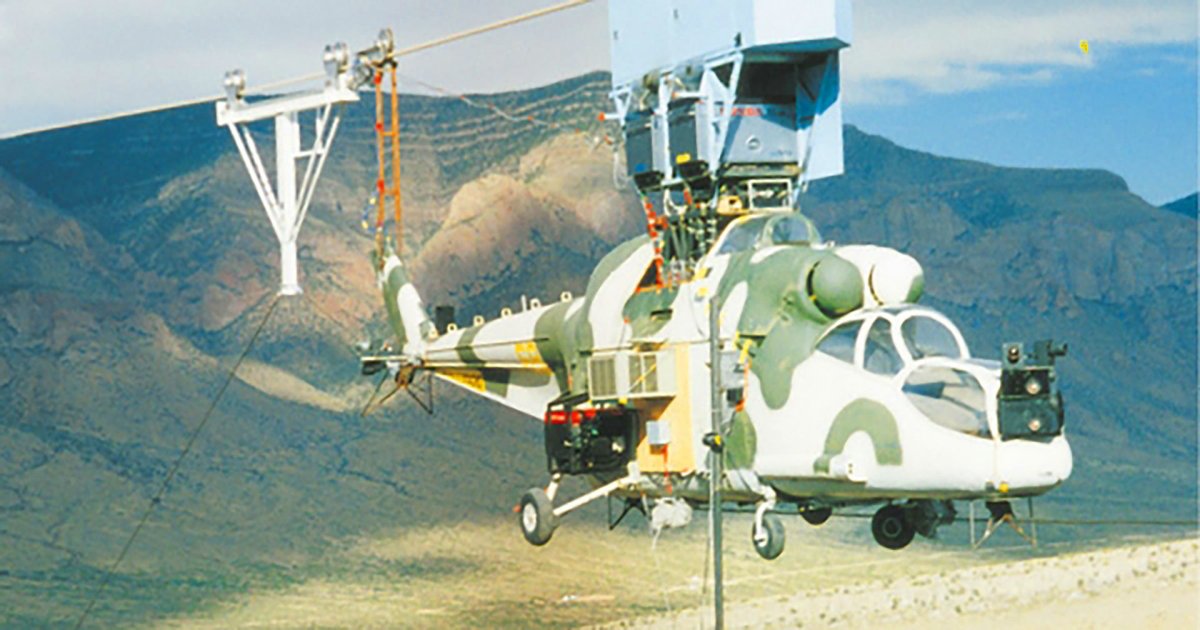
Dubbed the Aerial Cable Range, this facility is part of the sprawling White Sands Missile Range (WSMR) located in New Mexico. Managed by Lockheed Martin, the unique installation allows for simulated attacks on helicopters by anti-aircraft missile systems and other projectiles, but mainly the site is used for man-portable air defense systems (MANPADS) testing and testing of countermeasure systems that aim to repulse attacks from such weapons.
The Army describes the ACR as such:
The Aerial Cable Range (ACR) is a Tri-Service facility and has conducted tests for all armed forces. NATO customers have also been accommodated to service their needs. The facility provides a wide variety of testing which includes: Missile firings, Red and Blue types of Surface to Air (SAM) and Air to Air (ATA) Signature measurements (IR, UV, and Radar) Submunition Drops Antenna Development Ground fire characterization Aircraft characterization Electronic Warfare Countermeasure tests The ACR target can be stationary or dynamic. Dynamic gravity rolls of targets up to 120 knots and rocket-boosted rolls up to 240 knots can be accommodated. The ACR can position targets anywhere along the cable and have the targets rotated in 5 degree increments for different aspects. Depending on the target weight and size, targets can be lifted from ground level to a maximum of 1000 feet AGL. Onboard video links, timing, GPS, remote control via Labview, modems, and wireless LANS can be accommodated. The ACR is capable of high repeatability of test scenarios, target velocity, position, and control. Multiple launches are possible, as well as dual firings with any desired time separation. The ACR main features are: its 2.5 inch Kevlar able with 500,000 lbs breaking strength, 15,500 ft horizontal span and 2,500 ft vertical rop, operating tensions from less than 20,000 to 150,000 lbs, and 20,000 lb lift capability. There are no alternatives to this type of high-risk testing. The ACR provides flexible, devoted, and economic test services.
The Aerial Cable Range (ACR) is a Tri-Service facility and has conducted tests for all armed forces. NATO customers have also been accommodated to service their needs.
The facility provides a wide variety of testing which includes:
Missile firings, Red and Blue types of Surface to Air (SAM) and Air to Air (ATA)
Signature measurements (IR, UV, and Radar)
Ground fire characterization
Aircraft characterization
Countermeasure tests
The ACR target can be stationary or dynamic. Dynamic gravity rolls of targets up to 120 knots and rocket-boosted rolls up to 240 knots can be accommodated. The ACR can position targets anywhere along the cable and have the targets rotated in 5 degree increments for different aspects. Depending on the target weight and size, targets can be lifted from ground level to a maximum of 1000 feet AGL. Onboard video links, timing, GPS, remote control via Labview, modems, and wireless LANS can be accommodated.
The ACR is capable of high repeatability of test scenarios, target velocity, position, and control. Multiple launches are possible, as well as dual firings with any desired time separation.
The ACR main features are: its 2.5 inch Kevlar able with 500,000 lbs breaking strength, 15,500 ft horizontal span and 2,500 ft vertical rop, operating tensions from less than 20,000 to 150,000 lbs, and 20,000 lb lift capability.
There are no alternatives to this type of high-risk testing. The ACR provides flexible, devoted, and economic test services.
A Department of Defense article gives an even broader view of what the facility is capable of and its mission:
The range tests warning systems that alert military pilots to inbound enemy missiles. It consists of a synthetic cable three miles long, 2.5 inches thick, stretched between two mountain peaks; test platforms and targets that move along the cable; a control system to put the target in the right place at the right time, and a computer to collect and analyze data. Controllers can present moving or static targets. “The major advantages of this system are that it provides low-cost testing, precise data and quick turnaround times between tests,” facility manager George Huffman said. The alternative, he said, is overwater testing with drones. “But drones can test only one system, one time, and that’s expensive, whereas we can conduct 200 to 300 tests a year and use the target platform over and over again, at a cost of about $11,000 per day.” Lockheed spent $30 million to build the range, first used in 1994. Huffman said it saves DoD $80 million to $90 million a year over more expensive testing methods. Aerial cable targets typically are no-longer-used Apache and other model helicopters the range receives for the cost of shipping from the aerospace vehicle excess storage area at Davis-Monthan Air Force Base, Ariz. Weapons testers place experimental warning systems on the helicopter body, which are wired to computers in a carrier that attaches the helicopter to the aerial cable. Once all the experiments are on board the target platform, operators activate the cable system, which works like a ski lift, slowly moving the platform up toward 8,460-foot Jin Peak. Fixed and mobile instruments prepare to capture data from the target from positions on the mountainside, in the valley and aboard the target. Testers can fire missiles from any of 10 sites a kilometer apart, stretching down the length of the mountain valley. When everyone is ready, operators in the range control center send a signal to the cable-borne computer to launch the target and to missile launchers to fire away. Moving at speeds up to 250 knots, the cable propels the target forward until it reaches the predetermined juncture between target and missile. The missile impacts — and target debris drops to the desert floor. Within 30 minutes, crews recover the debris, keeping the fragile desert environment clean, while already the computers churn out data, and the cable is ready for the next experiments. “Everything about this system is extremely simple,” site manager Howard Waldie said. “It allows us to easily integrate projects, and tests can be accurately and easily repeated as often as necessary.
The range tests warning systems that alert military pilots to inbound enemy missiles. It consists of a synthetic cable three miles long, 2.5 inches thick, stretched between two mountain peaks; test platforms and targets that move along the cable; a control system to put the target in the right place at the right time, and a computer to collect and analyze data. Controllers can present moving or static targets.
“The major advantages of this system are that it provides low-cost testing, precise data and quick turnaround times between tests,” facility manager George Huffman said. The alternative, he said, is overwater testing with drones. “But drones can test only one system, one time, and that’s expensive, whereas we can conduct 200 to 300 tests a year and use the target platform over and over again, at a cost of about $11,000 per day.”
Lockheed spent $30 million to build the range, first used in 1994. Huffman said it saves DoD $80 million to $90 million a year over more expensive testing methods.
Aerial cable targets typically are no-longer-used Apache and other model helicopters the range receives for the cost of shipping from the aerospace vehicle excess storage area at Davis-Monthan Air Force Base, Ariz. Weapons testers place experimental warning systems on the helicopter body, which are wired to computers in a carrier that attaches the helicopter to the aerial cable.
Once all the experiments are on board the target platform, operators activate the cable system, which works like a ski lift, slowly moving the platform up toward 8,460-foot Jin Peak. Fixed and mobile instruments prepare to capture data from the target from positions on the mountainside, in the valley and aboard the target. Testers can fire missiles from any of 10 sites a kilometer apart, stretching down the length of the mountain valley.
When everyone is ready, operators in the range control center send a signal to the cable-borne computer to launch the target and to missile launchers to fire away. Moving at speeds up to 250 knots, the cable propels the target forward until it reaches the predetermined juncture between target and missile. The missile impacts — and target debris drops to the desert floor. Within 30 minutes, crews recover the debris, keeping the fragile desert environment clean, while already the computers churn out data, and the cable is ready for the next experiments.
“Everything about this system is extremely simple,” site manager Howard Waldie said. “It allows us to easily integrate projects, and tests can be accurately and easily repeated as often as necessary.
With the MANPADS threat having exploded over the last two decades, this facility is more important now than ever. Additionally, these days it is not just about countering shoulder-fired surface-to-air missiles with traditional decoy flares. BOL-IR expendables and especially directed-energy (laser) countermeasure systems have provided a more dynamic counter to even the most modern MANPADS.
But all these systems have to be tested both inside and outside of a lab—you can read much more about that testing here —and the Aerial Cable Range allows the latter to happen with economic efficiency and without putting lives in danger.
A whole new set of missile countermeasures are on the horizon that could bring a ton of work to the Aerial Cable Range. These include high-power laser defenses and even short-range kinetic kill systems .
The range supports testing not just aimed at defending allied helicopters from missile attacks but also at how to better kill enemy helicopters and low-flying aircraft. The FIM-92 Stinger remains America’s MANPADS of choice and close-in point air defense is becoming a major priority for the Army and Marines due to the rise of small but deadly drones and the increased possibility of peer-state warfare without the benefit of assured air superiority.
The Stinger has been upgraded over the years and operator training is now done in elaborate domed simulators to help ensure proper application during actual combat. But America’s potential enemies are also fielding advanced countermeasure systems, such as Russia’s President-S system which is now popping up on Russian helicopters operating in Syria and on export variants. Even Russia’s newest fighter, the Su-57, is equipped with a laser countermeasure system, the first of its kind for a fighter jet.
With all this in mind, building a better missile that can’t be fooled by the latest expendable countermeasures and directed energy light beams is absolutely essential. Being able to launch these missiles during testing at surrogate airframes equipped with advanced countermeasure systems and seeing how the missiles react is critical to keeping them relevant and effective on the modern battlefield. The ACR provides this unique capability.
So there you have it, White Sands Missile Range’s Aerial Cable Range, another obscure but essential testing facility in America’s massive weapons research and development infrastructure portfolio.
Contact the author: Tyler@thedrive.com
Comments couldn’t be loaded. Please refresh the page.
更新于美国东部时间2018年6月28日下午5:14
美国庞大的军工体系背后,其研发和测试基础设施之完善令人叹为观止。从宛如科幻小说中的雷达截面测量设施,到秘密或半公开的试验机场,再到巨大的消声室,以及位于爱达荷州湖畔的潜艇试验中心,这些设施以及许多其他类似的设施,将武器梦想转化为战场上的现实。
导弹及导弹反制技术的测试涵盖了对国家安全至关重要的关键能力,因此,验证此类系统在多种情况下的有效性至关重要。为此,人们开发了各种各样的测试设施,从全尺寸空中目标(FSAT)到模拟导弹导引头最终性能慢动作回放的大型模拟装置,应有尽有。而现在,我们又发现了一种与防空导弹及反制措施相关的复杂测试设施,该设施能让直升机沿着铁丝网在山顶间穿梭,同时模拟导弹从多个方向的攻击。
该设施被称为“空中电缆靶场”,是位于新墨西哥州的庞大白沙导弹靶场(WSMR)的一部分。该独特的设施由洛克希德·马丁公司管理,可以模拟防空导弹系统和其他弹药对直升机的攻击,但其主要用途是测试便携式防空导弹系统(MANPADS)以及旨在抵御此类武器攻击的反制系统。
陆军对ACR的描述如下:
架空电缆靶场 (ACR) 是三军联合设施,曾为所有武装部队进行过测试。北约客户也可在此获得服务,以满足其需求。该设施提供多种测试,包括:导弹发射、红蓝两类地对空导弹 (SAM) 和空对空导弹 (ATA) 测试、特征测量(红外、紫外和雷达)、子弹药投放、天线开发、地面火力特性测试、飞机特性测试以及电子战对抗测试。ACR 的目标可以是静止的,也可以是动态的。它可以进行高达 120 节的重力翻滚测试和高达 240 节的火箭助推翻滚测试。ACR 可以将目标放置在电缆上的任意位置,并以 5 度为增量旋转目标,以适应不同的视角。根据目标的重量和尺寸,目标可以从地面提升到最高 1000 英尺(约 305 米)的高度。此外,还可以配备机载视频链路、计时系统、GPS、基于 LabVIEW 的远程控制、调制解调器和无线局域网。 ACR 能够高度重复地模拟测试场景、目标速度、位置和控制。它支持多次发射,以及任意时间间隔的双发。ACR 的主要特点包括:采用 2.5 英寸凯夫拉纤维,断裂强度达 50 万磅;水平跨度 15,500 英尺,垂直绳长 2,500 英尺;工作张力范围从不足 2 万磅到 15 万磅;以及 2 万磅的起重能力。这种高风险测试方式无可替代。ACR 提供灵活、专注且经济的测试服务。
架空电缆测试场(ACR)是三军联合设施,曾为所有武装部队进行过测试。北约客户也能在此获得服务,满足他们的需求。
该机构提供多种检测服务,其中包括:
导弹发射,包括红色和蓝色类型的地对空导弹(SAM)和空对空导弹(ATA)。
特征测量(红外、紫外和雷达)
地面火灾特征
飞机特性
对策试验
ACR目标可以是静止的,也可以是动态的。动态重力翻滚速度最高可达120节,火箭助推翻滚速度最高可达240节。ACR可以将目标放置在缆绳上的任意位置,并以5度为增量旋转目标,以满足不同视角的需求。根据目标的重量和尺寸,目标可以从地面提升到最高1000英尺(约305米)的高度。系统可集成视频链路、计时、GPS、基于LabVIEW的远程控制、调制解调器和无线局域网等功能。
ACR 能够高度重复地实现测试场景、目标速度、位置和控制。它支持多次发射,以及任意时间间隔的双发发射。
ACR 的主要特点是:2.5 英寸凯夫拉纤维,断裂强度为 500,000 磅,水平跨度为 15,500 英尺,垂直绳长为 2,500 英尺,操作张力从小于 20,000 磅到 150,000 磅,以及 20,000 磅的提升能力。
目前尚无其他高风险检测方法可供选择。美国放射学会 (ACR) 提供灵活、专业且经济的检测服务。
美国国防部的一篇文章更全面地介绍了该设施的能力及其使命:
该靶场用于测试预警系统,该系统能够提醒军方飞行员注意来袭的敌方导弹。它由一条长三英里、直径2.5英寸的合成缆绳组成,缆绳横跨两座山峰;测试平台和目标沿着缆绳移动;控制系统用于在正确的时间将目标放置在正确的位置;以及一台用于收集和分析数据的计算机。控制人员可以设置移动目标或静态目标。“该系统的主要优势在于其低成本的测试、精确的数据以及快速的测试周转时间,”设施经理乔治·霍夫曼说道。他表示,另一种方法是使用无人机进行水上测试。“但无人机一次只能测试一个系统,而且成本很高,而我们每年可以进行200到300次测试,并反复使用目标平台,每天的成本约为11,000美元。”洛克希德公司斥资3000万美元建造了该靶场,并于1994年首次投入使用。霍夫曼表示,与更昂贵的测试方法相比,该系统每年可为美国国防部节省8000万至9000万美元。空中缆绳靶标通常是不再使用的阿帕奇或其他型号的直升机,靶场只需支付运费即可从亚利桑那州戴维斯-蒙森空军基地的航空航天飞行器剩余物资储存区接收这些直升机。武器测试人员将实验性预警系统安装在直升机机身上,这些系统通过电缆连接到载具内的计算机,载具将直升机固定在空中缆绳上。所有实验设备就位后,操作人员启动缆绳系统,该系统像滑雪缆车一样,缓慢地将平台提升到海拔8460英尺的金峰。固定和移动仪器准备从山坡、山谷和靶标上采集目标数据。测试人员可以从山谷中沿线相距一公里的10个发射点发射导弹。一切准备就绪后,靶场控制中心的操作人员向缆绳上的计算机发送信号,启动靶标并向导弹发射器发送发射信号。缆绳以高达250节的速度推动靶标前进,直至其到达预定的靶标与导弹交汇点。导弹命中目标——目标碎片落到沙漠地面。30分钟内,工作人员回收了碎片,保持了脆弱的沙漠环境的清洁。与此同时,计算机已经开始处理数据,电缆也已准备就绪,可以进行下一次实验。“这套系统的所有方面都极其简单,”现场经理霍华德·沃尔迪说道,“它使我们能够轻松地整合各个项目,并且可以根据需要多次准确、便捷地重复测试。”
该靶场测试预警系统,该系统可向军用飞行员发出敌方导弹来袭的警报。它由一条长三英里、直径2.5英寸的合成电缆组成,该电缆横跨两座山峰;测试平台和目标沿电缆移动;控制系统用于在正确的时间将目标放置在正确的位置;以及一台用于收集和分析数据的计算机。控制人员可以呈现移动目标或静态目标。
“这套系统的主要优势在于其低成本的测试、精准的数据以及快速的测试周转时间,”设施经理乔治·霍夫曼说道。他表示,另一种方法是使用无人机进行水上测试。“但无人机一次只能测试一个系统,而且成本很高,而我们每年可以进行200到300次测试,并反复使用目标平台,每天的成本约为11000美元。”
洛克希德公司花费 3000 万美元建造了该靶场,该靶场于 1994 年首次投入使用。霍夫曼表示,与更昂贵的测试方法相比,该靶场每年可为美国国防部节省 8000 万至 9000 万美元。
空中电缆靶标通常是不再使用的阿帕奇和其他型号的直升机,靶场只需支付运费即可从亚利桑那州戴维斯-蒙森空军基地的航空航天飞行器剩余存储区获得这些直升机。武器测试人员将实验性预警系统安装在直升机机身上,这些系统通过电线连接到载具中的计算机,载具将直升机连接到空中电缆上。
所有实验设备就位后,操作人员启动缆车系统,该系统如同滑雪缆车一般,缓慢地将平台提升至海拔8460英尺的金峰。固定式和移动式仪器准备就绪,将从山坡、山谷以及平台内部的不同位置采集目标数据。测试人员可以从山谷中沿线相距一公里的10个发射点发射导弹。
当一切准备就绪后,靶场控制中心的操作员向缆载计算机发送信号,启动目标发射和导弹发射。缆绳以高达250节的速度推进目标,直至其到达预定的目标与导弹交汇点。导弹命中目标后,目标残骸落入沙漠地面。30分钟内,工作人员回收残骸,保持脆弱的沙漠环境清洁。与此同时,计算机开始处理数据,缆绳也已准备就绪,可用于下一次试验。
“这套系统的所有方面都非常简单,”现场经理霍华德·沃尔迪说。“它使我们能够轻松地整合项目,并且可以根据需要多次准确、轻松地重复测试。”
过去二十年来,便携式防空导弹系统的威胁呈爆炸式增长,使得该设施的重要性比以往任何时候都更加凸显。此外,如今对抗肩扛式地对空导弹不再仅仅依靠传统的诱饵弹。红外制导干扰弹,尤其是定向能(激光)对抗系统,为对抗最先进的便携式防空导弹系统提供了更加动态的手段。
但所有这些系统都必须在实验室内外进行测试——您可以在这里阅读更多关于测试的信息——而架空电缆测试范围允许以经济高效的方式进行后者,并且不会危及生命。
一系列全新的导弹对抗措施即将问世,可能会给空中电缆靶场带来大量工作。这些措施包括高功率激光防御系统,甚至还有短程动能拦截系统。
该靶场不仅支持旨在防御盟军直升机免受导弹攻击的测试,还支持测试如何更好地击落敌方直升机和低空飞行飞机。FIM-92“毒刺”导弹仍然是美国首选的便携式防空导弹系统,而由于小型但致命的无人机的兴起以及在无法确保制空权的情况下与势均力敌的国家发生战争的可能性增加,近距离防空正成为陆军和海军陆战队的一项重要任务。
“毒刺”导弹经过多年升级,操作员训练现在也在精密的穹顶模拟器中进行,以确保在实战中能够正确运用。但美国的潜在敌人也在部署先进的对抗系统,例如俄罗斯的“总统-S”系统,该系统目前已出现在在叙利亚作战的俄罗斯直升机和出口型直升机上。甚至俄罗斯最新的战斗机苏-57也配备了激光对抗系统,这是战斗机领域首例此类系统。
鉴于以上种种,研制一种无法被最新型消耗性对抗措施和定向能光束欺骗的更优导弹至关重要。能够在配备先进对抗系统的模拟飞机上进行导弹测试,并观察导弹的反应,对于确保其在现代战场上的有效性和相关性至关重要。ACR 系统具备这种独特的能力。
这就是白沙导弹靶场的空中电缆靶场,它是美国庞大的武器研发基础设施组合中另一个鲜为人知但至关重要的测试设施。
联系作者:Tyler@thedrive.com
评论加载失败,请刷新页面。