With No Ejection Seats, Skyknight Fighter Crews Slid Down A Tunnel To Salvation由于没有弹射座椅,空中骑士战斗机的机组人员只能滑下隧道逃生。
Even special operations commandos used the Skyknight’s escape chute as a clandestine insertion method.
Updated May 5, 2021 4:00 PM EDT
The Douglas F3D Skyknight was an early carrier-capable jet fighter that first saw combat in the Korean War, and again over Vietnam. Unusually, in case of a serious emergency, its crew were expected to bail out via an escape chute, rather than using more familiar ejection seats . This unusual procedure was even adapted to deliver special operations forces on at least one occasion during maneuvers in the late 1950s.
While rather forgotten today, the Skyknight represented a major advance for the U.S. Navy and Marine Corps when it arrived in service in 1950. Big and bulky, the Douglas design, armed with four 20mm cannons, had little in common with the sleek jets that were by then starting to appear. Still, over Korea it established an enviable record as a night-fighter, achieving the world’s first night-time jet-versus-jet kill using radar and becoming the highest-scoring Navy and Marine Corps fighter of that conflict.
A U.S. Navy F3D-1 Skyknight from the first operator, Fleet Composite Squadron Three at Naval Air Station Moffett Field, California, where service trials were conducted beginning in late 1950., U.S. Navy
The fact it was developed as a night-fighter goes some way to explain why the designers chose this unorthodox crew escape system. The squat, straight-winged Skyknight was built around a two-crew concept, with a pilot plus an airborne intercept operator (AIO), at least in the initial versions, to operate the separate search and tracking radars in the nose. Since this was the era of vacuum-tube technology, a wide fuselage was required to accommodate this equipment, which could detect targets at a range of between 15 and 20 miles. There was another radar in the tail to scan for hostile aircraft approaching from the rear.
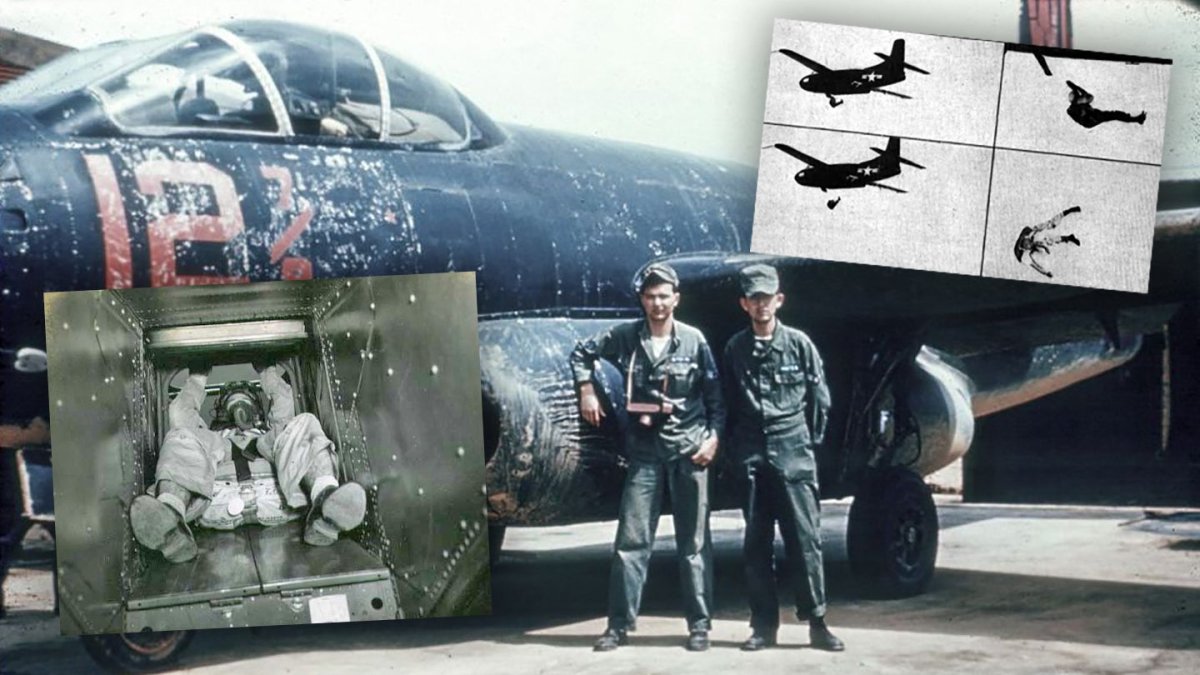
A Navy aviator bails out from an XF3D-1 at Naval Air Facility El Centro, California, in around 1949, during tests of the escape system., U.S. NAVY
Side-by-side seating was better for crew coordination and the ejection seats then available were not considered safe enough to extract two people sitting next to each other, due to the danger of collision or damage from the respective rocket motors. In addition, the rocket-powered seats would have added more weight and complexity to a design, which was powered by two non-afterburning Westinghouse turbojets that were already somewhat lacking in thrust.
Instead, a tunnel-like chute led down and aft from the cockpit, behind the seats, from which the crew could slide down in an emergency, popping out from the underside of the jet, between the engines. This system was also supposed to be safe to use at high speeds. A similar arrangement would later be a feature of the Douglas A3D Skywarrior , although that was a Cold War bomber design, so a lack of ejection seats was less unusual.
Crewman of a U.S. Marine Corps F3D during a night training mission in 1954. The airborne intercept operator is on the left, with the pilot on the right., NATIONAL ARCHIVES
Exactly how the crew would exit the stricken Skyknight is explained by former U.S. Air Force F-15 Eagle pilot Paul Woodford on his blog, which you can check out here :
“In the event that the crew had to bail out, they would depressurize the cockpit and pivot their seats toward each other. The first crewmember [the AIO] would get out of his seat, face aft, and kick open the escape chute door, which would presumably fall out and away through the chute. Grasping a horizontal bar, the crewmember would swing into the chute feet first, then slide out the belly of the aircraft, followed by the second crewmember.”
The following sequence of photos shows ground tests of the F3D crew escape system:
The crew members pivot their seats to face each other., VIA PAUL WOODFORD
Grabbing a bar above the escape chute, the first crewman kicks the hatch open and swings his legs out., VIA PAUL WOODFORD
Sliding down the escape chute., VIA PAUL WOODFORD
Followed by a safe landing onto a pile of mattresses below., VIA PAUL WOODFORD
This same method of practicing bailout was continued throughout the career of the F3D, which was redesignated F-10 from September 1962 when a new U.S. military-wide aircraft nomenclature system was adopted. Typically, the aircraft would be jacked up and mattresses would be laid out under the belly for this kind of training.
“When you get ready to go, there’s a handle that you pull, and a trap door flies open, and a panel on the bottom of the airplane falls off, and the pilot’s seat literally falls apart,” Marine General Jack Dailey told
Air & Space magazine. “We used to try to jump on the ECMO [electronic countermeasures officer, who replaced the AIO in later models],” Dailey added. “If he loitered on that mattress, he was going to get stomped on by the pilot.”
A rare color inflight view of a U.S. Navy F3D-1 in flight near Naval Air Station Patuxent River, Maryland., U.S. Navy
Despite being the recipient of several less than complimentary nicknames — “Willie the Whale,” “Turtle,” “Blue Whale,” “Drut” (the last of those intended to be read backward) — the Skyknight enjoyed a long career with the Navy and Marine Corps as a night-fighter, radar intercept trainer, and electronic jamming platform. The crew escape system does not seem to have been a particular problem and there are no recorded attempts to retrofit ejection seats, even during the jet’s final years of combat service in Vietnam.
Confidence in the escape system would have been provided, at least in part, by a series of live crew extractions made by experienced parachutists during tests at Naval Air Facility El Centro in California even before the F3D entered service. In these tests, parachutists successfully bailed out of the jet no fewer than 22 times at speeds of between 139 and 444 miles per hour.
Parachutist and part of the parachute seen from a camera mounted under the wing of the XF3D-1 prototype during the El Centro tests., PUBLIC DOMAIN
Then, test dummies were substituted for live parachutists as the speeds were increased to 496 miles per hour. The top speed of the F3D was around 530 miles per hour. Again, these trials proved successful. For the crew, it was recommended to open the parachute between five and 20 seconds after bailing out, it being calculated that they would have decelerated in that time and the forces exerted on them when the canopy opened would be reduced accordingly. In other tests, the jet maneuvered as the parachutist bailed out, imparting forces of up to 3.5 G. Again, things went as planned.
Such was the versatility of the Skyknight that thought was also given to using its unusual crew-extraction system to deliver Marine reconnaissance troops via the same method.
Interviewed by Air & Space magazine, Marine Corps pilot Jerry Dixon recalled an exercise in the Philippines in early 1958 in which his F3D was slated to fly a mission as an adversary aircraft. To make things tougher for the defending forces, a flight of four Skyknights would each carry a Marine commando instead of an AIO, dropping them behind enemy lines in a clandestine night-time insertion.
“When we got to the drop zone, the formation leader made the prearranged signal to drop, I tapped my raider on the head, and he was gone like a shot,” recalled Dixon. “You talk about a set of balls to do what those guys did.” Two of the commandos suffered broken bones once they landed in the jungle.
U.S. Marine Corps F3D-2Qs near Marine Corps Air Station El Toro, California, in 1958., U.S. NAVY
The Skyknight’s insertion of special forces continued a tradition established in World War II, during which adapted bombers were typically used to deliver agents, again often via chutes. Similar tactics also continued after that conflict and the Marines, in particular, also trained to drop reconnaissance elements from the cargo compartments of their OV-10 Bronco aircraft.
The latter half of the Skyknight’s career was dominated by second-line roles, but many of these involved critical test work, including for advanced radars, missile guidance systems, and other electronic equipment. During the 1950s, adapted aircraft had the new Sparrow I beam-riding air-to-air missile integrated, helping prove out this emerging technology, while another F3D became the first aircraft to complete an automatic carrier landing , in 1957.
The Skyknight also provided radar training to fighter pilots destined to fly other, more advanced types, including radar intercept officers (RIOs) for the F4H-1H Phantom II , which was later redesignated the F-4B.
A U.S. Navy F3D-2T2 trainer from Fighter Squadron VF-101 at Naval Air Station Key West, Florida, in 1961., U.S. NAVY
The very last frontline variant was the F3D-2Q — later redesignated the EF-10B — a radar-jamming aircraft that served with the Marine Corps at Da Nang, South Vietnam, from April 1965, flying passive and active electronic warfare missions over North Vietnam. The last such mission was flown in May 1970. Even after that date, F-10s continued to be used for various research and development work for decades, at least some technically being transferred to the Army and then operated by Raytheon contractors for this purpose.
All through this time, the crews of the Skyknight relied on a unique escape system, should they have ever got into serious trouble to the point of needing to make a hasty exit from the cockpit.
Contact the author: thomas@thedrive.com
Comments couldn’t be loaded. Please refresh the page.
更新于美国东部时间2021年5月5日下午4:00
道格拉斯F3D“空中骑士”是一款早期舰载喷气式战斗机,首次投入实战是在朝鲜战争中,之后又在越南战争中再次参战。不同寻常的是,在发生严重紧急情况时,其机组人员需要通过逃生伞跳伞,而不是使用更常见的弹射座椅。这种特殊的程序甚至在20世纪50年代末的一次演习中被用于运送特种作战部队。
尽管如今已鲜为人知,但“空中骑士”战斗机在1950年服役时,对美国海军和海军陆战队而言却是一项重大进步。这款由道格拉斯公司设计的大型笨重的战斗机,配备四门20毫米机炮,与当时开始出现的流线型喷气式战斗机截然不同。然而,在朝鲜战争中,它作为夜间战斗机取得了令人瞩目的战绩,实现了世界上首次利用雷达在夜间击落敌机的壮举,并成为朝鲜战争中美国海军和海军陆战队战绩最高的战斗机。
美国海军的一架F3D-1“空中骑士”战斗机,隶属于加利福尼亚州莫菲特海军航空站的第三舰队综合中队,该中队是该机型的首个用户,并于1950年末开始进行服役试验。
它最初是作为夜间战斗机开发的,这在一定程度上解释了为什么设计者会选择这种非传统的机组逃生系统。这款外形矮胖、采用直翼设计的“空中骑士”战斗机采用双机组布局,至少在最初版本中,由一名飞行员和一名空中拦截操作员(AIO)组成,负责操作机头独立的搜索和跟踪雷达。由于当时正值真空管技术时代,因此需要宽大的机身来容纳这些设备,这些设备可以探测15到20英里范围内的目标。机尾还装有另一部雷达,用于扫描从后方接近的敌机。
大约在1949年,一名海军飞行员在加利福尼亚州埃尔森特罗海军航空站从一架XF3D-1飞机上跳伞逃生,当时正在进行逃生系统测试。(美国海军)
并排座椅更有利于机组人员的协调配合,而且当时可用的弹射座椅安全性不足,无法安全地弹射并排就坐的两名乘客,因为存在碰撞或被各自火箭发动机损坏的风险。此外,火箭动力座椅还会增加飞机的重量和复杂性,而该飞机原本就由两台推力略显不足的无加力西屋涡轮喷气发动机提供动力。
取而代之的是,驾驶舱座椅后方设有一个隧道状的滑道,机组人员可以在紧急情况下从滑道滑下,从飞机底部、发动机之间弹出。这套系统据说在高速度下也能安全使用。类似的装置后来也出现在道格拉斯A3D“空中战士”轰炸机上,不过A3D是冷战时期的轰炸机设计,所以没有弹射座椅并不罕见。
1954年,美国海军陆战队一架F3D战斗机的机组人员在夜间训练任务中。左侧是空中拦截操作员,右侧是飞行员。(美国国家档案馆)
前美国空军F-15“鹰”式战斗机飞行员保罗·伍德福德在他的博客中详细解释了机组人员将如何离开这架故障的“空中骑士”战机,你可以在这里查看:
“如果机组人员必须跳伞,他们会先给驾驶舱减压,然后将座椅转向彼此。第一名机组人员(副驾驶)会离开座位,面向后方,踢开逃生舱门,舱门会随即从舱口滑出。该机组人员抓住一根横杆,脚先进入逃生舱,然后从机腹滑出,第二名机组人员紧随其后。”
以下照片序列展示了F3D乘员逃生系统的地面测试:
机组人员转动座椅,彼此面对面。(图片来自保罗·伍德福德)
第一名船员抓住逃生舱口上方的横杆,一脚踢开舱门,双腿伸了出去。(图片来自保罗·伍德福德)
滑下逃生滑道。(图片来自保罗·伍德福德)
随后安全着陆在下面的床垫堆上。(图片来自保罗·伍德福德)
这种弹射逃生训练方法在F3D的整个服役生涯中一直沿用。1962年9月,随着美国军方采用新的飞机命名系统,F3D被重新命名为F-10。通常情况下,这类训练会将飞机顶起,并在机腹下方铺上床垫。
“准备起飞时,你拉一下把手,舱门就会打开,飞机底部的一块面板就会脱落,飞行员的座椅也会彻底散架,”海军陆战队上将杰克·戴利说道。
《航空航天》杂志。“我们以前常常试图扑向电子对抗官(ECMO,后来的机型中取代了AIO),”戴利补充道。“如果他赖在床垫上不走,飞行员就会把他踩扁。”
一张罕见的彩色飞行照片,拍摄于马里兰州帕图克森特河海军航空站附近,展现了一架美国海军F3D-1战斗机的飞行姿态。
尽管“空中骑士”战斗机曾获得过不少不太好听的绰号——“鲸鱼威利”、“乌龟”、“蓝鲸”、“德鲁特”(最后一个是反着读的)——但它在海军和海军陆战队服役多年,曾作为夜间战斗机、雷达拦截训练机和电子干扰平台使用。机组人员逃生系统似乎并未出现什么大问题,也没有任何记录表明曾尝试为其加装弹射座椅,即使在该机在越南战争中服役的最后几年也是如此。
至少部分得益于经验丰富的跳伞员在F3D战斗机服役前于加利福尼亚州埃尔森特罗海军航空基地进行的一系列实弹机组人员撤离测试。在这些测试中,跳伞员以每小时139至444英里的速度成功跳伞不下22次。
在埃尔森特罗测试期间,从安装在XF3D-1原型机机翼下方的摄像机拍摄到的跳伞员和部分降落伞。(公共领域)
随后,试验人员用假人代替真人跳伞员,并将速度提升至每小时496英里。F3D的最高速度约为每小时530英里。这些试验再次取得了成功。对于机组人员,建议在跳伞后5至20秒内打开降落伞,因为据计算,在此期间他们会减速,降落伞打开时所受到的力也会相应减小。在其他测试中,喷气式飞机在跳伞员跳伞时进行机动,施加了高达3.5G的过载。一切也都按计划进行。
天空骑士的用途非常广泛,甚至有人考虑利用其独特的乘员撤离系统,以同样的方式运送海军陆战队侦察部队。
在接受《航空航天》杂志采访时,海军陆战队飞行员杰里·迪克森回忆起1958年初在菲律宾的一次演习。当时,他的F3D战斗机被安排执行假想敌任务。为了加大敌方防御难度,四架F3D“空中骑士”战斗机将分别搭载一名海军陆战队突击队员,而不是一名空中作战情报官(AIO),在夜间秘密空投至敌后。
“到达空降区后,队长发出预先约定的空降信号,我拍了拍我的突击队员的头,他就像箭一样冲了出去,”迪克森回忆道。“你不得不佩服他们的胆量。”两名突击队员在丛林着陆后骨折。
1958年,美国海军陆战队的F3D-2Q战斗机在加利福尼亚州埃尔托罗海军陆战队航空站附近。
“空中骑士”特种部队的部署延续了二战时期确立的传统,当时通常使用改装的轰炸机投放特工,而且往往是通过降落伞。类似的战术在二战后也得以延续,特别是海军陆战队,他们还训练从OV-10“野马”侦察机的货舱投放侦察兵。
“空中骑士”战机服役生涯的后半段主要承担二线任务,但其中许多任务都涉及关键的测试工作,包括先进雷达、导弹制导系统和其他电子设备的测试。20世纪50年代,一些改装后的飞机集成了新型的“麻雀I”型乘波空空导弹,帮助验证了这项新兴技术。1957年,另一架F3D战机成为首架完成自动航母着舰的飞机。
“空中骑士”还为即将驾驶其他更先进机型的战斗机飞行员提供雷达训练,包括为 F4H-1H“鬼怪II”(后来重新命名为 F-4B)训练雷达拦截官(RIO)。
1961年,美国海军第101战斗机中队的一架F3D-2T2教练机,驻扎在佛罗里达州基韦斯特海军航空站。
最后一款一线作战型号是F3D-2Q(后重新命名为EF-10B),这是一款雷达干扰飞机,自1965年4月起在南越岘港的美国海军陆战队服役,执行对北越的被动和主动电子战任务。最后一次此类任务于1970年5月执行。即便在那之后,F-10战斗机仍继续用于各种研发工作数十年,其中至少一部分在技术上移交给了美国陆军,并由雷神公司的承包商负责运营。
在此期间,天骑士号的机组人员依靠一种独特的逃生系统,以防他们遇到严重麻烦,需要迅速离开驾驶舱。
联系作者:thomas@thedrive.com
评论加载失败,请刷新页面。