France updates submarine-launched nuclear missile amid arms race法国在军备竞赛中更新潜射核导弹
The third and latest version of the M51 has new nuclear warheads as well as improved range, accuracy and capability to penetrate enemy defenses.
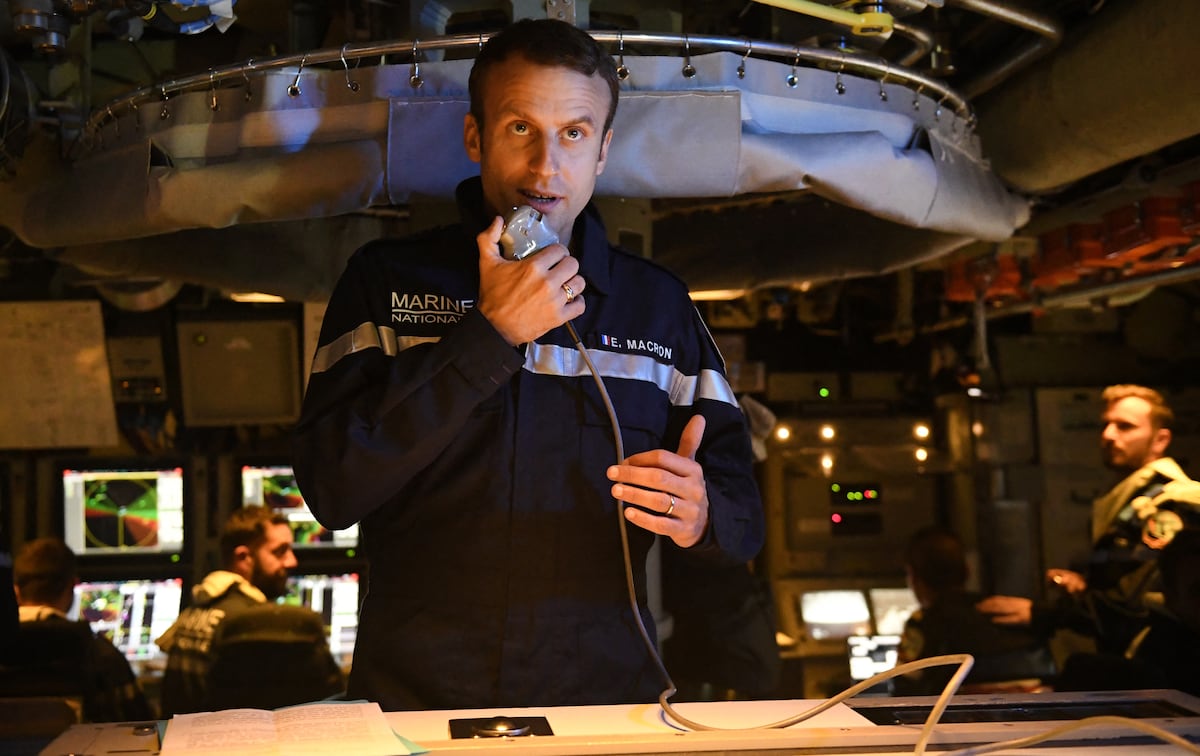
PARIS — France introduced a modernized version of its M51 submarine-launched strategic ballistic missile, a “major milestone” in the modernization of the country’s ocean-based nuclear deterrent, the Armed Forces Ministry said on Tuesday.
The third and latest version of the M51 has new nuclear warheads as well as improved range, accuracy and capability to penetrate enemy defenses, the ministry said in an emailed statement. The M51.3 will be deployed aboard France’s four Le Triomphant nuclear-powered ballistic missile submarines.
“The M51.3 ensures the continued credibility of the ocean-based component in the face of evolving enemy missile defenses,” the ministry said.
The M51 update comes amid what the Stockholm International Peace Research Institute in June described as a dangerous new nuclear arms race , with nearly all nuclear-armed states working to upgrade existing weapons and add newer versions.
As potential adversaries such as Russia modernize anti-ballistic missile capabilities , older missile designs could be at great risk of being intercepted. That in turn could diminish France’s ability to guarantee a credible second-strike capability, hurting its nuclear deterrence posture.
Armed Forces Minister Catherine Vautrin signed the operational commissioning of the M51.3 missile on Friday.
“This achievement embodies a major ambition of the 2024-2030 Military Programming Law: to accelerate the modernization of our capabilities and ensure the long-term credibility of our deterrence, the sovereign pillar of our security,” Vautrin said in a social media post .
The upgraded missile also signals France’s determination to maintain what it calls strategic autonomy within NATO. The country keeps its nuclear forces separate from the alliance’s command-and-control structure and decision-making process, though France and the U.K. in July agreed to potentially coordinate their respective deterrents.
The M51.3 program was overseen by France’s Directorate General for Armament, with the new TNO-2 warhead developed by France’s Commissariat for Atomic Energy, and with ArianeGroup in charge of missile design and propulsion.
The M51 missile has an intercontinental range and carries multiple nuclear warheads, according to the ministry. Each of France’s ballistic missile submarines is equipped with 16 of the missiles, which consist of a solid-propellant three-stage launcher with a weight of more than 50 metric tons and a length of 12 meters, according to ArianeGroup.
While the exact range of the missile is undisclosed, ArianeGroup says the M51 reaches an altitude of more than 2,000 kilometers before reentering the atmosphere at speed of Mach 20, carrying its payload over a distance of “several thousand kilometers.”
The M51.3 is estimated to have a range of more than 9,500 kilometers, compared to more than 9,000 kilometers for the previous iteration, according to the Bulletin of the Atomic Scientists .
The missile carries four to six multiple independently-targetable reentry vehicles or MIRVs, each with a yield believed to be 100 kilotons, according to the Bulletin. For each warhead, that would be more than six times the yield of the nuclear bomb dropped over Hiroshima in August 1945.
Work on the M51.3 started in 2014, while development of the TNO-2 warhead started in 2013, according to the Armed Forces Ministry. ArianeGroup and the DGA completed the first test flight of the M51.3 missile from the Biscarrosse launch site in southwestern France in November 2023.
The first version of the M51 ballistic missile became operational in 2010, and the DGA in August tasked ArianeGroup with development of the future M51.4 version .
France is also working to replace the Le Triomphant-class submarines starting in the 2030s as part of its nuclear modernization, with Naval Group cutting the first steel for the so-called SNLE 3G program in March last year. France expects to operate the next-generation submarines for nuclear deterrence until the end of the 2080s.
As well as updating the ocean-based nuclear-deterrence component, France is working on the air-launched ASN4G hypersonic missile to replace the ASMPA nuclear cruise missile carried by the Rafale fighter jet. The new missile is to be integrated on the future F5 standard of the Rafale.
The country is counting on the Future Combat Air System, the French-German-Spanish project marred by infighting between Dassault Aviation and Airbus, to provide the future airborne component of its nuclear deterrence. France has said its requirements for the FCAS aircraft include being able to carry a nuclear weapon and operate from an aircraft carrier.
Rudy Ruitenberg is a Europe correspondent for Defense News. He started his career at Bloomberg News and has experience reporting on technology, commodity markets and politics.
巴黎——法国武装部队部周二表示,法国推出了M51潜射战略弹道导弹的现代化版本,这是该国海洋核威慑力量现代化进程中的一个“重要里程碑”。
法国国防部在一份电子邮件声明中表示,M51导弹的第三代也是最新改进型配备了新型核弹头,射程、精度和穿透敌方防御的能力均有所提升。M51.3型导弹将部署在法国的四艘“凯旋”级核动力弹道导弹潜艇上。
“面对不断演变的敌方导弹防御系统,M51.3 确保了海洋防御系统的持续可靠性,”国防部表示。
M51 的更新正值斯德哥尔摩国际和平研究所 6 月份所描述的危险的新核军备竞赛之际,几乎所有拥有核武器的国家都在努力升级现有武器并增加新版本。
随着俄罗斯等潜在对手不断升级反弹道导弹能力,老旧导弹设计极易被拦截。这反过来又会削弱法国确保可靠二次打击能力的能力,损害其核威慑态势。
武装部队部长凯瑟琳·沃特林于周五签署了M51.3导弹的作战服役文件。
“这一成就体现了《2024-2030年军事规划法》的一项重大目标:加快我国军事能力的现代化,确保我国威慑力量(我国安全的支柱)的长期可信度,”沃特林在社交媒体上发帖说。
此次升级后的导弹也表明了法国维护其在北约内部所谓“战略自主”的决心。法国将其核力量与北约的指挥控制结构和决策程序分开,尽管法国和英国在7月份同意在必要时协调各自的核威慑力量。
M51.3 计划由法国军备总局监督,新型 TNO-2 弹头由法国原子能委员会开发,阿丽亚娜集团负责导弹设计和推进。
据法国国防部称,M51导弹射程可达洲际,并可携带多个核弹头。据阿丽亚娜集团称,法国每艘弹道导弹潜艇都配备16枚这种导弹,其由一个固体燃料三级发射装置组成,重量超过50吨,长度为12米。
虽然导弹的确切射程尚未公开,但阿丽亚娜集团表示,M51 导弹在以 20 马赫的速度重返大气层之前,可以达到 2000 公里以上的高度,并将有效载荷携带至“数千公里”的距离。
据《原子科学家公报》报道,M51.3 的射程估计超过 9500 公里,而上一代的射程超过 9000 公里。
据《原子科学家公报》报道,该导弹携带四到六枚多弹头独立重返大气层载具(MIRV),每枚弹头的当量据信为10万吨。如果按每枚弹头计算,其当量将是1945年8月投掷在广岛的原子弹当量的六倍以上。
据法国武装部队部称,M51.3导弹的研发工作始于2014年,而TNO-2弹头的研发工作则始于2013年。2023年11月,阿丽亚娜集团和法国国防采购局在法国西南部的比斯卡罗斯发射场完成了M51.3导弹的首次试飞。
M51弹道导弹的第一个版本于2010年投入使用,同年8月,法国国防采购局(DGA)委托阿丽亚娜集团开发未来的M51.4版本。
法国也在推进核现代化进程,计划从2030年代开始替换“凯旋”级潜艇。法国海军集团去年3月为所谓的SNLE 3G项目切割了第一块钢板。法国预计将使用下一代核威慑潜艇至2080年代末。
除了升级海基核威慑力量外,法国还在研发空射型ASN4G高超音速导弹,以取代阵风战斗机携带的ASMPA核巡航导弹。新型导弹将集成到未来F5型阵风战斗机上。
法国寄希望于未来作战空中系统(FCAS)——这个由法国、德国和西班牙联合开发,但因达索航空和空客公司内部纷争而陷入困境的项目——来为其未来的核威慑力量提供空中组成部分。法国曾表示,其对FCAS战机的要求包括能够携带核武器并从航空母舰上起降。
鲁迪·鲁伊滕贝格是《防务新闻》的欧洲记者。他的职业生涯始于彭博新闻社,拥有报道科技、大宗商品市场和政治方面的经验。