Rheinmetall, MBDA tout German shipborne laser gun for zapping drones莱茵金属公司和MBDA公司力推德国舰载激光炮,用于击落无人机
The system demonstrated what Rheinmetall described as a first for Europe: successful target engagement “in front of blue sky."
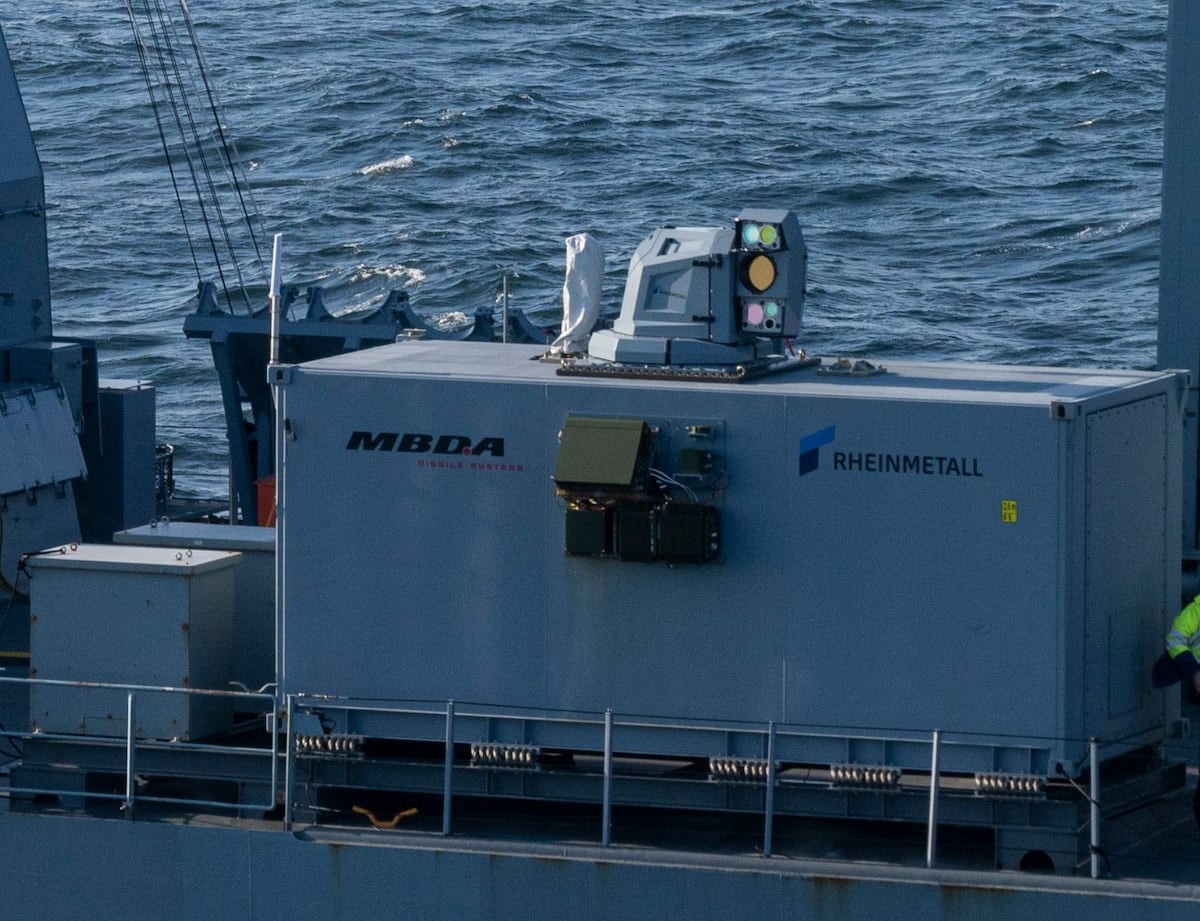
BERLIN — The German military has received a demonstrator for a high-energy laser weapon developed by Rheinmetall and MBDA, marking a milestone toward fielding an operational directed-energy system for naval use by 2029.
The containerized laser system was relocated to the Laser Competence Centre at the Technical Centre for Weapons and Ammunition (WTD 91) in Meppen on Oct. 28, following a year-long trial phase aboard the German Navy frigate Sachsen, Rheinmetall said in a statement. The hand-off comes after the demonstrator completed more than 100 live-firing tests under operational maritime conditions, proving its ability to track and engage drones and other fast-moving targets.
The system demonstrated what Rheinmetall described as a first for Europe: successful target engagement “in front of blue sky,” meaning without using terrain as a backstop for the laser beam. The trials validated the weapon’s tracking capability, precision and reaction speed against drones, which the companies emphasized as “one of the most pressing challenges” in modern warfare.
According to a statement by the two defense contractors, the laser weapon is designed to complement conventional cannons and guided missiles, particularly for defense against drones, drone swarms, speedboats, and potentially guided missiles at close range. Future iterations could be scaled up to engage supersonic missiles, rockets, and even mortar and artillery shells, Rheinmetall said.
The two German companies have collaborated on laser weapon development since 2019, with responsibilities divided between them. MBDA Germany handles target detection and tracking, the control console, and integration with command-and-control systems, while Rheinmetall oversees the aiming system, beam guidance, the high-energy laser source, and mechanical integration aboard naval platforms.
The demonstrator currently operates at approximately 20 kilowatts, suitable for neutralizing small unmanned aerial vehicles and light surface targets. However, the architecture is designed to be scalable, with future versions expected to exceed 100 kilowatts for engaging larger threats.
The system will now undergo further land-based drone defense testing at WTD 91, one of the largest fully instrumented ground firing ranges in Western Europe. If trials continue to meet German military requirements, procurement decisions could come within a few years, placing Germany among a small cadre of nations with operational naval laser weapons alongside the United States and Israel.
Linus Höller is Defense News' Europe correspondent and OSINT investigator. He reports on the arms deals, sanctions, and geopolitics shaping Europe and the world. He holds master’s degrees in WMD nonproliferation, terrorism studies, and international relations, and works in four languages: English, German, Russian, and Spanish.
柏林——德国军方已收到由莱茵金属公司和MBDA公司联合研制的高能激光武器演示样机,这标志着在2029年之前为海军部署可操作的定向能系统迈出了重要一步。
莱茵金属公司在一份声明中表示,经过在德国海军“萨克森”号护卫舰上为期一年的试验阶段后,这套集装箱式激光系统于10月28日被移交给位于梅彭的武器弹药技术中心(WTD 91)的激光能力中心。此次移交是在该系统完成100多次实弹射击测试之后进行的,测试模拟了海上作战环境,证明了其跟踪和打击无人机及其他高速移动目标的能力。
该系统展示了莱茵金属公司所称的欧洲首创:在“蓝天之下”成功锁定目标,这意味着无需利用地形作为激光束的阻挡。试验验证了该武器的跟踪能力、精度和对抗无人机的反应速度,两家公司强调,对抗无人机是现代战争中“最紧迫的挑战之一”。
两家国防承包商在一份声明中表示,这种激光武器旨在与传统火炮和制导导弹配合使用,尤其适用于近距离防御无人机、无人机群、快艇以及潜在的制导导弹。莱茵金属公司称,未来的改进型激光武器可以升级,用于拦截超音速导弹、火箭弹,甚至迫击炮弹和炮弹。
这两家德国公司自2019年以来一直在激光武器研发方面展开合作,双方分工明确。MBDA德国公司负责目标探测和跟踪、控制台以及与指挥控制系统的集成,而莱茵金属公司则负责瞄准系统、光束制导、高能激光源以及在海军平台上的机械集成。
该演示装置目前运行功率约为20千瓦,适用于摧毁小型无人机和轻型地面目标。然而,其架构设计具有可扩展性,未来版本预计功率将超过100千瓦,用于应对更大规模的威胁。
该系统接下来将在西欧最大的全功能地面靶场之一——WTD 91靶场进行进一步的陆基无人机防御测试。如果试验持续满足德国军方的要求,采购决定可能在几年内做出,届时德国将与美国和以色列一起,跻身少数几个拥有可操作海军激光武器的国家之列。
林努斯·霍勒是《防务新闻》的欧洲记者和开源情报调查员。他报道影响欧洲乃至全球的军火交易、制裁和地缘政治。他拥有大规模杀伤性武器不扩散、恐怖主义研究和国际关系三个硕士学位,并精通英语、德语、俄语和西班牙语四种语言。