UK eyes $50 billion in pooled NATO funds for new long-range strike initiative英国寻求利用北约500亿美元的联合资金,开展新的远程打击计划。
Details were scant about a project that may amount to another European weapons-coordination umbrella rather than new technology development.
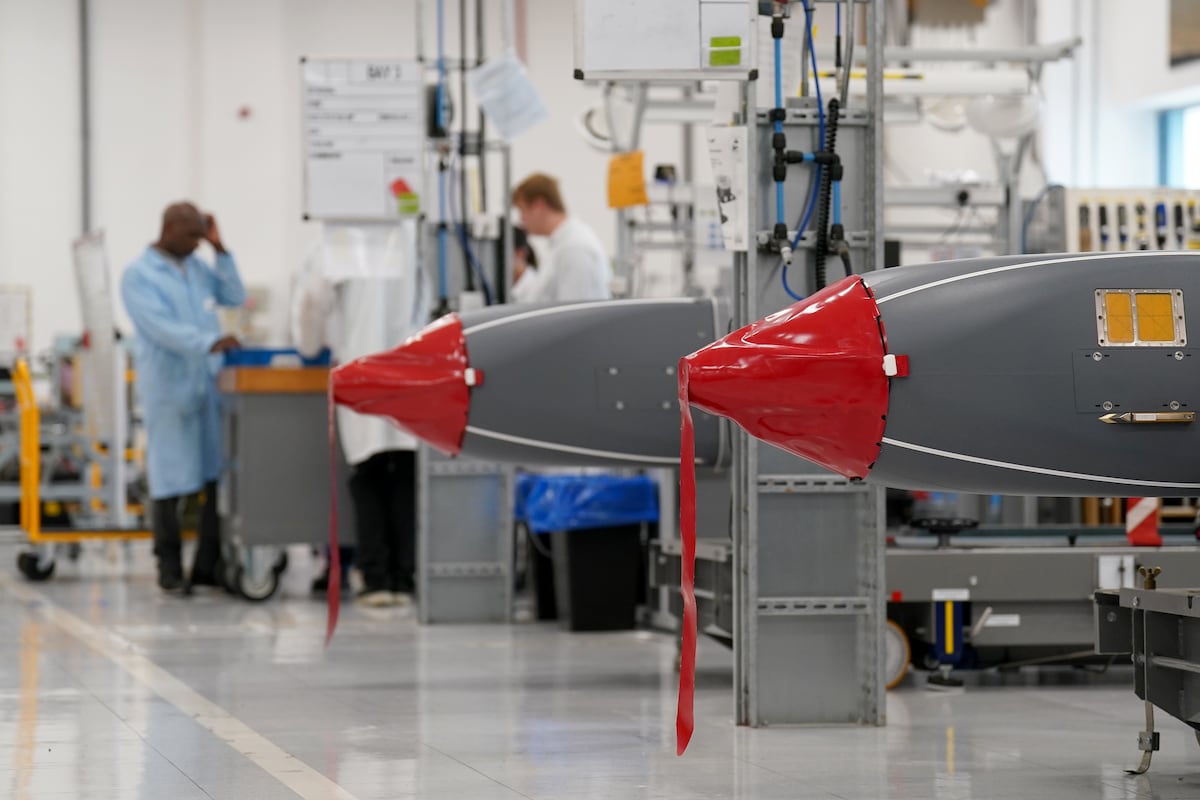
VIENNA — The United Kingdom unveiled a $50 billion, decade-long push to accelerate European deep precision strike capabilities during the NATO summit on Wednesday, positioning London at the head of a coalition of twelve NATO allies.
The figure is less a single procurement contract than a financing and coordination structure meant to knit together a scattered set of national and bilateral missile programs that have been building since 2024.
The announcement leans heavily on the idea of pooling, not building, new technology. British officials described the initiative as a mechanism to “share expertise, technology advances and deepen industrial collaboration to rapidly advance NATO capabilities,” rather than a specification for a single new weapon.
The breadth of range requirements involved − everything from 300 kilometers to systems eventually exceeding 2,000 kilometers − spans engineering problems likely too disparate to be solved by a single missile design.
Instead, the $50 billion appears to aggregate work already underway. The British contribution to the sum is £3 billion ($4 billion), according to a press release by the prime minister’s office, which was split across a bilateral project with Germany and trilateral work with Italy and France on the Stratus missile.
The U.K.-Germany Trinity House program targets the development of stealth and hypersonic weapons beyond 2,000 kilometers for entry into service in the 2030s. The Stratus effort, meanwhile, recently secured a fresh £1.4 billion ($1.9 billion) U.K. commitment over four years toward a Storm Shadow successor.
In the same announcement, London also said it is joining the U.S. and Australia in the Precision Strike Missile program, which is designed to replace the American ATACMS missile.
Separately, a day earlier, NATO said six of its members − Denmark, France, Italy, Norway, Turkey and the United Kingdom − had launched a “multinational Ground-Based Precision Strike Capabilities High Visibility Project to explore the multinational development of novel deep precision strike capabilities, including new launchers and missiles” under the auspices of the alliance. The relation to the U.K. announcement was not immediately clear.
The U.K. government did not specify which “around a dozen European partners” it had in mind for its $50-billion deep-strike scheme.
The new British announcement also sits against the broader backdrop of ELSA, the European Long-Range Strike Approach that France, Germany, Italy and Poland launched in July 2024, later joined by Sweden and the U.K. Analysts have described ELSA as a multi-pillar framework rather than a unified acquisition drive, and the new $50 billion commitment could be intended to inject momentum into an initiative that had struggled to gain real traction over its first two years.
The European scramble for deep-strike capabilities comes as the war in Ukraine has shown the devastating impact of these weapons on military supply lines far from the frontline. It has been instilled with further urgency by the partial U.S. withdrawal of troops from Germany, which has left Berlin scrambling to replace those capabilities domestically. Such capabilities had not been a key element in military planning across the continent until recently.
Linus Höller is Defense News' Europe correspondent and OSINT investigator. He reports on the arms deals, sanctions, and geopolitics shaping Europe and the world. He holds master’s degrees in WMD nonproliferation, terrorism studies, and international relations, and works in four languages: English, German, Russian, and Spanish.
维也纳——周三在北约峰会上,英国公布了一项耗资 500 亿美元、为期十年的计划,旨在加速欧洲的深度精确打击能力,使伦敦成为由 12 个北约盟国组成的联盟的领导者。
与其说这是一份单一的采购合同,不如说这是一个融资和协调结构,旨在将自 2024 年以来一直在发展的一系列分散的国家和双边导弹计划整合在一起。
此次公告重点强调的是技术共享而非自主研发。英国官员将该计划描述为一种“共享专业知识、技术进步并深化产业合作,以快速提升北约能力”的机制,而非针对单一新型武器的规格说明。
所涉及的射程要求范围很广——从 300 公里到最终超过 2000 公里的系统——涵盖了工程问题,这些问题可能过于分散,无法通过单一导弹设计来解决。
相反,这500亿美元似乎是对已开展工作的汇总。根据首相办公室发布的新闻稿,英国为此出资30亿英镑(40亿美元),这笔资金一部分用于与德国的双边项目,另一部分用于与意大利和法国就“云霄飞车”导弹开展的三方合作项目。
英国和德国的“三位一体之家”计划旨在研发射程超过2000公里的隐形高超音速武器,计划于2030年代投入使用。与此同时,“云层计划”最近获得了英国在未来四年内追加的14亿英镑(19亿美元)资金,用于研发“风暴阴影”导弹的后继型号。
在同一份声明中,伦敦还表示,它将加入美国和澳大利亚的精确打击导弹计划,该计划旨在取代美国的ATACMS导弹。
此外,就在一天前,北约宣布其六个成员国——丹麦、法国、意大利、挪威、土耳其和英国——启动了一项“多国陆基精确打击能力高知名度项目”,旨在北约的支持下探索新型纵深精确打击能力的多国合作研发,包括新型发射器和导弹。该项目与英国的声明之间的关联尚不明确。
英国政府并未具体说明其耗资 500 亿美元的深度打击计划中指的是哪“大约十几个欧洲伙伴”。
英国的这项新声明也与欧洲远程打击计划(ELSA)的大背景相吻合。ELSA是由法国、德国、意大利和波兰于2024年7月发起的一项计划,后来瑞典和英国也加入了该计划。分析人士将ELSA描述为一个多支柱框架,而不是一个统一的采购计划。新的500亿美元承诺可能旨在为这项在过去两年里难以取得真正进展的计划注入动力。
欧洲各国争相发展纵深打击能力,是因为乌克兰战争已经暴露出此类武器对远离前线的军事补给线造成的毁灭性影响。美国从德国部分撤军,使得柏林不得不紧急寻求在国内替代这些能力,这进一步加剧了这一趋势。直到最近,此类能力才成为整个欧洲大陆军事规划的关键要素。
林努斯·霍勒是《防务新闻》的欧洲记者和开源情报调查员。他报道影响欧洲乃至全球的军火交易、制裁和地缘政治。他拥有大规模杀伤性武器不扩散、恐怖主义研究和国际关系三个硕士学位,并精通英语、德语、俄语和西班牙语四种语言。