U.S. Air Force Seeks Anti-Aircraft Guns To Protect Its Overseas Bases美国空军寻求部署防空炮以保护其海外基地
The request for anti-drone and anti-cruise missile guns comes as the Air Force is pushing to take on more air defense responsibilities at its forward bases.
新闻视频
By Howard Altman , Tyler Rogoway
Published Sep 4, 2026 4:04 PM EDT
The U.S. Air Force is seeking anti-aircraft gun system to help defend its air bases around the world from drones and cruise missiles. The Request for Information (RFI) about these systems, posted on the government’s contracting website on Thursday, is part of a larger Air Force effort to play a greater role in air base defense via ground-based air defenses (GBADs), a capacity traditionally performed by the Army. As a result, the Air Force currently has no such systems. Now it is interested in changing that.
The request comes as the war against Iran exposed gaps in how the U.S. can provide effective, sustained air defenses for its foreign installations and amid concerns about a future fight against a peer competitor like China or Russia.
“The Government is conducting market research to identify potential industry sources capable of providing solutions for a Ground-Based, Medium-Caliber Gun Weapon System that fires affordable munitions, enables defense against air and missile threats with an initial focus on subsonic cruise missiles (CM) and Unmanned Aircraft Systems (UAS) to provide persistent defense in support of [the] United States Air Force,” the RFI notes.
The RFI doesn’t stipulate what it considers a medium-caliber round; however, according to the Army , the list includes 20mm, 25mm, 30x113mm, 30x173mm and 40mm shells.
“To effectively assess and compare air defense weapon system performance, there are 15 critical baseline operational and technical parameters that must be analyzed in unison,” the RFI explains.
(Air Force Request for Information)
“These key metrics begin with the system’s Salvo Probability of Kill (Pk) evaluated against both Cruise Missiles (CM) and Unmanned Aircraft Systems (UAS) Groups 1-5 at maximum range and altitude, ensuring robust lethality against diverse modern threats,” the RFI notes.
A salvo probability of kill measures how effectively a salvo, as opposed to a single shot, defeats a target.
The following chart displays the weight, normal operating altitude and speed of the five drone group classifications.
(Congressional Research Service chart of Group 1 through 5 drones)
The Air Force wants this system to be “rapidly deployable, maintaining a lightweight, modular, and transportable footprint that can be swiftly projected into austere theater environments to meet emergent threats.” The RFI does not provide further details of how the Air Force is looking to transport these systems; however, the service relies on its fleets of C-130 Hercules , C-17 Globemaster III and C-5 Galaxy transport aircraft to move equipment. The size and weight of the systems determines which kind of aircraft can transport it.
These systems could also be moved by truck or ship or on their own if self-propelled, but those options also incur a cost in terms of the timeliness of delivery, and can be impossible for rapid global deployments.
U.S. Army Soldiers from the 1st Battalion, 7th Air Defense Artillery Regiment, 108th Air Defense Artillery Brigade, load equipment and trucks onto a C-17 Globemaster III with U.S. Air Force Airmen assigned to the 21st Expeditionary Airlift Squadron at an undisclosed location in the CENTCOM Area of Operations, Dec. 31, 2023. (U.S. Army photo by Sgt. Christopher Neu) Staff Sgt. Christopher Neu
A key point of evaluation will be the overall cost of the munitions. The Air Force wants to ensure that the shell’s velocity and terminal effects “are maximized without driving the cost-per-engagement to unsustainable levels or exceeding the physical constraints of the host platform,” the RFI states. We’ll discuss these factors in more detail later in this story.
The service is also looking for the integration of “the right mix of radar, electro-optical, infrared, or radio-frequency sensors—to ensure reliable target acquisition and tracking across varying weather conditions, environments, and countermeasure scenarios.”
As we noted at the top of this story, the Air Force is seeking to improve its organic ability to defend its bases. This has become “an increasingly high priority” for the service, Air Force Secretary Troy E. Meink told Congress on May 20 .
“The Air Force is developing organic air and missile defense capabilities, including Counter-small Unmanned Aircraft Systems (C-sUAS) to defend our air bases in all theatres [sic],” Meink stated in his written testimony. “The fielding of the Air Base Air Defense Systems (ABADS) missile defense capability, including kinetic defenses, at overseas main operation bases contributes to joint layered defense but does not reduce the need for increased joint investment in air and missile defense. We will continue to work judiciously for the development and procurement of these critical defensive capabilities.”
(Written testimony of Air Force Secretary Troy E. Meink)
In its Fiscal Year 2027 budget request, the Air Force is seeking about $1.4 billion for a missile defense variant of the Air Base Air Defense Systems (ABADS), according to Air & Space Forces Magazine . In addition, the Air Force also requested $51.8 million in procurement funds for its Small Unmanned Air Defense Systems (SUADS) in Fiscal Year 2026, according to the Air Force Fiscal Year 2026 budget justification book.
The war against Iran and the Ukraine war have, in particular, illustrated the challenges of defending against drones and cruise missiles.
Iran launched thousands of these weapons against U.S. air bases and a wide range of critical infrastructure targets in Bahrain, Israel, Iraq, Jordan, Kuwait, Qatar, Saudi Arabia and the United Arab Emirates. It also launched hundreds of ballistic missiles.
Taken in concert, these attacks have resulted in the deaths of at least nine U.S. troops , more than 760 injuries and the destruction of aircraft , radars and other critical equipment as well as widespread damage to the Middle Eastern nations Iran has targeted.
Concerns about the tremendous expenditure of U.S. interceptors exacerbating the stress on America’s magazine depth of these high-end defensive weapons are an issue that TWZ has raised frequently for years.
There are two facets to potential use of gun systems for base defense. The first is that in complex air defense environments, it provides an inner, last line of defense against incoming threats. If the outer layers fail to take down the target or that target is not considered a priority over others, a hard-kill gun system offers a predictable and relatively reliable fallback. The gun system would become even more important if interceptor stocks run low, even temporarily, and those weapons need to be rationed for higher-end threats. With the outer defensive rings collapsing, the inner becomes far more important.
For small drones, that interceptors would not be effective anyway, the gun system can take them down in localized air defense scenarios. Then there is also defending bases in lower threat areas where there are not additional layers of SAM systems. A gun system can provide a core aerial defense against lower-end, lower-density drone and cruise missile threats without costing huge sums of money or requiring a huge logistical footprint.
Beyond that, there is a direct cost comparison argument, but again, that is in a vacuum and a gun system cannot take the place of a multi-layered air defense system without inviting huge risk. Still, the engagement cost comparison is worth mentioning.
High-end, expensive, difficult-to-manufacture air defense weapons, like Patriot PAC-3 MSE, are clearly inefficient against drones. For instance, a mass-produced Iranian Shahed-136 can cost about $35,000 to $50,000 , while a Patriot PAC-3 can run about $5 million and takes years to procure. By comparison, the cost-per-engagement efficiency of gun-based air defense systems, designed to defend against drones and subsonic cruise missiles, is far greater. One example of how this plays out is the cost of firing the Army’s Centurion Counter-Rocket, Artillery, Mortar (C-RAM) system . It is a ground-based version of the Phalanx Close-In Weapon System (CIWS) used on various U.S. and foreign warships, and is armed with a six-barrel 20mm Vulcan Gatling-type cannon firing M940 rounds. Those self-destructing rounds currently have a price tag of $80.70, according to the Army’s Fiscal Year 2025 budget request . This means a two-second burst from a Centurion, at a rate of fire of 4,500 rounds per minute, would cost just over $12,100.
Again, this is not a strict apples-to-apples comparison, but it can become a bigger factor during prolonged conflicts when high-end weapons stocks begin to run short. It’s also worth noting that drone interceptors are a rapidly growing capability set that are a lower-cost option for swatting down one-way attack drones and even some cruise missiles. Systems like Coyote have been in service for years with the Pentagon and have been protecting bases overseas with strong results. Even cheaper systems are emerging out of lessons learned in Ukraine. All of these systems have their own advantages and disadvantages, but pairing them with a new gun system would likely have synergistic effects. Overall, deploying densely layered short-range air defenses is becoming increasingly important in its own right, at least in high-threat areas.
Ukraine has a great deal of experience with the costs and prioritization of air defense capabilities. The country faces daily attacks by Russian missiles and drones , which is causing mounting casualties and destruction. This ceaseless bombardment has almost completely depleted Ukraine’s supply of Patriot interceptors , leaving it largely defenseless against ballistic missiles. As we noted yesterday , Ukraine is also running short of air-to-air missiles its Air Force F-16s use to swat down drones.
However, Ukraine has also relied heavily on a wide array of gun-based air defense systems, including the German-made Gepard self-propelled anti-aircraft guns (SPAAG). Based on the chassis of the Leopard 1 main battle tank , Gepards feature twin radar-aimed 35mm automatic cannons, mounted on a single turret. The German variant sports an S-band search radar and a Ku-band tracking radar. These radars are critical to the Gepard’s ability to locate, track, and engage targets at night and amid poor weather conditions.
The success of the Gepards in Ukraine have helped spur new global interest in SPAAGs .
The following video shows a Gepard blasting an Iranian-made Shahed-136 out of the sky.
A video reportedly showing two Russian Shahed-136 (Geran-2) loitering munitions being shot down by the Ukrainians with a German-delivered Flakpanzer Gepard self-propelled anti-aircraft gun (SPAAG) during last night's attack in Odesa Oblast, southern Ukraine.… pic.twitter.com/OhH7vTultm — Status-6 (War & Military News) (@Archer83Able) September 7, 2023
A video reportedly showing two Russian Shahed-136 (Geran-2) loitering munitions being shot down by the Ukrainians with a German-delivered Flakpanzer Gepard self-propelled anti-aircraft gun (SPAAG) during last night's attack in Odesa Oblast, southern Ukraine.… pic.twitter.com/OhH7vTultm
The Air Force force is also looking at directed energy weapons like lasers for force protection and especially for defending bases overseas. While gaining traction across the services due in large measure to the much lower cost of delivering effects, these systems are still works in progress. Gun-based air defenses, on the other hand, are mature and proven and modern precision-guided, programable ammunition makes them even more efficient and effective.
Beyond the cost, high-end air defense systems — including their component sensors — though portable, are generally fixed to a specific location. That makes them vulnerable to attack. This has been the case in both the war against Iran and Ukraine . The same concerns hold true of aircraft. Both conflicts have shown aircraft vulnerability to drones when parked out in the open. Ukraine’s Operation Spider Web attack on Russian strategic bombers last year in particular shed light on this issue, which we have been sounding the alarm a long time.
For years now, U.S. military officials have often pushed back on the utility and cost-effectiveness of investing more in the physical hardening of bases and other critical facilities, especially shelters to shield aircraft from drones and other threats. However, that is beginning to change . In February, the Pentagon released new guidance about hardening, which “does not mean enclosing an entire facility, but selectively introducing obstacles that disrupt predictable aerial access,” the document explains. “Even modest obstacles can deter low-cost, consumer-grade drones and force higher-risk flight profiles.”
In addition to these challenges, the Air Force is also facing the headwinds of an overall lack of U.S. short-range air defense capabilities, a concern we have been highlighting for years . Currently, there are three gun-based SHORAD systems being fielded by the U.S. military. These include the aforementioned Centurion C-RAM systems.
The Army also uses the Sgt. Stout, an air defense system based on the 8×8 Stryker light armored vehicle . The Sgt. Stout has a turret that can be fitted with up to two four-round launchers for Stingers. Those launchers can also be swapped out for ones that can be loaded with a pair of millimeter-wave radar-guided AGM-114L Hellfire missiles . The turret also has a 30mm XM914 automatic cannon, which can fire proximity-fuzed airbursting rounds against drones and other aerial threats, and a 7.62x51mm M240B machine gun.
Soldiers assigned to 4th Battalion, 60th Air Defense Artillery Regiment conducted a live fire exercise with the SGT STOUT (Stryker A1 M-SHORAD) vehicle in Fort Sill, Oklahoma, Sep. 23, 2025. (U.S. Army photo by Cpl. Emaney Wilson) Cpl. Emaney Wilson
The Marine Air Defense Integrated System (MADIS) is armed with 30mm cannons and M240C coaxial machine guns in remote weapon stations (RWS). The RWS on one of the two vehicles is also configured to fire Stinger missiles for a spectrum of ground-based air defense scenarios.
U.S. Marines with 12th Littoral Anti-Air Battalion, 12th Marine Littoral Regiment, 3rd Marine Division, fire an XM914 30mm chain gun mounted on a Marine Air Defense Integrated System during a live-fire range at Camp Schwab, Okinawa, Japan, July 28, 2026. (U.S. Marine Corps photo by Lance Cpl. Skilah Sanchez) Lance Cpl. Skilah Sanchez
The Army may have additional gun-based systems on the way. In July, the service put out a request for information to companies that can provide a new gun-based air defense option, using a 50mm cannon system to track and defeat Group 1, 2 and 3 drones.
A few weeks later, Northrop Grumman introduced its Raid Hunter 50mm GBAD system , which it said “combines proven Chain Gun® technology, precision‑guided 50mm ammunition and a networked, interoperable system controller to deliver powerful protection against high-volume, mixed-threat aerial raids. It is designed to defeat a range of aerial threats including high‑priority cruise missile threats, unmanned aerial systems (UAS), and other advanced threats.”
We’re introducing Raid Hunter™, our newly named 50mm gun-based air defense system designed to defeat mass, mixed aerial raids with cost-effective interceptors and deep magazine effectors which can be delivered to the warfighter at scale. Learn more: https://t.co/gnOzpo0RA3 pic.twitter.com/oTqORTG9Q4 — Northrop Grumman (@NGCNews) August 11, 2026
We’re introducing Raid Hunter™, our newly named 50mm gun-based air defense system designed to defeat mass, mixed aerial raids with cost-effective interceptors and deep magazine effectors which can be delivered to the warfighter at scale. Learn more: https://t.co/gnOzpo0RA3 pic.twitter.com/oTqORTG9Q4
There are foreign options should the Air Force want to go that route. For instance, German arms maker Rheinmetall makes the popular Skyranger 35 gun system, which is a turret that can fit on a wide array of armor hulls.
The Skyranger 35 “is equipped with a KDG 35/1000 revolver cannon in 35 mm x 228 caliber with a firing rate of 1,000 rounds per minute,” according to Rheinmetall , which began delivering these to Ukraine in January. “It has an effective range of up to 4,000 meters and a high degree of commonality with the Oerlikon Revolver Gun Mk 3. Thanks to AHEAD technology, the Skyranger 35 is airburst-capable. In the future, it will also be possible to equip it with modern guided missiles.”
Skyranger 35s mounted on Cold War-era Leopard 1 tanks have just emerged on the battlefield for Ukraine .
You can see a video of that system below.
It seems that Ukraine's 1020th Anti-Aircraft Missile Regiment which belongs to the Ground Forces has taken delivery of the first Skyranger 35 SPAAGs mounted on a Leopard 1 chassis made by @RheinmetallAG . A contract for the delivery of the Skyranger 35 SPAAGs was signed in H2 of… pic.twitter.com/VRWhGx1LCa — GAU (@deaidua) September 3, 2026
It seems that Ukraine's 1020th Anti-Aircraft Missile Regiment which belongs to the Ground Forces has taken delivery of the first Skyranger 35 SPAAGs mounted on a Leopard 1 chassis made by @RheinmetallAG . A contract for the delivery of the Skyranger 35 SPAAGs was signed in H2 of… pic.twitter.com/VRWhGx1LCa
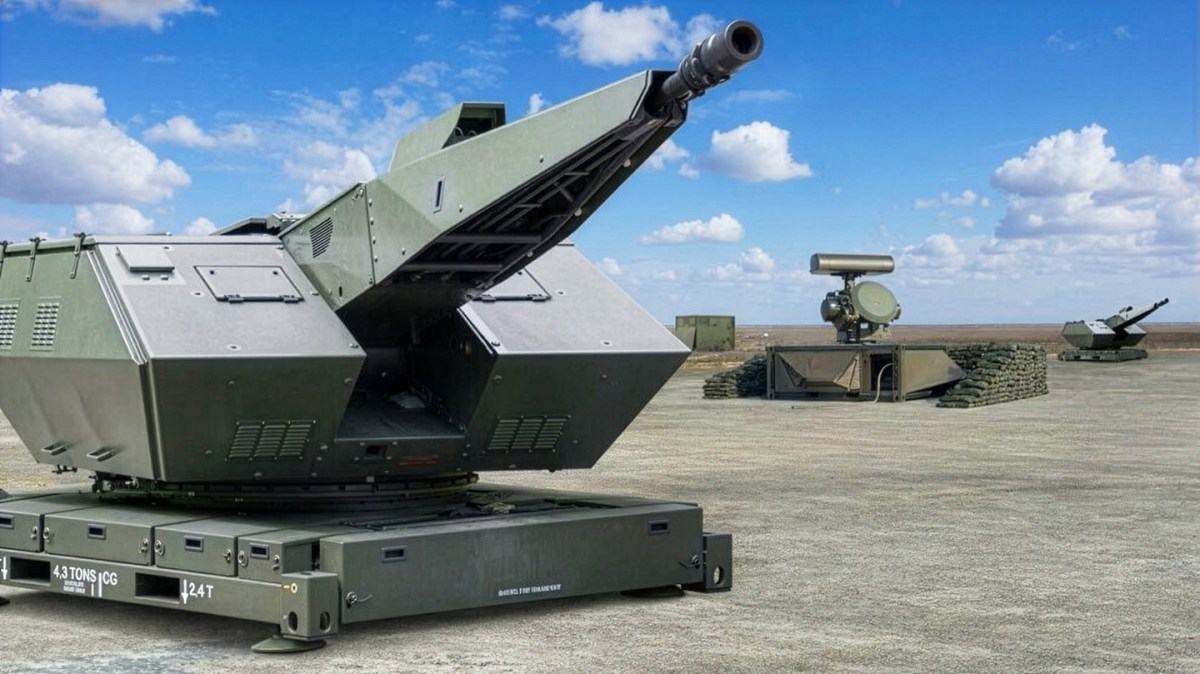
Skyshield is the fixed placement cousin of this system and has been bought by a number of nations
Skyshield (Rheinmetall)
This is just one example of a large number of potential offerings that could fit the USAF’s interests, from both domestic and foreign origins.
As we discussed earlier in this story, the U.S. is already facing a challenge defending against Iranian threats. A war with China would be more devastating and, when it comes to the Air Force protecting its bases, require far more robust defenses. At the same time, the Air Force is still very early in the process of taking on more responsibility for protecting its assets.
Parties have until 5 p.m. Oct. 9 to submit their proposals to the Air Force for a gun-based air defense system. With limited options and the service pushing to address its growing desire for organic air defenses, it will be interesting to see who comes forward and what systems they offer. We will provide more details about this effort when they become available.
Contact the author: howard@twz.com
Comments couldn’t be loaded. Please refresh the page.
作者:霍华德·奥特曼、泰勒·罗戈威
发布于美国东部时间2026年9月4日下午4:04
美国空军正在寻求一种防空炮系统,以帮助其防御全球各地的空军基地免受无人机和巡航导弹的攻击。周四,美国政府在其合同网站上发布了关于这些系统的信息征询书(RFI)。这是空军一项更大规模计划的一部分,旨在通过地面防空系统(GBAD)在空军基地防御中发挥更大的作用,而这项能力传统上由陆军承担。因此,空军目前没有此类系统。现在,空军有意改变这一现状。
此次请求是在对伊朗的战争暴露出美国在为其海外设施提供有效、持续的防空能力方面存在不足,以及对未来可能与中国或俄罗斯等势均力敌的竞争对手发生冲突的担忧之际提出的。
“政府正在进行市场调研,以确定能够为陆基中口径火炮武器系统提供解决方案的潜在行业来源。该系统能够发射价格合理的弹药,能够防御空中和导弹威胁,初期重点是亚音速巡航导弹 (CM) 和无人机系统 (UAS),从而为美国空军提供持续的防御支持。” 信息征询书指出。
信息征询书没有具体说明什么是中口径弹药;但是,根据陆军的说法,该清单包括 20 毫米、25 毫米、30x113 毫米、30x173 毫米和 40 毫米炮弹。
“为了有效评估和比较防空武器系统的性能,必须同时分析 15 个关键的基准操作和技术参数,”信息征询书解释道。
(空军信息征询书)
“这些关键指标首先是该系统的齐射杀伤概率 (Pk),该概率是在最大射程和高度下针对巡航导弹 (CM) 和 1-5 类无人机系统 (UAS) 进行评估的,从而确保对各种现代威胁具有强大的杀伤力,”信息征询书指出。
齐射杀伤概率衡量的是齐射(而非单发)击杀目标的有效性。
下表显示了五种无人机组别的重量、正常运行高度和速度。
(国会研究服务处绘制的第1至5组无人机图表)
空军希望这套系统能够“快速部署,保持轻便、模块化和易于运输的特点,以便迅速部署到条件艰苦的战区环境中,应对突发威胁”。信息征询书并未提供空军计划如何运输这些系统的更多细节;然而,空军主要依靠其C-130“大力神”、C-17“环球霸王III”和C-5“银河”运输机机队来运送装备。系统的尺寸和重量决定了哪些类型的飞机可以运输它们。
这些系统也可以用卡车或轮船运输,或者如果是自推进式系统,也可以自行运输,但这些选择也会在交付的及时性方面产生成本,而且对于快速的全球部署来说可能是不可能的。
2023年12月31日,在中央司令部作战区域内一处未公开地点,美国陆军第108防空炮兵旅第7防空炮兵团第1营的士兵与隶属于美国空军第21远征空运中队的空军人员一起,将装备和卡车装载到一架C-17“环球霸王III”运输机上。(美国陆军照片,由克里斯托弗·纽中士拍摄)
评估的关键点在于弹药的总体成本。空军希望确保炮弹的速度和末端效应“在不使单次交战成本达到不可持续水平或超出平台物理限制的前提下达到最大化”,信息征询书中如此写道。我们将在本文稍后部分更详细地讨论这些因素。
该部门还寻求整合“雷达、光电、红外或射频传感器的适当组合,以确保在各种天气条件、环境和对抗措施场景下可靠地捕获和跟踪目标”。
正如我们在本文开头提到的,空军正寻求提升自身保卫基地的能力。空军部长特洛伊·E·梅因克5月20日向国会表示,这已成为空军“日益重要的优先事项”。
“空军正在发展自主防空和导弹防御能力,包括反小型无人机系统(C-sUAS),以保卫我们在所有战区的空军基地,”梅因克在书面证词中表示。“在海外主要作战基地部署空军基地防空系统(ABADS)导弹防御能力,包括动能防御,有助于联合多层防御,但并不能减少对防空和导弹防御联合投资的必要性。我们将继续审慎地推进这些关键防御能力的研发和采购。”
(空军部长特洛伊·E·梅因克的书面证词)
据《空军与太空部队杂志》报道,美国空军在其2027财年预算申请中,寻求约14亿美元用于研发空军基地防空系统(ABADS)的导弹防御型。此外,根据美国空军2026财年预算说明,空军还在2026财年申请了5180万美元的采购资金,用于研发小型无人防空系统(SUADS)。
对伊朗的战争和对乌克兰的战争尤其凸显了防御无人机和巡航导弹所面临的挑战。
伊朗向美国空军基地以及巴林、以色列、伊拉克、约旦、科威特、卡塔尔、沙特阿拉伯和阿拉伯联合酋长国的众多关键基础设施目标发射了数千枚此类武器。此外,伊朗还发射了数百枚弹道导弹。
综合来看,这些袭击已造成至少九名美军士兵死亡,760多人受伤,飞机、雷达和其他关键设备被毁,伊朗袭击的中东国家也遭受了广泛的破坏。
TWZ多年来一直经常提出这样的担忧:美国拦截器的巨大开支会加剧美国高端防御武器弹药库深度的压力。
基地防御中使用火炮系统有两个方面。首先,在复杂的防空环境中,它可以作为抵御来袭威胁的最后一道内防线。如果外层防线未能击落目标,或者该目标并非优先目标,那么硬杀伤火炮系统就能提供可预测且相对可靠的后备方案。如果拦截弹库存不足(即使是暂时的),需要将这些武器用于应对更高级的威胁,那么火炮系统的重要性将更加凸显。随着外层防御体系的崩溃,内层防御的重要性将大大增加。
对于拦截器难以有效拦截的小型无人机,该火炮系统可以在局部防空场景中将其击落。此外,它还可以用于防御威胁较低、缺乏额外防空导弹系统的基地。该火炮系统能够提供核心空中防御,有效应对低端、低密度无人机和巡航导弹的威胁,且无需耗费巨资或庞大的后勤保障。
除此之外,还可以进行直接的成本比较,但这仍然是一个假设,单凭火炮系统无法在不带来巨大风险的情况下取代多层防空系统。尽管如此,交战成本的比较仍然值得一提。
高端、昂贵且制造难度高的防空武器,例如“爱国者”PAC-3 MSE,显然无法有效对抗无人机。举例来说,一架量产的伊朗“沙赫德-136”无人机造价约为3.5万至5万美元,而一套“爱国者”PAC-3系统则可能耗资约500万美元,且采购周期长达数年。相比之下,专为防御无人机和亚音速巡航导弹而设计的火炮防空系统的单次交战成本效率要高得多。陆军的“百夫长”反火箭、反炮、反迫击炮(C-RAM)系统就是一个例证。它是“密集阵”近程防御武器系统(CIWS)的陆基版本,后者装备于美国和外国的各种军舰上,该系统配备一门六管20毫米“火神”加特林式火炮,发射M940型炮弹。根据陆军2025财年预算申请,这些自毁弹药目前的单价为80.70美元。这意味着,百夫长坦克以每分钟4500发的射速进行一次两秒的短点射,成本将略高于12100美元。
再次强调,这并非完全公平的比较,但在高端武器库存开始短缺的长期冲突中,这一点会变得更加重要。值得注意的是,无人机拦截器正迅速发展成为一种成本更低的拦截单向攻击无人机甚至部分巡航导弹的手段。像“郊狼”(Coyote)这样的系统已在五角大楼服役多年,并在保护海外基地方面取得了显著成效。从乌克兰的经验中汲取的教训正在催生出更经济的系统。所有这些系统各有优缺点,但如果将它们与新型火炮系统结合使用,很可能产生协同效应。总而言之,部署密集的多层近程防空系统本身正变得越来越重要,至少在高威胁地区是如此。
乌克兰在防空能力的成本和优先级排序方面拥有丰富的经验。该国每天都面临俄罗斯导弹和无人机的袭击,造成越来越多的人员伤亡和财产损失。这种持续不断的轰炸几乎耗尽了乌克兰的“爱国者”拦截导弹,使其在面对弹道导弹时几乎毫无防御能力。正如我们昨天提到的,乌克兰空军F-16战斗机用于击落无人机的空空导弹也即将短缺。
然而,乌克兰也大量依赖各种火炮防空系统,包括德国制造的“猎豹”自行高射炮(SPAAG)。“猎豹”自行高射炮以“豹1”主战坦克的底盘为基础,配备两门雷达瞄准的35毫米自动炮,安装在一个炮塔上。德国版本还配备了S波段搜索雷达和Ku波段跟踪雷达。这些雷达对于“猎豹”在夜间和恶劣天气条件下定位、跟踪和攻击目标至关重要。
“猎豹”自行高炮在乌克兰的成功激发了全球对自行高炮的新兴趣。
以下视频显示,一架猎豹战斗机将一架伊朗制造的沙赫德-136战斗机从空中击落。
据报道,一段视频显示,在昨晚乌克兰南部敖德萨州发生的袭击事件中,乌克兰军队使用一门德国交付的“猎豹”自行高射炮(SPAAG)击落了两枚俄罗斯“沙赫德-136”(Geran-2)巡飞弹。…… pic.twitter.com/OhH7vTultm — Status-6 (War & Military News) (@Archer83Able) September 7, 2023
据报道,一段视频显示,在昨晚乌克兰南部敖德萨州发生的袭击事件中,乌克兰军队使用一门德国交付的“猎豹”自行高射炮(SPAAG)击落了两枚俄罗斯“沙赫德-136”(Geran-2)巡飞弹。…… pic.twitter.com/OhH7vTultm
空军也在研究定向能武器,例如激光武器,用于部队防护,特别是用于保卫海外基地。虽然这些系统由于其作战成本远低于其他武器,在各军种中越来越受欢迎,但它们仍处于研发阶段。另一方面,火炮防空系统已经成熟可靠,而现代精确制导可编程弹药的出现,更使其效率和效能大幅提升。
除了成本之外,高端防空系统(包括其组成传感器)虽然便携,但通常固定在特定位置。这使得它们容易受到攻击。在对伊朗和对乌克兰的战争中都出现了这种情况。同样的担忧也适用于飞机。这两场冲突都表明,停放在开阔地带的飞机很容易受到无人机的攻击。尤其是去年乌克兰对俄罗斯战略轰炸机发起的“蜘蛛网行动”,更加凸显了这个问题,而我们长期以来一直在发出警告。
多年来,美国军方官员一直对加大基地和其他关键设施(尤其是用于保护飞机免受无人机和其他威胁的掩体)的物理加固投入的实用性和成本效益持保留态度。然而,这种情况正在发生改变。今年2月,五角大楼发布了关于加固的新指导方针,该文件解释说,加固“并非意味着封闭整个设施,而是有选择地设置障碍物,以干扰可预测的空中通道”。“即使是较小的障碍物也能阻止低成本的消费级无人机,并迫使无人机选择风险更高的飞行路线。”
除了上述挑战之外,美国空军还面临着整体短程防空能力不足的困境,我们多年来一直强调这个问题。目前,美军正在部署三种机炮型短程防空系统,其中包括前文提到的“百夫长”C-RAM系统。
陆军还使用“斯托特中士”(Sgt. Stout)防空系统,该系统基于8×8“斯特瑞克”(Stryker)轻型装甲车。“斯托特中士”的炮塔最多可安装两具四联装“毒刺”(Stinger)导弹发射器。这些发射器也可更换为可装载两枚毫米波雷达制导AGM-114L“地狱火”(Hellfire)导弹的发射器。炮塔还配备一门30毫米XM914自动炮,可发射近炸引信空爆弹攻击无人机和其他空中目标,以及一挺7.62×51毫米M240B机枪。
2025年9月23日,驻俄克拉荷马州锡尔堡的第60防空炮兵团第4营的士兵使用“斯特瑞克A1 M-SHORAD”(Stryker A1 M-SHORAD)装甲车进行了实弹射击演习。(美国陆军下士埃马尼·威尔逊摄)
海军陆战队防空综合系统(MADIS)配备有30毫米机炮和M240C同轴机枪,这些武器均安装在遥控武器站(RWS)上。其中一辆车辆上的RWS还可发射毒刺导弹,以应对各种地面防空场景。
2026年7月28日,在日本冲绳施瓦布营地,隶属于美国海军陆战队第3师第12近海防空营、第12近海团的美国海军陆战队员在实弹射击训练中,使用安装在海军陆战队防空综合系统上的XM914 30毫米链式机炮进行射击。(美国海军陆战队下士斯基拉·桑切斯摄)
陆军可能即将引进更多火炮防空系统。今年7月,陆军向能够提供新型火炮防空方案的公司发出信息征询书,该方案拟采用50毫米火炮系统来追踪并击落1、2、3类无人机。
几周后,诺斯罗普·格鲁曼公司推出了其“突袭猎手”50毫米地面防空系统,该公司称该系统“结合了成熟的链式机炮®技术、精确制导的50毫米弹药以及联网、可互操作系统的控制器,能够有效抵御大规模、混合威胁的空中袭击。该系统旨在应对包括高优先级巡航导弹威胁、无人机系统(UAS)和其他先进威胁在内的各种空中威胁。”
我们隆重推出“突袭猎手™”(Raid Hunter™),这是一款全新命名的50毫米火炮防空系统,旨在利用经济高效的拦截器和可大规模部署到作战人员手中的深弹匣,有效应对大规模、混合型空中袭击。了解更多信息:https://t.co/gnOzpo0RA3 pic.twitter.com/oTqORTG9Q4 — Northrop Grumman (@NGCNews) August 11, 2026
我们隆重推出“突袭猎手™”(Raid Hunter™),这是一款全新命名的50毫米火炮防空系统,旨在利用经济高效的拦截器和可大规模部署到作战人员手中的深弹匣,有效应对大规模、混合型空中袭击。了解更多:https://t.co/gnOzpo0RA3 pic.twitter.com/oTqORTG9Q4
如果空军想走这条路,也有外国的选择。例如,德国武器制造商莱茵金属公司生产的广受欢迎的“天行者35”火炮系统,是一种可以安装在多种装甲车体上的炮塔。
据莱茵金属公司称,Skyranger 35“配备一门35毫米×228倍径的KDG 35/1000型转轮炮,射速为每分钟1000发”,该公司已于今年1月开始向乌克兰交付该型火炮。“其有效射程可达4000米,并与厄利孔Mk 3型转轮炮具有高度通用性。得益于AHEAD技术,Skyranger 35具备空爆能力。未来,它还可以装备现代化的制导导弹。”
冷战时期豹1坦克上安装的Skyranger 35导弹系统已经出现在乌克兰战场上。
您可以在下方观看该系统的视频。
乌克兰陆军第1020防空导弹团似乎已接收了首批由莱茵金属公司(@RheinmetallAG)制造、安装在豹1坦克底盘上的“天行者35”(Skyranger 35)自行高炮。该型自行高炮的交付合同于下半年签署…… pic.twitter.com/VRWhGx1LCa — GAU (@deaidua) September 3, 2026
乌克兰陆军第1020防空导弹团似乎已接收了首批由莱茵金属公司(@RheinmetallAG)制造、安装在豹1坦克底盘上的“天行者35”(Skyranger 35)自行高炮。该型自行高炮的交付合同于下半年签署…… pic.twitter.com/VRWhGx1LCa
Skyshield是该系统的固定式版本,已被多个国家购买。
天盾(莱茵金属)
这只是众多可能符合美国空军利益的潜在产品中的一个例子,这些产品既有来自国内的,也有来自国外的。
正如我们在本文前面讨论过的,美国目前在应对伊朗威胁方面已经面临挑战。与中国的战争后果将更加惨重,而且就空军保护其基地而言,需要更加强大的防御力量。与此同时,空军在承担更多保护自身资产的责任方面仍处于起步阶段。
各方须在10月9日下午5点前向美国空军提交基于机炮的防空系统方案。由于选择有限,且空军正大力推进其日益增长的自主防空需求,因此最终会有哪些厂商参选以及他们提供的系统方案,值得我们拭目以待。我们将会在获得更多信息后及时更新。
联系作者:howard@twz.com
评论加载失败,请刷新页面。