Investigation: Russian shadow airlines use Algeria as base for secretive missions调查显示:俄罗斯影子航空公司利用阿尔及利亚作为秘密行动基地
Algeria has become a key customer for Russian arms at a time when Moscow has seen a slump in its military-export business after the invasion of Ukraine.
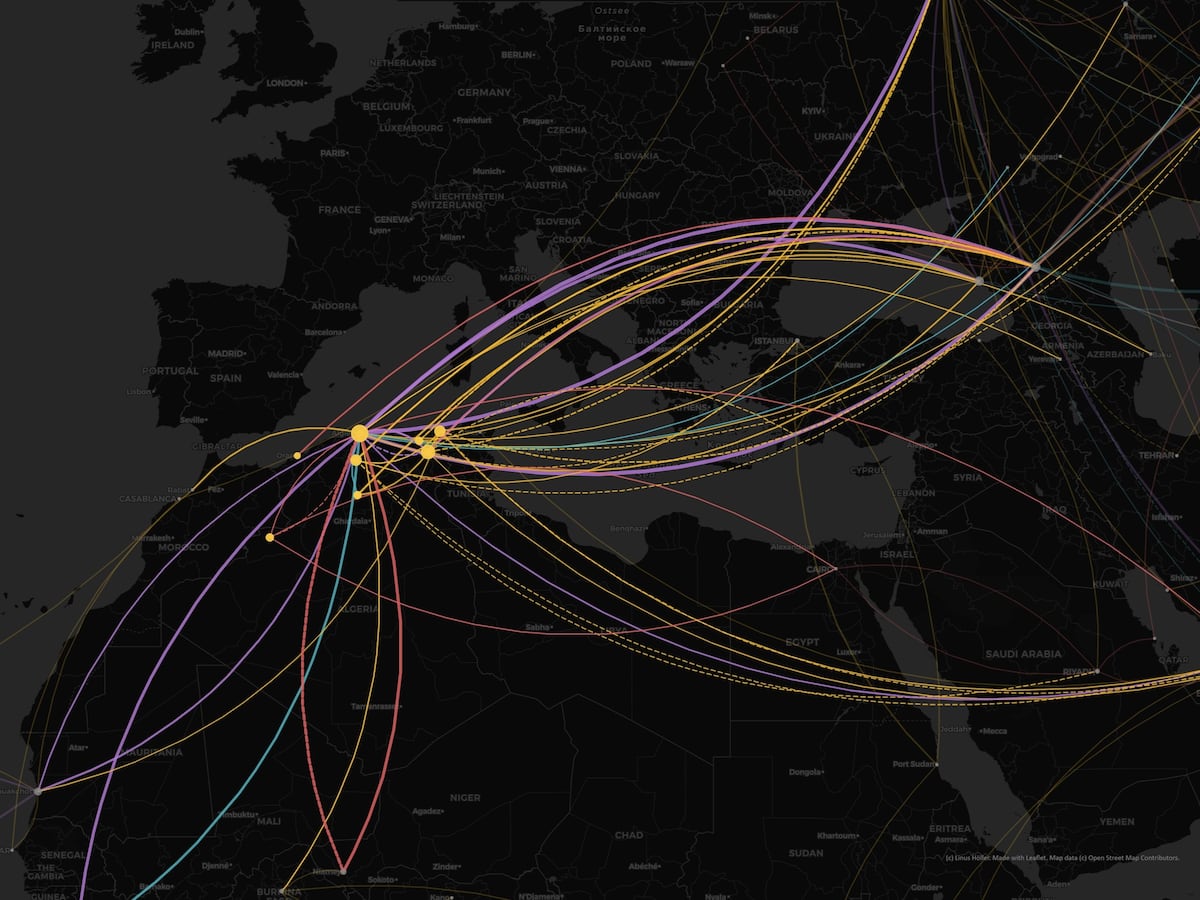
BERLIN/VIENNA — A fleet of Russian military-affiliated cargo aircraft has made over a hundred flights to Algeria over the past year, likely delivering modern fighter jets and equipment to bolster an increasingly important Russian ally at Europe’s southern flank, and using the country as a hub to project Russia’s power deeper into Africa.
A Defense News investigation found at least 167 cargo flights linking Russia to Algeria between March 2025 and April 2026, making the North African country one of the key hubs in Moscow’s global freight network.
Many of the flights connected airfields associated with United Aircraft Corporation, Russia’s state-owned maker of military jets, to Algerian air bases. Several of the cargo flights also roughly coincided with the sighting of new Russian-made warplanes roaring over the Algerian countryside .
The uptick in air traffic comes amid ongoing deliveries of several types of Russian-made warplanes to Algeria. The country is currently receiving Su-57 fifth-generation stealth fighter jets and Su-35 fighters from Russia. It also operates a fleet of about 60 Su-30 multirole fighters and around 40 MiG-29 air-superiority fighters.
At least some of the Russia-Algeria flights are likely linked to the flow of new-generation weaponry. “I think this is a pretty reasonable explanation for these flights,” said Margaux Garcia, a senior analyst with Washington-based C4ADS who tracks Russia’s covert activities.
Algeria has become a key customer for Russian arms at a time when Moscow has seen a slump in its billion-dollar military export business following the invasion of Ukraine.
Algiers bought 73% of its weapons from Russia between 2018 and 2022, and though the share of Russian-origin weapons has declined in recent years, Russia remains Algeria’s top supplier of arms, according to data from the Stockholm International Peace Research Institute. The country has recently placed several large orders for new aircraft, including the ones manufactured at the very sites the cargo aircraft tracked for this investigation frequently visited.
Since the start of Russia’s invasion of Ukraine and the imposition of harsh Western sanctions as a result, government-affiliated airlines have grown in importance for the Kremlin. In its “Shadow Airlines” investigation, Defense News has tracked about a dozen operators and manually retraced thousands of flight routes, providing a first-of-its-kind comprehensive picture of this unreported underworld. This article is the first in a multi-part series that uncovers this peculiar network of front companies, airlines and Soviet-era freight planes that move Russian weapons and influence around the world.
Defense News tracked Russian cargo flights to the Oum El Bouaghi Air Base, Ain Oussera Air Base, Annaba Air Base, Laghouat Air Base and Béchar in Algeria, among other destinations.
Some flights may also have touched down in other parts of Algeria, but many of the aircraft appeared to be involved in tracking-evasion techniques such as turning off their ADS-B transponders or misdeclaring airports in their itineraries. Particularly flights heading south out of Algiers, the capital and a key hub for the shadow airlines, frequently dropped off ADS-B tracking radars even though other nearby aircraft remained within coverage.
According to an air cargo industry insider, who wished to remain unnamed to speak freely, this is a known evasion technique deliberately employed by pilots. It also matches other clandestine flights that Defense News has tracked.
Aircraft were frequently observed visiting key Russian fighter jet production sites shortly before heading to Algeria. For instance, Algeria-bound aircraft visited Komsomolsk-on-Amur, the sole production site for both the Su-57 and Su-35, at least a dozen times during the period investigated. There were also at least eight flights through Irkutsk Northwest airport, which is central to the Su-30 production line. At least 28 flights relating to Algeria went through Yeltsovka Airport near Novosibirsk, which is the only facility producing and maintaining the Su-34 frontline bomber. Algeria is known to operate or have ordered all of these aircraft and is the first foreign buyer for several of them.
Within Russia, the airport of Mineralnye Vody – a civilian installation with a runway nearly 4,000 meters long – plays a key role in the logistics supply chain on these Algeria flights. About two-thirds of all flights landed here from other Russian destinations before heading onward to Algeria. The airport, located in the North Caucasus, Russia’s far southwestern edge, is a convenient staging location as it minimizes the flight distance between the motherland and destinations in Africa and the Middle East.
The Ilyushin Il-76, the workhorse of these shadow airline operators, typically has a range of around 5,000 kilometers when reasonably loaded. That limits Russia’s power projection abilities without access to intermediary airports for refueling, which are hard to come by given Russia’s current status as a pariah in much of the world.
Data collected by Defense News suggests that Algeria may not only be a destination but also a transit spot for Russian military equipment or support flowing elsewhere into Africa. Between July and September, two Il-76 planes operated by Gelix Airlines, RA-76373 and RA-76360, made eight return flights between Russia and Conakry, Guinea, by way of Algiers.
An Antonov 124 and an Ilyushin 76 of Russia's "shadow airlines" fleet are pictured parking at Algiers Airport, Algeria, April 18, 2026. (Planet Labs/provided by James Martin Center for Nonproliferation Studies. Annotations: Linus Höller/staff)
Guinea, a frequent onward destination from Algeria for the shadow airline fleet, has long been a key Russian-aligned country in West Africa, and ties have deepened further since a military junta took over in a coup in 2021. Russia is deeply involved in the country’s mining sector, especially for bauxite, and the country also serves as a key gateway for Russian weapons deliveries into the Sahel region.
In January 2025, Le Monde documented that two sanctioned Russian cargo ships unloaded over 2,000 tons of military cargo, including light tanks and armored vehicles, at Conakry, from where the convoy then drove north to Mali.
Additionally, Algeria appears to serve as a gateway for Russia into the turbulent country of Niger, where Russian paramilitary forces have been active and the Kremlin has a deep web of interests, not least the country’s vast uranium deposits. An investigation by Italian newspaper Il Foglio from December 2025 showed an airlift operation was underway to move many tons of uranium purchased by state-owned Rosatom from Niger to Russia.
In recent days, a super-heavy Antonov An-124 “Ruslan” aircraft operated by Volga-Dnepr Airlines started flying regular shuttles between Algiers and sub-Saharan Africa, with tracking data suggesting the destination was likely Niamey, the capital of Niger, although the transponder signal is spotty. Satellite imagery reviewed by Defense News shows a large aircraft with dimensions that match those of the An-124 parked at Niamey airport on at least two of the dates in question.
The An-124 is capable of carrying well over 100,000 kg in payload and is the world’s largest operational heavy-lift aircraft.
The aircraft in question, RA-82079, has flown the circuit between Algeria and Niger at least eight times since April 21, and remains in the area at the time of writing. It previously came to Algeria from the Irkutsk Northwest Airport, the assembly site for the Su-30 aircraft, by way of Mineralnye Vody and first landing in Africa at the Oum El Bouaghi air base, where one of Algeria’s Su-30 squadrons is based. From there, it leaped over to Algiers, where it sat for nine days before beginning the shuttle flights to Niger.
An Russian An-124 cargo aircraft sits at Niamey airport in Niger on April 26, 2026. (Planet Labs/provided by James Martin Center for Nonproliferation Studies. Annotations: Linus Höller/staff)
Three other An-124 aircraft operated by Volga-Dnepr have visited Algeria in the past year, including on unusual routes flying to military bases deep in the Algerian Sahara desert by way of Saudi Arabia and Egypt.
Algeria has also served as a stopover for intercontinental flight itineraries.
In March 2025, one of the same aircraft that flew to Guinea – RA-76373 – had stopped in Algeria and its southwesterly neighbor, Mauritania, on an unusual mission to and from Latin America, where it visited Venezuela and Mexico. Similarly, a plane with the tail number RA-78765 used Algiers and Conakry as stops on the way to a multi-hop tour of Latin America that took it through Brazil, Bolivia, Colombia, Venezuela, Mexico and Cuba, before returning to Russia by way of Venezuela, Mauritania and Annaba Air Base in northeastern Algeria.
On the route back to Russia, the United Arab Emirates – particularly Dubai, Sharjah and Fujairah – have emerged as common stops, appearing 25 times across multiple operators and aircraft types in the data. On several occasions, aircraft flew directly from Algerian military air bases to Emirati airports before returning to Russia or continuing onward to Central Asia, another key region for Russian sanctions evasion.
The United Arab Emirates itself has been identified in Western government reports and financial investigations as a key sanctions-evasion hub for Russian entities since 2022, offering financial infrastructure, a transshipment hub to obscure supply chains, and airspace access that Russia lacks elsewhere.
The flight patterns also point to a second type of activity entrusted to the shadow airlines: serving as the logistics arm for Russia’s paramilitary forces abroad, such as the former Wagner Group and current Africa Corps, the group’s successor.
Algiers appears to be a convenient staging ground for West African operations, and one that may be under less scrutiny than some other staging grounds previously used by Russia for supplying its mercenaries on the continent. Planes tracked for this investigation made frequent flights to the Algerian capital with only short stays there, and sometimes, aircraft operating on separate circuits converged in Algiers.
One of these airlines is Aviacon Zitotrans, which has been sanctioned by the United States, Canada and Ukraine. The U.S. Treasury Department, in an explanation accompanying the sanctions listing in 2023, said that “Aviacon Zitotrans has shipped military equipment such as rockets, warheads, and helicopter parts all over the world,” including to “Venezuela, Africa, and other locations.”
Candace Rondeaux, director of public intelligence firm Future Frontlines and the author of an authoritative book on the Wagner Group’s history, said she estimates at least half of the flights by airlines like Gelix and Aviacon Zitotrans are flown on behalf of the Kremlin’s State Property Management Office. That bureau lies outside the structures of the Ministry of Defense and is instead directly subordinate to the president of the Russian Federation, Vladimir Putin.
The Russian government operates two of its own, technically civilian, airlines: the 223rd and 224th Flight Units, which are also frequently used for special-mission air lifts.
According to the 224th Flight Unit’s English-language website, the Office of the President of the Russian Federation is the airline’s main customer. It also lists Rossiya Special Flight Unit, which is responsible primarily for VIP transport, Russia’s state-owned arms dealer Rosoboronexport, and the warplane maker MiG as “other major customers.”
A Russian Il-76 aircraft flying for Gelix Airlines is pictured at Laghouat Air Base, Algeria, Dec. 29, 2025. (Planet Labs/provided by James Martin Center for Nonproliferation Studies. Annotations: Linus Höller/staff)
While Russia’s air force and the 224th Flight Unit operate heavy Antonov and Ilyushin cargo aircraft in their own fleets, the use of charter airlines gives the Kremlin more capacity and easier access to civilian aviation procedures than flying government- or military-owned planes abroad, not to mention a layer of obfuscation and plausible deniability.
Analytics firm Dallas Analytics recently published an investigation that included internal Russian government documents and Ministry of Defense air waybills, finding that Russia’s military aviation maintenance backbone is “collapsing due to sanctions and absent spare parts,” with repair facilities effectively insolvent and growing numbers of military aircraft grounded.
“By placing a portion of its fleet on the civil registry and painting them in standard commercial liveries, the Ministry of Defense exploits civil aviation protocols. This allows them to bypass diplomatic red tape and fly into crucial transit nodes like the UAE, Turkey, or various African states under the guise of civilian charter flights,” Dallas Analytics wrote in their report.
The report made public a series of original primary documents that prove the military nature of at least some of the flights, including ones predating the full-scale war in Ukraine. Among them are air waybills that confirm that Aviacon Zitotrans transported Russian military helicopters to Laos in November 2020 under explicit orders from the Russian Ministry of Defense, and a separate set of waybills shows the same airline executing shipments of defense electronics to China on behalf of two of Russia’s leading jet engine manufacturers. Dallas Analytics also published documents regarding the shipment of complete missile systems to India via Aviacon Zitotrans in late 2022.
These various airlines have traditionally served a key logistical function, particularly far from Russia’s shores, and were an integral part of the Wagner Group’s African operations, flying in personnel, weapons and gear, and flying out gold on behalf of the Corp’s former boss, Yevgeniy Prigozhin, said Rondeaux.
While the Wagner Group had its wings clipped after Prigozhin’s ill-fated coup attempt in the summer of 2023, the logistics networks and even many of the mercenary operations in sub-Saharan Africa have remained, if sometimes under new management.
“The media, even intelligence services, have bought this idea that the Wagner brand was dead, and therefore there’s no connectivity,” said Rondeaux.
“Nothing has changed about Russia’s need to circumvent sanctions. In fact, it’s become only more urgent to do so,” she added.
Garcia, the senior C4ADS analyst, said that in places like Mali, approximately 80% of the Africa Corps’ personnel had previously served with the Wagner Group.
Air carriers like those operating in Algeria are key to maintaining these semi-covert missions and serve as wet leasing companies, said Rondeaux. They “provide crews, they provide a flight plan ... essentially they manage the logistical arm of what we called Air Wagner.”
Gelix Airlines has emerged as a key player in recent years, with many flights that raise questions about their purpose on unconventional routes to conflict zones. A combination of hopping around West African locations known to base Russian mercenaries and regular flights back to the Russian mainland should raise eyebrows, said Garcia.
Antonov An-124 cargo planes of the Russian Volga-Dnepr Group parked at Leipzig/Halle Airport, Germany, Feb. 19, 2026. (Jan Woitas/picture alliance via Getty Images)
In an email interview with Defense News, Gelix CEO Vadim Baldin disputed the notion that there was no commercial demand on the routes flown by Gelix.
“Guinea, Somalia, Myanmar, Yeltsovka airports, and Irkutsk Northwest Airport − all of these are takeoff and landing points for our aircraft,” Baldin said, adding he was “not able to say anything specific” about the nature of the cargo, other than it was “not military.”
Baldin said Gelix flights “transport cars, machinery, and containers. In short, everything that can be legally loaded onto an Il-76.”
Asked about his company’s flights to United Aircraft Corporation-affiliated airports, he said that “we adhere to purely businesslike relationships with all participants in the air transportation market.”
Speaking to Russian business newspaper Kommersant on April 10, Baldin reported that 2025’s revenue surged more than twofold compared to the previous year. He attributed it to “flights to Latin American countries (Mexico, Venezuela) and a number of West African countries (Mauritania, Guinea),” the paper wrote. Flight hours tripled in 2025, and the upswing meant that Gelix is “seen and entrusted with complex tasks in difficult climatic conditions, which opens up access to new tenders,” Baldin said.
“The guys who come to us to find a job imagine that they will work in white shirts,” Baldin was quoted by a company social media account in the Russian VK social network in March. “But we have slightly different conditions.”
Speaking to Defense News, Baldin confirmed that “Algeria is indeed an important hub for international logistics,” but emphasized that “it is only one of 36 countries to which our airline flies.”
He said it was “absolutely correct” that Algeria plays a key role due to its location, which makes it a key refueling point and cargo logistics point to extend the Russian Ilyushins’ reach.
The company is used to executing a range of special missions. In August of last year, the firm became the third in Russia to be licensed to transport nuclear materials and radioactive substances aboard planes, according to the Russian government agency Rostekhnadzor.
“There is a certain demand for the delivery of equipment that contains radioactive elements to polar stations,” the CEO was quoted as saying at the time.
The company has existed since the 1990s, but for decades was only a helicopter operator focused on regional tourism and local air lifts. Then, in 2021, the company received three heavy-lift Ilyushin Il-76D aircraft from the state-owned diamond mining company Alrosa. The aircraft are fully owned by Gelix, Baldin confirmed.
The new aircraft were reportedly based in Ulyanovsk, the Russian “aviation capital,” rather than Gelix’s longstanding headquarters in Perm. And despite being built in the years immediately after the fall of the Soviet Union, the aircraft were retrofitted with the required gear specifically with an eye toward flying abroad, as Russian business journal Kommersant reported . In the same article, a Russian air freight director was cited as saying that the free market was currently “not the most favorable” for air cargo.
Operators flying the Ilyushin Il-76 are of particular interest to analysts, said analyst Garcia, as the aircraft type is renowned for having been used to transport weapons or troops. “We find them quite interesting when they’re taken on by private sector companies that are operating in areas that we know armed group activity occurs in,” she said. Gelix Airlines’ shift from decades of helicopter operations to long-haul Il-76 flights to unstable parts of the world stands out as a red flag, she said.
“Indeed, the life of Gelix Airlines has taken a dramatic turn since my arrival as director,” Baldin told Defense News in an email.
Friends in high places
Aviacon Zitotrans, the charter operator of the majority of the Russian flights to Algeria in the past year, has also been known to fly military equipment elsewhere on Russia’s behalf. Ahead of the U.S. intervention in Venezuela, an Aviacon Zitotrans-owned aircraft traveled to Venezuela, a story that was first reported by Defense News. Russian lawmakers later revealed that air defense systems were aboard the aircraft.
Like the Wagner group, many of the shadow airlines appear to have grown out of legitimate businesses that have found a lucrative gig in serving the Kremlin’s more sensitive missions. Prigozhin famously started his career as a restaurateur who catered Putin’s events before he branched out into military logistics, private security for major state-affiliated enterprises, and from there, into the world of private military contractors.
And like the web of actors surrounding the private military contractor world in Russia, which is comprised of opportunists, military veterans, and security forces protecting the oil and gas industry, the shadow airlines world, too, bears the hallmarks of a tangled web.
On several occasions, for example, aircraft linked to the sanctioned Aviacon Zitotrans were spotted operating under Gelix callsigns, including while flying out of a military airbase in Ethiopia and St. Petersburg.
Asked about the discrepancy, Gelix’s CEO, Vadim Baldin, told Defense News that it was an artifact of the aircraft leasing model. Databases used by journalists, he said, don’t necessarily update fast enough to reflect who is operating aircraft that are merely leased to temporarily expand a fleet rather than owned by an airline.
The leaders of both companies appear well-established in the relevant political circles, and both have ties to the Russian Federation’s government. Baldin, who has led Gelix since 2020, represented the Russian Federation on the boards of two state-owned military-industrial companies – Special Design Bureau Salyut, a defense electronics manufacturer, and Design Bureau Gorizont, an avionics and special-purpose electronics maker – between 2014 and 2017, according to Russian bibliographical database viperson.ru. Both are subordinate to Minpromtorg, the Russian Ministry of Industry and Trade.
He has also posted on Telegram about awards for completing training with the ruling party’s United Russia Party Higher Party School and funding a monument for soldiers killed during the so-called “Special Military Operation,” the Russian government’s state-approved euphemism for the war in Ukraine.
Baldin, born in 1974, has previously served as the deputy chairman of the Expert Council of the Commission of the Russian Union of Industrialists and Entrepreneurs on the Military-Industrial Complex and aerospace-related advisory bodies. Combined with his educational and practical background in civil aviation, this placed him at the critical nexus between the military and civil worlds at which Russia’s shadow airlines operate.
Of Gelix’s flights tracked for this investigation, more than three-quarters stopped at Russian military aviation plants before heading to Algeria, more than any other operator.
The owner of Aviacon Zitotrans, Valery Savelyev, meanwhile, has served as a regional deputy for Putin’s “United Russia” ruling party.
Unlike Aviacon Zitotrans, Gelix Airlines, the operator that flew repeatedly via Algeria to West Africa, is not sanctioned by any country.
The Russian and Algerian governments, as well as Aviacon Zitotrans, did not immediately respond to a request for comment in time for publication. Volga-Dnepr Airlines acknowledged receipt of Defense News’ questions but did not provide answers by press time.
Linus Höller is Defense News' Europe correspondent and OSINT investigator. He reports on the arms deals, sanctions, and geopolitics shaping Europe and the world. He holds master’s degrees in WMD nonproliferation, terrorism studies, and international relations, and works in four languages: English, German, Russian, and Spanish.
柏林/维也纳——过去一年,一支与俄罗斯军方有关联的货运机队已向阿尔及利亚进行了一百多次飞行,很可能是为了向这个在欧洲南翼日益重要的俄罗斯盟友运送现代化战斗机和装备,并将该国作为枢纽,将俄罗斯的实力更深入地投射到非洲。
《防务新闻》的一项调查发现,2025 年 3 月至 2026 年 4 月期间,至少有 167 个货运航班连接俄罗斯和阿尔及利亚,使这个北非国家成为莫斯科全球货运网络的关键枢纽之一。
许多航班连接了俄罗斯国有军用飞机制造商联合航空制造集团旗下的机场和阿尔及利亚空军基地。一些货运航班的飞行时间也与人们目击到俄罗斯新型战机在阿尔及利亚乡村上空呼啸而过的事件大致吻合。
随着俄罗斯向阿尔及利亚持续交付多种型号的战机,空中交通量也随之增加。阿尔及利亚目前正在接收俄罗斯交付的苏-57第五代隐形战斗机和苏-35战斗机。此外,该国还拥有约60架苏-30多用途战斗机和约40架米格-29空中优势战斗机。
至少部分俄阿之间的飞行可能与新一代武器的输送有关。“我认为这是对这些飞行相当合理的解释,”总部位于华盛顿的C4ADS高级分析师玛戈·加西亚说道,她负责追踪俄罗斯的秘密活动。
在入侵乌克兰后,莫斯科价值数十亿美元的军火出口业务大幅下滑,而阿尔及利亚却成为了俄罗斯武器的重要客户。
2018年至2022年间,阿尔及尔73%的武器来自俄罗斯。尽管近年来俄罗斯武器的占比有所下降,但根据斯德哥尔摩国际和平研究所的数据,俄罗斯仍然是阿尔及利亚最大的武器供应国。该国近期订购了多架新型飞机,其中包括一些在本次调查追踪的货运飞机频繁出入的工厂生产的飞机。
自俄罗斯入侵乌克兰以及西方因此实施严厉制裁以来,与政府有关联的航空公司对克里姆林宫的重要性日益凸显。《防务新闻》在其“影子航空公司”调查中追踪了十几家运营商,并手动追溯了数千条飞行路线,首次全面揭示了这一鲜为人知的地下世界。本文是系列报道的第一篇,该系列报道将揭露这个由幌子公司、航空公司和苏联时期货运飞机组成的奇特网络,该网络负责在全球范围内运输俄罗斯武器和影响力。
《防务新闻》追踪了俄罗斯货运航班飞往乌姆布瓦吉空军基地、艾因乌塞拉空军基地、安纳巴空军基地、拉格瓦特空军基地以及阿尔及利亚贝沙尔等地的路线。
部分航班可能也曾在阿尔及利亚其他地区降落,但许多飞机似乎采用了诸如关闭ADS-B应答器或在行程单中谎报机场等规避追踪的手段。特别是从首都阿尔及尔(影子航空公司的重要枢纽)飞往南方的航班,经常从ADS-B追踪雷达上消失,即使附近的其他飞机仍在雷达覆盖范围内。
一位不愿透露姓名的航空货运行业内部人士表示,这是飞行员故意采用的一种已知的规避手段。这与《防务新闻》追踪的其他秘密航班的情况相符。
在飞往阿尔及利亚前不久,经常有飞机造访俄罗斯重要的战斗机生产基地。例如,在调查期间,飞往阿尔及利亚的飞机至少十几次造访阿穆尔河畔共青城,该基地是苏-57和苏-35战斗机的唯一生产基地。此外,至少有八架飞机途经伊尔库茨克西北机场,该机场是苏-30生产线的核心区域。至少有28架与阿尔及利亚相关的飞机途经新西伯利亚附近的叶利佐夫卡机场,该机场是生产和维护苏-34前线轰炸机的唯一基地。据悉,阿尔及利亚已拥有或订购了所有这些飞机,并且是其中几种飞机的首个外国买家。
在俄罗斯境内,矿水城机场(一座拥有近4000米长跑道的民用机场)在飞往阿尔及利亚的航班物流供应链中扮演着关键角色。大约三分之二的航班从俄罗斯其他城市经停此机场,然后再飞往阿尔及利亚。该机场位于俄罗斯西南边缘的北高加索地区,地理位置优越,是连接俄罗斯本土与非洲和中东目的地的理想中转站,因为它最大限度地缩短了俄罗斯本土与这些目的地之间的飞行距离。
伊尔-76是这些影子航空公司的主力机型,在合理载重的情况下,航程通常约为5000公里。这限制了俄罗斯在无法使用中转机场进行加油的情况下投射力量的能力,而鉴于俄罗斯目前在世界大部分地区被视为孤立国家,获得中转机场加油的机会十分有限。
《防务新闻》收集的数据显示,阿尔及利亚不仅是俄罗斯军事装备或支援物资运往非洲其他地区的目的地,也可能是其中转站。7月至9月期间,格利克斯航空公司运营的两架伊尔-76飞机(注册号分别为RA-76373和RA-76360)经阿尔及尔往返于俄罗斯和几内亚首都科纳克里之间,共执行了八次航班。
2026年4月18日,俄罗斯“影子航空公司”的一架安-124运输机和一架伊尔-76运输机停泊在阿尔及利亚阿尔及尔机场。(图片由Planet Labs提供,詹姆斯·马丁防扩散研究中心供稿。注释:Linus Höller/工作人员)
几内亚是影子航空公司机队从阿尔及利亚出发的常见中转站,长期以来一直是西非地区与俄罗斯关系密切的重要国家,自2021年军政府通过政变上台以来,两国关系进一步加深。俄罗斯深度参与该国的采矿业,特别是铝土矿开采,该国也是俄罗斯向萨赫勒地区运送武器的重要门户。
2025 年 1 月,《世界报》报道,两艘受制裁的俄罗斯货船在科纳克里卸下了 2000 多吨军用货物,其中包括轻型坦克和装甲车,然后车队从那里向北驶往马里。
此外,阿尔及利亚似乎成了俄罗斯进入动荡不安的尼日尔的门户。俄罗斯准军事部队在尼日尔十分活跃,克里姆林宫在该国拥有错综复杂的利益网络,其中就包括尼日尔丰富的铀矿资源。意大利报纸《Il Foglio》2025年12月的一项调查显示,俄罗斯国家原子能公司(Rosatom)正在进行空运行动,将尼日尔购买的数吨铀运往俄罗斯。
近日,伏尔加-第聂伯航空公司运营的一架超重型安-124“鲁斯兰”运输机开始执飞阿尔及尔与撒哈拉以南非洲之间的定期航班。追踪数据显示,其目的地很可能是尼日尔首都尼亚美,尽管应答器信号时断时续。《防务新闻》查阅的卫星图像显示,在至少两个相关日期,一架尺寸与安-124相符的大型飞机停放在尼亚美机场。
安-124 的有效载荷能力超过 100,000 公斤,是目前世界上最大的现役重型运输机。
这架编号为RA-82079的飞机自4月21日以来至少八次往返于阿尔及利亚和尼日尔之间,截至发稿时仍停留在该区域。此前,该飞机从苏-30战斗机的组装基地伊尔库茨克西北机场起飞,途经矿水城,首次降落在阿尔及利亚的乌姆布瓦吉空军基地(阿尔及利亚一个苏-30战斗机中队驻扎于此)。之后,该飞机飞往阿尔及尔,在那里停留了九天,然后开始往返尼日尔的飞行任务。
2026年4月26日,一架俄罗斯安-124运输机停在尼日尔尼亚美机场。(图片由Planet Labs提供,詹姆斯·马丁防扩散研究中心制作。注释:Linus Höller/工作人员)
过去一年里,伏尔加-第聂伯航空公司运营的另外三架安-124飞机也曾到访阿尔及利亚,其中包括一些不寻常的航线,它们经由沙特阿拉伯和埃及飞往阿尔及利亚撒哈拉沙漠深处的军事基地。
阿尔及利亚也曾是洲际航班的经停站。
2025年3月,一架曾飞往几内亚的飞机(注册号RA-76373)在执行一次不同寻常的拉丁美洲往返任务时,经停了阿尔及利亚及其西南邻国毛里塔尼亚,期间还访问了委内瑞拉和墨西哥。同样,另一架尾号为RA-78765的飞机也曾经停阿尔及尔和科纳克里,前往拉丁美洲进行多站飞行,途经巴西、玻利维亚、哥伦比亚、委内瑞拉、墨西哥和古巴,最终经委内瑞拉、毛里塔尼亚和阿尔及利亚东北部的安纳巴空军基地返回俄罗斯。
在返回俄罗斯的途中,阿联酋——尤其是迪拜、沙迦和富查伊拉——成为常见的经停点,数据显示,多家运营商和多种机型共计25次经停这些机场。在一些情况下,飞机直接从阿尔及利亚的军事空军基地飞往阿联酋的机场,然后再返回俄罗斯或继续飞往中亚——俄罗斯规避制裁的另一个关键地区。
自 2022 年以来,西方政府报告和金融调查已将阿拉伯联合酋长国认定为俄罗斯实体规避制裁的关键枢纽,为俄罗斯提供了其他地方所缺乏的金融基础设施、用于掩盖供应链的转运枢纽以及空域准入。
飞行模式还表明,影子航空公司还承担着第二种类型的活动:为俄罗斯在海外的准军事部队(例如前瓦格纳集团和该集团的继承者——现非洲军团)提供后勤保障。
阿尔及尔似乎是西非军事行动的便捷中转站,而且与俄罗斯此前用于向非洲大陆输送雇佣兵的其他一些中转站相比,它可能受到的审查较少。本次调查追踪的飞机频繁飞往阿尔及利亚首都,但停留时间都很短;有时,不同航线的飞机也会在阿尔及尔汇合。
这些航空公司中就包括Aviacon Zitotrans,该公司已被美国、加拿大和乌克兰制裁。美国财政部在2023年发布的制裁名单中解释道,“Aviacon Zitotrans向世界各地运送了火箭、弹头和直升机部件等军事装备”,包括“委内瑞拉、非洲和其他地区”。
公共情报公司“未来前线”(Future Frontlines)的主管坎迪斯·朗多(Candace Rondeaux)著有一本关于瓦格纳集团历史的权威著作。她估计,像Gelix和Aviacon Zitotrans这样的航空公司至少有一半的航班是代表克里姆林宫的国家财产管理办公室执行的。该机构不隶属于国防部,而是直接向俄罗斯联邦总统弗拉基米尔·普京汇报。
俄罗斯政府运营着两家属于民用航空公司:第 223 和第 224 飞行队,这两家飞行队也经常用于执行特殊任务的空运。
根据第224飞行队的英文网站,俄罗斯联邦总统办公室是该航空公司的主要客户。网站还将主要负责贵宾运输的俄罗斯特种飞行队、俄罗斯国有武器贸易公司俄罗斯国防出口公司以及战机制造商米格公司列为“其他主要客户”。
2025年12月29日,一架隶属于格利克斯航空公司的俄罗斯伊尔-76飞机在阿尔及利亚拉格瓦特空军基地。(图片由Planet Labs提供,詹姆斯·马丁防扩散研究中心制作。注释:Linus Höller/工作人员)
虽然俄罗斯空军和第 224 飞行队拥有自己的安东诺夫和伊留申重型运输机,但与驾驶政府或军方拥有的飞机出国相比,使用包机航空公司能让克里姆林宫拥有更大的运力,更容易获得民用航空程序,更不用说还能起到一定的掩盖和否认作用。
分析公司 Dallas Analytics 最近发布了一项调查,其中包括俄罗斯政府内部文件和国防部空运提单,调查发现,由于制裁和缺乏备件,俄罗斯的军事航空维修体系正在崩溃,维修设施实际上已经破产,越来越多的军用飞机停飞。
达拉斯分析公司在其报告中写道:“国防部通过将部分机队登记在民用航空局名下,并涂装成标准的商用涂装,利用了民用航空协议。这使得他们能够绕过外交繁文缛节,以民用包机航班的名义飞往阿联酋、土耳其或非洲各国等重要的过境枢纽。”
该报告公开了一系列原始文件,证实了至少部分航班的军事性质,其中包括一些早于乌克兰全面战争的航班。这些文件包括空运提单,证实Aviacon Zitotrans公司于2020年11月奉俄罗斯国防部明确指示,将俄罗斯军用直升机运往老挝;另一组提单则显示,同一家航空公司代表俄罗斯两家领先的喷气发动机制造商向中国运送国防电子设备。达拉斯分析公司还公布了有关Aviacon Zitotrans公司于2022年底向印度运送完整导弹系统的文件。
Rondeaux 表示,这些航空公司历来发挥着重要的后勤作用,尤其是在远离俄罗斯海岸的地区,它们是瓦格纳集团在非洲业务不可或缺的一部分,代表该集团前老板叶夫根尼·普里戈任运送人员、武器和装备,以及运出黄金。
尽管瓦格纳集团在普里戈任于 2023 年夏天发动的失败政变后实力有所削弱,但其在撒哈拉以南非洲的后勤网络甚至许多雇佣兵行动仍然存在,尽管有时是由新的管理层领导。
Rondeaux说:“媒体,甚至情报机构,都接受了瓦格纳品牌已经消亡,因此与瓦格纳没有任何联系的说法。”
她补充说:“俄罗斯规避制裁的需求没有任何改变。事实上,这种需求变得更加迫切了。”
高级 C4ADS 分析师加西亚表示,在马里等地,非洲军团约 80% 的人员此前曾在瓦格纳集团服役。
Rondeaux表示,像在阿尔及利亚运营的航空公司这样的机构对于维持这些半隐蔽行动至关重要,它们充当着湿租公司的角色。“它们提供机组人员,提供飞行计划……本质上,它们管理着我们所说的‘瓦格纳航空’的后勤保障。”
近年来,格利克斯航空公司已成为一家重要的航空公司,其许多航班都执飞一些非常规航线飞往冲突地区,引发人们对其目的的质疑。加西亚表示,该公司频繁往返于西非一些已知驻扎着俄罗斯雇佣兵的地点,并定期飞回俄罗斯本土,这种做法本身就令人怀疑。
2026年2月19日,俄罗斯伏尔加-第聂伯集团的安东诺夫An-124货机停放在德国莱比锡/哈勒机场。(Jan Woitas/picture alliance via Getty Images)
在接受《防务新闻》的电子邮件采访时,Gelix 首席执行官 Vadim Baldin 反驳了 Gelix 运营的航线没有商业需求的说法。
巴尔丁说:“几内亚、索马里、缅甸、叶利佐夫卡机场和伊尔库茨克西北机场——这些都是我们飞机的起降点。”他还补充说,除了“不是军用货物”之外,他“无法透露任何关于货物性质的具体信息”。
巴尔丁表示,Gelix航空公司的航班“运输汽车、机械和集装箱。简而言之,所有能合法装载到伊尔-76飞机上的东西都运。”
当被问及他所在公司飞往联合飞机公司附属机场的航班时,他表示:“我们与航空运输市场的所有参与者都坚持纯粹的商业关系。”
巴尔金4月10日接受俄罗斯商业报纸《生意人报》采访时表示,2025年的收入比上一年增长了一倍多。他将此归功于“飞往拉丁美洲国家(墨西哥、委内瑞拉)和一些西非国家(毛里塔尼亚、几内亚)的航班”,该报写道。2025年飞行小时数增长了两倍,这一增长意味着Gelix“在恶劣的气候条件下承担了更多复杂的任务,从而获得了参与新招标的机会”,巴尔金说道。
“来我们这里找工作的人都以为自己会穿白衬衫上班,”巴尔丁在3月份接受俄罗斯社交网络VK旗下公司社交媒体账号采访时表示,“但我们的工作条件略有不同。”
巴尔丁在接受《防务新闻》采访时证实,“阿尔及利亚确实是国际物流的重要枢纽”,但他强调,“这只是我们航空公司飞往的 36 个国家之一”。
他表示,阿尔及利亚由于其地理位置而发挥着关键作用,这“绝对正确”,因为阿尔及利亚是重要的加油站和货物物流站,可以扩大俄罗斯伊尔-24轰炸机的作战范围。
该公司习惯于执行各种特殊任务。据俄罗斯联邦技术监督局(Rostekhnadzor)称,去年8月,该公司成为俄罗斯第三家获得许可,可以空运核材料和放射性物质的公司。
据报道,这位首席执行官当时表示:“对向极地科考站运送含有放射性元素的设备有一定的需求。”
该公司成立于上世纪90年代,但几十年来一直是一家专注于区域旅游和本地空中运输的直升机运营商。2021年,该公司从国有钻石矿业公司阿尔罗萨(Alrosa)接收了三架伊尔-76D重型运输机。巴尔金证实,这些飞机完全归格利克斯公司所有。
据报道,这些新飞机并非以格利克斯公司位于彼尔姆的长期总部为基地,而是驻扎在俄罗斯“航空之都”乌里扬诺夫斯克。俄罗斯商业杂志《生意人报》报道称,尽管这些飞机是在苏联解体后建造的,但它们都经过了必要的改装,以适应国际航线运营。同一篇文章援引一位俄罗斯航空货运主管的话说,目前的自由市场对航空货运“并非最有利”。
分析师加西亚表示,伊尔-76运输机的运营商尤其引起分析师的关注,因为该机型以曾被用于运输武器或部队而闻名。“当私营企业在已知存在武装团体活动的地区运营时,我们会觉得这些飞机非常值得关注,”她说道。她指出,格利克斯航空公司从数十年的直升机运营转向使用伊尔-76进行飞往世界动荡地区的长途飞行,这本身就是一个危险信号。
“事实上,自从我担任董事以来,Gelix Airlines 的命运发生了巨大的转变,”巴尔丁在给《防务新闻》的电子邮件中写道。
高层朋友
过去一年里,俄罗斯飞往阿尔及利亚的大部分航班都由包机运营商Aviacon Zitotrans承运,该公司也曾代表俄罗斯向其他地区运送军事装备。在美国干预委内瑞拉之前,一架Aviacon Zitotrans旗下的飞机飞往委内瑞拉,这一消息最初由《防务新闻》报道。俄罗斯议员随后透露,该飞机上载有防空系统。
与瓦格纳集团类似,许多影子航空公司似乎都是由合法企业发展而来,这些企业在为克里姆林宫执行更敏感的任务时找到了有利可图的生意。普里戈任的职业生涯始于一家为普京的活动提供餐饮服务的餐馆老板,之后他涉足军事后勤、为大型国有企业提供私人安保服务,并最终进入了私人军事承包商领域。
就像俄罗斯私人军事承包商圈子里错综复杂的各方势力一样,其中既有投机分子,也有退伍军人,还有保护石油和天然气行业的安保人员,影子航空公司圈子也同样呈现出错综复杂的关系网。
例如,曾多次发现与受制裁的 Aviacon Zitotrans 有关联的飞机使用 Gelix 的呼号运行,包括从埃塞俄比亚和圣彼得堡的军事空军基地起飞。
当被问及数据差异时,Gelix公司首席执行官瓦迪姆·巴尔丁告诉《防务新闻》,这是飞机租赁模式的固有缺陷。他表示,记者使用的数据库更新速度不一定足够快,无法反映出哪些航空公司运营的飞机仅仅是租赁用于临时扩充机队,而非航空公司所有。
两家公司的领导人似乎在相关政治圈内都颇具影响力,并且都与俄罗斯联邦政府关系密切。据俄罗斯文献数据库viperson.ru显示,自2020年起担任Gelix公司首席执行官的巴尔金,曾在2014年至2017年间代表俄罗斯联邦政府担任两家国有军工企业的董事,分别是国防电子产品制造商“礼炮”特种设计局和航空电子设备及特种电子产品制造商“地平线”设计局。这两家公司均隶属于俄罗斯工业和贸易部(Minpromtorg)。
他还曾在 Telegram 上发布过关于完成执政党统一俄罗斯党高级党校培训并获得奖励的信息,以及为在所谓的“特别军事行动”(俄罗斯政府官方认可的对乌克兰战争的委婉说法)中阵亡的士兵建造纪念碑的信息。
巴尔金生于1974年,曾任俄罗斯工业家和企业家联盟军事工业综合体及航空航天相关咨询机构专家委员会副主席。凭借其在民用航空领域的教育和实践背景,他处于俄罗斯影子航空公司运作的军民两界交汇的关键位置。
在本次调查追踪的 Gelix 航班中,超过四分之三的航班在飞往阿尔及利亚之前在俄罗斯军用航空工厂停留,比其他任何运营商都多。
与此同时,Aviacon Zitotrans 的老板瓦列里·萨维列夫曾担任普京领导的“统一俄罗斯”执政党的地区代表。
与 Aviacon Zitotrans 不同,多次经阿尔及利亚飞往西非的 Gelix Airlines 航空公司并未受到任何国家的制裁。
俄罗斯和阿尔及利亚政府以及Aviacon Zitotrans公司均未在截稿前立即回复置评请求。伏尔加-第聂伯航空公司已确认收到《防务新闻》的提问,但截至发稿时仍未作出答复。
林努斯·霍勒是《防务新闻》的欧洲记者和开源情报调查员。他报道影响欧洲乃至全球的军火交易、制裁和地缘政治。他拥有大规模杀伤性武器不扩散、恐怖主义研究和国际关系三个硕士学位,并精通英语、德语、俄语和西班牙语四种语言。